Version 3 (current)
Nov 15, 2026. Version history
Late blight is a destructive disease of potato and tomato caused by Phytophthora infestans, a fungus-like water mould; it killed the potato crops behind the Irish Great Famine of the 1840s and remains a major threat to potato and tomato crops worldwide.
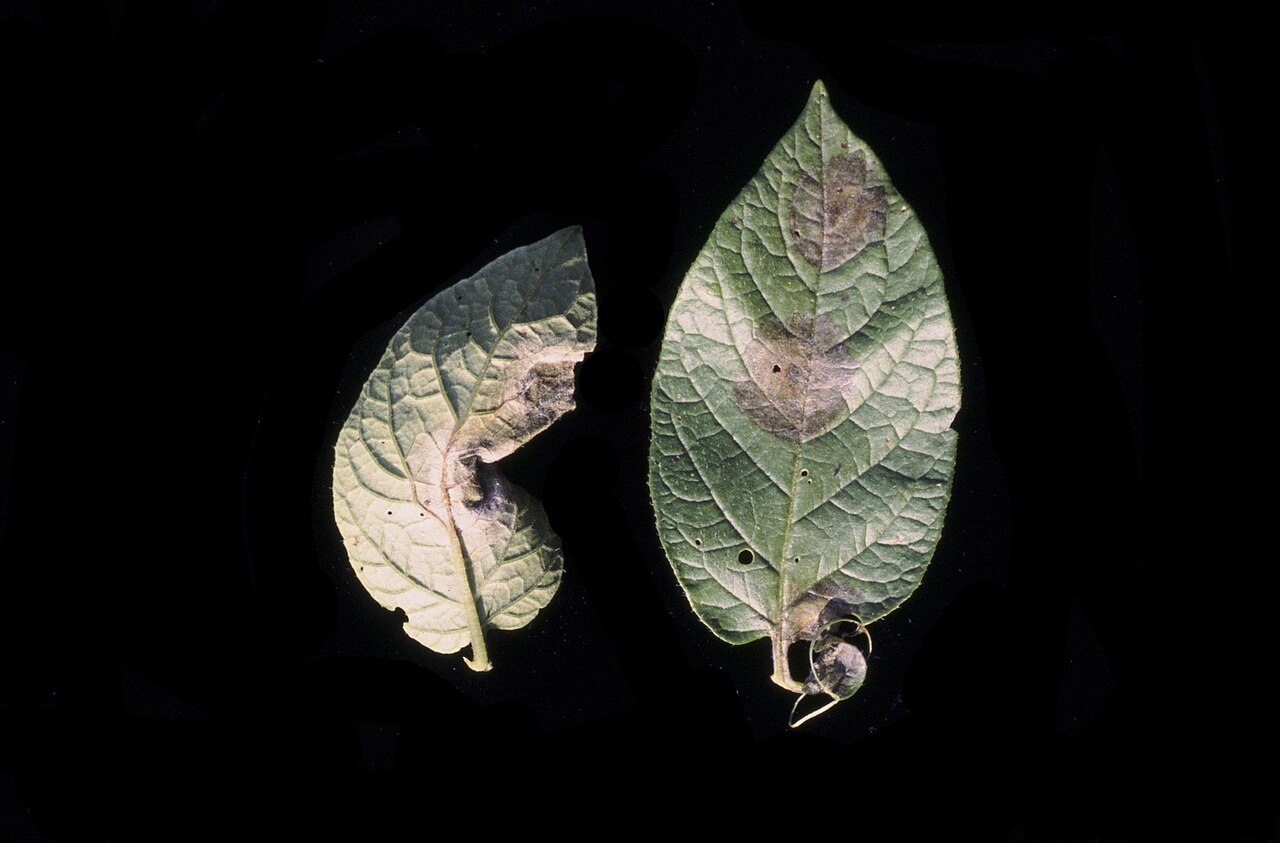
Via Wikimedia Commons: Phytophthora infestans on potato leaf 2 by Mary Ann Hansen, Virginia Polytechnic Institute and State Un, CC BY 3.0 us.
The pathogen
Phytophthora infestans is not a true fungus. It belongs to the oomycetes, which the team that sequenced its genome describe as a distinct lineage of fungus-like eukaryotes that are related to organisms such as brown algae and diatoms (a eukaryote is any organism whose cells have a nucleus).[1] The extension guides of the University of Minnesota and Cornell University call it a water mold. Its host range is narrow: the Minnesota guide says it is typically limited to potato and tomato, though hairy nightshade, a related weed, is readily infected and petunia can be under greenhouse conditions.[6]
The organism has an unusually large genome. The 2009 sequencing study in Nature by Brian Haas, Sophien Kamoun and colleagues put it at about 240 megabases, several times the size of the genomes of two related Phytophthora species, with about 74% of it made of repetitive DNA. The authors linked the pathogen's remarkable speed of adaptation to fast-changing regions of that genome that carry genes for effectors, proteins the pathogen secretes to manipulate the plant it infects.[1]
P. infestans can reproduce both clonally (asexually) and sexually, according to a 2024 study in Nature Communications.[4] Populations are tracked as clonal lineages given code names; the Minnesota guide gives US-23 as an example and notes that some lineages are specific to one host or the other.[6] Cornell's vegetable program states that in the United States the pathogen reproduces asexually, and that these asexual spores cannot survive the winter without living plant tissue.[5]
Symptoms
The disease attacks leaves, stems, tomato fruit and potato tubers. The Minnesota guide describes leaf infections as large, dark brown blotches with a green-gray edge that are not confined by the leaf's major veins, and stem lesions that are firm and dark brown. In cool, wet weather whole fields can turn brown and wilted, as if hit by frost. On tomatoes, firm, dark brown spots spread over large parts of the fruit; infected potato tubers become discoloured and can be invaded by secondary soft-rot bacteria. Cornell notes that in humid conditions the dark lesions are ringed with white sporulation or 'fuzz', the pathogen's spore-bearing growth, while in dry weather they may appear only as dry, dark patches.
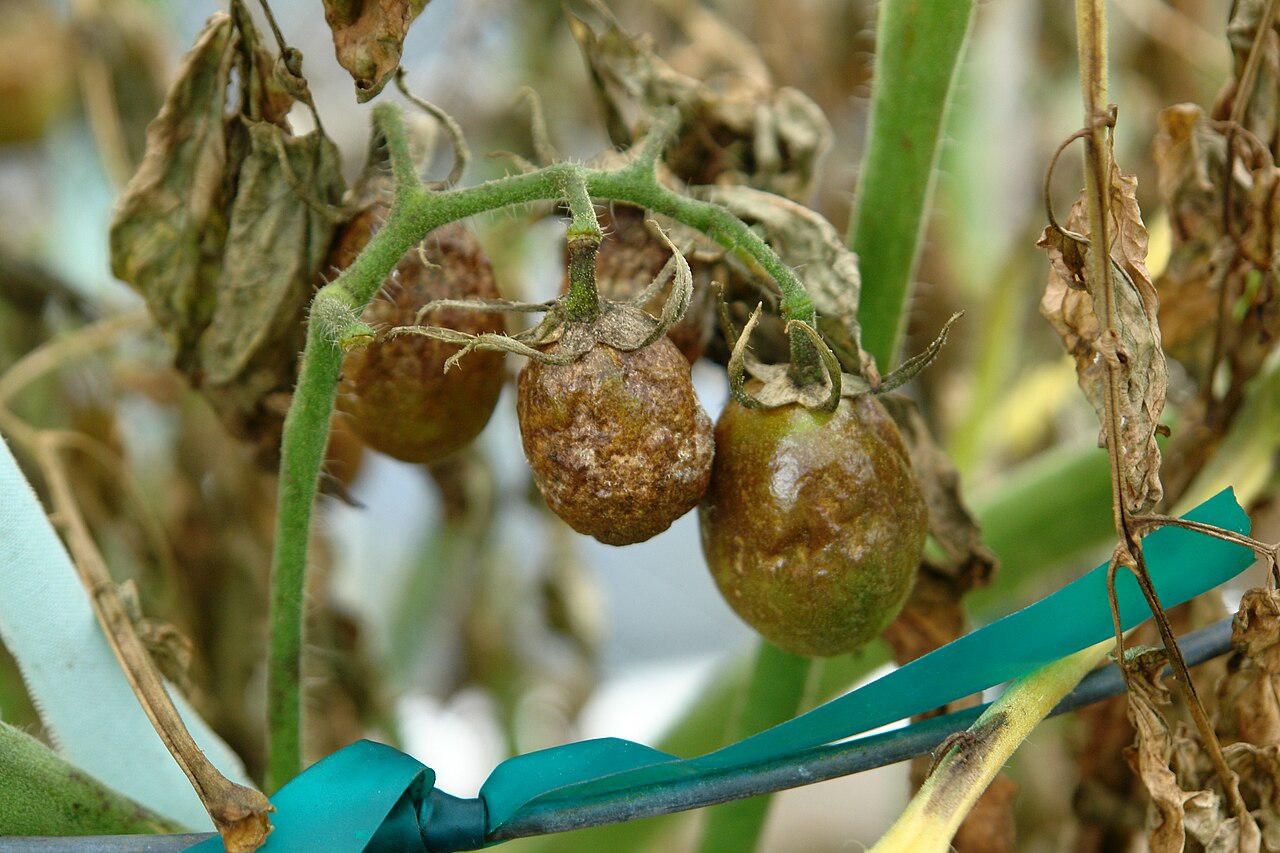
Via Wikimedia Commons: Tomato late blight fruit rot (5816739820) by Scot Nelson from Honolulu, Hawaii, USA, CC0.
How it spreads
The pathogen spreads through sporangia, small spore cases produced on infected tissue. Under cool, wet conditions it can, according to the Minnesota guide, produce thousands of sporangia per lesion in less than five days, and these easily become airborne.[6] Cornell reports that sporangia can be aerially dispersed several miles and stay viable for several hours.[5] In warmer weather a sporangium can infect a leaf directly; in cooler conditions, with wet leaf surfaces and temperatures between 60 and 70 °F (about 16 to 21 °C), it releases swimming spores called zoospores that invade the plant. Symptoms appear three to six days after a leaf is infected, and tubers can be infected when rain washes zoospores into the soil. Prolonged hot, dry weather, the Minnesota guide says, can halt pathogen spread.[6]
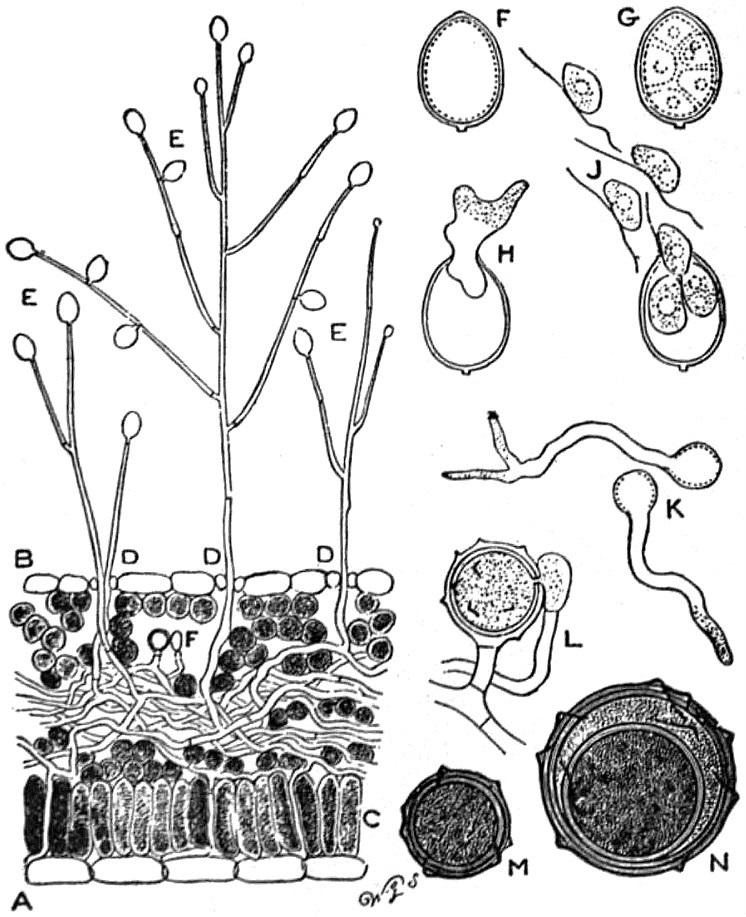
Via Wikimedia Commons: EB1911 Fungi - fungus of potato disease by signature illegible, public domain.
Because the asexual spores need living tissue to survive the winter, outbreaks in the United States usually start from infected material carried into a season. Cornell lists the main sources as contaminated plant debris/tubers that were improperly disposed, volunteer plants growing from infected tubers, transplants and compost piles.[5] The Minnesota guide adds infected potato seed tubers, tomato transplants shipped in from other regions, and sporangia blown in on the wind, and notes that the pathogen can survive a Minnesota winter in protected potato cull piles.
History
Origin
Where the pathogen first evolved has been argued over for decades. A 2014 study in the Proceedings of the National Academy of Sciences by Erica Goss and colleagues summarised the debate as a choice between South America or central Mexico, both centres of diversity of the Solanum plants it infects, and noted that different lines of evidence supported each.[3] Analysing genetic markers and four nuclear genes from populations in the Andes, Mexico and elsewhere, the authors found no support for an Andean origin and concluded that the data suggest a Mexican one, with Andean populations descended from Mexican ones. The 2013 eLife study discussed below likewise describes the species as thought to originate from Toluca Valley, Mexico, where it infects wild relatives of potato and reproduces sexually.[2]
The 1840s epidemics and the Irish famine
The potato reached Europe from South America after the Spanish conquest, but, as the eLife authors note, Europe stayed free of P. infestans for three centuries. A devastating disease struck potatoes in the United States in 1843, and in 1845 the pathogen reached Europe, spreading from Belgium across the mainland and then to Great Britain and Ireland.
The consequences were worst in Ireland, where people depended on the potato for subsistence more than anywhere else in Europe. The eLife authors write that the famine that followed killed around 1 million people, and an additional million were forced to leave the island, and that, as of 2013, the Irish population was still less than three quarters of what it was at the start of the 1840s.[2] The 2024 Nature Communications study dates the epidemic to 1845–1852.[4] The eLife authors attribute the scale of the disaster in part to the absence of any chemical or genetic means of fighting the disease, which became available only decades later.[2]
According to the 2024 study, the pathogen was identified in 1846 by M. J. Berkeley and renamed Phytophthora infestans by Anton de Bary in 1876; the eLife authors write that de Bary's detailed descriptions and drawings, with the reports of other early plant pathologists, leave no doubt that P. infestans caused the nineteenth-century epidemic.[4][2]
Which strain caused the famine
Until the late 1970s, populations outside Mexico and South America were dominated by a single clonal lineage called US-1, and it was proposed that US-1 descended directly from the famine strain. Analyses of infected nineteenth-century leaves kept in herbaria (collections of preserved plants) challenged that idea. In 2013 Kentaro Yoshida and colleagues compared the genomes of 11 herbarium and 15 modern strains and concluded that the epidemic was caused by a single genotype, which they named HERB-1, that persisted for over 50 years.[2] HERB-1 was distinct from all the modern strains they examined but closely related to US-1, which replaced it outside Mexico in the twentieth century; they proposed that both arose from a population established outside the species' centre of diversity in the early 1800s.
The 2024 Nature Communications study, by Allison Coomber, Amanda Saville and Jean Beagle Ristaino, used herbarium specimens from 1845 to 1954. It calls the famine lineage FAM-1, reports that it was diploid (carrying two sets of chromosomes) while later US-1 lineages were triploid, and says FAM-1 was displaced by US-1 in the 1930s to 1950s.[4]
Resistance and the arms race with breeders
Since the famine, breeders have developed potatoes carrying resistance (R) genes, including genes found in wild relatives of the potato. An R gene works by recognising one of the pathogen's effectors and triggering a defence. The 2024 study reports that most deployed R genes are quickly overcome by the pathogen, and found that the famine lineage already carried a form of the Avr1 effector gene able to defeat the R1 resistance gene before breeders had introduced it.[4] The eLife authors explain the mechanism: once a matching R gene is bred into a crop, an effector it recognises becomes a liability, and natural selection favours pathogen strains in which that gene is pseudogenized or mutated.[2] Cornell notes that some potato and tomato varieties are resistant to late blight but most are not, and the Minnesota guide says even resistant varieties show some symptoms when conditions strongly favour the disease, with effectiveness varying by clonal lineage.
Importance today
Late blight remains a major problem for world agriculture. The 2009 genome paper called it the most destructive disease of potato, the fourth-largest food crop, and cited a conservative estimate of $6.7 billion in annual worldwide crop losses.[1] The eLife authors, writing in 2013, put the yearly losses at enough potatoes to feed anywhere from 80 to many hundreds of millions of people, and the 2014 PNAS study described it as the most costly potato pathogen to manage.[2][3] The 2024 study notes that management still requires expensive fungicides.[4]
Management
Extension services describe management as prevention rather than cure. Cornell's guidance for growers covers planting resistant varieties, disposing of infected tubers, rotating away from tomato, potato and related crops for three years, checking regional outbreak reports, scouting fields, quickly destroying infected plants with their neighbours, and using approved fungicides. The Minnesota guide says fungicides work best when applied before infection, when weather favours the disease.[6] For home gardens, the same guide recommends rotation of three to four years, keeping leaves dry with drip irrigation or morning watering, staking and spacing plants for airflow, and removing plants at the end of the season; it adds that because late blight is seldom seen in Minnesota gardens, it does not recommend pesticide sprays there.
## Sources
- Brian J. Haas, Sophien Kamoun et al., "Genome sequence and analysis of the Irish potato famine pathogen Phytophthora infestans", Nature 461: 393–398, September 2009. nature.com/articles/nature08358
- Kentaro Yoshida et al., "The rise and fall of the Phytophthora infestans lineage that triggered the Irish potato famine", eLife 2: e00731, May 2013 (PubMed Central copy). pmc.ncbi.nlm.nih.gov/articles/PMC3667578/
- Erica M. Goss et al., "The Irish potato famine pathogen Phytophthora infestans originated in central Mexico rather than the Andes", Proceedings of the National Academy of Sciences 111(24): 8791–8796, June 2014 (PubMed Central copy). pmc.ncbi.nlm.nih.gov/articles/PMC4066499/
- Allison Coomber, Amanda Saville and Jean Beagle Ristaino, "Evolution of Phytophthora infestans on its potato host since the Irish potato famine", Nature Communications 15, 5 August 2024. nature.com/articles/s41467-024-50749-4
- Cornell University Vegetable Program, "Late Blight" disease fact sheet (read November 2026). vegetables.cornell.edu/pest-management/disease-factsheets/late-blight/
- University of Minnesota Extension, "Late blight of tomato and potato" (read November 2026). extension.umn.edu/agriculture/specialty-crops/vegetable-farming/dis…
