Version 7
Nov 15, 2026. Compare with the current version · Version history
The African National Congress (ANC) is a South African political party, founded in 1912 to fight for the rights of black South Africans, which campaigned against apartheid and has been in power since the country's first democratic election in 1994.
Origins
The organisation was founded on 8 January 1912 in Bloemfontein as the South African Native National Congress (SANNC), and took the name African National Congress in 1923, according to South African History Online.[13] The South African History Archive dates the founding conference to 8 January 1912.[24] The ANC's own history describes the meeting as a gathering of representatives of chiefs, churches, people's organisations and others, and credits the call for unity to Pixley ka Isaka Seme, quoting him: "We are one people. these divisions, these jealousies, are the cause of all our woes today."[21]
One of the first laws the new organisation faced was the Natives Land Act of 1913, which, in the ANC's account, barred Africans from buying, renting or using land outside the reserves set aside for them.[21] South African History Online describes the early decades as a period of political inertia caused by power struggles and a lack of resources.[13] The ANC's history records that J. T. Gumede was elected its president in 1927 and voted out in 1930 (ANC).[21]
Mass resistance, 1940s and 1950s
A new generation changed the organisation's methods. The ANC Youth League was formed in 1944 by, among others, Nelson Mandela, Walter Sisulu and Oliver Tambo. In 1949, the year after the National Party came to power, the ANC adopted the Youth League's Programme of Action, calling for strikes, boycotts and defiance.[21]
The Defiance Campaign began on 26 June 1952. On 26 June 1955 the Congress of the People, held at Kliptown near Johannesburg, adopted the Freedom Charter.[21][18] The congress was called by the Congress Alliance, made up of the ANC, the South African Indian Congress, the South African Coloured People's Congress, the South African Congress of Democrats and the South African Congress of Trade Unions, and South African History Online puts the gathering at about three thousand delegates from all races. The charter opens with the declaration that "South Africa belongs to all who live in it, black and white" and sets out ten demands, from "The People Shall Govern!" to "There Shall be Peace and Friendship!", covering equal rights for all national groups, a share of the country's wealth and land, equality before the law, work, education, housing and peace.[17] The ANC's constitution records that the ANC itself ratified the charter in April 1956 and still annexes it as a statement of the organisation's "essential philosophy".[15] Albert Luthuli was elected the ANC's president-general on 16 October 1952, and his movements were restricted soon afterwards; in 1956 he was charged with treason, and when the charges were dropped he was banned again for five years. He was awarded the Nobel Peace Prize for 1960 "for his non-violent struggle against apartheid", and received it a year later, in 1961. The Nobel Foundation describes him as Africa's first Peace Prize laureate. He led the ANC until his death on 21 July 1967, and was succeeded by Oliver Tambo, who held the post until 1991 (SAHO).
Not all members accepted the ANC's direction: in 1959 a group known as the Africanists broke away and formed the Pan Africanist Congress (PAC).[21]
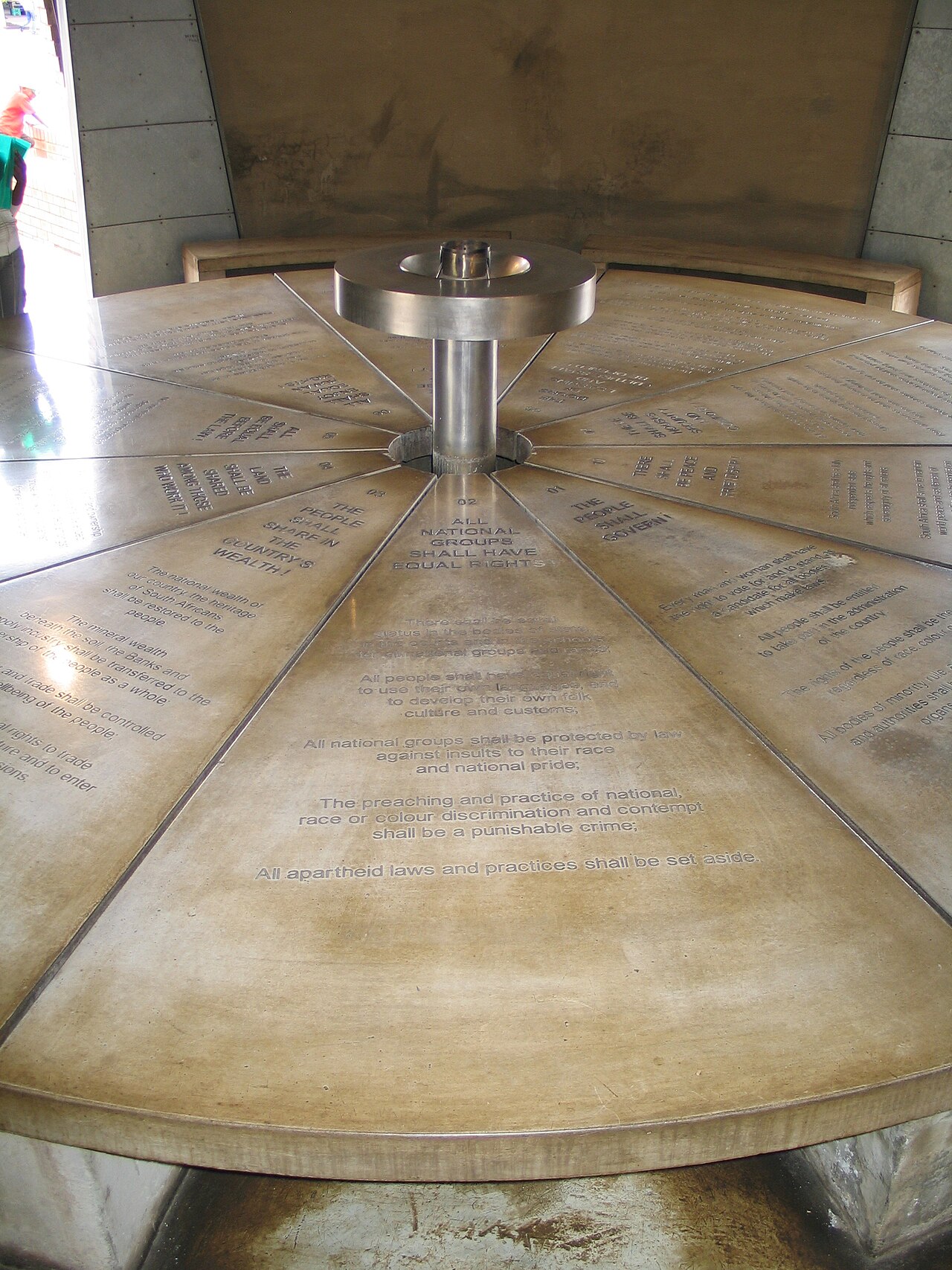
Via Wikimedia Commons: Kliptown Freedom Charter Memorial by Joonasl, CC BY-SA 3.0.
Banning and armed struggle
On 21 March 1960, during a PAC campaign against the pass laws, police at Sharpeville killed 69 people and wounded 186. The government declared a state of emergency and banned both the ANC and the PAC; South African History Online links the ANC's banning to the aftermath of the Sharpeville massacre.
After the banning, the ANC turned to armed resistance. It formed Umkhonto we Sizwe (MK) with the South African Communist Party (SACP) in 1961, and between 1961 and 1963 MK was responsible for about 134 acts of sabotage.[13] Its first armed actions are dated to 16 December 1961.[24] The ANC's history quotes MK's founding aim as to "hit back by all means within our power in defence of our people, our future and our freedom".[21]
In 1963 police raided MK's headquarters and arrested its leadership (ANC).[21] The resulting Rivonia Trial ended on 12 June 1964 with life sentences for Mandela, Sisulu, Govan Mbeki, Denis Goldberg, Ahmed Kathrada, Andrew Mlangeni, Raymond Mhlaba and Elias Motsoaledi.
Exile
Leaders who escaped arrest, among them Oliver Tambo and Joe Slovo, left South Africa and directed the movement from abroad (ANC). A National Consultative Conference at Morogoro was held on 26 April 1969;[13] the ANC's history says it set out the "four pillars of struggle" (ANC).[21] South African History Online notes that MK received support from some African countries and from the Soviet bloc (SAHO).[13]
Inside the country, resistance continued in other forms. In 1976 students protesting against the use of Afrikaans in their schools were shot by police, among them 13-year-old Hector Petersen, and the ANC's history puts the death toll of the uprising that followed at over 1,000, mostly killed by police.[21] The Congress of South African Trade Unions (COSATU) was formed in 1985, the year the ANC called for the townships to be made ungovernable (ANC).[21]
Unbanning and the transition
South African History Online attributes the apartheid government's decision to negotiate to a combination of internal dissent, international pressure and the collapse of the Soviet Union.[13] On 2 February 1990 the ANC was legalised after 30 years, along with the SACP, the PAC and about 70 other organisations, and Nelson Mandela was released from prison on 11 February 1990.[24] In 1991 Mandela was elected ANC president, with Tambo as national chairperson (ANC).[21]
The negotiations led, in South African History Online's words, to the collapse of apartheid and the ushering in of democratic rule in 1994.[13] In the first democratic election, in April 1994, the ANC won 62.6 percent of more than 22 million votes, and Mandela was inaugurated as President on 10 May 1994.[21]
In government
The ANC has been in power in South Africa since 1994. Its share of the vote rose in each national election from 1994 to 2004, then fell in 2009 and again in 2014, a period that coincided with the presidency of Jacob Zuma, which began on 9 May 2009. In the 2019 general election the party took 57.5 percent of the national vote.
The individual results trace that curve. In the election of 2 June 1999 the ANC received 10,601,330 votes and 266 of the 400 seats in the National Assembly.[4] It took 69.69 percent in 2004 and 65.9 percent in 2009, and in 2014 about 62 percent, with more than 11.4 million votes.[9][10]
Economic policy
The ANC entered government with the Reconstruction and Development Programme (RDP), the platform on which it fought the 1994 election, which became the new government's main socio-economic programme.[19] The ANC's 1994 text set concrete targets: "At minimum, one million low-cost houses should be constructed over five years" (section 2.5.2), and the land reform programme was to aim to redistribute 30 per cent of agricultural land within its first five years (section 2.4.14).[16]
In 1996 the government introduced a macroeconomic framework, the Growth, Employment and Redistribution strategy (GEAR), aimed at reducing fiscal deficits, lowering inflation and keeping the exchange rate stable.[19] South African History Online records that GEAR was criticised above all by COSATU, one of the ANC's own alliance partners. GEAR was followed by the Accelerated and Shared Growth Initiative for South Africa (ASGISA) in 2005, by the New Growth Path, which Jacob Zuma announced in his 2010 State of the Nation address, and by the National Development Plan (NDP) 2030, introduced in early 2013.
Mbeki, Polokwane and the recall
Nelson Mandela led the ANC from 1991 to 1997 and was succeeded as party president by Thabo Mbeki, who held the post from 1997 to 2007 (SAHO).[1] The new Parliament elected Mbeki President of South Africa on 14 June 1999, and he was inaugurated at the Union Buildings on 16 June 1999, the ceremony at which Mandela stepped down from public office.[5]
The party's leadership changed at its 52nd National Conference, held from 16 to 20 December 2007 at the University of Limpopo in Polokwane.[6] Mbeki stood for a further term as ANC president and lost: Jacob Zuma was elected with 2,329 votes from about 4,000 voting delegates, and Kgalema Motlanthe was elected deputy president.[6] Mbeki remained President of the country until the ANC's National Executive Committee decided to "recall" him (SAHO).[6] He resigned on 21 September 2008, and Motlanthe was sworn in as President on 25 September 2008.[7] Zuma became President of the country after the 2009 election.
Zuma's term as party leader ended at a conference in Johannesburg in December 2017, where Cyril Ramaphosa defeated Nkosazana Dlamini-Zuma for the ANC presidency by 2,440 votes to 2,261.
Zuma's presidency ended early. On 13 February 2018 the ANC's National Executive Committee announced its decision to recall him, and on 14 February he announced his resignation, saying: "I have therefore come to the decision to resign as president of the republic with immediate effect." South African History Online records that he had at first refused, and that the party had said it would hold a vote of no confidence.[14] Cyril Ramaphosa was elected President of South Africa on 15 February 2018.[14]
State capture
Allegations of "state capture" were examined by a judicial commission of inquiry led by Raymond Zondo, who became Chief Justice. The commission delivered the final part of its report on 22 June 2022. It found "substantial evidence that the party itself was a beneficiary of state capture", noted that the ANC was responsible for deploying people to the highest positions in the state, and said the party had allowed corrupt activities to continue under its watch. Ramaphosa, in his testimony, had acknowledged what he called "a dropping of the ball". The ANC responded that it would study the findings to support the "fundamental renewal and rebuilding within our movement", and that members implicated in alleged corruption should make representations to its internal Integrity Commission.[22]
Leadership
South African History Online's list of the ANC's presidents (called presidents-general in the early decades) gives: John Langalibalele Dube (1912–1917), Sefako Mapogo Makgatho (1917–1924), Zaccheus Richard Mahabane (1924–1927), Josiah Gumede (1927–1930), Pixley ka Isaka Seme (1930–1936), Mahabane again (1937–1940), Alfred Bitini Xuma (1940–1949), James Moroka (1949–1952), Albert Luthuli (1952–1967), Oliver Tambo (1967–1991), Nelson Mandela (1991–1997), Thabo Mbeki (1997–2007) and Jacob Zuma, from 2007 (SAHO).[1] Cyril Ramaphosa succeeded Zuma as party president in December 2017.
Aims and organisation
The ANC's constitution, in the version amended at its 55th National Conference at Nasrec in 2022, describes the organisation as "a non-racial and non-sexist and democratic liberation movement" that also contests elections as a registered political party (Rule 3).[15] Its stated aims include transforming South Africa into a united, non-racial, non-sexist and democratic country based on the principles of the Freedom Charter and "in pursuit of the National Democratic Revolution", a term the constitution defines as the process of turning an apartheid state into a society in which all people enjoy equal rights (Rule 2 and Definitions).[15] Membership is open to South Africans over the age of 18 (Rule 4.1). Its colours are black, green and gold (Rule 1.2).[15]
The organisation is built in tiers. Branches hold a Branch Biennial General Meeting (every two years) to elect their executive; regional and provincial conferences elect regional and provincial executive committees; and the National Conference elects the National Executive Committee (NEC) (Rule 7.1).[15] The National Conference is the "supreme ruling and controlling body of the ANC" and must meet at least once every five years; at least 90 per cent of its voting delegates come from branches, in proportion to their paid-up membership (Rules 10.1 and 10.5).[15] Between conferences the NEC must call a National General Council no later than 30 months after each conference (Rule 10.6).[15]
The NEC holds office for five years. Conference elects seven officials separately (the president, deputy president, national chairperson, secretary-general, first and second deputy secretaries-general and treasurer-general) and 80 further members, and provincial chairpersons and secretaries and the heads of the leagues sit on it ex officio (Rule 12.3).[15] A National Working Committee, elected by the NEC from its own members, runs day-to-day work (Rule 13). The constitution requires that at least half the members of every elected structure be women (Rules 6.1 and 12.3).[15]
Three leagues work as autonomous bodies within the ANC: the Women's League, open to the ANC's women members; the Youth League, open to people aged 14 to 35; and the Veterans' League, open to members aged 60 or over (ANC Constitution 2022, Rules 7.3 to 7.7).
The Tripartite Alliance
The ANC's principal allies have been the South African Communist Party, with which it formed Umkhonto we Sizwe in 1961, and the Congress of South African Trade Unions. South African History Online dates the formal three-way arrangement to 1990, when the three organisations agreed to work together as a "Revolutionary Alliance (Tripartite Alliance)".[8]
The Truth and Reconciliation Commission
The Truth and Reconciliation Commission (TRC) examined the conduct of the liberation movements. In its report it described the ANC and the PAC as "internationally recognised liberation movements conducting legitimate struggles" against the former government, but drew a distinction between a "just war" and "just means", and found that the ANC and its organs had committed gross violations of human rights in the course of their political activities and armed struggle, for which it held them morally and politically accountable (Volume 5, Chapter 6, paragraphs 131–132).[12] The commission found that the ANC had made "the most conscious effort to conduct its armed struggle within the framework of international humanitarian law", that it was in general not ANC policy to target civilians, and that the leadership had told MK cadres to abandon a landmine campaign once it became clear that civilians were being killed and hurt by it (paragraphs 134–135).[12]
For the period from 1990 to 1994, the commission found the ANC responsible for killings, assaults and attacks on political opponents, including members of the Inkatha Freedom Party, the PAC, AZAPO and the South African Police, and for contributing to a spiral of violence by creating and arming self
