Version 1
Nov 9, 2026. Compare with the current version · Version history
The Bank of England is the central bank of the United Kingdom, founded in 1694 as a private company to lend money to the English government and today responsible for setting the UK's main interest rate and keeping its money and financial system stable.
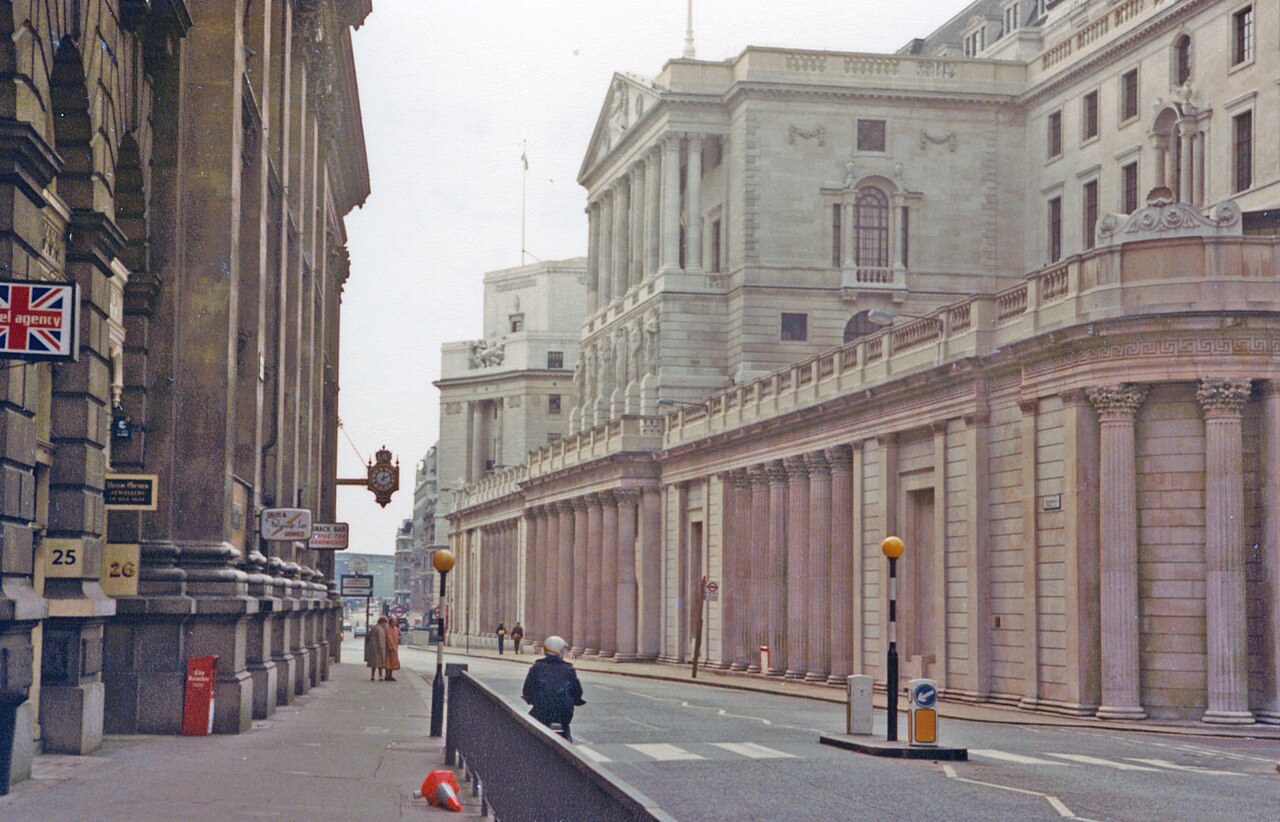
Via Wikimedia Commons: Saturday in the City, 1983, Threadneedle Street and Bank of England - by Ben Brooksbank, CC BY-SA 2.0.
Founding
The Bank's own museum traces its origins to a loss of trust between the Crown and London's lenders. In 1672 Charles II stopped repaying the goldsmiths who had lent to him, and many of their businesses collapsed; when William III needed money for war against France in 1693, the surviving goldsmiths would not lend. A Scottish merchant, William Paterson, proposed instead that members of the public lend the government £1.2 million. According to the museum, 1,268 people subscribed and the target was reached in 11 days, with the government paying the lenders 8 percent interest, less than half the 20 to 30 percent the goldsmiths had charged (Bank of England Museum, 2021).
The lenders were incorporated as a bank by Royal Charter on 27 July 1694. The Bank describes itself as founded as a private bank to act as the government's banker, primarily to fund the war effort against France, and notes that King William and Queen Mary were among its first stockholders. The charter said the Bank was founded to "promote the public Good and Benefit of our People", wording the Bank still echoes in its mission of "maintaining monetary and financial stability". It opened for business on 1 August 1694 in rented space at Mercers' Hall in Cheapside, with 17 clerks and two gatekeepers, and Sir John Houblon was its first Governor (Bank of England).
Threadneedle Street and the "Old Lady"
In 1734 the Bank moved to Threadneedle Street in the City of London, where it still stands, and over time it bought the neighbouring properties until it held the whole 3.5-acre site. The building's long tenure gave the Bank its nickname. In 1797, with Britain at war with France, the Bank's gold reserves fell from £16 million to £2 million, and the Prime Minister, William Pitt the Younger, issued a Privy Council order stopping the Bank from paying out gold for its notes. This "Restriction Period" lasted until 1821 (Bank of England). A cartoon published in 1797 by James Gillray showed Pitt courting an old lady who stood for the Bank, while really reaching for her gold; the Bank dates its nickname, the "Old Lady of Threadneedle Street", to that cartoon.
Banknotes and the nineteenth century
The Bank first issued partially printed banknotes with set denominations in 1725, and opened its first branch, in Gloucester, on 19 July 1826. The Bank Charter Act 1844 gave the Bank new powers over the note issue: in the Bank's summary, it "formalised the issuance of banknotes in the UK", restricted note issue by other banks in England and Wales, and stopped new banks anywhere in the UK from issuing notes (Bank of England). In 1866 the Bank refused help to Overend Gurney, then the largest discount house, on 9 May, and the firm suspended payments the next day (Bank of England). From 1870 the Bank's Chief Cashier became the only person to sign its notes.
The twentieth century: war, gold and nationalisation
The Bank helped the government finance the First World War. Montagu Norman, Governor from 1920 to 1944, remains its longest-serving Governor, and in September 1931 the UK suspended the gold standard, under which the currency had been convertible into gold (Bank of England).
After the Second World War the Bank passed into public ownership. The Bank of England Act 1946, which received Royal Assent on 14 February 1946, was enacted "to bring the capital stock of the Bank of England into public ownership and bring the Bank under public control". It gave the government the power to appoint the Governors and directors, and the Treasury the power to give the Bank directions in the public interest after consulting the Governor; the Bank says that power of direction has not been used. In its present form, section 4 of the Act excludes monetary policy from that power.
Until 1997, changes to short-term interest rates had to be approved by the Chancellor of the Exchequer. On 16 September 1992, "Black Wednesday", the UK left the European Exchange Rate Mechanism, and in February 1993 the Bank published its first Inflation Report, now called the Monetary Policy Report.
Independence
On 6 May 1997, days after the Labour government of Tony Blair took office, the new Chancellor, Gordon Brown, announced that the Bank would be given the power to set interest rates itself (Walsh, FRBSF Economic Letter, 12 September 1997). Explaining the plan to the House of Commons on 20 May 1997, Brown said that "on 6 May, I announced the means by which we would achieve that promise", that responsibility for banking supervision would be moved out of the Bank to a single regulator built on the Securities and Investments Board, and that the government would "retain the right to override the Bank's operational independence in extreme economic circumstances" for a limited period, subject to the approval of the House.
The arrangement was written into law by the Bank of England Act 1998, which received Royal Assent on 23 April 1998 and provided, among other things, for the transfer of supervisory functions away from the Bank. Section 11 sets the Bank's monetary policy objectives: "to maintain price stability, and subject to that, to support the economic policy of Her Majesty's Government, including its objectives for growth and employment". A 2025 Bank Underground article by Michael Salib and Mesha Ghazaleh calls the 1998 Act the "watershed moment" for those objectives, noting that for over 300 years the Bank's legislation had said little about its purpose.
The independence is operational rather than complete. The government sets the inflation target, which is 2 percent, owns the Bank and appoints its senior policymakers; the Bank chooses how to meet the target, "free from day-to-day political influence", and answers to Parliament, including in public hearings of the House of Commons Treasury Committee. Under section 19 of the 1998 Act, the Treasury may, after consulting the Governor, direct the Bank on monetary policy if it is satisfied that this is required in the public interest and "by extreme economic circumstances". Such an order must be laid before Parliament, lapses after 28 days unless both Houses approve it, can last no more than three months, and suspends the section 11 objectives while it is in force. Salib and Ghazaleh state that the power has never been used.
How monetary policy is set
Monetary policy is decided by the Bank's Monetary Policy Committee (MPC). Under section 13 of the 1998 Act, as amended, the committee consists of the Governor, the three Deputy Governors for financial stability, for markets and banking, and for monetary policy, a Chief Economist appointed by the Governor after consulting the Chancellor, and four members appointed by the Chancellor. The Bank describes these as nine members with one vote each, the Governor having the casting vote in a tie; the committee announces its decisions eight times a year, roughly every six weeks.
Its main instrument is Bank Rate, which the Bank calls "the core interest rate in the UK": the rate it pays to commercial banks and building societies that hold money with it and charges on its loans to them, which in turn shapes the rates those lenders offer their own customers. After the global financial crisis the Bank added a second tool. It began quantitative easing (QE), buying bonds to push down longer-term interest rates, in March 2009, and bought £895 billion of bonds in total, £875 billion of them UK government bonds and £20 billion corporate bonds. In February 2022 the MPC decided to begin reducing those holdings, a process known as quantitative tightening.
As of 9 November 2026, Bank Rate stands at 4 percent. At its decision published on 5 November 2026 the MPC raised the rate by 0.25 percentage points, saying energy prices had stayed high and volatile because of conflict in the Middle East; the Bank gave UK inflation as 3.5 percent against its 2 percent target, and expected it to reach about 5 percent by mid-2027. The next decision is due on 17 December 2026.
Financial stability and regulation
Alongside monetary policy, the Bank oversees the stability of the financial system. In 1996 it set up its real-time gross settlement (RTGS) system, through which institutions, mainly banks, settle payments, and published its first Financial Stability Review that autumn (Bank of England). Its regulatory role grew again under the Financial Services Act 2012, which created an independent Financial Policy Committee at the Bank and created the Prudential Regulation Authority as a subsidiary of the Bank; the Bank also took on the supervision of financial market infrastructure providers (Bank of England).
Banknotes today
The first Bank of England note to carry Queen Elizabeth II was issued on 17 March 1960, and the 1970 Shakespeare £20 was its first pictorial note. Its first polymer note, a £5 featuring Winston Churchill, was issued on 13 September 2016, and the first notes featuring King Charles III entered circulation on 5 June 2024.
Sources
- Bank of England, "Our history" (read November 2026). bankofengland.co.uk/about/history
- Alice Beagley, "Why was the Bank of England founded?", Bank of England Museum, 19 February 2021. bankofengland.co.uk/museum/online-collections/blog/why-was-the-bank…
- Bank of England, "Who is the Old Lady of Threadneedle Street?" (read November 2026). bankofengland.co.uk/explainers/who-is-the-old-lady-of-threadneedle-…
- Bank of England, "How is the Bank of England independent of the Government?", updated 18 May 2020. bankofengland.co.uk/explainers/how-is-the-bank-of-england-independe…
- Bank of England, "Monetary policy", updated 21 October 2026. bankofengland.co.uk/monetary-policy
- Bank of England, Bank Rate page (read 9 November 2026). bankofengland.co.uk/monetary-policy/the-interest-rate-bank-rate
- Bank of England, "Quantitative easing", updated 5 December 2025. bankofengland.co.uk/monetary-policy/quantitative-easing
- Michael Salib and Mesha Ghazaleh, "The Bank of England's statutory monetary policy objectives: a historical and legal account", Bank Underground, 17 January 2025. bankunderground.co.uk/2025/01/17/the-bank-of-englands-statutory-mon…
- Bank Charter Act 1844, legislation.gov.uk. legislation.gov.uk/ukpga/Vict/7-8/32/contents
- Bank of England Act 1946, introductory text and section 4, legislation.gov.uk. legislation.gov.uk/ukpga/Geo6/9-10/27/introduction
- Bank of England Act 1998, introductory text and sections 11, 13 and 19, legislation.gov.uk (revised text as of November 2026). legislation.gov.uk/ukpga/1998/11/introduction
- Financial Services Act 2012, legislation.gov.uk. legislation.gov.uk/ukpga/2012/21/contents/enacted
- House of Commons, "Bank of England and Financial Regulation", Hansard, 20 May 1997, vol. 294, cols 507–524. api.parliament.uk/historic-hansard/commons/1997/may/20/bank-of-engl…
- Carl E. Walsh, "The Old Lady of Threadneedle Street Gets Her Independence", FRBSF Economic Letter 97-26, Federal Reserve Bank of San Francisco, 12 September 1997. frbsf.org/research-and-insights/publications/economic-letter/1997/0…
