Version 1
Nov 9, 2026. Compare with the current version · Version history
The Admonitions of Ipuwer is an ancient Egyptian poem in which a sage named Ipuwer laments a land overturned by violence, poverty and foreign intrusion; it survives in a single damaged papyrus copy, Papyrus Leiden I 344, now in Leiden.
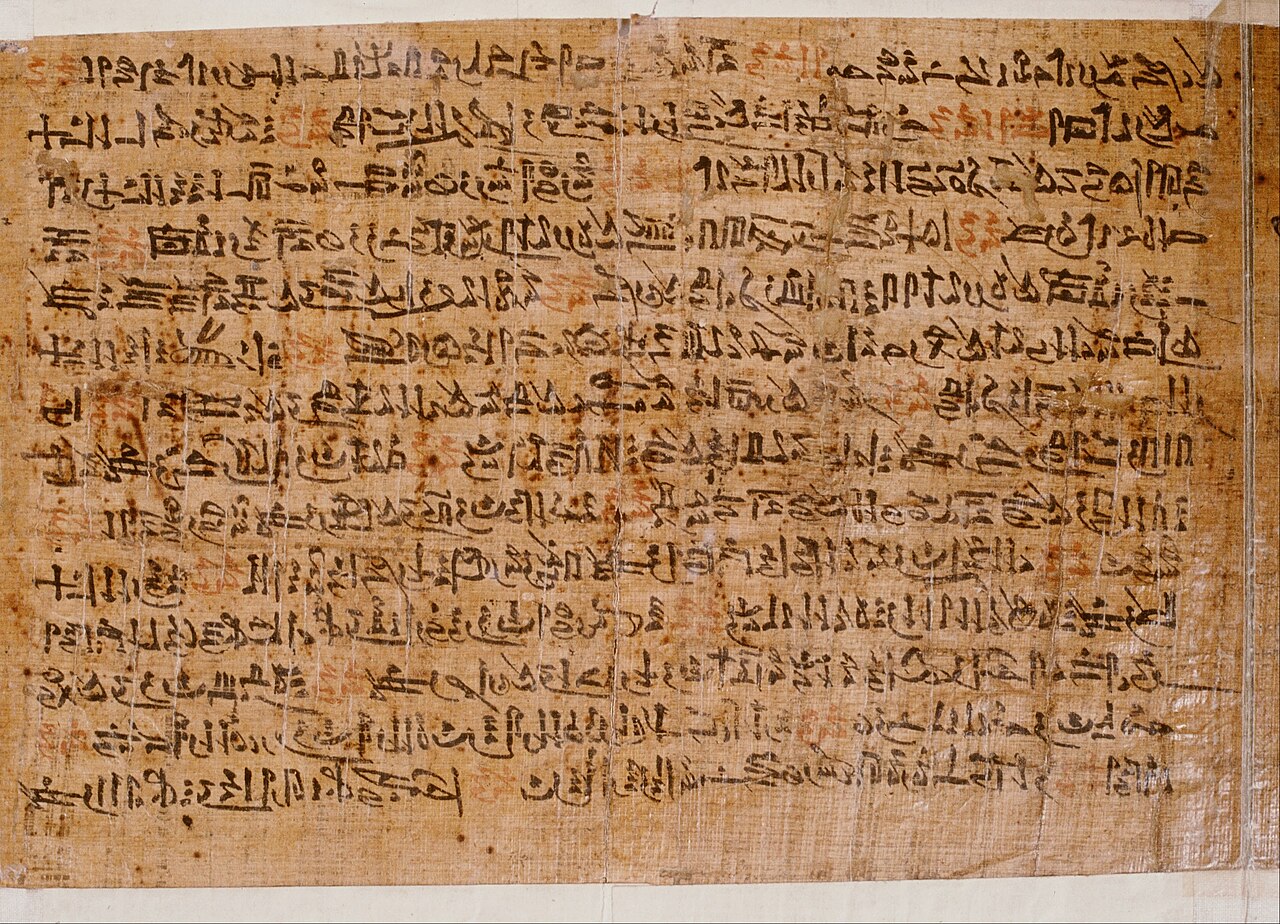
Via Wikimedia Commons: Papyrus van Ipoewer - Google Art Project by Unknown – Creator, public domain.
The work is also called the Dialogue of Ipuwer and the Lord of All, the title used by the Egyptologist Roland Enmarch, who edited it in 2005 and treats it as a Middle Egyptian poem about the justice of the creator god. Middle Egyptian is the stage of the Egyptian language of the early second millennium BCE, whose literature later Egyptians went on copying for centuries as a kind of classical literature. The older title, The Admonitions of an Egyptian Sage, comes from Alan Gardiner's 1909 edition and translation.
The papyrus
The only known copy is written on the front (recto) of a papyrus held by the Rijksmuseum van Oudheden, the national museum of antiquities in Leiden, the Netherlands. In the museum's inventory it is AMS 27, a manuscript of eight sheets that came from the collection of G. d'Anastasi, a diplomat who served as consul-general for Sweden–Norway in Egypt. Gardiner recorded that the museum bought it at the sale of Anastasi's antiquities in 1828, and that Anastasi said it had been found at Memphis, which Gardiner took to mean the cemetery of Saqqara. Daniel Soliman of the Leiden museum notes that as early as 1840 C. Leemans, in his catalogue of the collection, thought this papyrus and two others, Leiden I 343 and I 345, may have come from the same find-spot, and that Enmarch has pointed out the three share similar patterns of damage.

Via Wikimedia Commons: Rijksmuseum van Oudheden by Goodness Shamrock, CC BY-SA 3.0.
As Gardiner measured it, the papyrus in its damaged state was 378 centimetres long and 18 centimetres high, and had been mounted in book form, with its pages folded over one another and protected by varnish, a treatment he thought had darkened and damaged it. Both sides are written on. The recto carries the poem in seventeen complete and incomplete pages, mostly of fourteen lines each. Only the last third of eleven lines survives from the first page; pages two to seven are fairly complete though often rubbed; and from page eight onwards large holes (lacunae) have destroyed most of the middle of each page. The back (verso) carries hymns to the sun, in what Gardiner described as a bigger and more regular hand.
Gardiner judged from the handwriting and spelling that the copy could not have been written earlier than the beginning of the 19th Dynasty of the New Kingdom, but that the scribe was copying from an older manuscript, possibly one as old as the beginning of the 18th Dynasty. Blank spaces left in several lines, and frequent dropped words, suggested to him that the scribe's original was torn or illegible in places, and in some passages the scribe had clearly been unable to read it. The language of the poem itself, he found, was that of the Middle Kingdom, with no sign of the later forms of Egyptian.
Early study
A facsimile of the papyrus, drawn by T. Hooiberg, was published by Leemans in the museum's catalogue of its Egyptian monuments. Gardiner called it "quite inadequate for the purposes of accurate study" but noted that it preserves signs since lost. The scholars who first tried to make sense of the text did not see it as a single work. In an introduction to the facsimile, Chabas took the first eight pages to be proverbs and the rest a philosophical text; in 1872 Lauth translated the first nine pages as a collection of sayings for teaching; and Erman reported that Heinrich Brugsch once said it contained a collection of riddles.
The turning point came in 1903, when H. O. Lange, Chief Librarian of the Royal Library in Copenhagen, published a paper titled "Prophezeiungen eines ägyptischen Weisen" ("Prophecies of an Egyptian sage"). In Gardiner's account, Lange was the first to show that the text was one continuous composition rather than a string of separate sayings, and he read it as prophecy: a sage foretelling disaster for Egypt and, in one passage, the coming of a saviour king. Gardiner, who had collated the papyrus in Leiden from 1905, joined Lange as a collaborator on a full edition and read through the whole text with him in Copenhagen in 1906, but Lange withdrew from co-authorship in 1908, saying Gardiner's share of the work had become much the larger, and Gardiner dedicated the 1909 edition to him instead.
Contents
The beginning of the poem is lost, and with it any narrative frame that introduced the speaker. Gardiner compared the work to other Middle Kingdom compositions such as the Eloquent Peasant, in which a short story serves mainly as a setting for long speeches, and concluded that such a frame must once have explained how a man named Ipuwer came to address the king and his court. The reading of the name itself, he cautioned, is not certain.
The text is built from short sections, each opened by a repeated formula, usually written in red ink. In Gardiner's analysis the first part, up to page 10, describes the downfall of Egypt in detail: civil war and foreign invasion, the social order turned upside down, crafts abandoned and no goods arriving from abroad. In his translation, "the land turns round as does a potter's wheel" (2,8); "the river is blood, and (yet) men drink of it" (2,10); and "the poor of the land have become rich, and (the possessor) of property has become one who has nothing" (8,2). The poem complains that Asiatics, invaders from the north, have overrun the Delta and taken up its crafts, and that "a foreign tribe from abroad has come to Egypt" (Gardiner, 1909).
Two series of exhortations follow; in the second, the word "remember" is repeated before a list of religious acts and observances to be kept up. A long passage then describes an ideal ruler, "the herdsman of mankind" in whose heart there is "no evil", before turning into a denunciation of someone addressed directly, whom Gardiner took to be the king. Later sections recall the pleasures of better days, and on page 15 a new speech begins in which Ipuwer answers the king. The text breaks off on page 17.
The herdsman passage and the "Lord of All"
The passage about the herdsman has been read in sharply different ways. Lange saw in it a prophecy of a coming saviour, a wise and gentle ruler who would restore order. Gardiner thought Lange had made too much of a metaphor that was common for a good ruler, and argued instead that the passage refers to the sun god Re, the mythical first king of Egypt, and asks why the creator shaped humankind "without distinguishing the timid man from him whose nature is violent"; he stated that there is "no certain or even likely trace of prophecies" in the whole work. He chose the title Admonitions because he considered the exhortations beginning on page 10 to be the kernel of the work, and summed up its subject as the conditions of social and political well-being.
Later scholarship has taken Gardiner's reading of the passage further. Writing in the UCLA Encyclopedia of Egyptology in 2008, Enmarch describes the work as the most direct critique, in Middle Egyptian poetry, of the conventional view of the creator god. In it, he writes, a human sage accuses the creator of being too distant from human affairs and of failing to distinguish the meek from the fierce, implying that the creator is to blame if creation is flawed. Enmarch adds that the poem does not finally reject the accepted order but forms a plea for closer and more discerning intervention by the god, and by the king, so that justice is done. This places it among Egyptian texts on theodicy, the question of whether the divine is just.
Date
The date of the poem's composition is uncertain, because its only copy is centuries later than the language it is written in. Gardiner weighed two historical settings for its scenes of civil war and Asiatic occupation of the Delta: the dark age of the seventh to tenth dynasties, before the eleventh, and the later Hyksos period. He reported that Sethe favoured the Hyksos period, which had better support from the historical record, while the language and handwriting pointed him towards the earlier date. He concluded that it was "wisest to leave this question open".
Later work has generally treated the poem as a product of the Middle Kingdom. Joshua J. Mark's 2026 article for the World History Encyclopedia dates it to the Middle Kingdom and states that it is believed to have been composed later in that period than related works of the same kind. Dating Middle Egyptian literature as a whole remains debated. Reviewing two 2013 volumes on the subject, Leo Depuydt of Brown University described attempts to move some works long dated to the Middle Kingdom much later, on the ground that no copy of them earlier than the 19th Dynasty survives; one paper in those volumes, by John Van Seters, compared the dating of biblical narrative with the dating of the Admonitions (Depuydt, Journal of the American Oriental Society, 2017).
History or literature
Because the poem describes disaster so vividly, early readers often took it as an eyewitness record. Gardiner himself, while treating it as literature, thought that "the existence of some historical background few will venture to dispute", arguing that an Egyptian writer could hardly have imagined such a collapse without some basis in fact, any more than an English novelist could imagine "an England subject to the Turks".
Later scholars have mostly read it differently, as part of a Middle Kingdom literary tradition of "national distress" in which chaos and the overturning of social order are recurring themes. According to Mark, the Egyptologist Miriam Lichtheim credited the scholar S. Luria with first recognising, in 1929, the fictional and conventional character of such descriptions of social chaos, and that other scholars later reached the same conclusion about the Admonitions. Enmarch's reading of it as a debate about divine justice, rather than a report of events, belongs to this approach.
Comparisons with the Exodus
The poem's line that "the river is blood" and its other images of plague and disorder have led some writers to compare it with the plagues of Egypt in the biblical Book of Exodus, where the Nile is turned to blood in Exodus 7. Comparison with the Hebrew Bible began early: in 1909 Gardiner noted that Eduard Meyer had discussed the papyrus in its bearing on Hebrew prophecy. In the 1950s and 1960s the independent writer Velikovsky used the text as support for his claim that planetary influences had caused catastrophes in world history, and the 2014 documentary Patterns of Evidence: Exodus presented it as an Egyptian account of the events of the Exodus (Mark, 2026). Those who make the comparison see the Egyptian lament as independent evidence for the biblical story. Mark writes that scholars have rejected the reading of the poem as historical reportage, holding that it belongs to an established genre of Middle Kingdom literature; Velikovsky's wider theories, he adds, have been refuted by scholars in several fields.
Sources
- Alan H. Gardiner, The Admonitions of an Egyptian Sage from a Hieratic Papyrus in Leiden (Pap. Leiden 344 recto), Leipzig: J. C. Hinrichs, 1909; scan hosted by the Institute of Fine Arts, New York University. mc.dlib.nyu.edu/files/books/ifa_egypt000149/ifa_egypt000149_hi.pdf
- Roland Enmarch, "Theodicy", UCLA Encyclopedia of Egyptology, ed. Jacco Dieleman and Willeke Wendrich, version 1, April 2008. journalpub.escholarship.org/nelc_uee/article/3942/galley/2518/download
- Daniel Soliman, "New Kingdom Hieratic Texts in the Collection of the Rijksmuseum van Oudheden in Leiden", in New Kingdom Hieratic Collections from around the World, vol. 2, Liège: Presses Universitaires de Liège, 2024, pp. 227–248. presses.uliege.be/wp-content/uploads/2024/12/NKH_10-Leiden_Final-V2…
- Leo Depuydt, review of Dating Egyptian Literary Texts (ed. G. Moers and others) and A. Stauder, Linguistic Dating of Middle Egyptian Literary Texts, Journal of the American Oriental Society 137.3, 2017. lockwoodonlinejournals.com/index.php/jaos/article/download/1203/999…
- Joshua J. Mark, "The Admonitions of Ipuwer", World History Encyclopedia, 21 January 2026. worldhistory.org/article/981/the-admonitions-of-ipuwer/
