Compare versions
Version 1 → Version 3 (current). Removed · Added. This shows the entry's text as it is written, including its formatting marks.
Version 1 · Version 3 (current) · Version history
Side by side · Together
Version 1Version 3 (current)
3 unchanged paragraphs
The ozone hole is a region of severely depleted ozone in the stratosphere over Antarctica that forms each southern spring, from about August to October, caused mainly by chlorine and bromine released from human-made chemicals such as chlorofluorocarbons (CFCs).
The ozone hole is a region of severely depleted ozone in the stratosphere over Antarctica that forms each southern spring, from about August to October, caused mainly by chlorine and bromine released from human-made chemicals such as chlorofluorocarbons (CFCs).
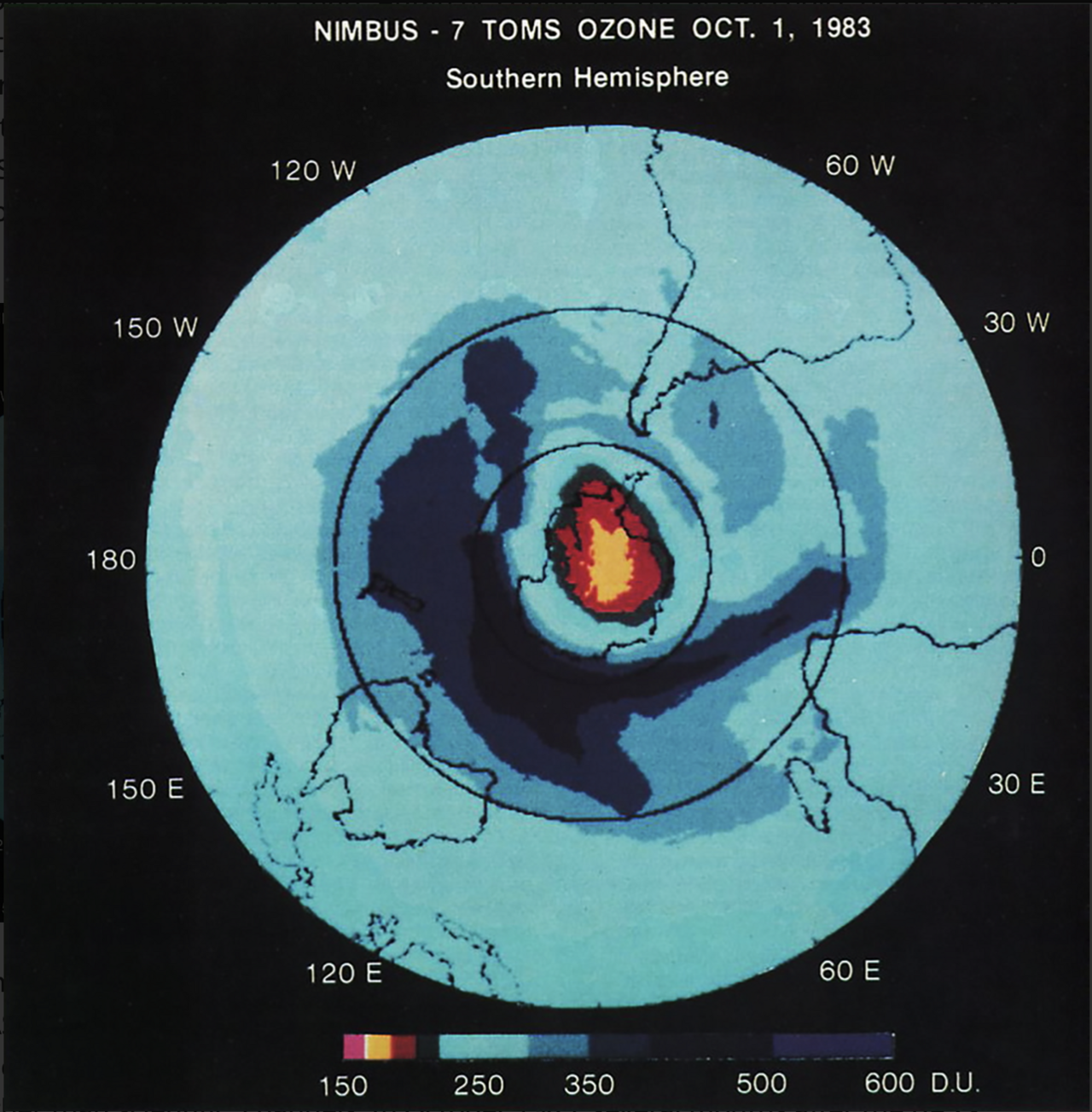

*Via Wikimedia Commons: [Satellite map of ozone about Antartica](https://commons.wikimedia.org/wiki/File:Satellite_map_of_ozone_about_Antartica.png) by NASA, public domain.*
*Via Wikimedia Commons: [Satellite map of ozone about Antartica](https://commons.wikimedia.org/wiki/File:Satellite_map_of_ozone_about_Antartica.png) by NASA, public domain.*
The name is a metaphor. NASA's Ozone Watch explains that the ozone hole is [not technically a "hole" where no ozone is present, but a region of exceptionally depleted ozone](https://ozonewatch.gsfc.nasa.gov/facts/hole_SH.html) in the Antarctic stratosphere, and that scientists draw its edge where the total ozone in a column of air falls to 220 Dobson units or lower. Its yearly size and depth have been measured from satellites since 1979.
The name is a metaphor. NASA's Ozone Watch explains that the ozone hole is [not technically a "hole" where no ozone is present, but a region of exceptionally depleted ozone](https://ozonewatch.gsfc.nasa.gov/facts/hole_SH.html) in the Antarctic stratosphere, and that scientists draw its edge where the total ozone in a column of air falls to 220 Dobson units or lower.[1] Its yearly size and depth have been measured from satellites since 1979.
## The ozone layer
## The ozone layer
Ozone is a gas whose molecules consist of three oxygen atoms (O₃). The Royal Swedish Academy of Sciences, in its announcement of the 1995 Nobel Prize in Chemistry, noted that if all the ozone in the atmosphere were compressed to the pressure at the Earth's surface, [the layer would be only 3 mm thick](https://www.nobelprize.org/prizes/chemistry/1995/press-release/). Small as that amount is, ozone, together with ordinary oxygen, absorbs most of the sun's ultraviolet (UV) radiation before it reaches the ground; the Academy wrote that without a protective ozone layer, animals and plants could not exist, at least on land. NASA's Earth Observatory notes that the UV light the layer absorbs [damages DNA in plants and animals, including humans, and leads to sunburns and skin cancer](https://science.nasa.gov/earth/earth-observatory/ozone-hole-reaches-its-2026-maximum/).
Ozone is a gas whose molecules consist of three oxygen atoms (O₃). The Royal Swedish Academy of Sciences, in its announcement of the 1995 Nobel Prize in Chemistry, noted that if all the ozone in the atmosphere were compressed to the pressure at the Earth's surface, [the layer would be only 3 mm thick](https://www.nobelprize.org/prizes/chemistry/1995/press-release/). Small as that amount is, ozone, together with ordinary oxygen, absorbs most of the sun's ultraviolet (UV) radiation before it reaches the ground; the Academy wrote that without a protective ozone layer, animals and plants could not exist, at least on land. NASA's Earth Observatory notes that the UV light the layer absorbs [damages DNA in plants and animals, including humans, and leads to sunburns and skin cancer](https://science.nasa.gov/earth/earth-observatory/ozone-hole-reaches-its-2026-maximum/).[4]
Ozone forms when UV light splits oxygen molecules (O₂) and the freed oxygen atoms join other oxygen molecules. The English physicist Sidney Chapman set out the first photochemical theory of this process in 1930, which explains why [the highest ozone concentrations occur between about 15 and 50 km up](https://www.nobelprize.org/prizes/chemistry/1995/press-release/), the region called the ozone layer. The layer is not a sheet of pure ozone: NASA describes it as [simply a region where ozone is more common than it is at other altitudes](https://ozonewatch.gsfc.nasa.gov/facts/dobson_SH.html).
Ozone forms when UV light splits oxygen molecules (O₂) and the freed oxygen atoms join other oxygen molecules. The English physicist Sidney Chapman set out the first photochemical theory of this process in 1930, which explains why [the highest ozone concentrations occur between about 15 and 50 km up](https://www.nobelprize.org/prizes/chemistry/1995/press-release/), the region called the ozone layer. The layer is not a sheet of pure ozone: NASA describes it as [simply a region where ozone is more common than it is at other altitudes](https://ozonewatch.gsfc.nasa.gov/facts/dobson_SH.html).[3]
Stratospheric ozone is distinct from ozone at ground level, which NASA and NOAA describe as [an air pollutant commonly resulting from human activities](https://science.nasa.gov/earth/2026-ozone-hole/).
Stratospheric ozone is distinct from ozone at ground level, which NASA and NOAA describe as [an air pollutant commonly resulting from human activities](https://science.nasa.gov/earth/2026-ozone-hole/).[5]
### Measuring ozone: the Dobson unit
### Measuring ozone: the Dobson unit
Ozone is usually measured as the total amount in a column of air from the ground to space, expressed in Dobson units (DU). One Dobson unit is the amount of ozone that would make [a layer of pure ozone 0.01 millimetres thick at 0 °C and a pressure of one atmosphere](https://ozonewatch.gsfc.nasa.gov/facts/dobson_SH.html), about 2.69 × 10¹⁶ molecules over each square centimetre. The world average is roughly 300 DU, a layer 3 mm thick if compressed; inside the Antarctic ozone hole, NASA notes, the concentration drops to an average of about 100 DU.
Ozone is usually measured as the total amount in a column of air from the ground to space, expressed in Dobson units (DU). One Dobson unit is the amount of ozone that would make [a layer of pure ozone 0.01 millimetres thick at 0 °C and a pressure of one atmosphere](https://ozonewatch.gsfc.nasa.gov/facts/dobson_SH.html), about 2.69 × 10¹⁶ molecules over each square centimetre.[3] The world average is roughly 300 DU, a layer 3 mm thick if compressed; inside the Antarctic ozone hole, NASA notes, the concentration drops to an average of about 100 DU.[3]
9 unchanged paragraphs
The 220 DU boundary used to define the hole has a historical basis. According to NASA, [total column ozone values of less than 220 Dobson units were not observed prior to 1979](https://ozonewatch.gsfc.nasa.gov/facts/hole_SH.html), and aircraft measurements over Antarctica showed that values below that level result from ozone loss catalysed by chlorine and bromine compounds.
The 220 DU boundary used to define the hole has a historical basis. According to NASA, [total column ozone values of less than 220 Dobson units were not observed prior to 1979](https://ozonewatch.gsfc.nasa.gov/facts/hole_SH.html), and aircraft measurements over Antarctica showed that values below that level result from ozone loss catalysed by chlorine and bromine compounds.
## Discovery
## Discovery
### Early warnings: nitrogen oxides and CFCs
### Early warnings: nitrogen oxides and CFCs
Scientists realised in the 1970s that the ozone layer could be damaged by human activity. As the Nobel committee's account sets out, Paul Crutzen showed in 1970 that [nitrogen oxides react catalytically with ozone](https://www.nobelprize.org/prizes/chemistry/1995/press-release/), destroying it without being used up themselves; and in 1971 Harold Johnston warned that a planned fleet of supersonic aircraft could release nitrogen oxides in the middle of the ozone layer.
Scientists realised in the 1970s that the ozone layer could be damaged by human activity. As the Nobel committee's account sets out, Paul Crutzen showed in 1970 that [nitrogen oxides react catalytically with ozone](https://www.nobelprize.org/prizes/chemistry/1995/press-release/), destroying it without being used up themselves; and in 1971 Harold Johnston warned that a planned fleet of supersonic aircraft could release nitrogen oxides in the middle of the ozone layer.
In 1974 Mario Molina and F. Sherwood Rowland published in *Nature* their analysis of the threat from chlorofluorocarbons, gases then used in spray cans, as the coolant in refrigerators and in plastic foams. They drew on two earlier findings: James Lovelock's measurements showing that these entirely human-made, chemically inert gases had already spread throughout the atmosphere, and work by Richard Stolarski and Ralph Cicerone showing that free chlorine atoms can destroy ozone catalytically. Molina and Rowland reasoned that CFCs, which do not break down in the lower atmosphere, would slowly rise to the ozone layer, where intense UV light would split off their chlorine. They calculated that [continued use at the same rate would deplete the ozone layer by many percent after some decades](https://www.nobelprize.org/prizes/chemistry/1995/press-release/). Many scientists criticised the calculations; the Academy later wrote that the two had been right in all essentials and had even underestimated the risk. Their work led to some restrictions on CFC releases in the late 1970s and early 1980s.
In 1974 Mario Molina and F. Sherwood Rowland published in *Nature* their analysis of the threat from chlorofluorocarbons, gases then used in spray cans, as the coolant in refrigerators and in plastic foams. They drew on two earlier findings: James Lovelock's measurements showing that these entirely human-made, chemically inert gases had already spread throughout the atmosphere, and work by Richard Stolarski and Ralph Cicerone showing that free chlorine atoms can destroy ozone catalytically. Molina and Rowland reasoned that CFCs, which do not break down in the lower atmosphere, would slowly rise to the ozone layer, where intense UV light would split off their chlorine. They calculated that [continued use at the same rate would deplete the ozone layer by many percent after some decades](https://www.nobelprize.org/prizes/chemistry/1995/press-release/). Many scientists criticised the calculations; the Academy later wrote that the two had been right in all essentials and had even underestimated the risk. Their work led to some restrictions on CFC releases in the late 1970s and early 1980s.
### Halley, 1985
### Halley, 1985
The ozone hole itself was found by ground-based measurement. The British Antarctic Survey set up the Halley Bay Observatory in 1956, ahead of the International Geophysical Year, and [began measuring ozone with a Dobson spectrophotometer in 1957](https://ozonewatch.gsfc.nasa.gov/facts/history_SH.html). In May 1985 three of its scientists, Joseph Farman, B. G. Gardiner and J. D. Shanklin, reported in *Nature* that [the spring values of total ozone in Antarctica had fallen considerably](https://www.nature.com/articles/315207a0). Their paper noted that the atmospheric models of the time, built for 30° north and often accepted as global estimates, had suggested that changes in total ozone would remain small for at least another decade. Because the circulation of the lower stratosphere appeared unchanged, they argued that chemical causes had to be considered, and proposed that the very low temperatures of the Antarctic stratosphere from midwinter to several weeks after the spring equinox made it uniquely sensitive to the growth of inorganic chlorine.
The ozone hole itself was found by ground-based measurement. The British Antarctic Survey set up the Halley Bay Observatory in 1956, ahead of the International Geophysical Year, and [began measuring ozone with a Dobson spectrophotometer in 1957](https://ozonewatch.gsfc.nasa.gov/facts/history_SH.html). In May 1985 three of its scientists, Joseph Farman, B. G. Gardiner and J. D. Shanklin, reported in *Nature* that [the spring values of total ozone in Antarctica had fallen considerably](https://www.nature.com/articles/315207a0). Their paper noted that the atmospheric models of the time, built for 30° north and often accepted as global estimates, had suggested that changes in total ozone would remain small for at least another decade. Because the circulation of the lower stratosphere appeared unchanged, they argued that chemical causes had to be considered, and proposed that the very low temperatures of the Antarctic stratosphere from midwinter to several weeks after the spring equinox made it uniquely sensitive to the growth of inorganic chlorine.
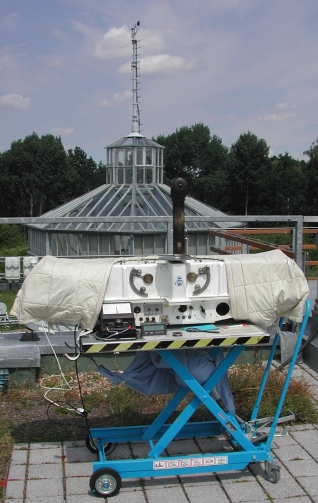

*Via Wikimedia Commons: [Dobson071](https://commons.wikimedia.org/wiki/File:Dobson071.jpg) by André Knöfel, [CC BY-SA 3.0](http://creativecommons.org/licenses/by-sa/3.0/).*
*Via Wikimedia Commons: [Dobson071](https://commons.wikimedia.org/wiki/File:Dobson071.jpg) by André Knöfel, [CC BY-SA 3.0](http://creativecommons.org/licenses/by-sa/3.0/).*
In 1986, NASA scientists used data from the Total Ozone Mapping Spectrometer (TOMS) and the Solar Backscatter Ultraviolet (SBUV) instrument to show that [the ozone hole is a regional-scale Antarctic phenomenon](https://ozonewatch.gsfc.nasa.gov/facts/history_SH.html), not a local one. The Nobel committee described the Halley finding as "the real shock": the depletion was, at least at times, [far greater than expected from earlier calculations of the CFC effect](https://www.nobelprize.org/prizes/chemistry/1995/press-release/), and it set off a debate over whether it was a natural climatic variation or chemical destruction caused by people.
In 1986, NASA scientists used data from the Total Ozone Mapping Spectrometer (TOMS) and the Solar Backscatter Ultraviolet (SBUV) instrument to show that [the ozone hole is a regional-scale Antarctic phenomenon](https://ozonewatch.gsfc.nasa.gov/facts/history_SH.html), not a local one.[2] The Nobel committee described the Halley finding as "the real shock": the depletion was, at least at times, [far greater than expected from earlier calculations of the CFC effect](https://www.nobelprize.org/prizes/chemistry/1995/press-release/), and it set off a debate over whether it was a natural climatic variation or chemical destruction caused by people.
### The chemical explanation
### The chemical explanation
Several papers in 1986 and 1987 proposed chemical, meteorological and solar-cycle explanations. NASA's history of the ozone hole singles out a paper by Susan Solomon and colleagues as [among the key papers explaining the atmospheric chemistry of CFCs and ozone depletion](https://ozonewatch.gsfc.nasa.gov/facts/history_SH.html), one that stressed the role of polar stratospheric clouds. Also in 1986, Michael McElroy and colleagues described a role for bromine. Paul Crutzen and Frank Arnold proposed that the polar clouds could be made of nitric acid trihydrate, which would explain why they appear at altitudes and temperatures not cold enough for the stratosphere's tiny amount of water vapour to condense on its own.
Several papers in 1986 and 1987 proposed chemical, meteorological and solar-cycle explanations. NASA's history of the ozone hole singles out a paper by Susan Solomon and colleagues as [among the key papers explaining the atmospheric chemistry of CFCs and ozone depletion](https://ozonewatch.gsfc.nasa.gov/facts/history_SH.html), one that stressed the role of polar stratospheric clouds.[2] Also in 1986, Michael McElroy and colleagues described a role for bromine.[2] Paul Crutzen and Frank Arnold proposed that the polar clouds could be made of nitric acid trihydrate, which would explain why they appear at altitudes and temperatures not cold enough for the stratosphere's tiny amount of water vapour to condense on its own.
Field measurements settled the question. The National Ozone Expedition found elevated chlorine dioxide over McMurdo Station during the springtime hole, and in 1987 the Antarctic Airborne Ozone Expedition flew NASA's ER-2 and DC-8 research aircraft from Punta Arenas, Chile, into the Antarctic polar vortex. NASA calls the result [the "smoking gun" linking CFC-derived chlorine to the ozone hole](https://ozonewatch.gsfc.nasa.gov/facts/history_SH.html): where chlorine monoxide (ClO) was higher, ozone was lower. In 1988 Mario and Luisa Molina described the reactions through which ClO catalyses the very rapid destruction of ozone.
Field measurements settled the question. The National Ozone Expedition found elevated chlorine dioxide over McMurdo Station during the springtime hole, and in 1987 the Antarctic Airborne Ozone Expedition flew NASA's ER-2 and DC-8 research aircraft from Punta Arenas, Chile, into the Antarctic polar vortex.[2] NASA calls the result [the "smoking gun" linking CFC-derived chlorine to the ozone hole](https://ozonewatch.gsfc.nasa.gov/facts/history_SH.html): where chlorine monoxide (ClO) was higher, ozone was lower.[2] In 1988 Mario and Luisa Molina described the reactions through which ClO catalyses the very rapid destruction of ozone.[2]
4 unchanged paragraphs
In 1995 Crutzen, Molina and Rowland shared the Nobel Prize in Chemistry [for their work in atmospheric chemistry, particularly concerning the formation and decomposition of ozone](https://www.nobelprize.org/prizes/chemistry/1995/press-release/). The Academy's announcement also credited Susan Solomon and James Anderson among the researchers who established that the depletion is caused chiefly by chlorine and bromine from industrially manufactured gases.
In 1995 Crutzen, Molina and Rowland shared the Nobel Prize in Chemistry [for their work in atmospheric chemistry, particularly concerning the formation and decomposition of ozone](https://www.nobelprize.org/prizes/chemistry/1995/press-release/). The Academy's announcement also credited Susan Solomon and James Anderson among the researchers who established that the depletion is caused chiefly by chlorine and bromine from industrially manufactured gases.
## How the hole forms
## How the hole forms
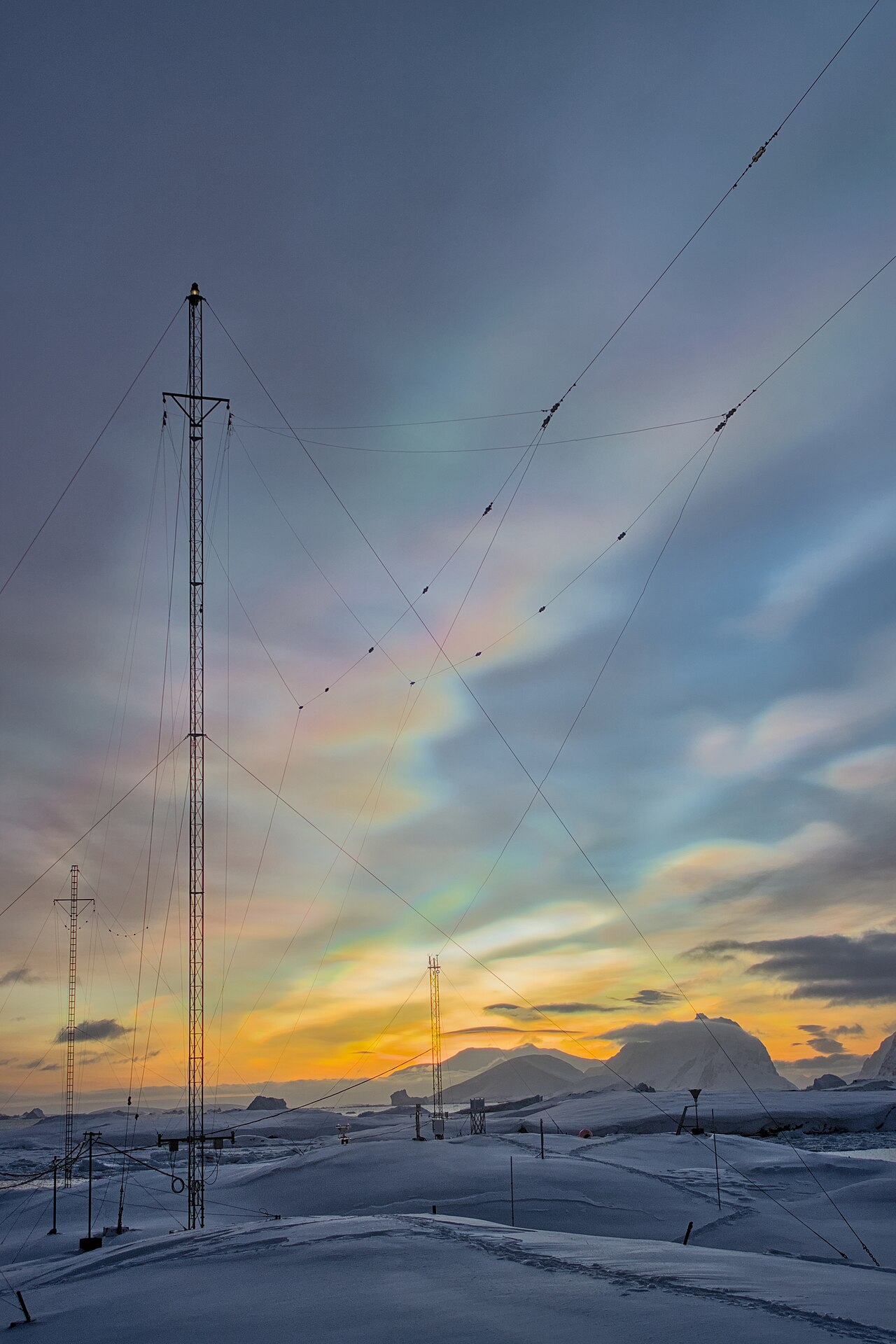

*Via Wikimedia Commons: [Polar stratospheric clouds](https://commons.wikimedia.org/wiki/File:Polar_stratospheric_clouds.jpg) by Oleksandr Bogomaz, [CC BY-SA 4.0](https://creativecommons.org/licenses/by-sa/4.0).*
*Via Wikimedia Commons: [Polar stratospheric clouds](https://commons.wikimedia.org/wiki/File:Polar_stratospheric_clouds.jpg) by Oleksandr Bogomaz, [CC BY-SA 4.0](https://creativecommons.org/licenses/by-sa/4.0).*
NASA's Ozone Watch describes the sequence. CFCs escape from refrigeration, propellants and industrial processes and are so stable in the lower atmosphere that they persist for years, even decades, long enough for some to reach the stratosphere. There UV light breaks chlorine atoms off the CFC molecules. Most of this chlorine does not attack ozone straight away: it is locked up in two stable "reservoir" chemicals, [hydrochloric acid and chlorine nitrate](https://ozonewatch.gsfc.nasa.gov/facts/hole_SH.html).
NASA's Ozone Watch describes the sequence. CFCs escape from refrigeration, propellants and industrial processes and are so stable in the lower atmosphere that they persist for years, even decades, long enough for some to reach the stratosphere. There UV light breaks chlorine atoms off the CFC molecules. Most of this chlorine does not attack ozone straight away: it is locked up in two stable "reservoir" chemicals, [hydrochloric acid and chlorine nitrate](https://ozonewatch.gsfc.nasa.gov/facts/hole_SH.html).[1]
Antarctica's winter frees it. During the months of polar darkness, a ring of strong stratospheric winds, the polar vortex, isolates the air above the continent, and that air grows so cold that clouds form even though it is extremely thin and dry. On the surfaces of these polar stratospheric cloud particles, which may be water, ice or nitric acid depending on the temperature, reactions take place that could not happen elsewhere in the atmosphere, converting the reservoir chemicals into more active forms, especially chlorine gas (Cl₂). When sunlight returns in spring, UV light splits the chlorine gas, and the free chlorine destroys ozone in a catalytic cycle that regenerates the chlorine, so that [a single chlorine atom can destroy thousands of ozone molecules](https://ozonewatch.gsfc.nasa.gov/facts/hole_SH.html). Bromine takes part in a second catalytic cycle with chlorine that accounts for a large share of the loss. The Nobel committee described this as the start of a new branch of atmospheric chemistry, ["heterogeneous" chemical reactions on particle surfaces](https://www.nobelprize.org/prizes/chemistry/1995/press-release/).
Antarctica's winter frees it. During the months of polar darkness, a ring of strong stratospheric winds, the polar vortex, isolates the air above the continent, and that air grows so cold that clouds form even though it is extremely thin and dry. On the surfaces of these polar stratospheric cloud particles, which may be water, ice or nitric acid depending on the temperature, reactions take place that could not happen elsewhere in the atmosphere, converting the reservoir chemicals into more active forms, especially chlorine gas (Cl₂). When sunlight returns in spring, UV light splits the chlorine gas, and the free chlorine destroys ozone in a catalytic cycle that regenerates the chlorine, so that [a single chlorine atom can destroy thousands of ozone molecules](https://ozonewatch.gsfc.nasa.gov/facts/hole_SH.html). Bromine takes part in a second catalytic cycle with chlorine that accounts for a large share of the loss.[1] The Nobel committee described this as the start of a new branch of atmospheric chemistry, ["heterogeneous" chemical reactions on particle surfaces](https://www.nobelprize.org/prizes/chemistry/1995/press-release/).
The hole grows through early spring until the stratosphere warms and the vortex weakens. Air from lower latitudes then mixes in, the active chlorine disperses, and the ozone layer stabilises until the following spring.
The hole grows through early spring until the stratosphere warms and the vortex weakens. Air from lower latitudes then mixes in, the active chlorine disperses, and the ozone layer stabilises until the following spring.
NASA's Earth Observatory states that scientists estimate [about 80 percent of the chlorine in the stratosphere today comes from human, not natural, sources](https://science.nasa.gov/earth/earth-observatory/ozone-hole-reaches-its-2026-maximum/), and that human-made bromine compounds, far less abundant but much more destructive to ozone, also contribute.
NASA's Earth Observatory states that scientists estimate [about 80 percent of the chlorine in the stratosphere today comes from human, not natural, sources](https://science.nasa.gov/earth/earth-observatory/ozone-hole-reaches-its-2026-maximum/), and that human-made bromine compounds, far less abundant but much more destructive to ozone, also contribute.[4]
## The record since 1979
## The record since 1979
NASA's satellite series, which began in 1979, shows how quickly the hole developed. The deepest point of the hole that first year was 194 DU, not far below the earlier historical low. Minimum values then fell to [173 DU in 1982, 154 in 1983 and 124 in 1985](https://science.nasa.gov/earth/earth-observatory/ozone-hole-reaches-its-2026-maximum/); in 1991 ozone fell below 100 DU for the first time, and the deepest hole on the satellite record came in 1994, when concentrations fell to 73 DU on 30 September. The hole grew rapidly in area and depth from 1980 to the early 1990s and roughly stabilised in the early years of the 21st century. NASA notes that records for depth and area have never fallen in the same year.
NASA's satellite series, which began in 1979, shows how quickly the hole developed. The deepest point of the hole that first year was 194 DU, not far below the earlier historical low.[4] Minimum values then fell to [173 DU in 1982, 154 in 1983 and 124 in 1985](https://science.nasa.gov/earth/earth-observatory/ozone-hole-reaches-its-2026-maximum/); in 1991 ozone fell below 100 DU for the first time, and the deepest hole on the satellite record came in 1994, when concentrations fell to 73 DU on 30 September.[4] The hole grew rapidly in area and depth from 1980 to the early 1990s and roughly stabilised in the early years of the 21st century. NASA notes that records for depth and area have never fallen in the same year.[4]
The satellite measurements were made by TOMS instruments on Nimbus-7 and other satellites from 1979 to 2004, by the Ozone Monitoring Instrument on the Aura satellite from 2005 to 2011, by the Ozone Mapping and Profiler Suite (OMPS) on the Suomi NPP satellite from 2012 to 2025, and in 2026 by the OMPS on NOAA-20; no data are available for 1995. NOAA also launches balloon-borne instruments from its South Pole observatory. Year-to-year changes in the hole's size are driven by stratospheric temperature and circulation: colder conditions give a larger hole and lower ozone in its core.
The satellite measurements were made by TOMS instruments on Nimbus-7 and other satellites from 1979 to 2004, by the Ozone Monitoring Instrument on the Aura satellite from 2005 to 2011, by the Ozone Mapping and Profiler Suite (OMPS) on the Suomi NPP satellite from 2012 to 2025, and in 2026 by the OMPS on NOAA-20; no data are available for 1995.[4] NOAA also launches balloon-borne instruments from its South Pole observatory. Year-to-year changes in the hole's size are driven by stratospheric temperature and circulation: colder conditions give a larger hole and lower ozone in its core.
## The Montreal Protocol
## The Montreal Protocol
The discovery turned scientific warnings into policy. The [Vienna Convention for the Protection of the Ozone Layer](https://csl.noaa.gov/assessments/ozone/2022/executivesummary/) was agreed in 1985, and the Montreal Protocol on Substances that Deplete the Ozone Layer, which the UN Ozone Secretariat describes as an agreement to phase out [both the production and consumption of ozone-depleting substances](https://ozone.unep.org/treaties/montreal-protocol), was signed in 1987 and entered into force in 1989. Its parties meet every year and have adjusted or amended the protocol six times. As of 23 October 2026, the Ozone Secretariat's table of ratifications lists [198 parties to both the Vienna Convention and the Montreal Protocol](https://ozone.unep.org/all-ratifications).
The discovery turned scientific warnings into policy. The [Vienna Convention for the Protection of the Ozone Layer](https://csl.noaa.gov/assessments/ozone/2022/executivesummary/) was agreed in 1985, and the Montreal Protocol on Substances that Deplete the Ozone Layer, which the UN Ozone Secretariat describes as an agreement to phase out [both the production and consumption of ozone-depleting substances](https://ozone.unep.org/treaties/montreal-protocol), was signed in 1987 and entered into force in 1989. Its parties meet every year and have adjusted or amended the protocol six times.[8] As of 23 October 2026, the Ozone Secretariat's table of ratifications lists [198 parties to both the Vienna Convention and the Montreal Protocol](https://ozone.unep.org/all-ratifications).[9]
The most recent amendment, agreed at Kigali in 2016, calls for a phase-down of hydrofluorocarbons (HFCs). These gases had been adopted as replacements for ozone-depleting substances; [they do not deplete the ozone layer but are powerful greenhouse gases](https://ozone.unep.org/treaties/montreal-protocol). The Ozone Secretariat's table lists 176 parties to the Kigali Amendment as of 23 October 2026.
The most recent amendment, agreed at Kigali in 2016, calls for a phase-down of hydrofluorocarbons (HFCs). These gases had been adopted as replacements for ozone-depleting substances; [they do not deplete the ozone layer but are powerful greenhouse gases](https://ozone.unep.org/treaties/montreal-protocol). The Ozone Secretariat's table lists 176 parties to the Kigali Amendment as of 23 October 2026.[9]
The treaty's controls have climate effects too, since [CFCs, like carbon dioxide, are greenhouse gases](https://www.nobelprize.org/prizes/chemistry/1995/press-release/). The 2022 *Scientific Assessment of Ozone Depletion*, prepared for the parties to the protocol and published by the World Meteorological Organization, estimated that the Montreal Protocol [had already avoided 0.17 ± 0.06 K of global surface warming in 2020](https://csl.noaa.gov/assessments/ozone/2022/executivesummary/), and would likely avoid about 0.5 to 1 K by the middle of the century, compared with a world of uncontrolled emissions; it estimated that the Kigali Amendment would avoid 0.3 to 0.5 °C of warming by 2100.
The treaty's controls have climate effects too, since [CFCs, like carbon dioxide, are greenhouse gases](https://www.nobelprize.org/prizes/chemistry/1995/press-release/). The 2022 *Scientific Assessment of Ozone Depletion*, prepared for the parties to the protocol and published by the World Meteorological Organization, estimated that the Montreal Protocol [had already avoided 0.17 ± 0.06 K of global surface warming in 2020](https://csl.noaa.gov/assessments/ozone/2022/executivesummary/), and would likely avoid about 0.5 to 1 K by the middle of the century, compared with a world of uncontrolled emissions; it estimated that the Kigali Amendment would avoid 0.3 to 0.5 °C of warming by 2100.
## Recovery
## Recovery
The 2022 assessment found that recovery of Antarctic ozone [continues to progress](https://csl.noaa.gov/assessments/ozone/2022/executivesummary/), and that the hole had generally diminished in size and depth since 2000. It reported that the total amount of chlorine and bromine from the substances controlled under the original protocol is still declining, and projected that total column ozone would return to its 1980 values around 2066 over Antarctica, around 2045 in the Arctic and around 2040 for the near-global average between 60° north and 60° south. It also noted that the return of the Antarctic ozone hole may depend on the course of climate change, with projections of a return around 2050 under some climate scenarios. NASA's Earth Observatory reported that [in 2018 scientists published the first direct satellite evidence of recovery](https://science.nasa.gov/earth/earth-observatory/ozone-hole-reaches-its-2026-maximum/), a 20 percent decrease in ozone depletion during the Antarctic winter months from 2005 to 2016.
The 2022 assessment found that recovery of Antarctic ozone [continues to progress](https://csl.noaa.gov/assessments/ozone/2022/executivesummary/), and that the hole had generally diminished in size and depth since 2000.[10] It reported that the total amount of chlorine and bromine from the substances controlled under the original protocol is still declining, and projected that total column ozone would return to its 1980 values around 2066 over Antarctica, around 2045 in the Arctic and around 2040 for the near-global average between 60° north and 60° south.[10] It also noted that the return of the Antarctic ozone hole may depend on the course of climate change, with projections of a return around 2050 under some climate scenarios.[10] NASA's Earth Observatory reported that [in 2018 scientists published the first direct satellite evidence of recovery](https://science.nasa.gov/earth/earth-observatory/ozone-hole-reaches-its-2026-maximum/), a 20 percent decrease in ozone depletion during the Antarctic winter months from 2005 to 2016.
Recovery does not proceed in a straight line. The assessment described the holes of 2019 to 2021 as varying widely in size, strength and longevity, a behaviour it found [largely dynamically driven and consistent with the evidence that recovery has begun](https://csl.noaa.gov/assessments/ozone/2022/executivesummary/): the 2019 hole was the smallest since 2002, while those of 2020 and 2021 were relatively large and long-lasting.
Recovery does not proceed in a straight line. The assessment described the holes of 2019 to 2021 as varying widely in size, strength and longevity, a behaviour it found [largely dynamically driven and consistent with the evidence that recovery has begun](https://csl.noaa.gov/assessments/ozone/2022/executivesummary/): the 2019 hole was the smallest since 2002, while those of 2020 and 2021 were relatively large and long-lasting.[10]
### The 2026 ozone hole
### The 2026 ozone hole
As of November 2026, the most recent season produced a large hole. NASA and NOAA reported on 4 November 2026 that, averaged over peak depletion season from 7 September to 13 October, the hole covered [about 25 million square kilometres (9.6 million square miles), the seventh largest by area in 48 years of monitoring](https://science.nasa.gov/earth/2026-ozone-hole/), and that it reached its greatest single-day extent on 18 September, at 27.1 million square kilometres (10.5 million square miles). The agencies attributed the size to an unusually strong and large polar vortex; NOAA's Amy Butler said weather systems that usually rise from the lower atmosphere and break up the vortex had been especially weak in August and September. The hole was not as deep as the record holes of earlier decades: balloon instruments at the South Pole recorded a lowest overhead value of 105 DU on 17 October, against a South Pole record low of 92 DU in October 2006.
As of November 2026, the most recent season produced a large hole. NASA and NOAA reported on 4 November 2026 that, averaged over peak depletion season from 7 September to 13 October, the hole covered [about 25 million square kilometres (9.6 million square miles), the seventh largest by area in 48 years of monitoring](https://science.nasa.gov/earth/2026-ozone-hole/), and that it reached its greatest single-day extent on 18 September, at 27.1 million square kilometres (10.5 million square miles).[5] The agencies attributed the size to an unusually strong and large polar vortex; NOAA's Amy Butler said weather systems that usually rise from the lower atmosphere and break up the vortex had been especially weak in August and September.[5] The hole was not as deep as the record holes of earlier decades: balloon instruments at the South Pole recorded a lowest overhead value of 105 DU on 17 October, against a South Pole record low of 92 DU in October 2006.[5]
Paul Newman, longtime leader of NASA's ozone research team, said the hole had been [forming later in the season in recent years, a sign that the ozone layer is healing](https://science.nasa.gov/earth/2026-ozone-hole/), and that it would have been larger still if ozone-depleting substances were as abundant as at their peak in 2000. NOAA's Stephen Montzka said chlorine from these substances in the Antarctic stratosphere had declined by about a third from its peak, relative to 1980s levels. Because legacy compounds linger in the atmosphere and leak from old products and landfills for decades, the agencies said scientists estimate that the ozone hole will recover by the 2070s.
Paul Newman, longtime leader of NASA's ozone research team, said the hole had been [forming later in the season in recent years, a sign that the ozone layer is healing](https://science.nasa.gov/earth/2026-ozone-hole/), and that it would have been larger still if ozone-depleting substances were as abundant as at their peak in 2000. NOAA's Stephen Montzka said chlorine from these substances in the Antarctic stratosphere had declined by about a third from its peak, relative to 1980s levels.[5] Because legacy compounds linger in the atmosphere and leak from old products and landfills for decades, the agencies said scientists estimate that the ozone hole will recover by the 2070s.[5]
## Arctic ozone loss and continuing concerns
## Arctic ozone loss and continuing concerns
Ozone loss also occurs over the Arctic, though less regularly. The 2022 assessment found Arctic ozone trends small compared with large year-to-year swings, too small to identify a statistically significant trend over 2000 to 2021, but it reported that [Arctic total ozone reached exceptionally low values in spring 2020](https://csl.noaa.gov/assessments/ozone/2022/executivesummary/), when a very stable, cold and long-lived vortex allowed chemical ozone loss that exceeded the previous record set in spring 2011.
Ozone loss also occurs over the Arctic, though less regularly. The 2022 assessment found Arctic ozone trends small compared with large year-to-year swings, too small to identify a statistically significant trend over 2000 to 2021, but it reported that [Arctic total ozone reached exceptionally low values in spring 2020](https://csl.noaa.gov/assessments/ozone/2022/executivesummary/), when a very stable, cold and long-lived vortex allowed chemical ozone loss that exceeded the previous record set in spring 2011.[10]
The assessment also described continuing challenges. Unexpected emissions of CFC-11 were identified in the years after 2012; investigations located the source region for at least half of them and [substantial emissions reductions followed](https://csl.noaa.gov/assessments/ozone/2022/executivesummary/), with global CFC-11 emissions falling after 2018. It noted that human emissions of nitrous oxide (N₂O), another ozone-depleting gas, were by 2020 more than twice the ozone-depleting effect of all CFC emissions that year, measured in CFC-11 equivalents.
The assessment also described continuing challenges. Unexpected emissions of CFC-11 were identified in the years after 2012; investigations located the source region for at least half of them and [substantial emissions reductions followed](https://csl.noaa.gov/assessments/ozone/2022/executivesummary/), with global CFC-11 emissions falling after 2018.[10] It noted that human emissions of nitrous oxide (N₂O), another ozone-depleting gas, were by 2020 more than twice the ozone-depleting effect of all CFC emissions that year, measured in CFC-11 equivalents.[10]
## Significance
## Significance
NASA's Earth Observatory writes that the ozone hole [opened the world's eyes to the global effects of human activity on the atmosphere](https://science.nasa.gov/earth/earth-observatory/ozone-hole-reaches-its-2026-maximum/). Its discovery showed that compounds whose [chemical stability and non-toxicity had made them seem environmentally ideal](https://www.nobelprize.org/prizes/chemistry/1995/press-release/) could, by that very stability, reach and damage the upper atmosphere. The Ozone Secretariat describes the ozone layer as [well on its way to recovery](https://ozone.unep.org/treaties/montreal-protocol), while the scientific assessments project that full recovery over Antarctica will take until the second half of the 21st century.
NASA's Earth Observatory writes that the ozone hole [opened the world's eyes to the global effects of human activity on the atmosphere](https://science.nasa.gov/earth/earth-observatory/ozone-hole-reaches-its-2026-maximum/).[4] Its discovery showed that compounds whose [chemical stability and non-toxicity had made them seem environmentally ideal](https://www.nobelprize.org/prizes/chemistry/1995/press-release/) could, by that very stability, reach and damage the upper atmosphere. The Ozone Secretariat describes the ozone layer as [well on its way to recovery](https://ozone.unep.org/treaties/montreal-protocol), while the scientific assessments project that full recovery over Antarctica will take until the second half of the 21st century.
## Sources
## Sources
- NASA Ozone Watch, "What is the Ozone Hole?", NASA Goddard Space Flight Center, page last updated 23 September 2024. https://ozonewatch.gsfc.nasa.gov/facts/hole_SH.html
- NASA Ozone Watch, "History of the Ozone Hole", NASA Goddard Space Flight Center, page last updated 23 September 2024. https://ozonewatch.gsfc.nasa.gov/facts/history_SH.html
- NASA Ozone Watch, "What is a Dobson Unit?", NASA Goddard Space Flight Center, page last updated 23 September 2024. https://ozonewatch.gsfc.nasa.gov/facts/dobson_SH.html
- NASA Earth Observatory, "Ozone Hole Reaches Its 2026 Maximum", 9 November 2026. https://science.nasa.gov/earth/earth-observatory/ozone-hole-reaches-its-2026-maximum/
- Sally Younger, "NASA, NOAA Track 2026 Antarctic Ozone Hole", NASA, 4 November 2026. https://science.nasa.gov/earth/2026-ozone-hole/
- The Royal Swedish Academy of Sciences, "The Nobel Prize in Chemistry 1995", press release, 11 October 1995, NobelPrize.org. https://www.nobelprize.org/prizes/chemistry/1995/press-release/
- J. C. Farman, B. G. Gardiner and J. D. Shanklin, "Large losses of total ozone in Antarctica reveal seasonal ClOx/NOx interaction", *Nature* 315, 207–210, 1 May 1985 (abstract). https://www.nature.com/articles/315207a0
- Ozone Secretariat, UN Environment Programme, "The Montreal Protocol on Substances that Deplete the Ozone Layer" (read November 2026). https://ozone.unep.org/treaties/montreal-protocol
- Ozone Secretariat, UN Environment Programme, "Status of ratification", as of 23 October 2026. https://ozone.unep.org/all-ratifications
- World Meteorological Organization, *Scientific Assessment of Ozone Depletion: 2022*, Executive Summary, GAW Report No. 278, Geneva, 2022 (hosted by NOAA Chemical Sciences Laboratory). https://csl.noaa.gov/assessments/ozone/2022/executivesummary/
