Compare versions
Version 1 → Version 2. Removed · Added. This shows the entry's text as it is written, including its formatting marks.
Version 1 · Version 2 · Version history
Side by side · Together
Version 1Version 2
A dividend is a payment a company makes to its shareholders out of its profits, usually in cash and on a regular schedule, giving the owners of its shares a direct portion of what the business has earned.
A dividend is a payment a company makes to its shareholders out of its profits, usually in cash and on a regular schedule, giving the owners of its shares a direct portion of what the business has earned.
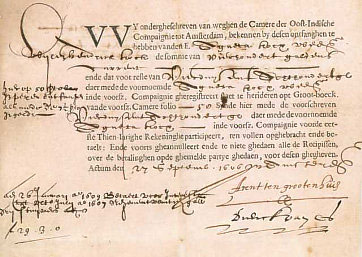
*Via Wikimedia Commons: [Voc-stock](https://commons.wikimedia.org/wiki/File:Voc-stock.jpg) by VOC, public domain.*
36 unchanged paragraphs
## Definition
## Definition
The U.S. Securities and Exchange Commission's investor-education site defines a dividend as [a portion of a company's profit paid to shareholders](https://www.investor.gov/introduction-investing/investing-basics/glossary/dividend). It notes that public companies that pay dividends usually do so on a fixed schedule but can pay at any time, and that unscheduled payments are called special or extra dividends. The U.S. Internal Revenue Service uses a narrower, tax-based definition: dividends are [distributions of earnings and profits paid by a corporation to stockholders](https://www.irs.gov/taxtopics/tc404), and while most are paid in cash, a company may also distribute stock, stock rights or other property.
The U.S. Securities and Exchange Commission's investor-education site defines a dividend as [a portion of a company's profit paid to shareholders](https://www.investor.gov/introduction-investing/investing-basics/glossary/dividend). It notes that public companies that pay dividends usually do so on a fixed schedule but can pay at any time, and that unscheduled payments are called special or extra dividends. The U.S. Internal Revenue Service uses a narrower, tax-based definition: dividends are [distributions of earnings and profits paid by a corporation to stockholders](https://www.irs.gov/taxtopics/tc404), and while most are paid in cash, a company may also distribute stock, stock rights or other property.
A dividend is one of two ways a shareholder can earn a return on a share; the other is capital appreciation, a rise in the share's price. The SEC lists both, describing dividend payments as what [comes when the company distributes some of its earnings to stockholders](https://www.investor.gov/introduction-investing/investing-basics/investment-products/stocks). Not every company pays one. The same SEC page notes that growth stocks [rarely pay dividends](https://www.investor.gov/introduction-investing/investing-basics/investment-products/stocks), their buyers hoping instead for a rising price, while income stocks pay them consistently.
A dividend is one of two ways a shareholder can earn a return on a share; the other is capital appreciation, a rise in the share's price. The SEC lists both, describing dividend payments as what [comes when the company distributes some of its earnings to stockholders](https://www.investor.gov/introduction-investing/investing-basics/investment-products/stocks). Not every company pays one. The same SEC page notes that growth stocks [rarely pay dividends](https://www.investor.gov/introduction-investing/investing-basics/investment-products/stocks), their buyers hoping instead for a rising price, while income stocks pay them consistently.
### Common and preferred shares
### Common and preferred shares
Companies issue two main kinds of stock. Owners of common stock are entitled to vote at shareholder meetings and to receive dividends. Holders of preferred stock usually cannot vote, but they [receive dividend payments before common stockholders do](https://www.investor.gov/introduction-investing/investing-basics/investment-products/stocks) and rank ahead of common stockholders if the company is liquidated.
Companies issue two main kinds of stock. Owners of common stock are entitled to vote at shareholder meetings and to receive dividends. Holders of preferred stock usually cannot vote, but they [receive dividend payments before common stockholders do](https://www.investor.gov/introduction-investing/investing-basics/investment-products/stocks) and rank ahead of common stockholders if the company is liquidated.
### Funds
### Funds
Investment funds also pay dividends. The IRS notes that mutual funds, exchange-traded funds, money market funds and real estate investment trusts (REITs) [also pay dividends to shareholders](https://www.irs.gov/taxtopics/tc404), passing through to their own investors the dividend income from the shares they hold.
Investment funds also pay dividends. The IRS notes that mutual funds, exchange-traded funds, money market funds and real estate investment trusts (REITs) [also pay dividends to shareholders](https://www.irs.gov/taxtopics/tc404), passing through to their own investors the dividend income from the shares they hold.
## How a dividend is paid
## How a dividend is paid
A dividend is declared by a company's board of directors. Delaware's corporation law, for example, gives the power to [the directors of every corporation](https://delcode.delaware.gov/title8/c001/sc05/index.html), subject to the company's certificate of incorporation. When the board declares a dividend it sets a record date, the date on which a person [must be on the company's books as a shareholder](https://www.investor.gov/introduction-investing/investing-basics/glossary/ex-dividend-dates-when-are-you-entitled-stock-and) to receive it, and a payable date on which the money is paid.
A dividend is declared by a company's board of directors. Delaware's corporation law, for example, gives the power to [the directors of every corporation](https://delcode.delaware.gov/title8/c001/sc05/index.html), subject to the company's certificate of incorporation. When the board declares a dividend it sets a record date, the date on which a person [must be on the company's books as a shareholder](https://www.investor.gov/introduction-investing/investing-basics/glossary/ex-dividend-dates-when-are-you-entitled-stock-and) to receive it, and a payable date on which the money is paid.
Stock exchange rules also fix an ex-dividend date. As of November 2026 the SEC explains that for U.S. stocks it is [usually set as the record date or one business day before](https://www.investor.gov/introduction-investing/investing-basics/glossary/ex-dividend-dates-when-are-you-entitled-stock-and) if the record date is not a business day. Whoever buys the share on or after the ex-dividend date does not receive the next payment; the seller does. The SEC's worked example has a dividend declared on Monday 2 March 2026 with a record date and ex-dividend date of Monday 16 March and a payable date of Tuesday 17 March.
Stock exchange rules also fix an ex-dividend date. As of November 2026 the SEC explains that for U.S. stocks it is [usually set as the record date or one business day before](https://www.investor.gov/introduction-investing/investing-basics/glossary/ex-dividend-dates-when-are-you-entitled-stock-and) if the record date is not a business day. Whoever buys the share on or after the ex-dividend date does not receive the next payment; the seller does. The SEC's worked example has a dividend declared on Monday 2 March 2026 with a record date and ex-dividend date of Monday 16 March and a payable date of Tuesday 17 March.
Black noted in 1976 that the price of a dividend-paying share [drops on the ex-dividend date by about the amount of the dividend](https://doi.org/10.3905/jpm.1976.408558), since the company is about to pay out that much cash. The SEC notes that with a significant dividend [the price of a stock may fall by that amount](https://www.investor.gov/introduction-investing/investing-basics/glossary/ex-dividend-dates-when-are-you-entitled-stock-and). For a dividend of 25 percent or more of the share's value, special rules defer the ex-dividend date to one business day after the dividend is paid.
Black noted in 1976 that the price of a dividend-paying share [drops on the ex-dividend date by about the amount of the dividend](https://doi.org/10.3905/jpm.1976.408558), since the company is about to pay out that much cash. The SEC notes that with a significant dividend [the price of a stock may fall by that amount](https://www.investor.gov/introduction-investing/investing-basics/glossary/ex-dividend-dates-when-are-you-entitled-stock-and). For a dividend of 25 percent or more of the share's value, special rules defer the ex-dividend date to one business day after the dividend is paid.
### Stock dividends and reinvestment
### Stock dividends and reinvestment
A company may pay a dividend in shares rather than cash: [additional shares in the company or in a subsidiary being spun off](https://www.investor.gov/introduction-investing/investing-basics/glossary/ex-dividend-dates-when-are-you-entitled-stock-and). For these, the ex-dividend date is the first business day after the shares are paid, and a shareholder who sells before then must hand the new shares on to the buyer.
A company may pay a dividend in shares rather than cash: [additional shares in the company or in a subsidiary being spun off](https://www.investor.gov/introduction-investing/investing-basics/glossary/ex-dividend-dates-when-are-you-entitled-stock-and). For these, the ex-dividend date is the first business day after the shares are paid, and a shareholder who sells before then must hand the new shares on to the buyer.
Dividend reinvestment plans [allow you to buy more shares of a stock you already own](https://www.investor.gov/introduction-investing/investing-basics/investment-products/stocks) by putting the dividend back into the company's shares rather than taking it as cash. The SEC notes that such a plan may charge a fee.
Dividend reinvestment plans [allow you to buy more shares of a stock you already own](https://www.investor.gov/introduction-investing/investing-basics/investment-products/stocks) by putting the dividend back into the company's shares rather than taking it as cash. The SEC notes that such a plan may charge a fee.
## Legal limits
## Legal limits
Company law restricts what a company may pay out, to protect its creditors. In Delaware, directors may pay dividends [out of its surplus](https://delcode.delaware.gov/title8/c001/sc05/index.html), or, if there is no surplus, out of net profits for the year in which the dividend is declared or the year before; they may not pay out of those profits while the capital behind preferred shares remains impaired. In the United Kingdom, section 830 of the Companies Act 2006 provides that [a company may only make a distribution out of profits available for the purpose](https://www.legislation.gov.uk/ukpga/2006/46/section/830), meaning its accumulated realised profits less its accumulated realised losses.
Company law restricts what a company may pay out, to protect its creditors. In Delaware, directors may pay dividends [out of its surplus](https://delcode.delaware.gov/title8/c001/sc05/index.html), or, if there is no surplus, out of net profits for the year in which the dividend is declared or the year before; they may not pay out of those profits while the capital behind preferred shares remains impaired. In the United Kingdom, section 830 of the Companies Act 2006 provides that [a company may only make a distribution out of profits available for the purpose](https://www.legislation.gov.uk/ukpga/2006/46/section/830), meaning its accumulated realised profits less its accumulated realised losses.
Lenders add their own limits. The economist Fischer Black observed in 1976 that when a company has debt outstanding, the indenture, the formal agreement with its bondholders, [will almost always limit the dividends the company can pay](https://doi.org/10.3905/jpm.1976.408558), because paying out all of a company's assets as a dividend would leave creditors "holding an empty shell". Holders of a company's [bonds](/t/1636/bond) are among the creditors these terms protect.
Lenders add their own limits. The economist Fischer Black observed in 1976 that when a company has debt outstanding, the indenture, the formal agreement with its bondholders, [will almost always limit the dividends the company can pay](https://doi.org/10.3905/jpm.1976.408558), because paying out all of a company's assets as a dividend would leave creditors "holding an empty shell". Holders of a company's [bonds](/t/1636/bond) are among the creditors these terms protect.
## History
## History
The early history of the Dutch East India Company (VOC), founded in 1602, shows how central the question of payouts was to the first modern corporations; by the early 1620s it had [transferable shares, a permanent capital, and limited liability](https://repub.eur.nl/pub/32952/ERS-2012-007-FA.pdf) for owners and managers. According to a study of its first two decades by the economic historians Oscar Gelderblom, Abe de Jong and Joost Jonker, the company was originally to be [liquidated and the capital returned to shareholders](https://repub.eur.nl/pub/32952/ERS-2012-007-FA.pdf) after ten years, unless they chose to reinvest in a successor company. When its directors moved to keep the capital in the business instead, a former director, Isaac Lemaire, petitioned in May 1609 that without dividends, full accounts and liquidation, no investor would subscribe to a successor.
The early history of the Dutch East India Company (VOC), founded in 1602, shows how central the question of payouts was to the first modern corporations; by the early 1620s it had [transferable shares, a permanent capital, and limited liability](https://repub.eur.nl/pub/32952/ERS-2012-007-FA.pdf) for owners and managers. According to a study of its first two decades by the economic historians Oscar Gelderblom, Abe de Jong and Joost Jonker, the company was originally to be [liquidated and the capital returned to shareholders](https://repub.eur.nl/pub/32952/ERS-2012-007-FA.pdf) after ten years, unless they chose to reinvest in a successor company. When its directors moved to keep the capital in the business instead, a former director, Isaac Lemaire, petitioned in May 1609 that without dividends, full accounts and liquidation, no investor would subscribe to a successor.
The directors responded with large payouts. Between 1610 and 1612 the VOC awarded [dividends totaling 162.5 per cent, or 10.4 million guilders](https://repub.eur.nl/pub/32952/ERS-2012-007-FA.pdf), of the original capital. Short of cash, it offered the first of them, in 1610, largely in kind, in mace (a spice) valued at the company's own prices. Many shareholders [refused to accept dividends in kind](https://repub.eur.nl/pub/32952/ERS-2012-007-FA.pdf), and the company had to stretch the cash payments it owed them over several years, to 1613 and 1616. In 1616 it decided to [convert unpaid dividends into interest bearing loans](https://repub.eur.nl/pub/32952/ERS-2012-007-FA.pdf). The authors list the pressure to meet shareholders' legitimate demands for dividends among the forces that shaped the modern corporate form.
The directors responded with large payouts. Between 1610 and 1612 the VOC awarded [dividends totaling 162.5 per cent, or 10.4 million guilders](https://repub.eur.nl/pub/32952/ERS-2012-007-FA.pdf), of the original capital. Short of cash, it offered the first of them, in 1610, largely in kind, in mace (a spice) valued at the company's own prices. Many shareholders [refused to accept dividends in kind](https://repub.eur.nl/pub/32952/ERS-2012-007-FA.pdf), and the company had to stretch the cash payments it owed them over several years, to 1613 and 1616. In 1616 it decided to [convert unpaid dividends into interest bearing loans](https://repub.eur.nl/pub/32952/ERS-2012-007-FA.pdf). The authors list the pressure to meet shareholders' legitimate demands for dividends among the forces that shaped the modern corporate form.
## Taxation
## Taxation
Tax rules differ by country and change over time. In the United States, as of November 2026, the IRS treats all taxable dividends as ordinary income but taxes "qualified dividends" at the [lower capital gain rates](https://www.irs.gov/taxtopics/tc404); the paying company identifies which dividends qualify on Form 1099-DIV. A distribution that is a return of capital is not a dividend: the IRS describes it as [a return of some or all of your investment](https://www.irs.gov/taxtopics/tc404) in the stock, which reduces the shareholder's cost basis, and it generally arises when the company has no current or accumulated earnings and profits.
Tax rules differ by country and change over time. In the United States, as of November 2026, the IRS treats all taxable dividends as ordinary income but taxes "qualified dividends" at the [lower capital gain rates](https://www.irs.gov/taxtopics/tc404); the paying company identifies which dividends qualify on Form 1099-DIV. A distribution that is a return of capital is not a dividend: the IRS describes it as [a return of some or all of your investment](https://www.irs.gov/taxtopics/tc404) in the stock, which reduces the shareholder's cost basis, and it generally arises when the company has no current or accumulated earnings and profits.
The tax treatment of dividends has long shaped the debate over whether companies should pay them at all. Writing in 1976, Black noted that in a world where dividends are taxed more heavily than capital gains, a company that pays no dividend [will be more attractive to taxable individual investors](https://doi.org/10.3905/jpm.1976.408558), and that a company's interest payments are deductible for tax purposes while its dividends are not.
The tax treatment of dividends has long shaped the debate over whether companies should pay them at all. Writing in 1976, Black noted that in a world where dividends are taxed more heavily than capital gains, a company that pays no dividend [will be more attractive to taxable individual investors](https://doi.org/10.3905/jpm.1976.408558), and that a company's interest payments are deductible for tax purposes while its dividends are not.
## Why companies pay dividends
## Why companies pay dividends
### The irrelevance argument
### The irrelevance argument
In 1961 the economists Merton Miller and Franco Modigliani showed that, in an idealized market without taxes or transaction costs, a company's dividend policy should not affect what its shares are worth. Black summarized their theorem as saying that dividends [do not affect the value of its shares or the returns to investors](https://doi.org/10.3905/jpm.1976.408558), because the higher the dividend, the less the investor receives in capital appreciation. A company that pays no dividend can still return cash in other ways, the most obvious being to buy back its own shares.
In 1961 the economists Merton Miller and Franco Modigliani showed that, in an idealized market without taxes or transaction costs, a company's dividend policy should not affect what its shares are worth. Black summarized their theorem as saying that dividends [do not affect the value of its shares or the returns to investors](https://doi.org/10.3905/jpm.1976.408558), because the higher the dividend, the less the investor receives in capital appreciation. A company that pays no dividend can still return cash in other ways, the most obvious being to buy back its own shares.
### The dividend puzzle
### The dividend puzzle
Real markets do have taxes and costs, and on Black's reasoning those should make dividends less attractive, not more, yet companies kept paying them. Black called this [the dividend puzzle](https://doi.org/10.3905/jpm.1976.408558): "The harder we look at the dividend picture, the more it seems like a puzzle, with pieces that just don't fit together." He weighed several explanations. Dividends may carry information, since managers dislike cutting them and so raise them only when they expect the company can sustain the higher payment; an announced cut therefore [often leads to a drop in the company's stock price](https://doi.org/10.3905/jpm.1976.408558), and an increase often leads to a rise. He judged, though, that this does not explain why companies pay dividends in the first place, and noted that some investors and trustees may believe that stocks without dividends should not be held. His paper ends without an answer: "What should the corporation do about dividend policy? We don't know."
Real markets do have taxes and costs, and on Black's reasoning those should make dividends less attractive, not more, yet companies kept paying them. Black called this [the dividend puzzle](https://doi.org/10.3905/jpm.1976.408558): "The harder we look at the dividend picture, the more it seems like a puzzle, with pieces that just don't fit together." He weighed several explanations. Dividends may carry information, since managers dislike cutting them and so raise them only when they expect the company can sustain the higher payment; an announced cut therefore [often leads to a drop in the company's stock price](https://doi.org/10.3905/jpm.1976.408558), and an increase often leads to a rise. He judged, though, that this does not explain why companies pay dividends in the first place, and noted that some investors and trustees may believe that stocks without dividends should not be held. His paper ends without an answer: "What should the corporation do about dividend policy? We don't know."
Eugene Fama and Kenneth French opened a 2001 study the same way: [Dividends have long been an enigma](https://doi.org/10.1016/S0304-405X%2801%2900038-1).
Eugene Fama and Kenneth French opened a 2001 study the same way: [Dividends have long been an enigma](https://doi.org/10.1016/S0304-405X%2801%2900038-1).
## Disappearing dividends and share buybacks
## Disappearing dividends and share buybacks
Fama and French found that the share of U.S. companies paying dividends had fallen sharply. Among publicly traded non-financial, non-utility firms on the NYSE, AMEX and Nasdaq, the proportion paying cash dividends [falls from 66.5% in 1978 to 20.8% in 1999](https://doi.org/10.1016/S0304-405X%2801%2900038-1). Part of the fall came from a flood of new listings by small, less profitable, fast-growing companies of the kind that had never paid dividends; by 1999 only 3.7 percent of newly listed firms paid one. But they also found that firms had become [less likely to pay dividends, whatever their characteristics](https://doi.org/10.1016/S0304-405X%2801%2900038-1), a change they called a lower propensity to pay, and judged it at least as important as the change in the kind of firms listed.
Fama and French found that the share of U.S. companies paying dividends had fallen sharply. Among publicly traded non-financial, non-utility firms on the NYSE, AMEX and Nasdaq, the proportion paying cash dividends [falls from 66.5% in 1978 to 20.8% in 1999](https://doi.org/10.1016/S0304-405X%2801%2900038-1). Part of the fall came from a flood of new listings by small, less profitable, fast-growing companies of the kind that had never paid dividends; by 1999 only 3.7 percent of newly listed firms paid one. But they also found that firms had become [less likely to pay dividends, whatever their characteristics](https://doi.org/10.1016/S0304-405X%2801%2900038-1), a change they called a lower propensity to pay, and judged it at least as important as the change in the kind of firms listed.
Share buybacks grew over the same years. Fama and French report aggregate repurchases of 3.37 percent of aggregate earnings in 1973–77 and 5.12 percent in 1978–82, rising to [31.42% of earnings](https://doi.org/10.1016/S0304-405X%2801%2900038-1) in 1983–98. Because buybacks were made mostly by companies that already paid dividends, they concluded that buybacks did little to explain why fewer companies paid dividends; their main effect was to increase the already high payouts of dividend payers.
Share buybacks grew over the same years. Fama and French report aggregate repurchases of 3.37 percent of aggregate earnings in 1973–77 and 5.12 percent in 1978–82, rising to [31.42% of earnings](https://doi.org/10.1016/S0304-405X%2801%2900038-1) in 1983–98. Because buybacks were made mostly by companies that already paid dividends, they concluded that buybacks did little to explain why fewer companies paid dividends; their main effect was to increase the already high payouts of dividend payers.
## Regulators and bank dividends
## Regulators and bank dividends
Bank supervisors have restricted dividends in a crisis to preserve banks' capital. On 27 March 2020, early in the COVID-19 pandemic, the European Central Bank recommended that the banks it supervises [should not pay dividends for the financial years 2019 and 2020 until at least 1 October 2020](https://www.bankingsupervision.europa.eu/press/pr/date/2020/html/ssm.pr200327~d4d8f81a53.en.html), and that they refrain from share buybacks, so that the capital kept could support lending and absorb losses. On 25 June 2020 the U.S. Federal Reserve Board, after its annual stress tests, required large banks for the third quarter of 2020 to preserve capital by [suspending share repurchases, capping dividend payments](https://www.federalreserve.gov/newsevents/pressreleases/bcreg20200625c.htm), and allowing dividends only according to a formula based on recent income. The Board noted that buybacks had made up about 70 percent of large banks' shareholder payouts; under its rule a bank could not raise its dividend above the amount paid in the second quarter.
Bank supervisors have restricted dividends in a crisis to preserve banks' capital. On 27 March 2020, early in the COVID-19 pandemic, the European Central Bank recommended that the banks it supervises [should not pay dividends for the financial years 2019 and 2020 until at least 1 October 2020](https://www.bankingsupervision.europa.eu/press/pr/date/2020/html/ssm.pr200327~d4d8f81a53.en.html), and that they refrain from share buybacks, so that the capital kept could support lending and absorb losses. On 25 June 2020 the U.S. Federal Reserve Board, after its annual stress tests, required large banks for the third quarter of 2020 to preserve capital by [suspending share repurchases, capping dividend payments](https://www.federalreserve.gov/newsevents/pressreleases/bcreg20200625c.htm), and allowing dividends only according to a formula based on recent income. The Board noted that buybacks had made up about 70 percent of large banks' shareholder payouts; under its rule a bank could not raise its dividend above the amount paid in the second quarter.
## Sources
## Sources
- U.S. Securities and Exchange Commission, Investor.gov, "Dividend" (glossary; read November 2026). https://www.investor.gov/introduction-investing/investing-basics/glossary/dividend
- U.S. Securities and Exchange Commission, Investor.gov, "Ex-Dividend Dates: When Are You Entitled to Stock and Cash Dividends" (read November 2026). https://www.investor.gov/introduction-investing/investing-basics/glossary/ex-dividend-dates-when-are-you-entitled-stock-and
- U.S. Securities and Exchange Commission, Investor.gov, "Stocks" (read November 2026). https://www.investor.gov/introduction-investing/investing-basics/investment-products/stocks
- Internal Revenue Service, "Topic no. 404, Dividends and other corporate distributions" (read November 2026). https://www.irs.gov/taxtopics/tc404
- State of Delaware, Delaware Code, Title 8, Chapter 1, Subchapter V, § 170, "Dividends; payment; wasting asset corporations" (read November 2026). https://delcode.delaware.gov/title8/c001/sc05/index.html
- United Kingdom, Companies Act 2006, section 830, "Distributions to be made only out of profits available for the purpose", legislation.gov.uk (read November 2026). https://www.legislation.gov.uk/ukpga/2006/46/section/830
- Oscar Gelderblom, Abe de Jong and Joost Jonker, "The Formative Years of the Modern Corporation: The Dutch East India Company VOC, 1602–1623", ERIM Report Series ERS-2012-007-F&A, Erasmus University Rotterdam, June 2012 (published in the *Journal of Economic History* 73, no. 4, 2013). https://repub.eur.nl/pub/32952/ERS-2012-007-FA.pdf
- Fischer Black, "The Dividend Puzzle", *The Journal of Portfolio Management* 2, no. 2 (1976): 5–8. https://doi.org/10.3905/jpm.1976.408558
- Eugene F. Fama and Kenneth R. French, "Disappearing dividends: changing firm characteristics or lower propensity to pay?", *Journal of Financial Economics* 60 (2001): 3–43. https://doi.org/10.1016/S0304-405X%2801%2900038-1
- European Central Bank, "ECB asks banks not to pay dividends or buy back shares during COVID-19 pandemic", press release, 27 March 2020. https://www.bankingsupervision.europa.eu/press/pr/date/2020/html/ssm.pr200327~d4d8f81a53.en.html
- Board of Governors of the Federal Reserve System, "Federal Reserve Board releases results of stress tests for 2020 and additional sensitivity analyses conducted in light of the coronavirus event", press release, 25 June 2020. https://www.federalreserve.gov/newsevents/pressreleases/bcreg20200625c.htm
- U.S. Securities and Exchange Commission, Investor.gov, "Dividend" (glossary; read November 2026). https://www.investor.gov/introduction-investing/investing-basics/glossary/dividend
- U.S. Securities and Exchange Commission, Investor.gov, "Ex-Dividend Dates: When Are You Entitled to Stock and Cash Dividends" (read November 2026). https://www.investor.gov/introduction-investing/investing-basics/glossary/ex-dividend-dates-when-are-you-entitled-stock-and
- U.S. Securities and Exchange Commission, Investor.gov, "Stocks" (read November 2026). https://www.investor.gov/introduction-investing/investing-basics/investment-products/stocks
- Internal Revenue Service, "Topic no. 404, Dividends and other corporate distributions" (read November 2026). https://www.irs.gov/taxtopics/tc404
- State of Delaware, Delaware Code, Title 8, Chapter 1, Subchapter V, § 170, "Dividends; payment; wasting asset corporations" (read November 2026). https://delcode.delaware.gov/title8/c001/sc05/index.html
- United Kingdom, Companies Act 2006, section 830, "Distributions to be made only out of profits available for the purpose", legislation.gov.uk (read November 2026). https://www.legislation.gov.uk/ukpga/2006/46/section/830
- Oscar Gelderblom, Abe de Jong and Joost Jonker, "The Formative Years of the Modern Corporation: The Dutch East India Company VOC, 1602–1623", ERIM Report Series ERS-2012-007-F&A, Erasmus University Rotterdam, June 2012 (published in the *Journal of Economic History* 73, no. 4, 2013). https://repub.eur.nl/pub/32952/ERS-2012-007-FA.pdf
- Fischer Black, "The Dividend Puzzle", *The Journal of Portfolio Management* 2, no. 2 (1976): 5–8. https://doi.org/10.3905/jpm.1976.408558
- Eugene F. Fama and Kenneth R. French, "Disappearing dividends: changing firm characteristics or lower propensity to pay?", *Journal of Financial Economics* 60 (2001): 3–43. https://doi.org/10.1016/S0304-405X%2801%2900038-1
- European Central Bank, "ECB asks banks not to pay dividends or buy back shares during COVID-19 pandemic", press release, 27 March 2020. https://www.bankingsupervision.europa.eu/press/pr/date/2020/html/ssm.pr200327~d4d8f81a53.en.html
- Board of Governors of the Federal Reserve System, "Federal Reserve Board releases results of stress tests for 2020 and additional sensitivity analyses conducted in light of the coronavirus event", press release, 25 June 2020. https://www.federalreserve.gov/newsevents/pressreleases/bcreg20200625c.htm
