Version 1
Nov 9, 2026. Compare with the current version · Version history
Preferred stock is a class of company shares that ranks ahead of ordinary (common) stock for dividends and for repayment if the company is wound up, but behind the company's creditors and bondholders, and that usually carries no vote.
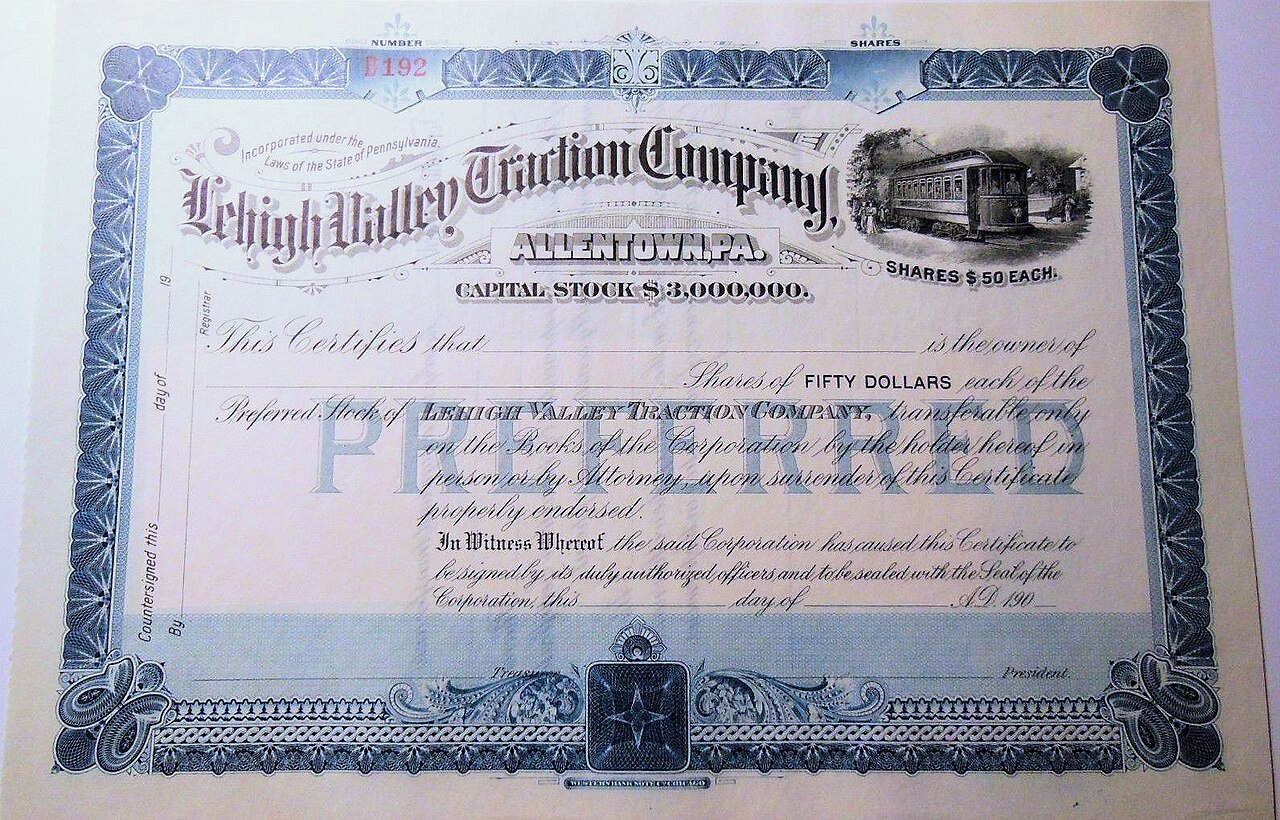
Via Wikimedia Commons: 1900 - Lehigh Valley Traction Company Preferred Stock Certificate Alle by Unknown author Unknown author, public domain.
What it is
The Legal Information Institute at Cornell Law School defines preferred stock as shares that have priority in receiving dividends and other benefits over common stock. The exact benefits vary from one issue to another, but every kind has some form of priority over common stockholders. A dividend is a payment a company makes to its shareholders; on preferred stock it is usually fixed when the shares are issued, stated as an amount or as a percentage of the issue price.
Preferred stock sits between debt and common equity. Its dividends are not a guaranteed repayment like that of a bond (a bond is a loan the company must repay), but because they rank ahead of common dividends they give a steadier income than common stock. If the company is dissolved, preferred holders are typically paid after creditors and bondholders but before common shareholders. A company can issue several series of preferred stock with different levels of seniority and different dividends.
Preferred holders commonly do not have the voting rights that common shareholders have. Many issues also carry clauses that let the company buy the shares back at a set price, or that convert them into common stock.
Common terms
The rights attached to each series are set out in its own terms; for a U.S. company these are often filed as a "certificate of designations", as in Strategy's filings for its preferred series. The terms most often found are these.
- Liquidation preference: the amount per share the holder is owed ahead of common shareholders. In the examples below it is also the base on which the dividend rate is calculated, as in 8.00% a year on a $100 liquidation preference.
- Cumulative or non-cumulative dividends: with cumulative preferred, unpaid dividends accumulate and, under terms such as the Treasury's 2008 term sheet, must be paid before common shareholders can receive dividends; with non-cumulative preferred, unpaid dividends do not accumulate.
- Perpetual life: perpetual preferred has no maturity date, as with the Treasury's 2008 shares, so the issuer never has to repay the principal, although it may have the right to redeem the shares.
- Redemption and conversion: clauses that allow the company to buy back the preferred stock at a certain price or convert it into common stock.
- Protective voting rights: a vote limited to matters that affect the preferred holders, and sometimes the right to elect directors if dividends go unpaid, as in the 2008 Treasury terms.
The U.S. Treasury's 2008 term sheet for buying preferred stock in banks shows these features together. The shares had a liquidation preference of $1,000 per share, ranked senior to common stock, and had a "perpetual life". They paid cumulative dividends of 5% a year for five years and 9% a year after that, quarterly, except that shares issued by banks without a holding company paid non-cumulative dividends at the same rates. They could not be redeemed for three years except with the proceeds of a qualifying new share issue, and afterwards could be redeemed at 100% of the issue price plus unpaid dividends. While they were outstanding, the bank could not pay common dividends unless the preferred dividends were fully paid. The shares were non-voting except for class votes on new senior shares, changes to their own rights and certain mergers; if dividends went unpaid for six periods, the holders gained the right to elect two directors until full dividends had been paid for four consecutive periods.
Taxation
In the United States, preferred dividends generally qualify for the lower capital gains tax rate if they meet the conditions. The tax code does not use a single definition of preferred stock. Section 1504(a)(4) of the Internal Revenue Code requires the stock to be nonvoting for its purposes, while the Treasury regulation at 26 CFR § 1.305-5 has no such requirement; under that regulation, preferred stock is stock that has a limited preference and "does not participate in corporate growth to any significant extent".
Preferred stock and bank capital
Bank regulators count some instruments besides common shares toward a bank's regulatory capital. Under the Federal Reserve's capital rule (12 CFR § 217.20), an instrument counts as "additional tier 1 capital" only if, among other conditions, it is subordinated to depositors, general creditors and subordinated debt holders; has no maturity date and no dividend step-up or other feature that creates an incentive to redeem it; can be called by the bank only after a minimum of five years, and then only with the Board's prior approval; and leaves the bank full discretion at all times to cancel dividends without triggering a default.
Use in the 2008 financial crisis
The U.S. government used preferred stock to put money into financial institutions in 2008.
On 7 September 2008, the day after the mortgage companies Fannie Mae and Freddie Mac were placed in conservatorship, the Treasury signed a Senior Preferred Stock Purchase Agreement with each. In return for its financial support, the Treasury received senior preferred stock with quarterly dividends, and warrants for 79.9% of each company's common stock on a diluted basis. The agreements were amended several times; the third amendment, of 17 August 2012, based the dividends on each company's net worth.
On 14 October 2008, the Treasury announced the Capital Purchase Program and made available $250 billion of purchase authority, under which it would buy senior preferred shares on standardized terms, with warrants to buy common stock later. Each bank could sell preferred stock equal to at least 1% of its risk-weighted assets and at most the lesser of $25 billion or 3%, and the warrants covered common stock worth 15% of the preferred investment. The Treasury's first report to Congress on the program, of 4 November 2008, recorded commitments of approximately $125 billion in its first round of funding.
Use by Bitcoin treasury companies
Preferred stock has also been issued by companies that hold bitcoin as a treasury asset. MicroStrategy Incorporated, which does business as Strategy, describes itself as having adopted bitcoin as its primary treasury reserve asset, and in January 2025 said it intended to use the proceeds of its first preferred offering for general corporate purposes, including the acquisition of bitcoin.
On 5 February 2025 it issued 7,300,000 shares of "8.00% Series A Perpetual Strike Preferred Stock" with a liquidation preference of $100 per share. According to its filing with the Securities and Exchange Commission, the shares accumulate cumulative dividends at 8.00% a year on the liquidation preference, payable when declared at the company's election in cash, in its class A common stock or in a combination; are convertible at an initial rate of 0.1000 class A shares per preferred share; and rank senior to the class A common stock but junior to the company's debt.
A later series shows a different design. The certificate of designations for the company's "Variable Rate Series A Perpetual Stretch Preferred Stock", dated 29 July 2025, set an initial dividend of 9.00% a year, payable monthly on the last day of each month from 31 August 2025. The company may change the rate for later months in its "sole and absolute discretion", within limits set out in the certificate, including that the rate may not fall below a benchmark based on the one-month Secured Overnight Financing Rate (SOFR), a short-term U.S. interest rate.
Sources
- Legal Information Institute, Cornell Law School, "Preferred stock", Wex (last reviewed October 2023, read November 2026). law.cornell.edu/wex/preferred_stock
- U.S. Department of the Treasury, "TARP Capital Purchase Program: Senior Preferred Stock and Warrants, Summary of Senior Preferred Terms" (October 2008). home.treasury.gov/system/files/136/termsheet.pdf
- U.S. Department of the Treasury, Tranche Report to Congress, 4 November 2008. home.treasury.gov/system/files/initiatives/financial-stability/repo…
- 12 CFR § 217.20, "Capital components and eligibility criteria for regulatory capital instruments", Legal Information Institute, Cornell Law School (read November 2026). law.cornell.edu/cfr/text/12/217.20
- Federal Housing Finance Agency, "Senior Preferred Stock Purchase Agreements" (last updated 17 October 2022, read November 2026). fhfa.gov/Conservatorship/Pages/Senior-Preferred-Stock-Purchase-Agre…
- MicroStrategy Incorporated, Form 8-K, 5 February 2025, U.S. Securities and Exchange Commission. sec.gov/Archives/edgar/data/1050446/000119312525020868/d791994d8k.htm
- MicroStrategy Incorporated, "MicroStrategy Prices Strike Preferred Stock Offering (STRK)", press release, Exhibit 99.1, 31 January 2025, U.S. Securities and Exchange Commission. sec.gov/Archives/edgar/data/1050446/000119312525017726/d830622dex99…
- MicroStrategy Incorporated, Certificate of Designations of Variable Rate Series A Perpetual Stretch Preferred Stock, Exhibit 3.1, 29 July 2025, U.S. Securities and Exchange Commission. sec.gov/Archives/edgar/data/1050446/000119312525167987/d43815dex31.htm
