← Medicaid
Compare versions
Version 2 → Version 8 (current). Removed · Added. This shows the entry's text as it is written, including its formatting marks.
Version 2 · Version 8 (current) · Version history
Side by side · Together
Medicaid is a public health insurance program in the United States, run by the states within federal rules and paid for jointly by the states and the federal government, that covers people with low incomes, including children, pregnant women, older adults and people with disabilities.
Medicaid is a public health insurance program in the United States, run by the states within federal rules and paid for jointly by the states and the federal government, that covers people with low incomes, including children, pregnant women, older adults and people with disabilities.[1]
## What it is
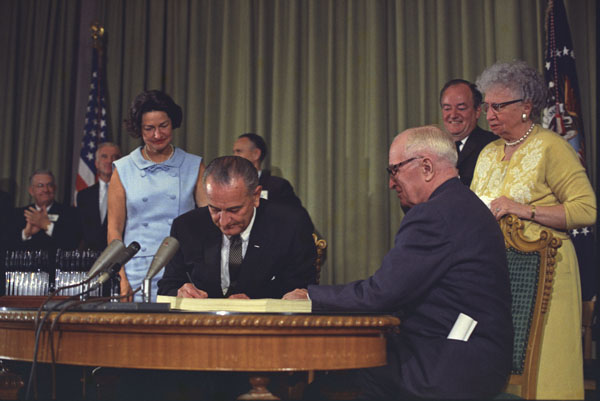
The federal agency that oversees the program, the Centers for Medicare & Medicaid Services (CMS), describes it as coverage for [eligible low-income adults, children, pregnant women, elderly adults and people with disabilities](https://www.medicaid.gov/medicaid). It states that Medicaid [is administered by states, according to federal requirements](https://www.medicaid.gov/medicaid) and that it is funded jointly by states and the federal government. The Medicaid and CHIP Payment and Access Commission (MACPAC), a nonpartisan agency that advises Congress, explains that each state sets its own [eligibility, benefits, provider payment, and administrative structures](https://www.macpac.gov/medicaid-101/) under broad federal guidelines. In practice, programs differ from state to state.
*Via Wikimedia Commons: [Photograph of President Lyndon Johnson signs the Medicare Bill at the ](https://commons.wikimedia.org/wiki/File:Photograph_of_President_Lyndon_Johnson_signs_the_Medicare_Bill_at_the_Harry_S._Truman_Library_in_Independence,_Missouri_-_DPLA_-_51fce92a46097af7d90bd09559672ffc.jpg) by President (1963-1969 : Johnson). White House Photograph Offi, public domain.*

## What it is
*Via Wikimedia Commons: [Sculpture "Life in the Community" in two separate installations of six](https://commons.wikimedia.org/wiki/File:Sculpture_%22Life_in_the_Community%22_in_two_separate_installations_of_six,_located_at_the_exterior_of_the_Health_Care_Financing_Administration_Building,_Woodlawn,_Maryland_LCCN2010720322.jpg) by Carol M. Highsmith, public domain.*
The federal agency that oversees the program, the Centers for Medicare & Medicaid Services (CMS), describes it as coverage for [eligible low-income adults, children, pregnant women, elderly adults and people with disabilities](https://www.medicaid.gov/medicaid). It states that Medicaid [is administered by states, according to federal requirements](https://www.medicaid.gov/medicaid) and that it is funded jointly by states and the federal government.[1] The Medicaid and CHIP Payment and Access Commission (MACPAC), a nonpartisan agency that advises Congress, explains that each state sets its own [eligibility, benefits, provider payment, and administrative structures](https://www.macpac.gov/medicaid-101/) under broad federal guidelines.[4] In practice, programs differ from state to state.
Medicaid is distinct from Medicare, which was created by the same 1965 law as [health insurance for the aged](https://www.archives.gov/milestone-documents/social-security-act-amendments).
Medicaid is distinct from Medicare, which was created by the same 1965 law as [health insurance for the aged](https://www.archives.gov/milestone-documents/social-security-act-amendments).[5]
## Origins
On 30 July 1965 President Lyndon B. Johnson [signed the Medicare and Medicaid Act](https://www.archives.gov/milestone-documents/social-security-act-amendments) at the Truman Presidential Library in Independence, Missouri, together with former president Harry Truman, according to the U.S. National Archives. MACPAC notes that Medicaid [was enacted as part of the Social Security Amendments of 1965 (P.L. 89-97)](https://www.macpac.gov/medicaid-101/). Its statute is codified in Subchapter XIX of Chapter 7 of Title 42 of the U.S. Code, whose opening section states that the money is appropriated to let each state furnish [medical assistance on behalf of families with dependent children and of aged, blind, or disabled individuals](https://www.law.cornell.edu/uscode/text/42/1396-1).
On 30 July 1965 President Lyndon B. Johnson [signed the Medicare and Medicaid Act](https://www.archives.gov/milestone-documents/social-security-act-amendments) at the Truman Presidential Library in Independence, Missouri, together with former president Harry Truman, according to the U.S. National Archives.[5] MACPAC notes that Medicaid [was enacted as part of the Social Security Amendments of 1965 (P.L. 89-97)](https://www.macpac.gov/medicaid-101/).[4] Its statute is codified in Subchapter XIX of Chapter 7 of Title 42 of the U.S. Code, whose opening section states that the money is appropriated to let each state furnish [medical assistance on behalf of families with dependent children and of aged, blind, or disabled individuals](https://www.law.cornell.edu/uscode/text/42/1396-1).[6]
That wording reflects the program's starting point. CMS's own history records that [at first, Medicaid gave medical insurance to people getting cash assistance](https://www.cms.gov/about-cms/who-we-are/history): eligibility was tied to the welfare programs of the day. Over the following decades Congress widened it step by step. In 1997 Congress created the Children's Health Insurance Program (CHIP), which, in CMS's words, provides [health insurance and preventive care](https://www.cms.gov/about-cms/who-we-are/history) to children; CHIP is a separate program, though enrollment figures usually count the two together.
That wording reflects the program's starting point. CMS's own history records that [at first, Medicaid gave medical insurance to people getting cash assistance](https://www.cms.gov/about-cms/who-we-are/history): eligibility was tied to the welfare programs of the day.[3] Over the following decades Congress widened it step by step. In 1997 Congress created the Children's Health Insurance Program (CHIP), which, in CMS's words, provides [health insurance and preventive care](https://www.cms.gov/about-cms/who-we-are/history) to children; CHIP is a separate program, though enrollment figures usually count the two together.
### How the program grew
CMS's chronology of the two programs, *Medicare & Medicaid Milestones, 1937–2015*, traces how that widening happened. In 1967 a comprehensive screening and treatment benefit, EPSDT, was [established for all children getting Medicaid](https://www.cms.gov/about-cms/agency-information/history/downloads/medicare-and-medicaid-milestones-1937-2015.pdf).[18] In 1972 eligibility for older, blind and disabled residents of a state was [linked to eligibility for the newly enacted Federal Supplemental Security Income (SSI) program](https://www.cms.gov/about-cms/agency-information/history/downloads/medicare-and-medicaid-milestones-1937-2015.pdf).[18] In 1977 the Health Care Financing Administration (HCFA) was set up to run Medicare and Medicaid; in 2001 it was [renamed the Centers for Medicare & Medicaid Services](https://www.cms.gov/about-cms/agency-information/history/downloads/medicare-and-medicaid-milestones-1937-2015.pdf).[18]
The 1980s brought new flexibility and new groups. In 1981 Congress created "freedom of choice" waivers and [home and community-based care waivers](https://www.cms.gov/about-cms/agency-information/history/downloads/medicare-and-medicaid-milestones-1937-2015.pdf), which let states pay for long-term care outside institutions, and required extra payments to "disproportionate share hospitals" that treat many low-income patients. Coverage of pregnant women and infants up to 100% of the federal poverty level became a state option in 1986 and was [mandated in 1988](https://www.cms.gov/about-cms/agency-information/history/downloads/medicare-and-medicaid-milestones-1937-2015.pdf); in 1989 coverage of pregnant women and children under six up to 133% of the poverty level was mandated, and in 1990 Congress phased in coverage of children aged 6 through 18 below the poverty level and created the [Medicaid prescription drug rebate program](https://www.cms.gov/about-cms/agency-information/history/downloads/medicare-and-medicaid-milestones-1937-2015.pdf).[18]
The 1996 welfare law replaced Aid to Families with Dependent Children with the Temporary Assistance for Needy Families block grant. In the milestones' words, [the welfare link to Medicaid was severed](https://www.cms.gov/about-cms/agency-information/history/downloads/medicare-and-medicaid-milestones-1937-2015.pdf): enrolment no longer followed automatically from receiving cash assistance, and a new mandatory low-income group not tied to welfare was added.[18] The Balanced Budget Act of 1997, which created CHIP, also set out [new Medicaid managed care options and requirements for states](https://www.cms.gov/about-cms/agency-information/history/downloads/medicare-and-medicaid-milestones-1937-2015.pdf).[18]
## How it is paid for
Medicaid is financed by matching. For each dollar a state spends on covered services, the federal government pays a share known as the federal medical assistance percentage (FMAP). The statute sets the formula: the FMAP is [100 per centum less the State percentage](https://www.law.cornell.edu/uscode/text/42/1396d), where the state percentage depends on the square of the state's per capita income compared with the national figure. Poorer states therefore receive a larger federal share. The law sets limits: the FMAP shall [in no case be less than 50 per centum or more than 83 per centum](https://www.law.cornell.edu/uscode/text/42/1396d), apart from listed exceptions. KFF, a health-policy research organization, notes that federal matching has no fixed cap for qualified services, so federal spending rises and falls with state spending.
Medicaid is financed by matching. For each dollar a state spends on covered services, the federal government pays a share known as the federal medical assistance percentage (FMAP). The statute sets the formula: the FMAP is [100 per centum less the State percentage](https://www.law.cornell.edu/uscode/text/42/1396d), where the state percentage depends on the square of the state's per capita income compared with the national figure.[7] Poorer states therefore receive a larger federal share. The law sets limits: the FMAP shall [in no case be less than 50 per centum or more than 83 per centum](https://www.law.cornell.edu/uscode/text/42/1396d), apart from listed exceptions.[7] KFF, a health-policy research organization, notes that federal matching has no fixed cap for qualified services, so federal spending rises and falls with state spending.
The sums are large. KFF reports that in fiscal year 2023 Medicaid spending totalled [$880 billion](https://www.kff.org/medicaid/10-things-to-know-about-medicaid/), of which 69% was federal money, and, citing CMS actuaries, that Medicaid accounted for 19% of all health care spending in the United States in 2023.
The sums are large. KFF reports that in fiscal year 2023 Medicaid spending totalled [$880 billion](https://www.kff.org/medicaid/10-things-to-know-about-medicaid/), of which 69% was federal money, and, citing CMS actuaries, that Medicaid accounted for 19% of all health care spending in the United States in 2023.[9]
## Who it covers and what it pays for
Federal law divides both eligibility and benefits into "mandatory" and "optional" categories. CMS explains that [States are required to provide all mandatory benefits under federal law](https://www.medicaid.gov/medicaid/benefits/mandatory-optional-medicaid-benefits) and may add optional ones. The mandatory list includes inpatient and outpatient hospital services, physician services, laboratory and X-ray services, nursing facility services, home health services, family planning, transportation to medical care, and Early and Periodic Screening, Diagnostic, and Treatment (EPSDT) services, a broad benefit for children. Optional benefits include prescription drugs, dental services, physical therapy, eyeglasses and personal care, among others.
Federal law divides both eligibility and benefits into "mandatory" and "optional" categories. CMS explains that [States are required to provide all mandatory benefits under federal law](https://www.medicaid.gov/medicaid/benefits/mandatory-optional-medicaid-benefits) and may add optional ones.[2] The mandatory list includes inpatient and outpatient hospital services, physician services, laboratory and X-ray services, nursing facility services, home health services, family planning, transportation to medical care, and Early and Periodic Screening, Diagnostic, and Treatment (EPSDT) services, a broad benefit for children. Optional benefits include prescription drugs, dental services, physical therapy, eyeglasses and personal care, among others.[2]
Because states make different choices, what Medicaid covers and who qualifies varies considerably from one state to the next.
Medicaid plays an outsized part in some areas of American health care. KFF's February 2025 summary reports that it [covers 41% of all births in the United States](https://www.kff.org/medicaid/10-things-to-know-about-medicaid/), pays for 61% of long-term care spending, and covers five in eight nursing home residents.
Medicaid plays an outsized part in some areas of American health care. KFF's February 2025 summary reports that it [covers 41% of all births in the United States](https://www.kff.org/medicaid/10-things-to-know-about-medicaid/), pays for 61% of long-term care spending, and covers five in eight nursing home residents.[9]
Spending is concentrated among older and disabled enrollees. KFF's analysis of 2021 federal data finds that seniors and people with disabilities [account for 23% of enrollment but 51% of spending](https://www.kff.org/medicaid/10-things-to-know-about-medicaid/), while children account for 34% of enrollment but 14% of spending.[9] National spending per full-benefit enrollee was $7,593 in 2021, varying widely by state. The share of people covered also varies: KFF's February 2025 summary gives 21% nationally, ranging [from 11% in Utah to 34% in New Mexico](https://www.kff.org/medicaid/10-things-to-know-about-medicaid/), and reports that in 2023 Medicaid covered nearly 4 in 10 children in the United States.[9]
## How care is delivered
Most Medicaid enrollees do not have the state pay each doctor or hospital directly. CMS describes managed care as [a health care delivery system organized to manage cost, utilization, and quality](https://www.medicaid.gov/medicaid/managed-care): the state contracts with managed care organizations (MCOs), which accept a set payment per member per month, known as capitation, and arrange the enrollees' care.[19] KFF reports that [75% of all Medicaid enrollees receive care through comprehensive, risk-based managed care organizations](https://www.kff.org/medicaid/10-things-to-know-about-medicaid/), that payments to MCOs accounted for 52% of Medicaid spending in fiscal year 2023, and that as of July 2024 42 states (including DC) contracted with comprehensive MCOs.[9]
These plans are a mix of for-profit, non-profit and government plans, but KFF notes that five for-profit parent firms (Centene, Elevance, UnitedHealth Group, Molina and CVS) [account for 50% of all Medicaid MCO enrollment](https://www.kff.org/medicaid/10-things-to-know-about-medicaid/). States have turned to managed care hoping to improve access and care coordination and to make costs more predictable; KFF's assessment is that while it has made state budgets more predictable, [the evidence about the impact of managed care on access to care, costs, and outcomes is both limited and mixed](https://www.kff.org/medicaid/10-things-to-know-about-medicaid/).[9]
## Section 1115 waivers
Section 1115 of the Social Security Act lets the Secretary of Health and Human Services approve [experimental, pilot, or demonstration projects](https://www.medicaid.gov/medicaid/section-1115-demonstrations/about-section-1115-demonstrations) that depart from the usual federal rules, if they are likely to advance Medicaid's objectives.[20] CMS says these demonstrations are meant to [demonstrate and evaluate state-specific policy approaches](https://www.medicaid.gov/medicaid/section-1115-demonstrations/about-section-1115-demonstrations), must be "budget neutral" to the federal government (federal spending with the demonstration may not exceed what it would have been without it), and are generally approved for an initial five-year period, with extensions commonly granted.[20]
KFF reports that [nearly all states have at least one active Section 1115 waiver](https://www.kff.org/medicaid/10-things-to-know-about-medicaid/).[9] States have used them to expand coverage or benefits, test premiums or other eligibility conditions, change how care is delivered and restructure financing, and KFF observes that the waivers approved reflect the [changing priorities from one presidential administration to another](https://www.kff.org/medicaid/10-things-to-know-about-medicaid/).
## Long-term care and people with Medicare
Medicare does not cover most long-term care, and Medicaid has become the main payer for it. KFF calls Medicaid [the primary payer for long-term care in the United States](https://www.kff.org/medicaid/10-things-to-know-about-medicaid/), at 61% of total spending.[9] Since 1981, states have been able to use home and community-based services waivers to pay for care at home rather than in nursing homes, and since 1988 federal rules have protected the spouse who stays at home when a husband or wife enters a nursing home, to prevent what CMS's chronology calls ["spousal impoverishment"](https://www.cms.gov/about-cms/agency-information/history/downloads/medicare-and-medicaid-milestones-1937-2015.pdf).[18]
Medicaid also fills gaps for low-income people who have Medicare, often called "dual eligibles". The 1988 law created the Qualified Medicare Beneficiary program to [pay Medicare premiums and cost-sharing charges](https://www.cms.gov/about-cms/agency-information/history/downloads/medicare-and-medicaid-milestones-1937-2015.pdf) for beneficiaries below set income and resource limits, and in 1990 Medicaid began paying Medicare premiums for a further group with incomes between 100% and 120% of the poverty level.[18] KFF reports that Medicaid pays Medicare premiums and often covers services Medicare does not, such as most long-term care, for [nearly 1 in 5 Medicare beneficiaries (13 million)](https://www.kff.org/medicaid/10-things-to-know-about-medicaid/).[9]
## The Affordable Care Act expansion
The Affordable Care Act of 2010 extended Medicaid to [nearly all adults with incomes up to 138% of the Federal Poverty Level](https://www.kff.org/medicaid/issue-brief/status-of-state-medicaid-expansion-decisions/), an income limit KFF gives as $21,597 a year for a single person in 2025. The federal government pays an enhanced share for this group: the statute sets it at [90 percent for calendar quarters in 2020 and each year thereafter](https://www.law.cornell.edu/uscode/text/42/1396d).
The Affordable Care Act of 2010 extended Medicaid to [nearly all adults with incomes up to 138% of the Federal Poverty Level](https://www.kff.org/medicaid/issue-brief/status-of-state-medicaid-expansion-decisions/), an income limit KFF gives as $21,597 a year for a single person in 2025.[10] The federal government pays an enhanced share for this group: the statute sets it at [90 percent for calendar quarters in 2020 and each year thereafter](https://www.law.cornell.edu/uscode/text/42/1396d).[7]
The law as written required states to adopt the expansion or risk their existing Medicaid funds. On 28 June 2012, in *National Federation of Independent Business v. Sebelius*, the Supreme Court held that this went too far. Chief Justice John Roberts's opinion found the expansion unconstitutional insofar as it threatened states [with the loss of their existing Medicaid funding](https://www.law.cornell.edu/supremecourt/text/11-393), and the Court cured the problem by barring the Secretary of Health and Human Services from withdrawing existing funds from states that declined. The expansion became, in effect, optional.
The law as written required states to adopt the expansion or risk their existing Medicaid funds.[8] On 28 June 2012, in *National Federation of Independent Business v. Sebelius*, the Supreme Court held that this went too far. Chief Justice John Roberts's opinion found the expansion unconstitutional insofar as it threatened states [with the loss of their existing Medicaid funding](https://www.law.cornell.edu/supremecourt/text/11-393), and the Court cured the problem by barring the Secretary of Health and Human Services from withdrawing existing funds from states that declined.[8] The expansion became, in effect, optional.
As of KFF's tracker published on 6 November 2026, [41 states (including DC) have adopted the Medicaid expansion and 10 states have not](https://www.kff.org/medicaid/issue-brief/status-of-state-medicaid-expansion-decisions/).
As of KFF's tracker published on 6 November 2026, [41 states (including DC) have adopted the Medicaid expansion and 10 states have not](https://www.kff.org/medicaid/issue-brief/status-of-state-medicaid-expansion-decisions/).[10]
## The pandemic and the "unwinding"
At the start of the COVID-19 pandemic, Congress passed the Families First Coronavirus Response Act, which required Medicaid programs to keep people continuously enrolled [through the end of the COVID-19 public health emergency](https://www.kff.org/medicaid/10-things-to-know-about-the-unwinding-of-the-medicaid-continuous-enrollment-provision/) in exchange for extra federal funding. With removals from the rolls largely paused, KFF estimated that enrollment in Medicaid and CHIP would grow by 23.3 million, to nearly 95 million, between February 2020 and the end of March 2023.
At the start of the COVID-19 pandemic, Congress passed the Families First Coronavirus Response Act, which required Medicaid programs to keep people continuously enrolled [through the end of the COVID-19 public health emergency](https://www.kff.org/medicaid/10-things-to-know-about-the-unwinding-of-the-medicaid-continuous-enrollment-provision/) in exchange for extra federal funding.[11] With removals from the rolls largely paused, KFF estimated that enrollment in Medicaid and CHIP would grow by 23.3 million, to nearly 95 million, between February 2020 and the end of March 2023.[11]
The Consolidated Appropriations Act, 2023, signed on 29 December 2022, separated the rule from the emergency declaration, [ending continuous enrollment on March 31, 2023](https://www.kff.org/medicaid/10-things-to-know-about-the-unwinding-of-the-medicaid-continuous-enrollment-provision/). States then had to recheck everyone, a process that became known as the "unwinding". KFF's tracker reports that by 12 September 2024 [at least 25,198,000 Medicaid enrollees had been disenrolled](https://www.kff.org/medicaid/medicaid-enrollment-and-unwinding-tracker/) during the unwinding, about 31% of completed renewals.
The Consolidated Appropriations Act, 2023, signed on 29 December 2022, separated the rule from the emergency declaration, [ending continuous enrollment on March 31, 2023](https://www.kff.org/medicaid/10-things-to-know-about-the-unwinding-of-the-medicaid-continuous-enrollment-provision/).[11] States then had to recheck everyone, a process that became known as the "unwinding". KFF's tracker reports that by 12 September 2024 [at least 25,198,000 Medicaid enrollees had been disenrolled](https://www.kff.org/medicaid/medicaid-enrollment-and-unwinding-tracker/) during the unwinding, about 31% of completed renewals.[12]
## Work requirements
The idea of making Medicaid coverage for some adults conditional on work has a longer history in individual states, but it became national law in 2025. On 4 July 2025 the president signed a budget reconciliation package, Public Law 119-21, which KFF notes was [once called the "One Big, Beautiful Bill"](https://www.kff.org/medicaid/a-closer-look-at-the-work-requirement-provisions-in-the-2025-federal-budget-reconciliation-law/) and which CMS calls the Working Families Tax Cut legislation. It requires adults in the expansion group to show [80 hours of work activities per month](https://www.kff.org/medicaid/a-closer-look-at-the-work-requirement-provisions-in-the-2025-federal-budget-reconciliation-law/) or qualify for an exemption, starting 1 January 2027 at the latest, though states may begin earlier. The Secretary may give a state that shows a good-faith effort until no later than 31 December 2028.
The idea of making Medicaid coverage for some adults conditional on work has a longer history in individual states, but it became national law in 2025. On 4 July 2025 the president signed a budget reconciliation package, Public Law 119-21, which KFF notes was [once called the "One Big, Beautiful Bill"](https://www.kff.org/medicaid/a-closer-look-at-the-work-requirement-provisions-in-the-2025-federal-budget-reconciliation-law/) and which CMS calls the Working Families Tax Cut legislation. It requires adults in the expansion group to show [80 hours of work activities per month](https://www.kff.org/medicaid/a-closer-look-at-the-work-requirement-provisions-in-the-2025-federal-budget-reconciliation-law/) or qualify for an exemption, starting 1 January 2027 at the latest, though states may begin earlier.[13] The Secretary may give a state that shows a good-faith effort until no later than 31 December 2028.[13]
CMS issued an interim final rule on 1 June 2026. According to its fact sheet, the requirement applies to [non-pregnant adults between the ages of 19 and 64](https://www.cms.gov/newsroom/fact-sheets/medicaid-community-engagement-requirement-certain-individuals-interim-final-rule-comment-period-cms) in the adult group who are not on Medicare. They can meet it by working, doing community service or joining a work program for at least 80 hours in a month, or by earning at least the federal minimum wage times 80. States must check compliance at application and at each renewal, and a person a state cannot verify must be given 30 days to show compliance or an exemption. Exemptions in the law include parents and caretakers of children aged 13 and under, people who are medically frail, and people who are pregnant or postpartum, among others.
CMS issued an interim final rule on 1 June 2026.[14] According to its fact sheet, the requirement applies to [non-pregnant adults between the ages of 19 and 64](https://www.cms.gov/newsroom/fact-sheets/medicaid-community-engagement-requirement-certain-individuals-interim-final-rule-comment-period-cms) in the adult group who are not on Medicare.[14] They can meet it by working, doing community service or joining a work program for at least 80 hours in a month, or by earning at least the federal minimum wage times 80.[14] States must check compliance at application and at each renewal, and a person a state cannot verify must be given 30 days to show compliance or an exemption.[14] Exemptions in the law include parents and caretakers of children aged 13 and under, people who are medically frail, and people who are pregnant or postpartum, among others.[14]
The policy is contested. Announcing the rule, CMS Administrator Mehmet Oz said that it [helps Americans build skills and independence through work, education, job training, or community service](https://www.cms.gov/newsroom/press-releases/cms-launches-nationwide-framework-implement-medicaid-work-requirements). Analysts have pointed to cost estimates and to earlier state experience. KFF reports that the Congressional Budget Office (CBO) expects the requirement to reduce federal Medicaid spending by [$326 billion over ten years](https://www.kff.org/medicaid/a-closer-look-at-the-work-requirement-provisions-in-the-2025-federal-budget-reconciliation-law/), the largest single source of the law's Medicaid savings, and that CBO's analysis of the House-passed version projected 4.8 million more uninsured people in 2034. KFF also notes that state work requirements proved hard to run in Arkansas and Georgia and [led to 18,000 people losing coverage in Arkansas](https://www.kff.org/medicaid/a-closer-look-at-the-work-requirement-provisions-in-the-2025-federal-budget-reconciliation-law/), where, citing CBO, it says many participants were unaware of the rule or found compliance too onerous to demonstrate.
The policy is contested. Announcing the rule, CMS Administrator Mehmet Oz said that it [helps Americans build skills and independence through work, education, job training, or community service](https://www.cms.gov/newsroom/press-releases/cms-launches-nationwide-framework-implement-medicaid-work-requirements).[15] Analysts have pointed to cost estimates and to earlier state experience. KFF reports that the Congressional Budget Office (CBO) expects the requirement to reduce federal Medicaid spending by [$326 billion over ten years](https://www.kff.org/medicaid/a-closer-look-at-the-work-requirement-provisions-in-the-2025-federal-budget-reconciliation-law/), the largest single source of the law's Medicaid savings, and that CBO's analysis of the House-passed version projected 4.8 million more uninsured people in 2034.[13] KFF also notes that state work requirements proved hard to run in Arkansas and Georgia and [led to 18,000 people losing coverage in Arkansas](https://www.kff.org/medicaid/a-closer-look-at-the-work-requirement-provisions-in-the-2025-federal-budget-reconciliation-law/), where, citing CBO, it says many participants were unaware of the rule or found compliance too onerous to demonstrate.[13]
In June 2026, 26 states sued over the CMS rule, arguing among other things that it narrowed the "medically frail" exemption beyond what the law allows, [according to Healthcare Dive](https://www.healthcaredive.com/news/states-sue-trump-administration-medicaid-work-requirements-rule/824060/). In late July 2026 District Judge Richard Stearns declined to pause the requirements while the case proceeds, writing that the timeline [was set by Congress](https://www.healthcaredive.com/news/judge-rejects-states-bid-pause-medicaid-work-requirements/826714/) rather than by CMS, and said it would continue to hear the case on its merits. Under the law, the requirements take effect by 1 January 2027.
In June 2026, 26 states sued over the CMS rule, arguing among other things that it narrowed the "medically frail" exemption beyond what the law allows, [according to Healthcare Dive](https://www.healthcaredive.com/news/states-sue-trump-administration-medicaid-work-requirements-rule/824060/).[16] In late July 2026 District Judge Richard Stearns declined to pause the requirements while the case proceeds, writing that the timeline [was set by Congress](https://www.healthcaredive.com/news/judge-rejects-states-bid-pause-medicaid-work-requirements/826714/) rather than by CMS, and said it would continue to hear the case on its merits.[17] Under the law, the requirements take effect by 1 January 2027.
## Research on its effects
Whether Medicaid improves health has been studied closely, and the answers depend on what is measured and over what period. The best-known test is the Oregon Health Insurance Experiment. In 2008 Oregon expanded Medicaid to low-income adults by lottery from a waiting list, which allowed researchers to compare winners and non-winners as in a [randomized controlled trial](/t/1740/randomized-controlled-trial).[21] Reporting in the *New England Journal of Medicine* in May 2013, Katherine Baicker and colleagues found that about two years after the lottery, coverage [generated no significant improvements in measured physical health outcomes](https://pubmed.ncbi.nlm.nih.gov/23635051/) such as blood pressure, cholesterol and glycated hemoglobin, but increased the use of health care, raised rates of diabetes detection and treatment, lowered rates of depression and nearly eliminated catastrophic out-of-pocket medical spending.[21]
Later studies of the Affordable Care Act expansions have looked at deaths. Sarah Miller, Norman Johnson and Laura Wherry, linking federal survey data to death records (NBER Working Paper 26081, revised January 2021), compared near-elderly low-income adults in states that did and did not expand. They estimated that the expansions produced [a 0.132 percentage point decline in annual mortality](https://www.nber.org/papers/w26081), a 9.4% reduction, driven by fewer disease-related deaths.[22] KFF's review of the wider literature concludes that enrollees have substantially better access to care than uninsured people and that access measures are generally comparable to private insurance, while noting persistent gaps in access to some providers, such as psychiatrists and dentists, linked in part to [Medicaid's lower physician payment rates](https://www.kff.org/medicaid/10-things-to-know-about-medicaid/).
## Public opinion
In a KFF Health Tracking Poll conducted from 7 to 14 January 2025, [more than three-fourths (77%) of Americans held favorable views of Medicaid](https://www.kff.org/medicaid/10-things-to-know-about-medicaid/), including 63% of Republicans, 81% of independents and 87% of Democrats.[9]
## Enrollment today
KFF's monthly tracker, updated on 30 October 2026, reports preliminary figures for July 2026 of [72.9 million people enrolled in Medicaid/CHIP nationally](https://www.kff.org/medicaid/medicaid-enrollment-and-unwinding-tracker/): 65.7 million in Medicaid and 7.2 million in CHIP. These monthly counts include only people with full benefits.
KFF's monthly tracker, updated on 30 October 2026, reports preliminary figures for July 2026 of [72.9 million people enrolled in Medicaid/CHIP nationally](https://www.kff.org/medicaid/medicaid-enrollment-and-unwinding-tracker/): 65.7 million in Medicaid and 7.2 million in CHIP.[12] These monthly counts include only people with full benefits.[12]
## Sources
- Centers for Medicare & Medicaid Services, "Medicaid", Medicaid.gov (read November 2026). https://www.medicaid.gov/medicaid
- Centers for Medicare & Medicaid Services, "Mandatory & Optional Medicaid Benefits", Medicaid.gov (read November 2026). https://www.medicaid.gov/medicaid/benefits/mandatory-optional-medicaid-benefits
- Centers for Medicare & Medicaid Services, "History", CMS.gov (read November 2026). https://www.cms.gov/about-cms/who-we-are/history
- Medicaid and CHIP Payment and Access Commission, "Medicaid 101" (read November 2026). https://www.macpac.gov/medicaid-101/
- U.S. National Archives, "Social Security Act Amendments (1965)", Milestone Documents (read November 2026). https://www.archives.gov/milestone-documents/social-security-act-amendments
- 42 U.S. Code § 1396-1, "Appropriations", via Legal Information Institute, Cornell Law School. https://www.law.cornell.edu/uscode/text/42/1396-1
- 42 U.S. Code § 1396d, "Definitions" (subsections (b) and (y)), via Legal Information Institute, Cornell Law School. https://www.law.cornell.edu/uscode/text/42/1396d
- Supreme Court of the United States, *National Federation of Independent Business v. Sebelius*, 567 U.S. 519, decided 28 June 2012, via Legal Information Institute. https://www.law.cornell.edu/supremecourt/text/11-393
- A. Burns, E. Hinton, R. Rudowitz and M. Mohamed, "10 Things to Know About Medicaid", KFF, 18 February 2025. https://www.kff.org/medicaid/10-things-to-know-about-medicaid/
- KFF, "Status of State Medicaid Expansion Decisions", 6 November 2026. https://www.kff.org/medicaid/issue-brief/status-of-state-medicaid-expansion-decisions/
- J. Tolbert and M. Ammula, "10 Things to Know About the Unwinding of the Medicaid Continuous Enrollment Provision", KFF, 9 June 2023. https://www.kff.org/medicaid/10-things-to-know-about-the-unwinding-of-the-medicaid-continuous-enrollment-provision/
- KFF, "Medicaid/CHIP Monthly Enrollment Tracker", updated 30 October 2026. https://www.kff.org/medicaid/medicaid-enrollment-and-unwinding-tracker/
- KFF, "A Closer Look at the Work Requirement Provisions in the 2025 Federal Budget Reconciliation Law", 30 July 2025. https://www.kff.org/medicaid/a-closer-look-at-the-work-requirement-provisions-in-the-2025-federal-budget-reconciliation-law/
- Centers for Medicare & Medicaid Services, "Medicaid Community Engagement Requirement for Certain Individuals Interim Final Rule with Comment Period (CMS-2454-IFC)", fact sheet, 1 June 2026. https://www.cms.gov/newsroom/fact-sheets/medicaid-community-engagement-requirement-certain-individuals-interim-final-rule-comment-period-cms
- Centers for Medicare & Medicaid Services, "CMS Launches Nationwide Framework to Implement Medicaid Work Requirements", press release, 1 June 2026. https://www.cms.gov/newsroom/press-releases/cms-launches-nationwide-framework-implement-medicaid-work-requirements
- Healthcare Dive, "States sue Trump administration over Medicaid work requirements rule", 30 June 2026. https://www.healthcaredive.com/news/states-sue-trump-administration-medicaid-work-requirements-rule/824060/
- E. Olsen, "Judge rejects states' bid to pause Medicaid work requirements", Healthcare Dive, 31 July 2026. https://www.healthcaredive.com/news/judge-rejects-states-bid-pause-medicaid-work-requirements/826714/- E. Olsen, "Judge rejects states' bid to pause Medicaid work requirements", Healthcare Dive, 31 July 2026. https://www.healthcaredive.com/news/judge-rejects-states-bid-pause-medicaid-work-requirements/826714/
- Centers for Medicare & Medicaid Services, "Medicare & Medicaid Milestones, 1937–2015", July 2015. https://www.cms.gov/about-cms/agency-information/history/downloads/medicare-and-medicaid-milestones-1937-2015.pdf
- Centers for Medicare & Medicaid Services, "Managed Care", Medicaid.gov (read November 2026). https://www.medicaid.gov/medicaid/managed-care
- Centers for Medicare & Medicaid Services, "About Section 1115 Demonstrations", Medicaid.gov (read November 2026). https://www.medicaid.gov/medicaid/section-1115-demonstrations/about-section-1115-demonstrations
- K. Baicker et al., "The Oregon Experiment — Effects of Medicaid on Clinical Outcomes", *New England Journal of Medicine* 368(18):1713–1722, 2 May 2013. https://pubmed.ncbi.nlm.nih.gov/23635051/
- S. Miller, N. Johnson and L. R. Wherry, "Medicaid and Mortality: New Evidence from Linked Survey and Administrative Data", NBER Working Paper 26081, July 2019, revised January 2021. https://www.nber.org/papers/w26081
 Get Micwyn on your home screenIts own icon, full screen, and notifications.