Compare versions
Version 2 → Version 3. Removed · Added. This shows the entry's text as it is written, including its formatting marks.
Version 2 · Version 3 · Version history
Side by side · Together
A sneaker wave is a wave that surges unexpectedly far up a beach, beyond where the waves before it reached, and can knock people down, trap them against rocks or jetties, roll heavy logs into them, or carry them into the sea.
## Definition
The U.S. National Weather Service describes sneaker waves as [potentially deadly waves that surge further up the beach than expected, overtaking the unaware](https://www.weather.gov/safety/sneaker-waves). Oregon State University calls them [wave runup events that can seem like a mini-tsunami](https://www.sciencedaily.com/releases/2023/01/230131160538.htm), because the water surges much farther up the beach than anticipated. Runup, in coastal science, is [the maximum excursion of the water level at the shoreline](https://nhess.copernicus.org/articles/23/107/2023/nhess-23-107-2023.pdf): how far up the beach the water travels. Researchers cataloguing these events have defined a sneaker wave by its effect on people, as [a wave event when somebody thought to be in a safe zone was caught off guard](https://www.earthmagazine.org/article/taking-surprise-out-sneaker-waves/).
The term describes what happens at the shore, not a kind of wave in the open sea. It is different from a rogue wave, which NOAA's National Ocean Service describes as a wave [greater than twice the size of surrounding waves](https://oceanservice.noaa.gov/facts/roguewaves.html) that often comes from an unexpected direction.
## Why they are dangerous
According to the National Weather Service, sneaker waves [can run up the beach by at least 150 feet (45 meters) into the dry beach](https://www.weather.gov/safety/sneaker-waves), and [there can be 10 to 20 minutes of small waves right before a sneaker wave strikes](https://www.weather.gov/safety/sneaker-waves), which is what makes them a surprise. The agency points to several hazards that come together on the coast of the Pacific Northwest: the cold water, in which people swept in [can lose control of their limbs in a matter of seconds](https://www.weather.gov/safety/sneaker-waves); the sand, water and gravel carried into clothing, which survivors have described as [feeling as heavy as concrete](https://www.weather.gov/safety/sneaker-waves); and drift logs, which are wet, can weigh hundreds of pounds, and can be [lifted or rolled up and down the beach by a single wave](https://www.weather.gov/safety/sneaker-waves), knocking over or pinning people.
The Oregon State researchers list the same dangers: a surge can [sweep beachgoers off their feet, trap them against jetties or rocky shorelines, push logs and other heavy debris into them and pull them into the ocean](https://www.sciencedaily.com/releases/2023/01/230131160538.htm) as it runs back down the beach.
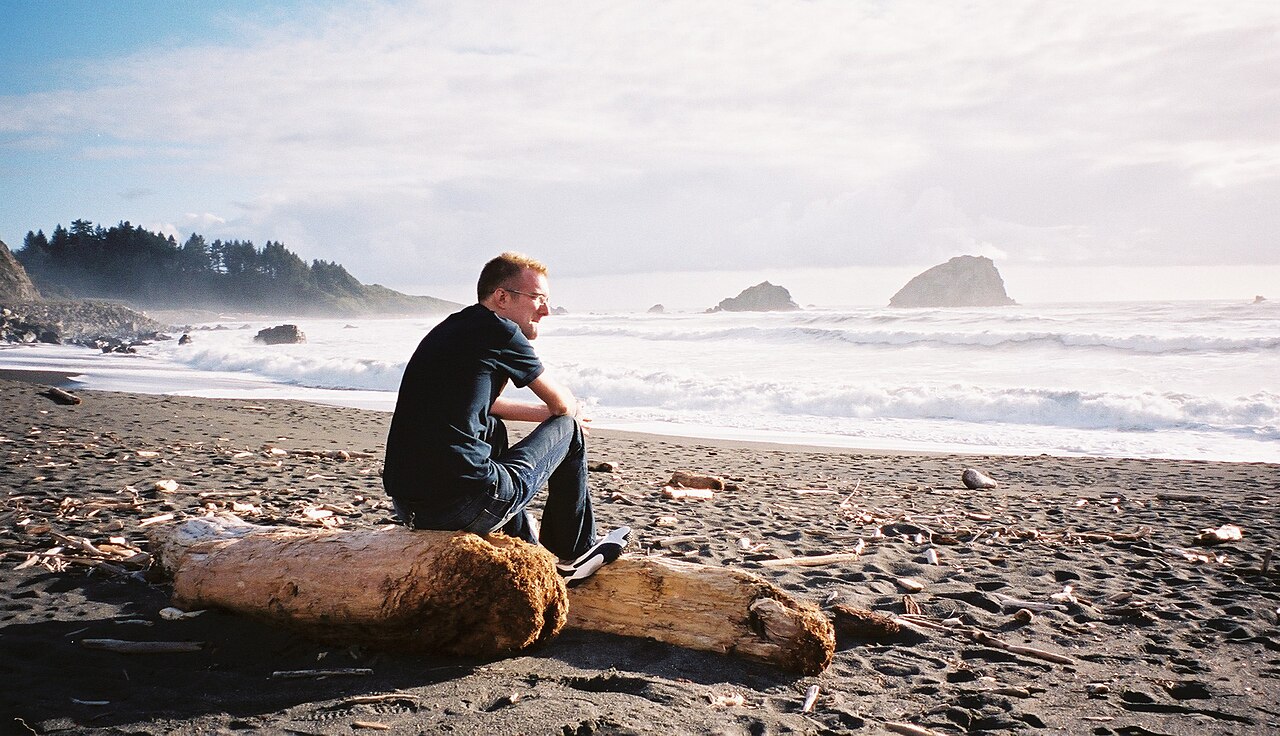Oregon.](/m/2026/11/zYlnY388gDBJnHZk.jpg)
*Via Wikimedia Commons: [Me sat on driftwood log near Coos Bay, Oregon (2377978992)](https://commons.wikimedia.org/wiki/File:Me_sat_on_driftwood_log_near_Coos_Bay,_Oregon_(2377978992).jpg) by Matt Kieffer from London, United Kingdom, [CC BY-SA 2.0](https://creativecommons.org/licenses/by-sa/2.0).*
Across Oregon, Washington and northern California, extreme runup events [contribute to about two drowning deaths each year](https://www.sciencedaily.com/releases/2023/01/230131160538.htm), according to Oregon State University (2023). A 2023 study in *Natural Hazards and Earth System Sciences* reports that large runup events are [the leading cause of deaths by drowning](https://nhess.copernicus.org/articles/23/107/2023/nhess-23-107-2023.pdf) in that region, including deaths in which the water moves logs, and gives the same figure of about two a year since 2005. A 2018 article in *Earth* magazine counted [more than two dozen confirmed fatalities in California and Oregon](https://www.earthmagazine.org/article/taking-surprise-out-sneaker-waves/) caused by sneaker waves since 2005.
## Where and when they occur
The National Weather Service notes that sneaker waves [can be present on surf beaches around the nation](https://www.weather.gov/safety/sneaker-waves), not only in the Northwest. The Pacific Northwest is especially exposed. Oregon State University's researchers say the waves are [more likely to occur in winter months](https://www.sciencedaily.com/releases/2023/01/230131160538.htm) and in places where the continental shelf (the shallow sea floor bordering a continent) is narrow, as it is there.
A catalogue of sneaker wave events in Oregon and northern California from 2005 to mid-2017, published in the journal *Natural Hazards* in 2018 by Gabriel García-Medina and colleagues, found that [sneaker waves occurred between the months of October and April](https://ideas.repec.org/a/spr/nathaz/v94y2018i2d10.1007_s11069-018-3403-z.html), the time of most storm activity in the region, and that most of the events were associated with long-period swell. Its authors describe sneaker waves as responsible for many casualties and beach rescues in the Pacific Northwest. It grouped the events by setting: those involving structures such as jetties, those on semi-enclosed beaches, and those on open-coast beaches. *Earth* magazine reported in May 2018 that researchers studying the events had [identified 27 cases in Northern California and Oregon](https://www.earthmagazine.org/article/taking-surprise-out-sneaker-waves/) in which witnesses confirmed that people had been hit by unexpectedly large waves.
The winter wave climate helps explain the season. On the Pacific Northwest coast from 2008 to 2018, the median peak wave period (roughly, the time between the most energetic wave crests) was [12.9 seconds in January and 8.3 seconds in August](https://nhess.copernicus.org/articles/23/107/2023/nhess-23-107-2023.pdf), and the median significant wave height was 2.8 metres in January against 1.4 metres in August.
## Causes
Earlier studies had linked tsunami-like runup without an earthquake or landslide to [three mechanisms: trapped waves over shallow bathymetry, long waves generated by abrupt breaking, and long waves created by atmospheric disturbances](https://nhess.copernicus.org/articles/23/107/2023/nhess-23-107-2023.pdf) (meteotsunamis). The 2023 study, led by Chuan Li with co-authors from Oregon State University, the Pacific Northwest National Laboratory and the National Weather Service office in Portland, examined a day of sneaker waves and found a fourth explanation plausible.
On 16 January 2016, at least five large runup events, [some with more than 100 m of horizontal excursion](https://nhess.copernicus.org/articles/23/107/2023/nhess-23-107-2023.pdf), were filmed by beachgoers at different places along about 1,000 km of coast within five hours, from Humboldt Bay in California to Pacific Beach in Washington. At Ocean Shores, Washington, according to the study, [a police car was completely submerged](https://nhess.copernicus.org/articles/23/107/2023/nhess-23-107-2023.pdf) as the officer tried to drive away from one, and at Humboldt Bay a woman was washed off a jetty and later recovered. The videos showed each event lasting [roughly 5 minutes from beginning to end](https://www.sciencedaily.com/releases/2023/01/230131160538.htm), which helped the researchers find the matching signals in tide-gauge records.
The study concluded that the events were [strongly associated with a rapid increase in wave energy at low frequencies](https://nhess.copernicus.org/articles/23/107/2023/nhess-23-107-2023.pdf), that is, the arrival of waves with very long periods, and that energy passing from the ordinary wind waves to "bound infragravity waves" was a plausible cause. Infragravity waves are long, low waves, with periods that can run to minutes, fed by the energy of groups of ordinary waves; in Oregon State's description, [one infragravity wave will run underneath a set of gravity waves](https://www.sciencedaily.com/releases/2023/01/230131160538.htm). The long-period swell that day was traced to a "trapped fetch", in which a storm's winds move [in the same direction and at speeds close to those of the wave groups](https://nhess.copernicus.org/articles/23/107/2023/nhess-23-107-2023.pdf).
Oregon State's account explains the physics in plain terms. Large storms near Alaska or the South Pacific can produce swell whose waves are well spaced and organized, which [also make the underlying infragravity waves longer and stronger](https://www.sciencedaily.com/releases/2023/01/230131160538.htm). Such long waves are less likely to break and carry more energy, so they run further up the beach. Local weather matters too: according to Tuba Özkan-Haller, a co-author, when a local storm jumbles the wave field sneaker waves do not occur, and [when the wind is calm and the local weather is mild, sneaker waves are more likely](https://www.sciencedaily.com/releases/2023/01/230131160538.htm).
## Warnings and forecasting
The National Weather Service issues statements about sneaker waves and other beach hazards for the coasts it covers, and its safety guidance asks beachgoers to [arrive knowing the local weather, surf, and tide forecasts](https://www.weather.gov/safety/sneaker-waves), to watch the ocean for at least 20 minutes before relaxing near it, and never to turn their backs on it. Oregon State University reports that the agency's warnings rest on the [known elements of predictability](https://www.sciencedaily.com/releases/2023/01/230131160538.htm): that sneaker waves are more likely in winter and where the continental shelf is narrow.
Both studies point toward more precise warnings. The 2018 catalogue found that neither beach slope nor significant wave height correlated with incidents, but its analysis of total water levels showed that runup [would have reached beachgoers in most of the cases](https://ideas.repec.org/a/spr/nathaz/v94y2018i2d10.1007_s11069-018-3403-z.html) studied, which the authors took to mean that a warning forecast system is feasible. The 2023 study developed a predictor linking offshore low-frequency wave energy to large runup, and found its predictive ability [reasonable for four out of the five tide gages](https://nhess.copernicus.org/articles/23/107/2023/nhess-23-107-2023.pdf) it tested, while noting that tide gauges were its only nearshore measurements. As of 2023, the researchers' stated goal was a warning system that is [specific, accurate and localized](https://www.sciencedaily.com/releases/2023/01/230131160538.htm), and they said more research was needed to understand why some places in the region are more prone to sneaker waves than others.
## Sources
- National Weather Service, "Sneaker Waves", weather.gov safety page (read November 2026). https://www.weather.gov/safety/sneaker-waves
- Li, C., Özkan-Haller, H. T., García Medina, G., Holman, R. A., Ruggiero, P., Jensen, T. M., Elson, D. B., and Schneider, W. R., "Observations of extreme wave runup events on the US Pacific Northwest coast", *Natural Hazards and Earth System Sciences*, 23, 107–126, 31 January 2023. https://nhess.copernicus.org/articles/23/107/2023/nhess-23-107-2023.pdf
- Oregon State University, "Far-off storms fuel sneaker waves along Pacific Northwest coast, new research suggests", news release via ScienceDaily, 31 January 2023. https://www.sciencedaily.com/releases/2023/01/230131160538.htm
- García-Medina, G., Özkan-Haller, H. T., Ruggiero, P., Holman, R. A., and Nicolini, T., "Analysis and catalogue of sneaker waves in the US Pacific Northwest between 2005 and 2017", *Natural Hazards*, 94(2), 583–603, November 2018 (abstract via IDEAS/RePEc). https://ideas.repec.org/a/spr/nathaz/v94y2018i2d10.1007_s11069-018-3403-z.html
- Mary Caperton Morton, "Taking the surprise out of sneaker waves", *Earth* magazine, American Geosciences Institute, 1 May 2018. https://www.earthmagazine.org/article/taking-surprise-out-sneaker-waves/
- NOAA National Ocean Service, "What is a rogue wave?" (last updated 23 September 2026). https://oceanservice.noaa.gov/facts/roguewaves.html
