Version 1
Nov 10, 2026. Compare with the current version · Version history
An initial public offering (IPO) is the first sale of a company's shares to the general public, usually made to raise new capital, after which the shares normally trade on a stock exchange and the company becomes "public".
The U.S. Securities and Exchange Commission (SEC) describes an IPO as the point at which a company sells shares to the public, usually to raise additional capital. Before the offering a company's shares are held privately, typically by its founders, employees and early investors; afterwards anyone can buy them in the market, and the company takes on the disclosure duties of a publicly traded firm. The phrase "going public" is used for the same step.
Why companies go public
In a 2002 survey of research on the subject in the Journal of Finance, the economists Jay Ritter and Ivo Welch wrote that in most cases the main reason is the desire to raise equity capital for the firm and to create a public market in which founders and other shareholders can later turn some of their holdings into cash. Equity capital is money raised by selling ownership stakes rather than by borrowing. Non-financial motives, such as publicity, play only a minor part for most firms, according to the same review.
Ritter and Welch also summarised several academic theories of the decision. One holds that investors in a young private company, such as "angel" investors and venture capitalists (firms that invest in young companies in exchange for shares), hold undiversified portfolios and so will not pay as much as diversified public investors; set against that are the fixed costs of going public and the difficulty of revealing confidential information, so a firm stays private early in its life and goes public if it grows sufficiently large. Another observes that many IPOs are exits less for the founders than for the venture capitalists who backed them. Market-timing theories hold that firms put off selling shares when they believe the market undervalues them and go public when prices are favourable, which helps explain why the number of IPOs rises and falls so sharply from year to year.
History
Selling shares in an enterprise to outside investors is centuries older than the term "IPO". The Dutch East India Company (Vereenigde Oostindische Compagnie, or VOC), founded in 1602, is a much-studied early example. According to a 2012 study by the economic historians Oscar Gelderblom, Abe de Jong and Joost Jonker, the company had transferable shares and limited liability for shareholders from the outset, raised a capital of 6.4 million guilders from subscribers who paid in four instalments, and was at first meant to be liquidated after ten years, with capital returned to shareholders; it obtained a permanent capital only in 1612. Transferable shares are shares that can be sold to someone else; limited liability means a shareholder can lose no more than the amount invested.
In the United States, the modern rules for public offerings date from the New Deal. The Securities Act of 1933 has two basic aims, according to the SEC: that investors receive financial and other significant information about securities offered for public sale, and that deceit, misrepresentation and other fraud in the sale of securities are prohibited. The Securities Exchange Act of 1934 created the Securities and Exchange Commission and gave it power to require periodic reporting of information by companies with publicly traded securities.
How an IPO works in the United States
Registration and the prospectus
Under the Securities Act, a company that wants to make a registered public offering must file a registration statement with the SEC, and it may not sell the securities until the SEC staff declares that statement effective. The registration forms call for a description of the company's properties and business, a description of the security being offered, information about management, and financial statements certified by independent accountants. The part of the registration statement given to investors is the prospectus. The SEC requires the information to be accurate but does not guarantee it: the system rests on disclosure, which leaves investors, not the government, to judge whether to buy. Once the registration statement is effective, the company becomes subject to the reporting requirements of the 1934 Act, which require annual and other periodic reports from companies above certain size thresholds (SEC).
Since the Jumpstart Our Business Startups (JOBS) Act, enacted on April 5, 2012, smaller issuers can qualify as "emerging growth companies". As of November 2026, the SEC defines these as companies with total annual gross revenues of less than $1.235 billion in their last fiscal year. They may give scaled-down disclosure, including audited financial statements for two fiscal years rather than three, may "test the waters" by talking with large institutional investors about a possible offering, and can keep the status for up to five fiscal years after the IPO.
Underwriters and bookbuilding
Most IPOs are sold through underwriters, the investment banks that market the offering, set its price with the company and place the shares with investors. The usual method in the United States is "bookbuilding". As Ritter and Welch describe it, a preliminary offer price range is set, and the underwriters and the company then go on a "road show" to present the company to prospective investors, who give "indications of interest": how many shares they would buy and at what price. If demand is strong, the underwriter sets a higher offer price. The bookbuilding period is typically about four weeks long. The underwriters have discretion over which investors receive shares, and how many.
The underwriters are paid a fee called the "gross spread", stated as a percentage of the money raised. For mid-sized American IPOs the spread is strikingly uniform. Of the 1,141 operating-company IPOs in 2001–2025 that raised between $30 million and $160 million (in 2025 dollars), 93.3 percent had a gross spread of exactly 7 percent, according to statistics compiled by Ritter at the University of Florida (updated November 2026); among larger deals, 54.4 percent paid less than 7 percent.
Lock-ups
Shareholders who held shares before the IPO usually agree not to sell them for a set time afterwards without the lead underwriter's permission. Ritter and Welch noted that although there is no legal minimum, most lockup periods are 180 calendar days in length and almost none are shorter than 90 days.
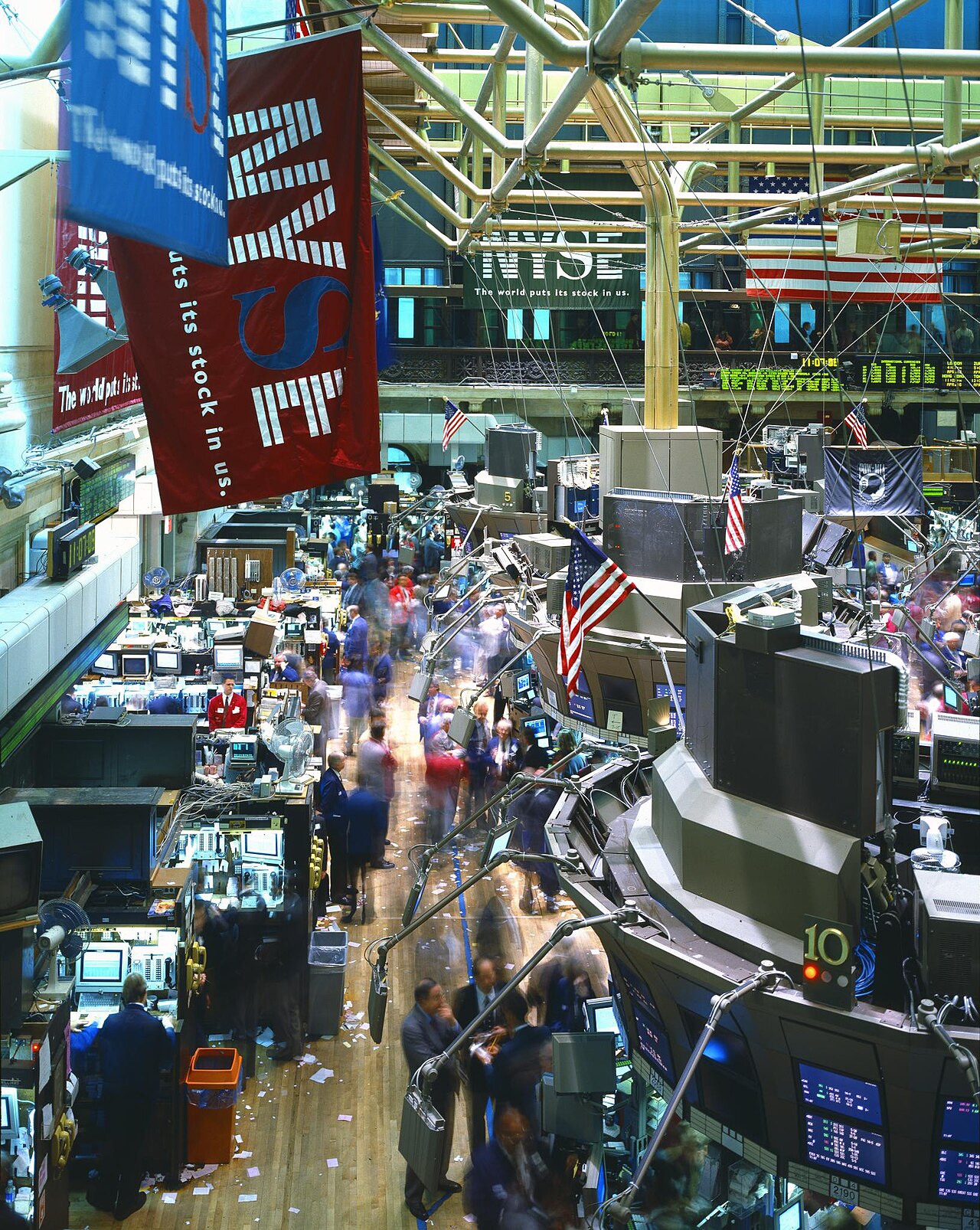
Via Wikimedia Commons: No Known Restrictions Trading Floor, New York Stock Exchange (Highsmit by Carol M. Highsmith, public domain.
Underpricing
The best-known pattern in IPO research is that shares tend to close their first day of trading well above the price at which they were sold. Researchers call the gap "underpricing" and its value "money left on the table": in Ritter's definition, the closing market price on the first day of trading minus the offer price, multiplied by the shares offered.
For 9,345 American IPOs from 1980 to 2025 (excluding very low-priced shares, special purpose acquisition companies, closed-end funds, real estate investment trusts and some other categories), Ritter's tables give a mean first-day return of 19.0 percent and a median of 7.0 percent. Across those years the companies raised about $1.2 trillion and left about $250.1 billion on the table. The averages swing widely: the mean first-day return was 71.2 percent in 1999 and 56.3 percent in 2000, at the height of the internet boom, against 11.9 percent in 2023 and 29.3 percent in 2025 (Ritter, Table 1).
Why issuers accept this has been debated for decades, and no single explanation is accepted. Ritter and Welch's review sets out the main ideas:
- The winner's curse. If some investors are better informed than others, the uninformed ones receive full allocations mainly of the offerings that informed investors avoid. Underpricing is then needed so that, on average, uninformed investors break even. This model is associated with Rock (1986).
- Information cascades. Investors watch whether others are buying; pricing slightly too high risks a complete failure in which everyone abstains because others abstain.
- Bookbuilding as information gathering. Investors who reveal that they would pay a high price must be rewarded for doing so with allocations and a lower price. In support, Ritter and Welch report that in 1980–2001 IPOs priced above their original range had average underpricing of 53 percent instead of three percent for those whose price was cut and 12 percent for those priced within the range.
- Conflicts of interest. Underwriters with discretion over allocations may leave more money on the table than necessary and give the shares to favoured clients. Ritter and Welch cite evidence of allocations traded for favours, and of a practice known as "spinning", in which shares in hot offerings were given to executives of companies that might hire the bank.
Long-run performance
Studies have also examined how IPO shares do in the years after the first day. In Ritter and Welch's sample of IPOs from 1980 to 2001, the average IPO over three years underperformed the CRSP value-weighted market index by 23.4 percent, but trailed established companies of similar size and book-to-market ratio by only 5.1 percent. The authors concluded that much of the weak performance reflects the kind of firm that goes public, mostly small growth companies, a category that had done poorly in general, and that long-run returns are sufficiently noisy to make any statistical inference difficult.
Who goes public
The typical company going public in the United States is about a decade old. Ritter's figures give a median age (years since founding) of 9 for 1980–2025 and 12 for IPOs in 2025, and show that 41 percent of IPOs in 1980–2025 were backed by venture capital. The number of offerings is highly cyclical: 476 in 1999, 311 in 2021 (raising $119.4 billion) and 38 in 2022, by Ritter's count of operating companies (Table 1).
Alternatives to a traditional IPO
Auctions
Some companies have sold their shares by auction instead of letting underwriters set the price and choose the buyers. The best-known American case is Google's IPO in 2004; Ritter's tables note that it climbed 18.04% on its first day of trading. Auctions have remained rare in the United States: Ritter counts 22 auction IPOs from 1999 to 2025, with an average first-day return of 12.5 percent. Ritter and Welch noted that worldwide, auctions had been losing market share relative to bookbuilding.
Direct listings
In a direct listing, a company's existing shares begin trading on an exchange without an underwritten offering. Spotify Technology listed this way on 3 April 2018, with a reference price of $132.00 and an opening price of $165.90. Early direct listings involved only sales by existing shareholders. On 22 December 2020 the SEC approved a New York Stock Exchange rule allowing a company to conduct a primary securities offering as part of a direct listing, that is, to sell newly issued shares and raise money without a traditional underwritten offering. According to Ritter, the companies using direct listings in 2022–2026 have generally been microcap stocks.
Special purpose acquisition companies
A special purpose acquisition company (SPAC) is a shell or "blank check" company that holds its own IPO to raise money and then merges with a private company, which thereby becomes public. The SEC describes the later merger, the "de-SPAC transaction", as one of the subsequent business combination transactions between SPACs and target companies. SPACs boomed briefly: Ritter counts 613 SPAC IPOs in 2021, raising $144.5 billion, more than the 311 operating-company IPOs that year, before falling to 31 in 2023 and recovering to 144 in 2025. On 24 January 2024 the SEC adopted rules requiring more disclosure in SPAC IPOs and de-SPAC transactions, about conflicts of interest, sponsor pay and dilution among other things, and bringing their liability rules closer to those of traditional IPOs.
Related entries
An IPO usually sells common stock; some companies later issue preferred stock or bonds, and some public companies pay a dividend.
Sources
- U.S. Securities and Exchange Commission, "Going Public" (read November 2026). sec.gov/resources-small-businesses/going-public
- U.S. Securities and Exchange Commission, "Emerging Growth Companies" (read November 2026). sec.gov/resources-small-businesses/going-public/emerging-growth-com…
- U.S. Securities and Exchange Commission, "Statutes and Regulations" (read November 2026). sec.gov/about/about-securities-laws
- U.S. Securities and Exchange Commission, "SEC Adopts Rules to Enhance Investor Protections Relating to SPACs, Shell Companies, and Projections", press release 2024-8, 24 January 2024. sec.gov/newsroom/press-releases/2024-8
- Jay R. Ritter, "Initial Public Offerings: Updated Statistics", University of Florida, 5 November 2026. site.warrington.ufl.edu/ritter/files/IPO-Statistics.pdf
- Jay R. Ritter and Ivo Welch, "A Review of IPO Activity, Pricing, and Allocations", Yale ICF Working Paper 02-01, 8 February 2002; published in Journal of Finance 57(4), 2002, 1795–1828. repec.som.yale.edu/icfpub/publications/2356.pdf
- Oscar Gelderblom, Abe de Jong and Joost Jonker, "The Formative Years of the Modern Corporation: The Dutch East India Company VOC, 1602–1623", ERIM Report ERS-2012-007-F&A, Erasmus University Rotterdam, 2012 (published in Journal of Economic History 73(4), 2013). repub.eur.nl/pub/32952/ERS-2012-007-FA.pdf
- Debevoise & Plimpton, "SEC Approves NYSE Primary Direct Listings (Again)", 24 December 2020. debevoise.com/insights/publications/2020/12/sec-approves-nyse-prima…
