Version 2
Nov 11, 2026. Compare with the current version · Version history
Cave art is the painting, drawing and engraving that prehistoric people made on the walls and ceilings of caves and rock shelters. The oldest securely dated examples are hand stencils at least 67,800 years old on the Indonesian island of Muna, off Sulawesi.

Via Wikimedia Commons: Lascaux painting by EU, public domain.
What counts as cave art
Archaeologists call images made on immovable rock surfaces parietal art, to set them apart from portable art such as carved figurines. A 2014 Nature study by Maxime Aubert and colleagues defines parietal art as paintings, drawings and engravings on immobile rock surfaces. Cave art is the part of that tradition found inside caves.
The subject matter is narrow. France's Ministry of Culture, describing Lascaux, says Palaeolithic (Old Stone Age) cave imagery is limited to three basic themes: animals, human figures and signs. Landscapes and plants are absent. Whole human figures are rare; people more often appear as a single body part, above all the hand, either as a positive print, made by pressing a painted hand to the wall, or as a negative stencil, made by applying pigment around a hand held against the rock; Chauvet has red hands, both positive and negative. Signs range from dots and lines to more elaborate grids and branching shapes found at only a few sites (Ministry of Culture, Lascaux).
Materials and techniques
The palette was small. At Lascaux, according to the Ministry of Culture, the painters used black and a narrow range of warm tones (dark brown, red and yellow); analysis shows the reds are hematites and the yellows are goethites, both iron oxides, while the blacks there are manganese oxide. In other regions of France, such as the Lot, the Ardèche and the Ariège, charcoal from wood or bone was mostly used for black instead.
The tools were simple. The Ministry lists a few flints, some blocks of pigment, grinding stones, a few brushes and swabs, and stencils cut from hides, although the hand itself was the usual stencil. At Lascaux water served as the binder; in the Niaux cave in the Ariège, pigments were generally mixed with talc to make scarce colourants go further. Drawing and engraving are the two commonest techniques in Palaeolithic caves; large-scale painting, as at Lascaux, is much rarer (Ministry of Culture).
At Altamira in northern Spain, the Altamira museum describes a layered method: outlines were first engraved and drawn in charcoal, then filled with red or yellowish paint, with black or charcoal used for details such as the colour change of a bison's belly or its hair, and engraving again for eyes and horns. At Chauvet in southern France, the Ministry records shading to model the animals' internal relief, outlining to make them stand out, and attempts to depict perspective.
How cave art is dated
Dating cave art is difficult, and most of the debate about it turns on method.
Radiocarbon dating measures the decay of carbon-14 in organic material, so it works on charcoal drawings but not on mineral pigments. The Altamira museum notes that its Magdalenian-period paintings in vegetable charcoal have been radiocarbon dated, but that its oldest figures, engraved or painted in red, are more complicated to date because their composition lacks organic matter.
Uranium-series dating gets around this by dating the thin crusts of calcium carbonate (calcite) that form over a painting as water seeps down a cave wall. Because the crust formed after the paint, its age is a minimum age for the image: the art is at least that old and may be older. The Spanish study of 2018 that reported very early dates for Iberian cave art used this method on carbonate crusts overlying paintings. In 2024 a team led by Adhi Agus Oktaviana and Renaud Joannes-Boyau introduced laser-ablation U-series imaging, which maps the crust in fine detail rather than dissolving whole layers; they report that it gives enhanced spatial accuracy and older minimum ages for art that had already been dated.
The method has a known weakness. Critics of the Spanish dates argued that water can leach uranium out of a crust, which makes the crust, and so the art, appear older than it is (White, Bosinski and Bourrillon, Journal of Human Evolution, 2020).
Other evidence fills the gaps: the style of the images, comparison with dated objects, and the age of human occupation layers in the cave (Altamira museum).
Discovery and acceptance
Altamira, in Cantabria in northern Spain, was the first place where Upper Palaeolithic cave art was recognised. According to the Altamira museum, a local man, Modesto Cubillas, found the cave around 1868. Marcelino Sanz de Sautuola visited it with him in 1875 and saw some lines he did not then think were human work. He returned in 1879 with his daughter María, who was the first to see the figures on the ceiling, and in 1880 he published a pamphlet attributing the paintings to the Palaeolithic.
Most specialists did not believe him. The museum says his contemporaries received the claim with scepticism and that recognition was delayed for quarter of a century, until Palaeolithic art was found in other caves, mainly in France (La Mouthe, Les Combarelles and Font-de-Gaume). In 1902 the French prehistorian Émile Cartailhac published an article whose title ended Mea culpa d'un sceptique ("a sceptic's mea culpa"), and from then on Altamira was accepted as authentic.
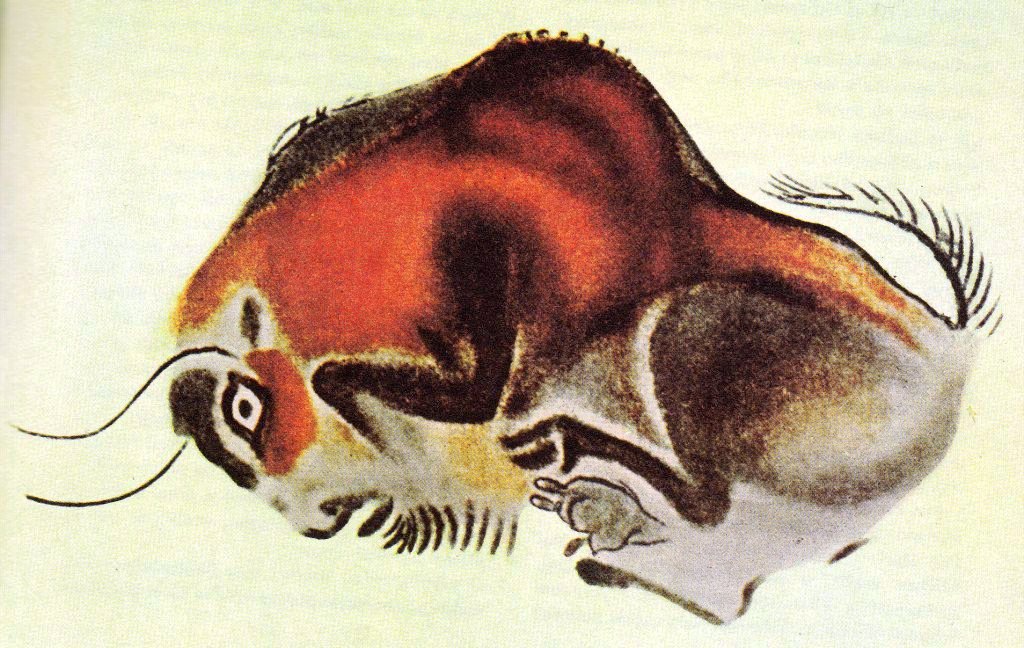
Via Wikimedia Commons: Altamira, bison by unknown prehistoric artist, public domain.
Major sites in Europe
Altamira (Spain). The museum states that bison, horses, deer, hands and signs were painted or engraved there between 36,000 and 13,000 years ago, across more than 290 metres of cave, with most in the Polychrome Room; the largest horses and bison are 125 to 170 centimetres long, and one deer is over two metres. A red symbol in the centre of the Polychrome Room has been dated by uranium series to 35,600 years ago. UNESCO inscribed the cave on the World Heritage List in 1985, and in 2008 extended the listing to seventeen more caves in Asturias, Cantabria and the Basque Country as "The cave of Altamira and the Paleolithic cave art of northern Spain" (Altamira museum).
Lascaux (France). Above the town of Montignac in the Dordogne, Marcel Ravidat, Jacques Marsal, Georges Agnel and Simon Coencas entered the cave on 12 September 1940, and their teacher Léon Laval went down on 18 September; the prehistorian Henri Breuil first visited on 21 September to authenticate the figures (Ministry of Culture). The cave holds some 600 representations of animals, mostly horses, followed by stags and aurochs (wild cattle), and a single human-like figure, in the scene at the bottom of the Shaft. Its age has been revised: radiocarbon dates on reindeer bone published by the LAsCO research project place the cave's occupation between 21,500 and 21,000 years before present, later than dates from the 1990s that some researchers had used to assign the paintings to the Upper Solutrean period, about 24,000 to 23,000 years ago. The same Ministry page also gives the age of the cave as 23,000 years, so its date remains under study.
Chauvet-Pont d'Arc (France). In the Ardèche, Jean-Marie Chauvet, Éliette Brunel and Christian Hillaire found the cave on 18 December 1994, after a draught from a small hole drew them to dig through fallen rocks. According to the Ministry, 82 radiocarbon dates reveal two periods of human use of the cave: the earliest, around 36,500 years ago, in the Aurignacian period, and the latest between 30,000 and 31,000 years ago, in the Gravettian. Of the 435 animal images found, mammoths, felines, rhinoceroses and bears make up almost 65 percent of the identifiable species, animals that were generally not hunted and later became rare in cave art. The Ministry calls Chauvet the best-dated decorated site in the world, and says its quality, at such an early date, changed our conceptions of how art began.
Southeast Asia and the oldest dates
Since 2014, dating in Indonesia has moved the oldest known cave art out of Europe.
In that year Aubert's team dated crusts over 12 hand stencils and two animal paintings in seven caves of the Maros karsts of South Sulawesi. The oldest stencil had a minimum age of 39,900 years, then the oldest known hand stencil in the world, and a painting of a babirusa ("pig-deer") was at least 35,400 years old. Archaeologists had long been puzzled that sophisticated art seemed to appear in Europe some 40,000 to 35,000 years ago with little well-dated equivalent elsewhere; the authors concluded that people were making rock art by about 40,000 years ago at opposite ends of the Ice Age Eurasian world.
Later work pushed figurative art (images that depict something recognisable, such as an animal) further back. In 2021 Adam Brumm and colleagues reported a painting of a Sulawesi warty pig at Leang Tedongnge with a minimum age of 45,500 years, which they called the earliest known representational work of art. In 2024 Oktaviana and colleagues re-dated a hunting scene at Leang Bulu' Sipong 4 to at least 50,200 years (±2,200), about 4,000 years older than first thought, and dated a newly described panel at Leang Karampuang to at least 51,200 years ago. The Leang Karampuang panel shows at least three human-like figures around a pig, and the authors describe it as the earliest known surviving example of representational art and of visual storytelling. Some of the figures at Leang Bulu' Sipong 4 combine human and animal features; the authors interpret these as therianthropes (part-human, part-animal beings), which suggests imaginative storytelling such as myth.
In January 2026 the same group reported dates from Southeast Sulawesi, where they had recorded 44 rock art sites, 14 of them newly found. A crust over a hand stencil in Liang Metanduno, a cave on Muna Island, gave a date of 71,600 ± 3,800 years, so the stencil is at least 67,800 years old. The stencil survives only as a faded 14-by-10-centimetre patch; the tip of one finger appears to have been deliberately narrowed, a style so far known only from Sulawesi, whose oldest previously dated example was about 17,000 years old. On the same panel, two episodes of painting are separated by at least 35,000 years. They argue that art this old on Sulawesi supports the view that people reached Sahul, the ice-age landmass joining Australia and New Guinea, about 65,000 years ago by sea journeys between Borneo and Papua (Oktaviana et al., 2026).
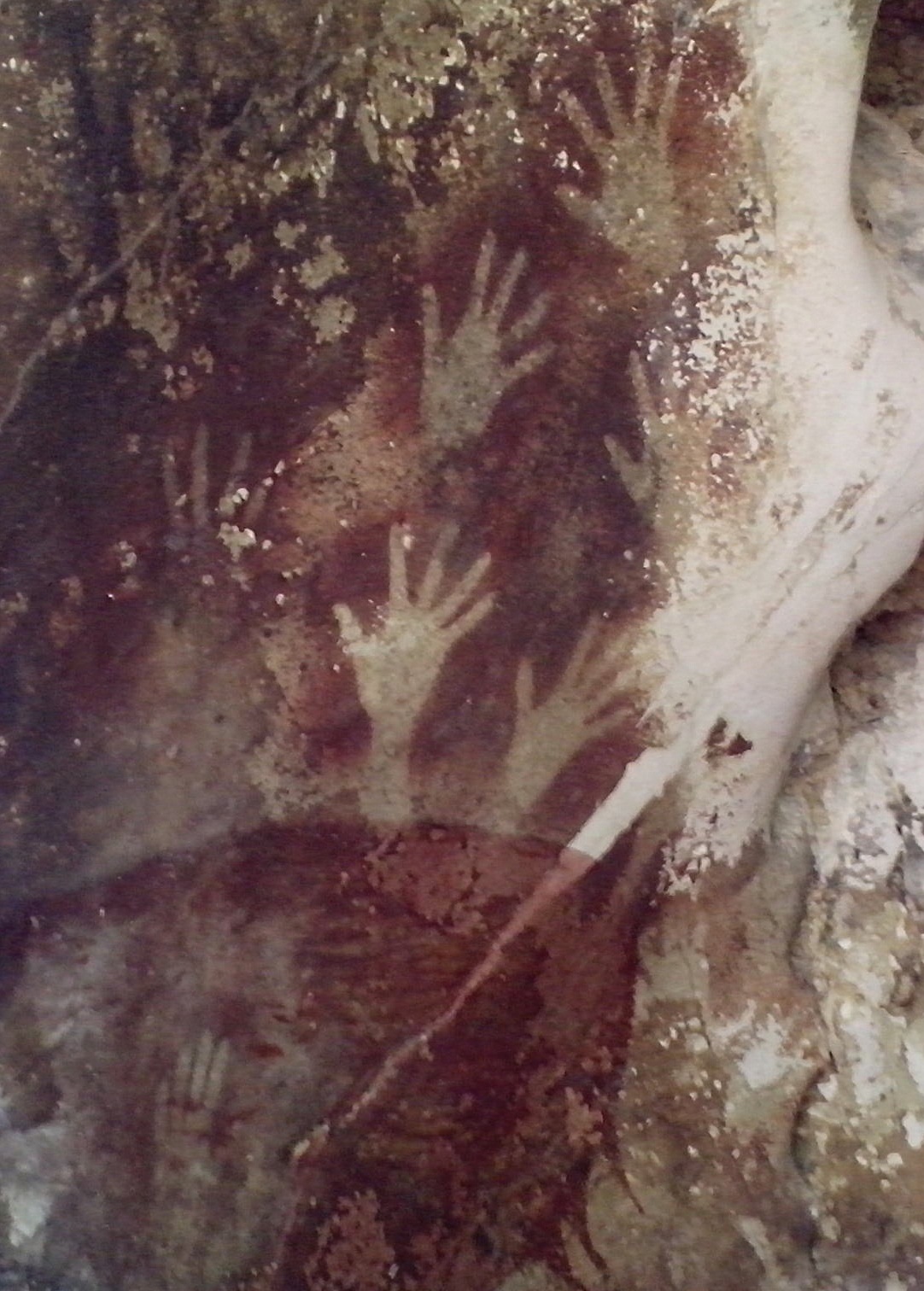
Via Wikimedia Commons: Hands in Pettakere Cave detail by Cahyo, CC BY-SA 4.0.
Borneo, Australia and Africa
Borneo. On Borneo, the island next to Sulawesi, Aubert and colleagues dated calcium carbonate deposits overlying a large reddish-orange painting of an animal in Lubang Jeriji Saléh, a limestone cave in East Kalimantan, to a minimum of 40,000 years, which they reported in 2018 as the oldest date then known for figurative artwork anywhere. Two hand stencils of the same colour at the site each had a minimum age of 37,200 years, and a third had a maximum age of 51,800 years. The study also identified a distinct later phase: dark-purple hand stencils, some decorated with intricate motifs, from about 21,000 to 20,000 years ago, and a rare depiction of a human figure, also dark purple, with a minimum age of 13,600 years. The authors concluded that cave painting appeared in eastern Borneo between 52,000 and 40,000 years ago, and that a major Palaeolithic cave art province existed at the eastern edge of continental Eurasia and the neighbouring islands from at least 40,000 years ago until the Last Glacial Maximum, the coldest phase of the last ice age (Aubert et al., 2018).
Australia. The oldest known Aboriginal figurative rock paintings, in the Kimberley region of Australia, commonly depict naturalistic animals, but until 2021 they had no quantitative dates. Damien Finch and colleagues then reported 27 radiocarbon dates on mud wasp nests that constrain the ages of 16 motifs from this earliest known phase of painting. A nest built over a painting must be younger than the paint, and one beneath it older, so nests on both sides bracket an image's age. The results suggest that paintings in this style proliferated between 17,000 and 13,000 years ago. One painting of a kangaroo, with three nests above it and three below, is dated to between 17,500 and 17,100 years ago, the oldest radiometrically dated rock painting still in place reported in Australia as of that study (Finch et al., 2021).
Africa. The oldest known drawing is not on a cave wall but on a stone. In 2018 Christopher Henshilwood and colleagues reported a cross-hatched pattern drawn with an ochre crayon on a ground flake of silcrete (a hard, silica-cemented rock) from Middle Stone Age layers about 73,000 years old at Blombos Cave, South Africa. Microscopic and chemical analysis confirmed that the red ochre had been applied deliberately. The layer, associated with stone tools of the Still Bay tradition, had earlier yielded shell beads and cross-hatched engravings on pieces of ochre. The authors note that the drawing is at least 30,000 years older than the earliest previously known abstract and figurative drawings, and that it shows early Homo sapiens in southern Africa producing graphic designs on different media with different techniques (Henshilwood et al., 2018). Because it was made on a portable object, it belongs to portable rather than parietal art, but it bears on when people began to draw at all.
Who made it: the Neanderthal debate
Nearly all cave art is credited to Homo sapiens, but one claim has divided the field. In February 2018 Dirk Hoffmann, Alistair Pike and colleagues reported uranium-series minimum ages for a red linear motif at La Pasiega (Cantabria), a hand stencil at Maltravieso (Extremadura) and red-painted cave formations at Ardales (Andalucía), concluding that cave art in Iberia is older than 64.8 thousand years. Because that is at least 20,000 years before modern humans reached Europe, they argued that Neanderthals made it. The Max Planck Society's summary of the study gives the Maltravieso stencil specifically as older than 66,000 years.
The claim was challenged at once. In Science in September 2018, Ludovic Slimak and colleagues argued that the data better supported an age of 47,000 years, which fits the archaeological record better; Hoffmann's team replied that the criticisms were unfounded. In 2020 Randall White and colleagues argued that uranium leaching could have inflated the ages and that the result conflicted with more than a century of archaeological evidence (White et al.), and Hoffmann's team responded again in the same journal (Hoffmann et al., 2020). As of 2026 the question is unresolved: Oktaviana's team writes that the Maltravieso stencil has a published minimum date of 66,700 years but that its dating has been controversial.
For the Sulawesi art the maker is also inferred rather than known. The 2026 paper says there is no obvious way to tell which human species made the Liang Metanduno stencil, noting that archaic humans lived on Sulawesi before modern humans arrived. The authors nonetheless present it as the oldest cave art that can be attributed to Homo sapiens (Oktaviana et al., 2026).
What it meant
Why people painted deep inside caves cannot be known directly, and explanations have changed with each generation of researchers. The French Ministry of Culture traces the sequence: after the first discoveries the usual view was "art for art's sake"; then, after images of bison marked with arrow-like signs were found in the Ariège, the art was read as magic of the hunt, though such marked figures proved rare. Theories of fertility and totemism followed.
Max Raphaël made the first studies of how the images were arranged in space. In 1957 Annette Laming-Emperaire, and then André Leroi-Gourhan, studied where images were placed and, using statistics, argued that animals and signs followed a consistent arrangement within each cave. In the late 1990s Jean Clottes and David Lewis-Williams related the painted ensembles to shamanism. At Lascaux, Norbert Aujoulat's research from 1988 to 1999 found that panels were built in a fixed order (horses, then aurochs, then stags) and that the animals' seasonal features match early spring, summer and autumn, which he read as a symbolic cycle of renewal (Ministry of Culture).
The Indonesian discoveries have widened the question. Oktaviana's team argues that the Sulawesi scenes show that portraying people and animals, and arranging them into scenes,
