Version 1
Nov 10, 2026. Compare with the current version · Version history
A heat dome is a large area of high atmospheric pressure that stays over one region for days or weeks, trapping hot air beneath it like a lid on a pot and producing a prolonged, intense heat wave.
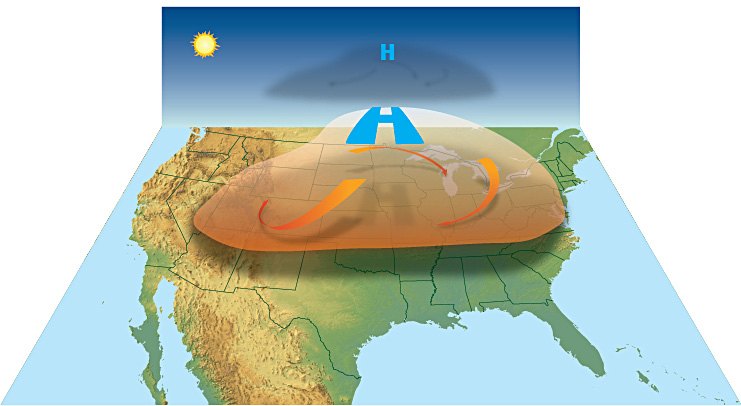
Via Wikimedia Commons: Heat Wave by U. S. National Weather Service/National Ocean Service, public domain.
The name is descriptive. The British Columbia Coroners Service notes that extreme heat events are described in the literature as "heat waves" or "heat domes" interchangeably, and the authors of the main scientific study of the 2021 Pacific Northwest heat wave call the high-pressure system behind it "a feature sometimes called a 'heat dome'".
How a heat dome forms
In an area of high pressure, air in the middle and upper atmosphere sinks toward the ground. According to the Royal Meteorological Society's explainer by Kirsty McCabe (11 August 2021), hot air near the surface would normally rise, but the high acts as a lid; and "as the air sinks, it warms by compression, and the heat builds". Weather under high pressure is dry and settled, and the ground itself warms and dries out, which makes it easier to heat further (Royal Meteorological Society).
What turns an ordinary area of high pressure into a heat dome is that it stops moving. Pressure systems usually travel from west to east, but they can become blocked, often when the jet stream, the band of strong winds high above the Earth's surface, weakens and buckles. One common shape is the omega block, in which a high is held in place between two areas of low pressure (Royal Meteorological Society). The heat keeps building until the pattern breaks down, bringing a risk of wildfire, drought and heat-related illness (Royal Meteorological Society).
Dry ground can make the heat worse. When soil is moist, part of the sun's energy goes into evaporating water rather than warming the air; when it is dry, less of that cooling takes place. The 2021 study notes that low soil moisture "can lead to a strong amplification of temperature during heat waves" (Philip and others, 2022).
The Pacific Northwest heat dome of 2021
The best-studied example struck the north-western United States and south-western Canada in late June 2021. In the analysis by Sjoukje Philip and 29 co-authors, published in Earth System Dynamics on 8 December 2022, an omega block developed over the region from about 25 June, centred near 52°N, 125°W, and drifted slowly east over the following days (Philip and others, 2022). The ridge reached a height of about 5,980 metres at the 500-hectopascal pressure level, which the authors describe as unprecedented for that part of western North America since at least 1948. Strong sinking air and high sunshine near the longest days of the year added to the surface heating.
Temperature records were broken by several degrees Celsius in several cities. The village of Lytton, British Columbia, set a new all-time Canadian record of 49.6 °C on 29 June 2021, and a wildfire driven by the winds that came with the change in weather quickly consumed the town the next day (Philip and others, 2022). The event exceeded the average annual maximum temperatures of other years by about 5 °C.
Deaths
The heat struck a region unused to it, where, according to the study, only about half of households had air conditioning (Philip and others, 2022). In British Columbia, the Coroners Service investigated more than 800 deaths during the week of 25 June to 1 July 2021, compared with an average of about 200 in the same week of previous years, and its death review panel, reporting on 7 June 2022, identified 619 deaths as caused by the extreme heat (BC Coroners Service, 2022). The panel found that 98 percent of those deaths occurred indoors, that 67 percent of those who died were 70 or older, that 56 percent lived alone, and that most were in homes without adequate cooling such as air conditioners or fans. Calls to 911 doubled at the peak of the heat.
The 2022 study cites estimates of 196 extra deaths in Washington State and 100 in Oregon during the event (Philip and others, 2022).
The role of climate change
Philip and her co-authors, working within the World Weather Attribution approach to linking individual weather events with climate change, found that a heat wave like that of June 2021 would have been "virtually impossible without human-caused climate change" (Philip and others, 2022). Because the observed temperatures lay so far outside the historical record, they could not say with confidence how rare the event was, but they estimated it as roughly a once-in-1,000-years event in the climate of 2021. On that basis they found such a heat wave to be at least 150 times rarer without human-induced warming, and about 2 °C hotter (with a range of 1.2 to 2.8 °C) than a comparable event would have been in 1850–1900. In a world 2 °C warmer than pre-industrial times, they estimated, an event like it would occur roughly every 5 to 10 years, with large uncertainties.
The authors also distinguish the weather pattern from the heat. Analysing the circulation of 28 June 2021, they concluded that the pattern itself was "probably not exceptional", while the temperatures associated with it were (Philip and others, 2022). They note that the record height of the high-pressure system was not very anomalous once the long-term rise in the height of that pressure level, driven by the thermal expansion of a warming atmosphere, is taken into account.
Other examples
Heat domes are not confined to North America. The Royal Meteorological Society's 2021 explainer links the summer heat and wildfires of that year in southern Europe to the same kind of pattern, citing a provisional reading of 48.8 °C at Siracusa, Sicily, and gives the summer of 1976 as an example of a weather block that lasted for weeks (Royal Meteorological Society).
Responses
The British Columbia review panel identified three areas that determine how many people die in extreme heat: how accustomed people are to it, the community's ability to respond, and the actions taken for the most vulnerable. It made recommendations on a provincial heat alert and response system, on checking on people at risk, and on cooling in housing, and it found a lag between official heat alerts and the public's response (BC Coroners Service, 2022).
Sources
- Sjoukje Y. Philip, Sarah F. Kew, Geert Jan van Oldenborgh, Faron S. Anslow, Sonia I. Seneviratne and others, "Rapid attribution analysis of the extraordinary heat wave on the Pacific coast of the US and Canada in June 2021", Earth System Dynamics 13 (2022): 1689–1713, published 8 December 2022, doi:10.5194/esd-13-1689-2022.
- British Columbia Coroners Service, Extreme Heat and Human Mortality: A Review of Heat-Related Deaths in B.C. in Summer 2021, report to the Chief Coroner of British Columbia, 7 June 2022.
- Kirsty McCabe, "What is a heat dome?", MetMatters, Royal Meteorological Society, 11 August 2021.
