Version 3 (current)
Nov 17, 2026. Version history
A heat dome is a large area of high atmospheric pressure that stays over one region for days or weeks, trapping hot air beneath it like a lid on a pot and producing a prolonged, intense heat wave.
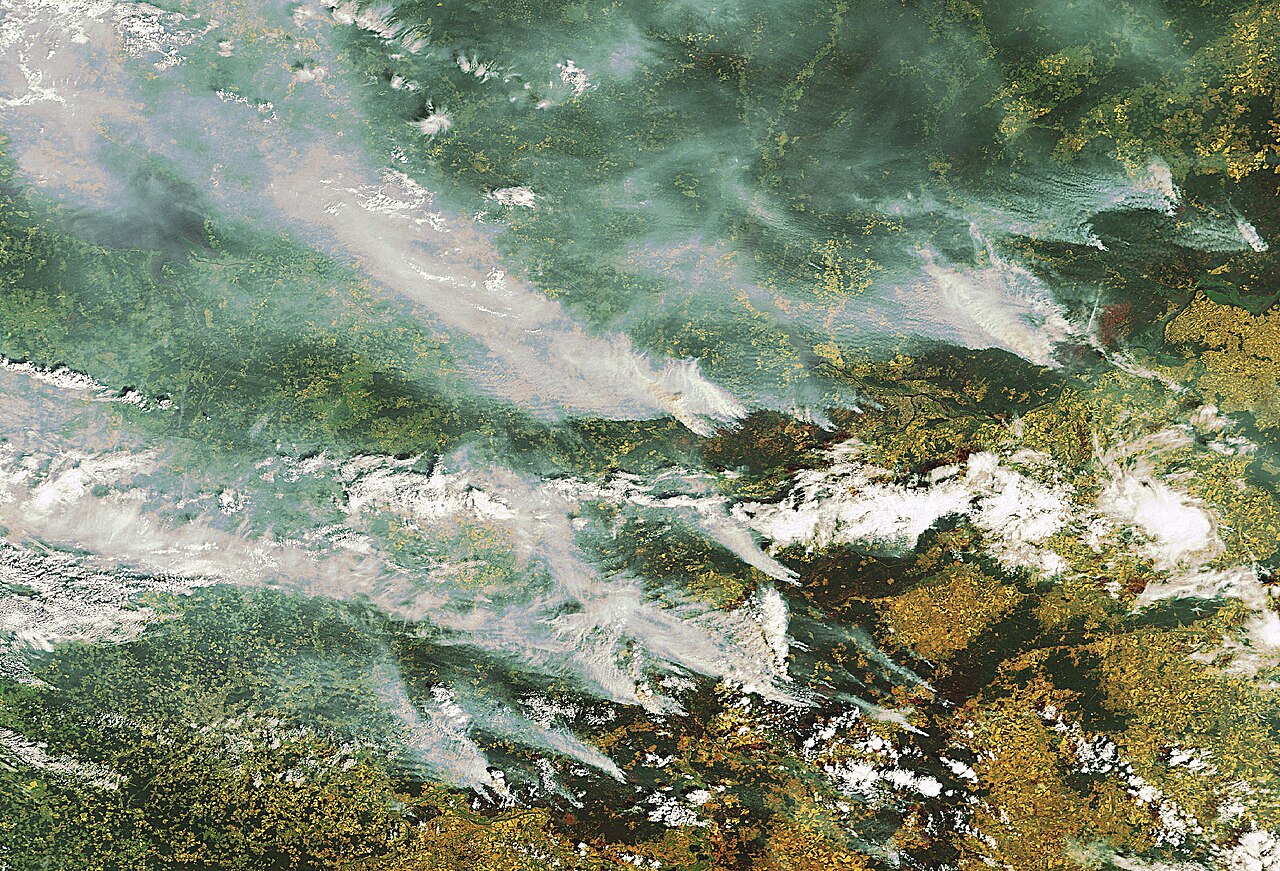
Via Wikimedia Commons: Smoke over Moscow by Envisat satellite, CC BY-SA 3.0 igo.
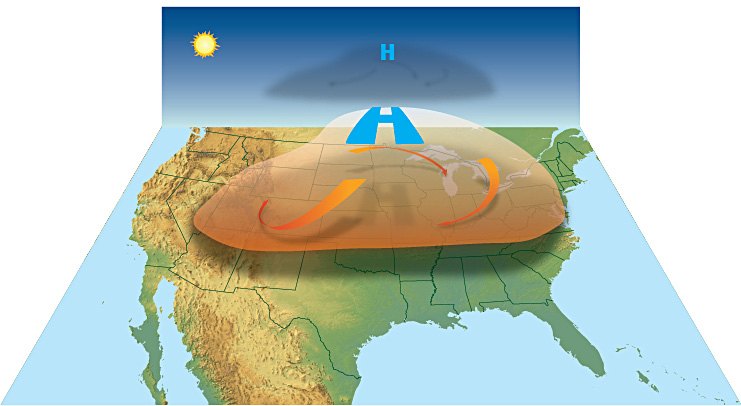
Via Wikimedia Commons: Heat Wave by U. S. National Weather Service/National Ocean Service, public domain.
The name is descriptive. The British Columbia Coroners Service notes that extreme heat events are described in the literature as "heat waves" or "heat domes" interchangeably, and the authors of the main scientific study of the 2021 Pacific Northwest heat wave call the high-pressure system behind it "a feature sometimes called a 'heat dome'".[1][2]
How a heat dome forms
In an area of high pressure, air in the middle and upper atmosphere sinks toward the ground. According to the Royal Meteorological Society's explainer by Kirsty McCabe (11 August 2021), hot air near the surface would normally rise, but the high acts as a lid; and "as the air sinks, it warms by compression, and the heat builds".[3] Weather under high pressure is dry and settled, and the ground itself warms and dries out, which makes it easier to heat further (Royal Meteorological Society).
What turns an ordinary area of high pressure into a heat dome is that it stops moving. Pressure systems usually travel from west to east, but they can become blocked, often when the jet stream, the band of strong winds high above the Earth's surface, weakens and buckles.[3] One common shape is the omega block, in which a high is held in place between two areas of low pressure (Royal Meteorological Society).[3] The heat keeps building until the pattern breaks down, bringing a risk of wildfire, drought and heat-related illness (Royal Meteorological Society).[3]
Dry ground can make the heat worse. When soil is moist, part of the sun's energy goes into evaporating water rather than warming the air; when it is dry, less of that cooling takes place. The 2021 study notes that low soil moisture "can lead to a strong amplification of temperature during heat waves" (Philip and others, 2022).[1]
The Pacific Northwest heat dome of 2021
The best-studied example struck the north-western United States and south-western Canada in late June 2021. In the analysis by Sjoukje Philip and 26 co-authors, published in Earth System Dynamics on 8 December 2022, an omega block developed over the region from about 25 June, centred near 52°N, 125°W, and drifted slowly east over the following days (Philip and others, 2022).[1] The ridge reached a height of about 5,980 metres at the 500-hectopascal pressure level, which the authors describe as unprecedented for that part of western North America since at least 1948.[1] Strong sinking air and high sunshine near the longest days of the year added to the surface heating.
Temperature records were broken by several degrees Celsius in several cities. The village of Lytton, British Columbia, set a new all-time Canadian record of 49.6 °C on 29 June 2021, and a wildfire driven by the winds that came with the change in weather quickly consumed the town the next day (Philip and others, 2022).[1] The event exceeded the average annual maximum temperatures of other years by about 5 °C.[1]
Deaths
The heat struck a region unused to it, where, according to the study, only about half of households had air conditioning (Philip and others, 2022).[1] In British Columbia, the Coroners Service investigated more than 800 deaths during the week of 25 June to 1 July 2021, compared with an average of about 200 in the same week of previous years, and its death review panel, reporting on 7 June 2022, identified 619 deaths as caused by the extreme heat (BC Coroners Service, 2022).[2] The panel found that 98 percent of those deaths occurred indoors, that 67 percent of those who died were 70 or older, that 56 percent lived alone, and that most were in homes without adequate cooling such as air conditioners or fans.[2] Calls to 911 doubled at the peak of the heat.[2]
The 2022 study cites estimates of 196 extra deaths in Washington State and 100 in Oregon during the event (Philip and others, 2022).[1]
The role of climate change
Philip and her co-authors, working within the World Weather Attribution approach to linking individual weather events with climate change, found that a heat wave like that of June 2021 would have been "virtually impossible without human-caused climate change" (Philip and others, 2022).[1] Because the observed temperatures lay so far outside the historical record, they could not say with confidence how rare the event was, but they estimated it as roughly a once-in-1,000-years event in the climate of 2021.[1] On that basis they found such a heat wave to be at least 150 times rarer without human-induced warming, and about 2 °C hotter (with a range of 1.2 to 2.8 °C) than a comparable event would have been in 1850–1900.[1] In a world 2 °C warmer than pre-industrial times, they estimated, an event like it would occur roughly every 5 to 10 years, with large uncertainties.[1]
The authors also distinguish the weather pattern from the heat. Analysing the circulation of 28 June 2021, they concluded that the pattern itself was "probably not exceptional", while the temperatures associated with it were (Philip and others, 2022).[1] They note that the record height of the high-pressure system was not very anomalous once the long-term rise in the height of that pressure level, driven by the thermal expansion of a warming atmosphere, is taken into account.[1]
The Russian heat wave of 2010
A second well-studied case, and the subject of a scientific dispute over cause, is the heat wave that settled over western Russia in the summer of 2010. A team at the United States National Oceanic and Atmospheric Administration led by Randall Dole found that the region had its warmest July since at least 1880, with numerous all-time temperature records, and linked the heat to a "strong and long-lived blocking event" of the same kind as the patterns described above.[4] According to a 2012 press release from the American Geophysical Union, temperatures peaked above 40 °C, the heat wave killed 55,000 people and caused about $15 billion in damage.[7]
Two answers to the same question
Dole and his co-authors, writing in Geophysical Research Letters in 2011, concluded that the heat wave was "mainly due to natural internal atmospheric variability", and that in their model simulations neither human influences nor slowly changing ocean conditions contributed substantially to its magnitude.[4]
Stefan Rahmstorf and Dim Coumou, in the Proceedings of the National Academy of Sciences later the same year, reached what looked like the opposite result. Using a statistical approach to how a warming trend changes the number of record-breaking values in a time series, they estimated that the local warming trend had increased the number of July heat records expected in Moscow in the preceding decade fivefold, which implied "an approximate 80% probability that the 2010 July heat record would not have occurred without climate warming".[5]
A 2012 study by Friederike Otto, Neil Massey, Geert Jan van Oldenborgh, Richard G. Jones and Myles Allen argued that the two findings answer different questions and can both be right: an event can be largely natural in its magnitude while human-induced warming has made it much more likely (American Geophysical Union, 2012).[7] In their large set of model simulations, as the American Geophysical Union summarised it, temperatures like those of 2010 recurred about once every 99 years under the conditions of the 1960s and about once every 33 years under those of the 2000s, a threefold increase in four decades, while peak temperatures of that size still lay within the natural range of a Russian summer.[7] The distinction between the strength of the weather pattern and the probability of the heat it brings recurs in later work, including the 2021 Pacific Northwest study described above.
Other examples
Heat domes are not confined to North America. The Royal Meteorological Society's 2021 explainer links the summer heat and wildfires of that year in southern Europe to the same kind of pattern, citing a provisional reading of 48.8 °C at Siracusa, Sicily, and gives the summer of 1976 as an example of a weather block that lasted for weeks (Royal Meteorological Society).
Heat domes in a warming climate
The Intergovernmental Panel on Climate Change, in the Summary for Policymakers of its Sixth Assessment Report on the physical science (2021), judged it "virtually certain that hot extremes (including heatwaves) have become more frequent and more intense across most land regions since the 1950s", with high confidence that human-induced climate change is the main driver, and found that some recent hot extremes "would have been extremely unlikely to occur without human influence on the climate system" (statement A.3.1).[8] The attribution studies of 2010 and 2021 illustrate the reasoning behind such statements: a warmer background makes a given blocking pattern produce higher temperatures, whether or not the pattern itself has become more common.
Responses
The British Columbia review lists several variables that shape the health effects of an extreme heat event, among them how accustomed people are to the heat, the community's ability to respond, and the actions taken, particularly for the most vulnerable.[2] It made recommendations on a provincial heat alert and response system, on checking on people at risk, and on cooling in housing, and it found a lag between official heat alerts and the public's response (BC Coroners Service, 2022).[2]
Sources
- Sjoukje Y. Philip, Sarah F. Kew, Geert Jan van Oldenborgh, Faron S. Anslow, Sonia I. Seneviratne and others, "Rapid attribution analysis of the extraordinary heat wave on the Pacific coast of the US and Canada in June 2021", Earth System Dynamics 13 (2022): 1689–1713, published 8 December 2022, doi:10.5194/esd-13-1689-2022.
- British Columbia Coroners Service, Extreme Heat and Human Mortality: A Review of Heat-Related Deaths in B.C. in Summer 2021, report to the Chief Coroner of British Columbia, 7 June 2022.
- Kirsty McCabe, "What is a heat dome?", MetMatters, Royal Meteorological Society, 11 August 2021.
- R. Dole, M. Hoerling, J. Perlwitz and others, "Was There a Basis for Anticipating the 2010 Russian Heat Wave?", Geophysical Research Letters 38 (2011): L06702, doi:10.1029/2010GL046582, summarised by NOAA Physical Sciences Laboratory, "Ongoing Scientific Assessment of the 2010 Western Russia Heatwave".
- Stefan Rahmstorf and Dim Coumou, "Increase of extreme events in a warming world", Proceedings of the National Academy of Sciences 108, no. 44 (2011): 17905–17909, published 24 October 2011, doi:10.1073/pnas.1101766108.
- Friederike E. L. Otto, Neil Massey, Geert Jan van Oldenborgh, Richard G. Jones and Myles R. Allen, "Reconciling two approaches to attribution of the 2010 Russian heat wave", Geophysical Research Letters 39 (2012): L04702.
- American Geophysical Union, "Russian heat wave had both manmade and natural causes", joint press release, 21 February 2012.
- IPCC, "Summary for Policymakers", in Climate Change 2021: The Physical Science Basis, contribution of Working Group I to the Sixth Assessment Report, 2021.
Corrections
- 2026-11-17: The 2021 Pacific Northwest study (source 1) lists 27 authors, so the count of co-authors was 26, not 29. The Responses section had said the British Columbia panel "identified three areas that determine" deaths; the report lists five variables behind heat's health effects and a separate set of three key areas for reducing deaths, so the sentence now says the report lists several variables. Source 6 (Otto and others, 2012) did not open from this desk (HTTP 403); the Otto study is described from source 7 and no sentence is numbered to source 6.
