I'd rather have a bottle in front of me than a frontal lobotomy
Lobotomy
A brain operation cutting the prefrontal lobes' connections, used for mental illness from 1935 until the 1950s
A brain operation cutting the prefrontal lobes' connections, used for mental illness from 1935 until the 1950s

A lobotomy, or prefrontal leucotomy, is a brain operation that cuts the connections between the prefrontal cortex, at the front of the brain, and deeper brain structures. From 1935 it was used to treat severe mental illness, until antipsychotic drugs largely replaced it from the mid-1950s.
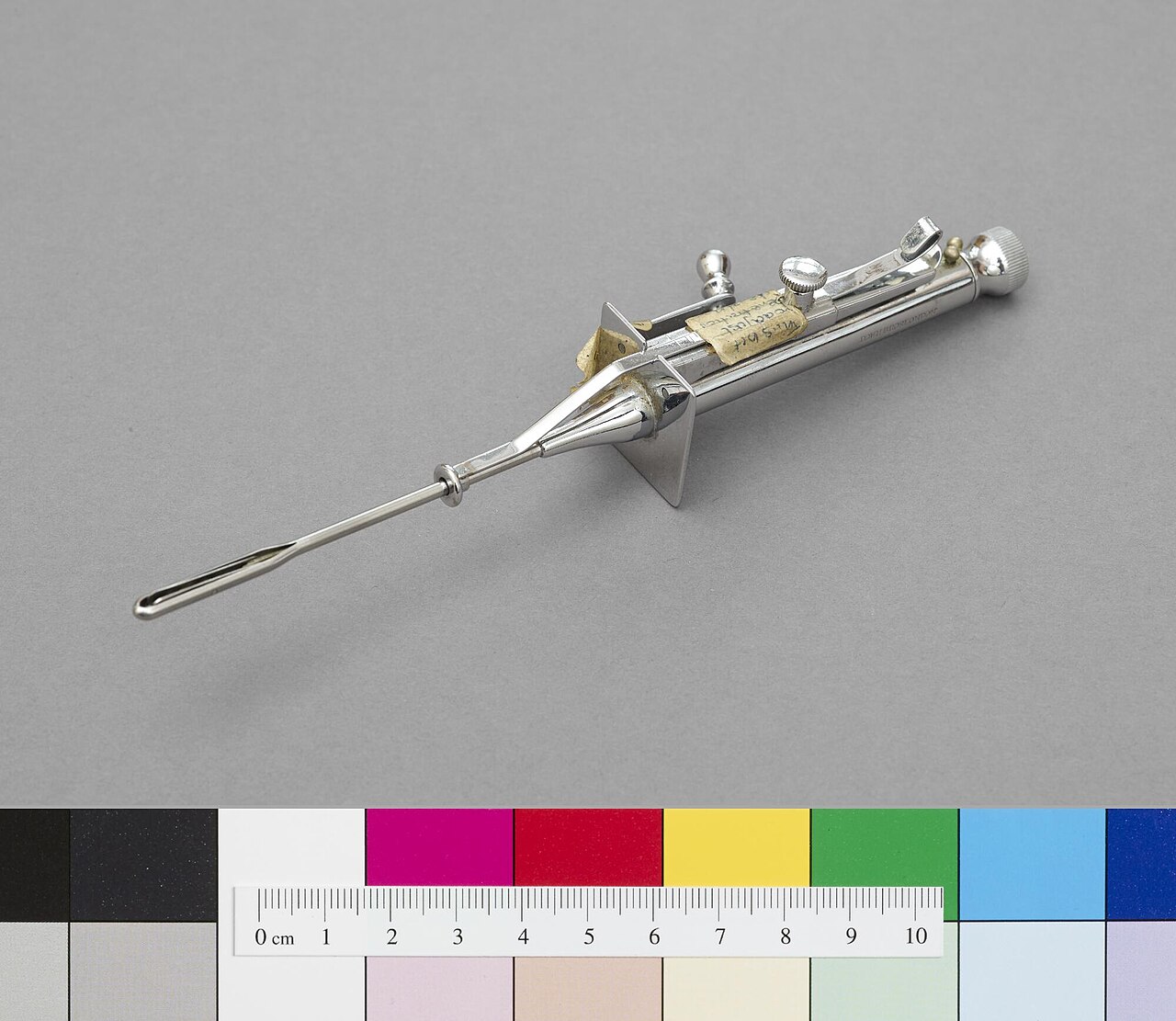
Via Wikimedia Commons: Leucotome, designed by Neurosurgeon Dr John Crumbie 1955 (front view) by The Museum of Medicine and Health, CC BY 4.0.
The two names began as slightly different things. In a 2013 history of psychosurgery (brain surgery meant to treat psychiatric symptoms), the neurosurgeon Miguel Faria describes frontal lobotomy as sectioning the prefrontal cortex and leucotomy as severing the white matter underneath it, the bundles of nerve fibres that link brain regions.[1] The Portuguese originators called their operation a frontal leucotomy, and the Americans who popularised it called theirs a frontal lobotomy (Faria, 2013).
Brain operations for mental illness had been tried before. Faria and a 2013 review of psychosurgery for schizophrenia by Matheus Soares and colleagues both date the first to 1888, when the Swiss psychiatrist Gottlieb Burckhardt operated on six patients; a 2017 article in the British Columbia Medical Journal gives the date as 1891.[1][2][4] His colleagues rejected the work, and he abandoned it.[4]
The idea returned in a setting of overcrowded asylums and few treatments. Faria cites a 1937 count of more than 450,000 patients in 477 institutions in the United States, nearly half of them hospitalised for five years or longer, and notes that drugs for psychosis did not exist until the 1950s.[1] At the Second International Neurological Congress in London in 1935, the American physiologist John Fulton described two chimpanzees whose prefrontal cortex had been removed on both sides and which had become "devoid of emotional expression".[1] Among those at the congress were the Portuguese neurologist Egas Moniz and the American neurologist Walter Freeman (Faria, 2013).[1]
Moniz, professor of neurology at the University of Lisbon, carried out his first psychosurgery on 12 November 1935, on a 63-year-old woman with depression, anxiety, paranoia, hallucinations and insomnia (Tan and Yip, 2014).[3] He worked with the neurosurgeon Almeida Lima.[3] Their first operations destroyed white matter in the frontal lobes with injections of alcohol; they then introduced the leucotome, a needle-like instrument with a retractable wire loop that cut the fibres (Tan and Yip, 2014; Faria, 2013).[1][3] Moniz presented a series of 20 patients the following year, and reported that his patients became calmer and more manageable, though with more blunted emotion (Faria, 2013).[1]
In 1949 Moniz shared the Nobel Prize in Physiology or Medicine, awarded to him "for his discovery of the therapeutic value of leucotomy in certain psychoses". The other half went to Walter Rudolf Hess for his discovery of the functional organisation of the interbrain. A 2014 profile of Moniz in the Singapore Medical Journal records that he was criticised for understating complications, for inadequate documentation and for poor follow-up of his patients.[3]
In 1936 Walter Freeman, a neurologist and neuropathologist, and James Watts, a neurosurgeon at George Washington University, performed the first frontal lobotomy in the United States.[1] Their standard operation went in through a hole about 1 cm wide on each side of the frontal bone of the skull; a leucotome was inserted and moved back and forth to cut the white matter tracts.[2] In 1942 they published the monograph Psychosurgery, reporting on 200 patients: 63 percent improved, 23 percent unchanged and 14 percent worse or dead after the operation.[1] The same year an editorial in the Journal of the American Medical Association supported the operation and its indications, according to Faria.[1]
Freeman then developed the transorbital lobotomy. An ice-pick-like instrument was pushed through the thin bone at the top of the eye socket into the base of the frontal lobe, to a depth of about 7 cm, and swept sideways; it was often done under local anaesthesia, or with the patient sedated after electroconvulsive therapy (Faria, 2013).[1] Freeman hoped it would let ordinary physicians treat hospital patients widely.[1] Watts objected to the crudeness of the method and the lack of sterile technique, and the two men ended their partnership (Faria, 2013).[1] A 2017 review in Neurosurgical Focus by James Caruso and Jason Sheehan says Freeman's showmanship made him popular with the press and that he performed more than 3,000 prefrontal and transorbital lobotomies between 1930 and 1960; Faria puts his total above 4,000.[1][5]
One of the best-known patients was Rosemary Kennedy, sister of President John F. Kennedy. A 2025 review of the history of psychosurgery, presented at the European Congress of Psychiatry, says she was operated on for mild developmental delays, anxiety and epilepsy and was left severely disabled, living in an institution for the rest of her life.
Faria cites an estimate of about 60,000 procedures in the United States and Europe between 1936 and 1956; Michael Gallea, writing in 2017, says "tens of thousands" of psychiatric patients underwent the operation.[1][4] Schizophrenia was among the conditions treated (Soares and others, 2013).[2]
The operation reached beyond hospital wards. In 2012 the neurosurgeon Daniel Nijensohn and colleagues published evidence in World Neurosurgery that Eva Perón, the wife of Argentina's president, underwent a prefrontal lobotomy in Buenos Aires before her death from metastatic cancer in 1952, to treat pain, anxiety and agitation. Their case rests on the statements of the surgeon George Udvarhelyi, who claimed to have taken part, on accounts from people close to her, and on skull X-rays and photographs; they conclude that the evidence "gives validity" to his claim.[7]
The operation spread well beyond Portugal and the United States. A 2022 comparative history by B. L. Lichterman and colleagues follows it in the United States, the Soviet Union and East Asia, and finds that in each region psychosurgery went from initial enthusiasm and high clinical caseloads to nearly complete disregard, with the opposition led by different groups for different reasons but always with political considerations mixed in.
Scandinavia used it heavily. In Sweden, Kenneth Ögren and M. Sandlund used the annual reports that hospitals sent to the National Board of Health to make the first national survey: approximately 4,500 lobotomies between 1944 and 1966. At Umedalen, a state mental hospital in the north of the country, they identified 771 patients lobotomised between 1947 and 1958. Of these, 84 percent had a diagnosis of schizophrenia, and 57 died after the operation, a post-operative death rate of 7.4 percent that reached 17 percent in 1949 (Ögren and Sandlund, 2007). Women made up 63 percent of the Umedalen patients, which the authors say supports earlier findings of a female preponderance among those lobotomised; before the operation the women had spent an average of 10.7 years in hospital and the men 3.5 years. The authors could not say for certain why the hospital operated so often, suggesting overcrowded wards and its standing as a modern hospital as possible reasons (Ögren and Sandlund, 2007).
A 2022 article in the journal of the Norwegian Medical Association puts the number of lobotomies in Norway at approximately 3,000 between 1940 and 1960, and says the treatment is now considered one of the greatest mistakes of modern medicine. In 1996 the BMJ reported that Norway was compensating lobotomy victims. In Denmark, J. V. Kragh of the University of Copenhagen's Medical Museion studied the archives of the state mental hospitals, including 336 records of lobotomised patients at the 850-bed hospital in Vordingborg in southern Zealand. He found that the dire conditions of the hospitals in the 1940s and 1950s led doctors to see the operation as a solution for patients living in the back wards, that patients who had spent years in "disturbed wards" were particularly exposed to it, and that the most common reasons recorded were "unruly" and "aggressive" behaviour, alongside long stays in hospital, pain and the failure of other physical treatments.
In Japan, according to a 2017 note by J. Nudeshima and T. Taira, frontal lobotomies were widely performed in the 1940s and 1950s, and some neurosurgeons used stereotactic methods until the 1960s. Protest campaigns in the 1960s and 1970s, which the authors tie to the political movements of the time rather than to medical evaluation, were followed in 1975 by a ban on surgical treatment for psychiatric disorders by the Japanese Society of Psychiatry and Neurology; as of 2017, the authors wrote, no neurosurgical treatment for psychiatric disorders had been used in Japan since the 1970s (Nudeshima and Taira, 2017).
Removal of or damage to the frontal lobes became associated with a recognisable set of changes: distractibility, euphoria, apathy, lack of initiative, lack of restraint and social disinhibition (Faria, 2013).[1] Soares and colleagues write that the classic lobotomy caused extensive brain injuries with varied complications.[2] In 1971 Freeman published a follow-up of 707 patients with schizophrenia, 4 to 30 years after their lobotomies; despite improvement in most, 73 percent were still in hospital or at home in what he called a "state of idle dependency" (Faria, 2013).[1]
Assessments differ in emphasis. Faria, describing the period, notes that many patients' worst symptoms eased, families were often grateful and institutionalised patients became easier to manage, while many physicians were disappointed by complications and deaths.[1] Gallea records the criticism that the Nobel award failed the prize's own test of conferring "the greatest benefit to mankind", since the operation did more harm.[4] Evidence of the kind now expected was missing even for the later, more precise operations: the 2013 review by Soares and colleagues found no prospective controlled trials (see Randomized controlled trial) of stereotactic psychosurgery for schizophrenia, and every study it included was a case series.[2]
The Soviet Union banned lobotomy in 1950.[6] In a 2017 article in the Bulletin of the History of Medicine, the historian Benjamin Zajicek describes how Soviet psychiatrists who saw mental illness as a "whole body" process argued against the operation, and how that dispute was drawn into the Communist Party's campaign against Western influence, with demands for adherence to the theories of Ivan Pavlov.[6]
Elsewhere, the operation faded with the arrival of drugs. Chlorpromazine, which Gallea describes as the first drug approved to treat schizophrenia with a positive effect, was introduced in Europe in 1953 and became available in the United States in 1955; Gallea writes that it was given to an estimated 2 million patients in its first year on the market, after which the lobotomy fell out of favour.[1][4] Caruso and Sheehan add poor patient outcomes, unfavourable portrayals in literature and film, and increasing regulatory scrutiny, and note that neurosurgical treatment of mental illness still carries a stigma.[5]
The broad cuts of the classic lobotomy gave way to small, targeted lesions. Stereotactic surgery, which guides a probe to a point in the brain using three-dimensional coordinates, reduced the death rate and the risk of epilepsy.[2] As of the 2013 review by Soares and colleagues, the procedures used in recent decades included cingulotomy, subcaudate tractotomy, limbic leucotomy, anterior capsulotomy and amygdalotomy, with cingulotomy the most common in the United States; the review called the value of psychosurgery "controversial" and found no data supporting stereotactic procedures for schizophrenia.[2] A 2023 article in the Canadian Journal of Psychiatry describes the field's move from operations used to "correct" unwanted behaviour towards selective, last-resort procedures, including reversible stimulation techniques, under a regulatory framework that its authors say still needs to be harmonised internationally.
This entry explains; it is not medical advice. Ask a doctor or pharmacist about your own health.
I'd rather have a bottle in front of me than a frontal lobotomy
Numbering: sources 1 to 8 of 17 done, no other text changed. All eight opened (the PubMed pages for 5, 6 and 7 would not show abstracts, so those were read through Europe PMC and PubMed record data). Source 1 (Faria) supports most of the history; 2 (Soares) the 1888 date, the 1 cm trepanations, the missing controlled trials and the later procedures; 3 (Tan and Yip) Moniz's first operation, the leucotome and the criticism of him; 4 (Gallea) the 1891 date, "tens of thousands", the Nobel criticism and chlorpromazine; 5 (Caruso and Sheehan) Freeman's count, the decline and the stigma; 6 (Zajicek) the Soviet ban; 7 (Nijensohn) the evidence on Eva Perón.
Left without a number because the source does not say everything in the sentence:
- "The Portuguese originators called their operation a frontal leucotomy, and the Americans ... a frontal lobotomy": Faria defines the two terms but does not tie them to nationalities.
- The Rosemary Kennedy sentence (source 8): the page does not say the review was presented at the European Congress of Psychiatry.
- The first Eva Perón sentence: the abstract gives uterine cancer, not "metastatic".
Also unnumbered so far: the opening sentence, the Nobel Prize paragraph and the later sections, which rest on sources 9 to 17. Source 8 supports no other sentence. Next: sources 9 to 16.
 Get Micwyn on your home screenIts own icon, full screen, and notifications.