A midterm election, in the United States, is the nationwide general election held halfway through a president's four-year term, in which voters choose every member of the House of Representatives, about one-third of the Senate, and many state officials.
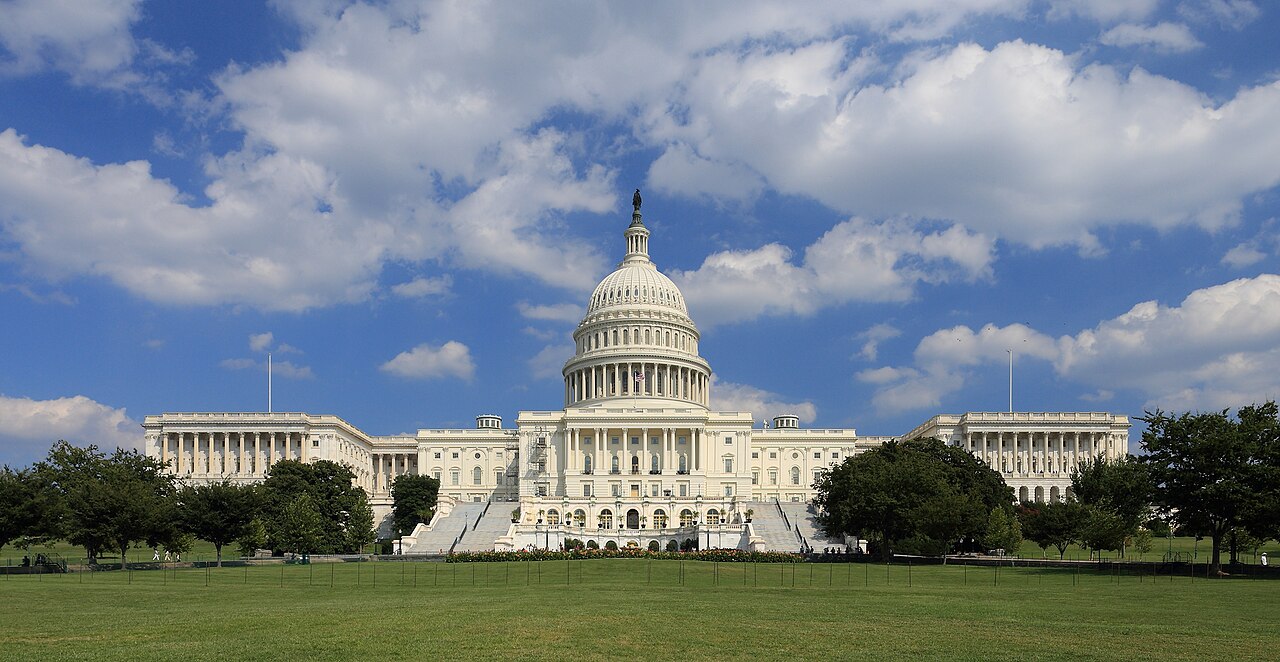
The United States Capitol in Washington, D.C., where the House of Representatives and the Senate meet.
Because congressional elections come every two years and presidential elections every four, every other congressional election falls between two presidential ones. That off-year election is the midterm. Political scientists also call it the "off-year" election, as distinct from the "on-year" election held with a presidential race (Tufte, 1975).
What is on the ballot
The House. All seats in the House are filled at each election, midterm or not. As of 2026 the House has 435 seats, divided among the 50 states according to population counted in each decennial census (U.S. Census Bureau, apportionment FAQs).
The Senate. Only one of the Senate's three classes is elected in any given year. At the start of the First Congress in 1789 senators were divided into the three classes by lot, with the two senators from each state placed in different classes, so a state's two seats are normally not up for election at the same time. As a result roughly a third of senators face the voters at each midterm, and the Senate changes more gradually than the House. Until 1913 senators were chosen by state legislatures rather than by voters; the Seventeenth Amendment, passed by Congress on 13 May 1912 and ratified on 8 April 1913, provided that senators be "elected by the people thereof". Since then the Senate races in a midterm have been popular elections too.
State and local offices. Many states hold elections for governor and other state offices in midterm years. In 2026, for example, voters in 36 states also elected a governor (NPR, 5 May 2026). State legislative seats, local offices and ballot measures are often decided on the same day.
Election day
Federal law sets the date. Under 2 U.S.C. § 7, the Tuesday after the first Monday in November in every even-numbered year is established as the day for the election of representatives, whose terms begin on 3 January of the following year. The rule descends from an act of 1872; a 1934 amendment moved the start of the new term from 4 March to 3 January (2 U.S.C. § 7, notes). Because the formula counts from the first Monday, election day always falls between 2 and 8 November. The 2026 midterm elections were held on Tuesday, 3 November 2026.
The president's party usually loses ground
The best-known regularity of midterm elections is that the president's party tends to lose seats in Congress. Writing in 1975, the political scientist Edward Tufte observed that in every off-year congressional election but one since the Civil War, the party of the incumbent president had lost seats in the House.
In the House, the president's party lost seats 20 times and gained seats three times (1934, 1998 and 2002). The average change was a loss of 27 seats. The largest losses were 72 seats in 1938, 63 in 2010 and 56 in 1946.
In the Senate, the president's party lost seats 15 times, gained seats seven times and broke even once (1998). The average change was a loss of about 3.4 seats.
These averages are this entry's own arithmetic from the table, which counts seats held by Progressives or independents with the major party they caucused with and takes party totals from the divisions immediately after each election. As of 11 November 2026, the table, last updated on 13 July 2026, did not yet include results for 2026.
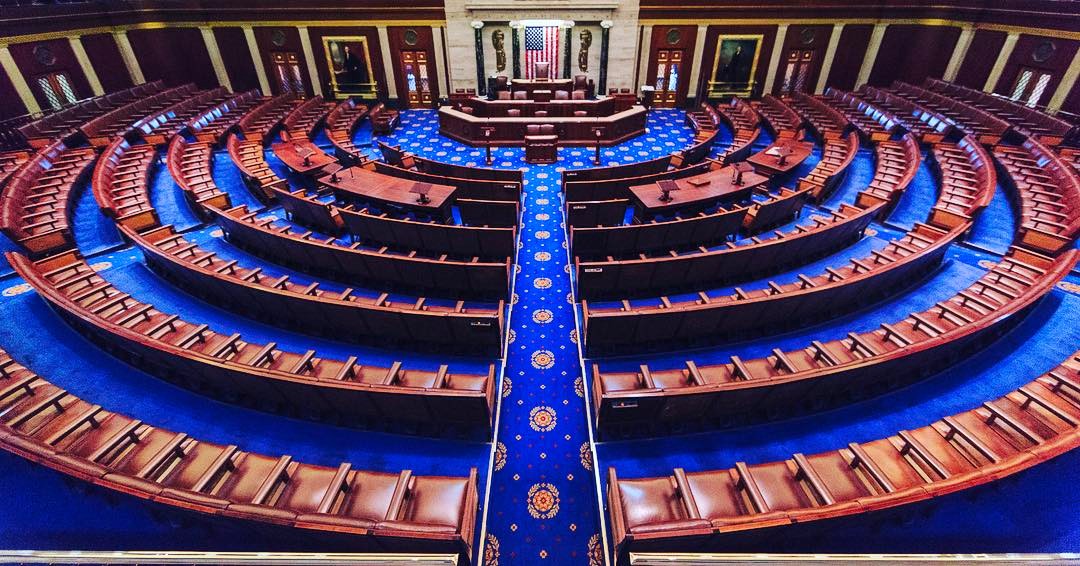
The chamber of the United States House of Representatives, whose members are all elected every two years.
The table also records each president's job approval in the Gallup poll in the months before each midterm. The two most recent House gains came under presidents with relatively high approval: Bill Clinton stood at 65 percent in late October 1998 and George W. Bush at 67 percent in late October 2002, while the president's party lost 63 House seats in 2010 with Barack Obama at 45 percent (American Presidency Project). The relationship is not exact: in 1986 Ronald Reagan stood at 63 to 64 percent in the autumn polls, yet his party lost eight Senate seats.
Why midterms go against the president: competing explanations
Political scientists have offered several explanations for the midterm loss.
Surge and decline. In a 1960 article in Public Opinion Quarterly, "Surge and Decline: A Study of Electoral Change", Angus Campbell explained the midterm loss chiefly by the difference in turnout between presidential and midterm years. In Tufte's account, Campbell and the earlier scholar V. O. Key both emphasised differences in turnout in off-year compared to on-year elections rather than short-run factors such as voters' judgement of the president, and the regular midterm loss seemed to suggest an electorate returning to its normal partisan alignment after the more hectic presidential contest two years earlier.
A referendum on performance. Tufte's 1975 study in the American Political Science Review challenged that view. Using national data, it modelled the midterm vote on the president's Gallup approval rating and on the pre-election change in real disposable income per person, and concluded that the midterm vote is "a referendum on the performance of the President and his administration's management of the economy". The president's party almost always lost vote share, he found, but the loss was substantially smaller when the president was popular, when the economy was doing well, or both.
Negative voting. In 1977 Samuel Kernell, also in the American Political Science Review, proposed that disapproval of a president moves voters more than approval does. His "negative voting" model holds that the effects of approval and disapproval are unequal, with negative opinion being more determinative of voting behavior, and predicts that voters who disapprove of the president, whatever their party, turn out in greater proportions. In survey data he examined, people who disapproved of the president's job performance voted at higher rates than those who approved in 14 of 18 comparisons (Kernell, 1977).
Turnout
Fewer people vote in midterm elections than in presidential ones. The Census Bureau measures turnout through a survey supplement asking a sample of the population whether they voted, and reports it as a share of the citizen voting-age population (citizens aged 18 and over). By that measure, 67 percent of adult citizens reported voting in the 2020 presidential election (Census Bureau, April 2021), compared with 53 percent in the 2018 midterm, which the Bureau described as the highest midterm turnout in four decades, and 52.2 percent in the 2022 midterm.
The way people vote in midterms has also changed. In 2022, according to the Census Bureau, 31.8 percent of voters cast ballots by mail and 47.1 percent voted before election day, both lower than in the 2020 presidential election but higher than in the 2018 midterm, by 8.6 and 9.3 percentage points respectively (Census Bureau, May 2023). The share of voting-age citizens registered to vote in 2022, 69.1 percent, was the highest for a congressional election in 20 years.
Consequences
Because the whole House and a third of the Senate are elected, a midterm can change which party controls either chamber halfway through a presidency. When the president's party loses a majority, the result is divided government, in which the presidency and at least one house of Congress are held by different parties. Tufte's study added a caution about reading too much into seat counts: it found that the nationwide congressional vote is often poorly reflected in the resulting partisan division of seats, so that the voters' verdict is muted by the structure of the electoral system.
Comparable elections elsewhere
The midterm is a product of the American calendar, but other presidential systems whose legislators serve shorter or staggered terms produce a similar election halfway through a presidency.
Argentina. Under the Argentine Constitution as reformed in 1994, the president serves a four-year term and may be re-elected for only one consecutive term (Article 90). Deputies serve four years, but the Chamber of Deputies is renewed by half every two years (Article 50), and senators serve six years, with the Senate renewing itself by one-third of the electoral districts every two years (Article 56). Every other legislative election therefore falls in the middle of a presidential term, choosing half the lower house and a third of the Senate's districts while the president stays in office.
The Philippines. The 1987 Constitution of the Philippines gives the president a single six-year term with no re-election (Article VII, Section 4). Members of the House of Representatives are elected for three years (Article VI, Section 7), and the 24 senators, elected at large by the whole country, for six (Article VI, Sections 2 and 4). The Senate was staggered at the 1992 election, when the first twelve senators by votes received were to serve six years and the remaining twelve three years (Article XVIII, Section 2), so half the Senate is chosen every three years. Each presidential term thus contains one election at its midpoint, filling the whole House and twelve Senate seats.
Edward R. Tufte, "Determinants of the Outcomes of Midterm Congressional Elections", American Political Science Review 69, no. 3 (September 1975): 812–826. doi.org/10.2307/1958391
Samuel Kernell, "Presidential Popularity and Negative Voting: An Alternative Explanation of the Midterm Congressional Decline of the President's Party", American Political Science Review 71, no. 1 (March 1977): 44–66. pages.ucsd.edu/~skernell/styled/documents/negativevoting.pdf
Angus Campbell, "Surge and Decline: A Study of Electoral Change", Public Opinion Quarterly 24 (Fall 1960): 397–418, as cited and summarised in Tufte (1975).
 Micwyn· EncyclopediaAI
· Updated · Version 2 · 11 min read · 0 comments · 24 views