Version 1
Nov 11, 2026. Compare with the current version · Version history
Haverhill is a city in northern Essex County, Massachusetts, on the Merrimack River near the New Hampshire border, settled by English colonists in 1640 and known for much of its history as a centre of shoe manufacturing.

Via Wikimedia Commons: 1910 waterfront Haverhill Massachusetts bySmithBros LC 6a06119u by Smith Bros., public domain.
Place
Haverhill lies in the north-east of Massachusetts, along the Merrimack River. According to the City of Haverhill, it covers almost 36 square miles and borders Methuen to the west, Groveland and Boxford to the south, West Newbury to the east and New Hampshire to the north, with land ranging from rural farmland to an urban industrial centre. The Encyclopædia Britannica of 1911 placed the city 33 miles north of Boston, "at the head of tide and navigation" on the Merrimack, describing it as about 3 miles wide and 10 miles long, stretched along the river, with several lakes inside its limits that supplied its water.
Founding
The 1911 Britannica records that Haverhill was settled in June 1640 by a small group of colonists from the Massachusetts towns of Newbury and Ipswich. The place had been known by the Native name Pentucket; the settlers renamed it Haverhill in honour of their first minister, the Rev. John Ward, who had been born at Haverhill in England. The city's own history likewise gives 1640 as the year it was established, as Pentucket. The 1911 Britannica dates its incorporation as a town to 1645.
A frontier town
For its first decades Haverhill was a frontier settlement in the wars between the English colonies and the Native peoples of northern New England and their French allies. The 1911 Britannica says the town suffered so severely from raids that in 1690 its abandonment was considered.
The best-known episode is the capture of Hannah Duston. She was captured in Haverhill in 1697, during King William's War (New Hampshire State Parks). Taken north to the vicinity of present-day Concord, New Hampshire, she, her nurse and a captive English boy killed ten of their Abenaki captors in the night and escaped down the river to Haverhill. New Hampshire Public Radio, reporting in 2021, described the dead as ten Abenaki people, six of them children. (The 1911 Britannica dates the raid to 1698; more recent sources give 1697.) By 1911 a monument to her stood in Haverhill's City Hall Park. The episode has been the subject of long-running debate: at the New Hampshire memorial site, erected in 1874, a state advisory committee, meeting in 2021 with Duston descendants and leaders of groups that identify as Abenaki, discussed a new historic marker giving "a more nuanced version of the raid and massacre", a more inclusive name and a possible memorial to the Abenaki who were killed.
The 1911 Britannica also records a later attack, in 1708, by a combined French and Native force, which it says killed 40 of the town's inhabitants; that figure is the encyclopedia's, and accounts of the raid differ.
From mills to shoes
Haverhill grew from farmland into a manufacturing town. The City of Haverhill dates its saw and grist mills to the late 17th century and its tanneries and boatyards to the early 18th century. Brickmaking, woollen hats (from the mid-18th century), woollen cloth (in mills dating from 1835) and morocco leather were all important trades, according to the 1911 Britannica.
The industry that defined the city was shoemaking. The 1911 Britannica dates its start to about 1795 and calls boots, shoes and slippers, "chiefly of the finer kinds", by far the city's leading manufacture. It reports that in 1905 Haverhill ranked fourth among United States cities by the value of the boots and shoes it made, which came to 4.8 percent of the national total, and that boots, shoes and their accessories made up 83.9 percent of the $24,446,594 of goods produced by the city's factories that year. In the same year the city's Board of Trade published a history describing Haverhill as "the first shoe city in the world". The City of Haverhill says shoe manufacturing was the leading industry for 180 years and that the city remained industrially strong until the severe depression of the 1930s.
Fire twice struck the business district. A fire in 1873 destroyed 35 places of business, and on 17 February 1882 nearly the whole shoe district, about 10 acres, burned, with losses put at more than $2,000,000; a larger business district was built on the ruins (1911 Britannica; Haverhill Board of Trade, 1905).
The 1842 disunion petition
In 1842 Representative John Quincy Adams of Massachusetts presented to the House of Representatives a petition from 46 citizens of Haverhill calling for the peaceful dissolution of the Union, arguing that much of their resources went to support institutions that benefited Southern slaveholders. According to the Office of the Historian of the House, Southern members answered with resolutions to censure Adams for "perjury" and "high treason"; the House voted 106 to 93 on 7 February 1842 to table the censure motion. The same account notes that historians doubt the petition's authenticity, some suggesting Adams or an ally wrote it.
Becoming a city
Haverhill moved from town to city government in 1869–1870. The 1911 Britannica and the Board of Trade's 1905 history give 1869 as the year it became a city, while the City of Haverhill gives 1870; the Board of Trade names Warner R. Whittier as the first mayor. Bradford, a largely residential town on the opposite bank of the Merrimack and the home of Bradford Academy (founded 1803, and in 1911 a school for girls), became part of the city in 1897, and in October 1908 voters adopted a charter providing for government by commission (1911 Britannica).
Whittier
The poet John Greenleaf Whittier was born in Haverhill and lived there from 1807 to 1836. The 1911 Britannica notes that he wrote the poem "Haverhill" for the town's 250th anniversary in 1890 and drew on its history, legends and scenery in many other poems. His birthplace in the eastern part of the city, the setting of his poem Snow-Bound, is listed on the National Register of Historic Places as the John Greenleaf Whittier Homestead.
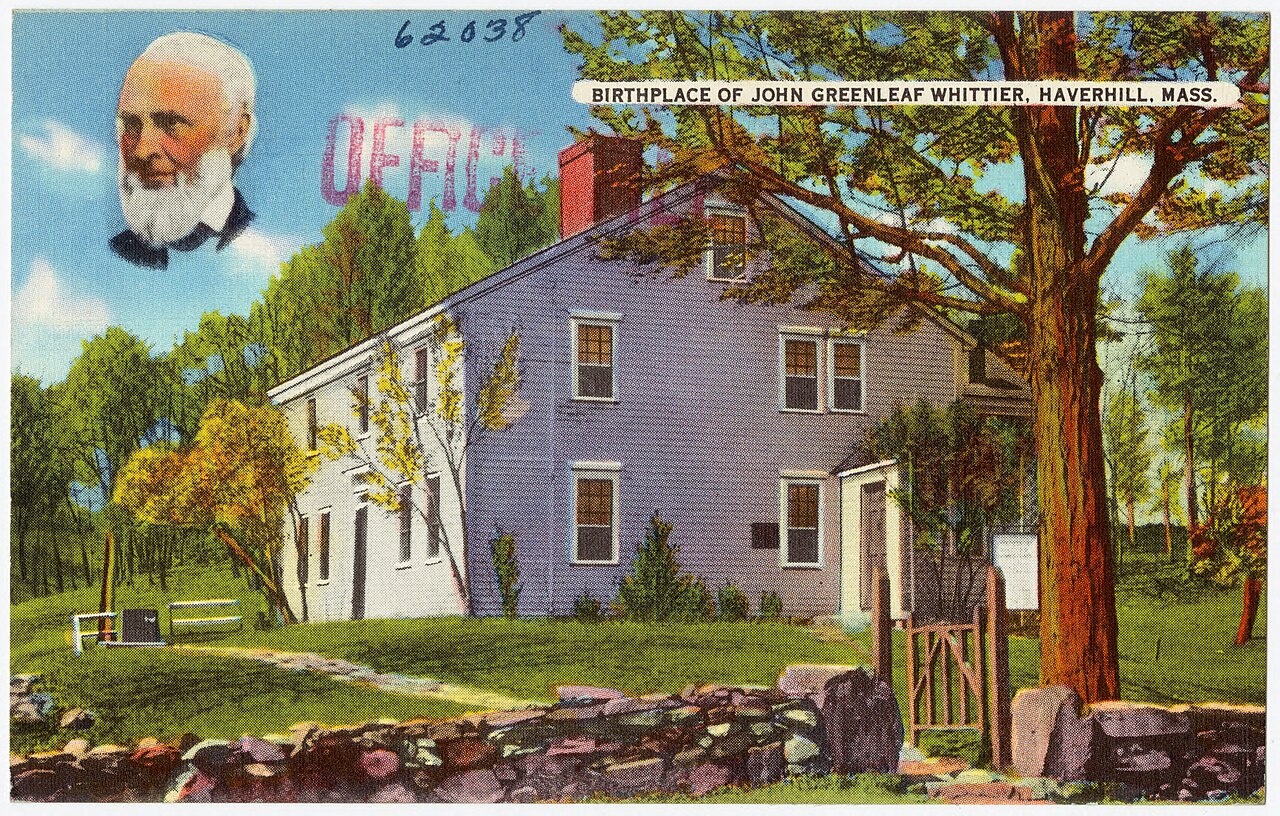
Via Wikimedia Commons: Birthplace of John Greenleaf Whittier, Haverhill, Mass (62038) by Published by Schlafman Borothers, Haverhill, Mass. Tichnor B, public domain.
Population
Haverhill grew quickly in the shoe era. The 1911 Britannica gives its population as 18,472 in 1880, 27,412 in 1890, 37,175 in 1900 and 44,115 in 1910. In 1900, 8,530 residents were foreign-born, among them 2,403 French Canadians, 1,651 English Canadians and 2,144 Irish.
The 2020 census counted 67,787 residents. A July 2023 report by researchers at the University of Massachusetts Boston found that 15,998 of them, or 23.6 percent, identified as Latino, making Latinos the city's second-largest ethnic and racial group, and that an 81.2 percent increase in the Latino population between 2010 and 2020 accounted for much of the city's growth over that decade (Granberry, Martins and Borges, 2023).
Haverhill today
According to the City of Haverhill, computer technology and research firms now operate in its industrial parks and business districts, alongside a rehabilitated central business district. The Merrimack River is used for walking, boating and bird watching, including the watching of bald eagles.
Sources
- City of Haverhill, "History and Heritage". haverhillma.gov/parks-recreation-culture/history-and-heritage/
- "Haverhill (Massachusetts)", Encyclopædia Britannica, 11th edition, vol. 13 (1911), transcribed on Wikisource. en.wikisource.org/wiki/1911_Encyclop%C3%A6dia_Britannica/Haverhill_…
- Haverhill Board of Trade, History of the City of Haverhill, Massachusetts, Showing Its Industrial and Commercial Interests and Opportunities (Haverhill, 1905), transcription at LDS Genealogy. ldsgenealogy.com/MA/History-of-the-city-of-Haverhill-Massachusetts-…
- New Hampshire State Parks, "Hannah Duston Memorial Historic Site". nhstateparks.org/find-parks-trails/hannah-duston-memorial-historic-…
- Jenny Whidden, "Abenaki leaders, Duston descendants gather on N.H.'s Hannah Duston island for first in-person state advisory committee meeting", New Hampshire Public Radio, 12 August 2021. nhpr.org/nh-news/2021-08-12/abenaki-leaders-duston-descendants-gath…
- U.S. House of Representatives, History, Art & Archives, "A Motion to Censure Representative John Quincy Adams of Massachusetts" (7 February 1842). history.house.gov/HistoricalHighlight/Detail/35497
- National Park Service, NPGallery, National Register of Historic Places record "Whittier, John Greenleaf, Homestead (Haverhill)". npgallery.nps.gov/AssetDetail/NRIS/14000759
- Phillip Granberry, Victor Luis Martins and Michelle Borges, "Latinos in Massachusetts Selected Areas: Haverhill", Gaston Institute, University of Massachusetts Boston, July 2023. scholarworks.umb.edu/gaston_pubs/300
