Compare versions
Version 2 → Version 3 (current). Removed · Added. This shows the entry's text as it is written, including its formatting marks.
Version 2 · Version 3 (current) · Version history
Side by side · Together
Merrimac is a small town in Essex County, Massachusetts, on the north bank of the Merrimack River at the New Hampshire border; it was the West Parish of Amesbury until 1876, and in the nineteenth century it was a centre of carriage building.
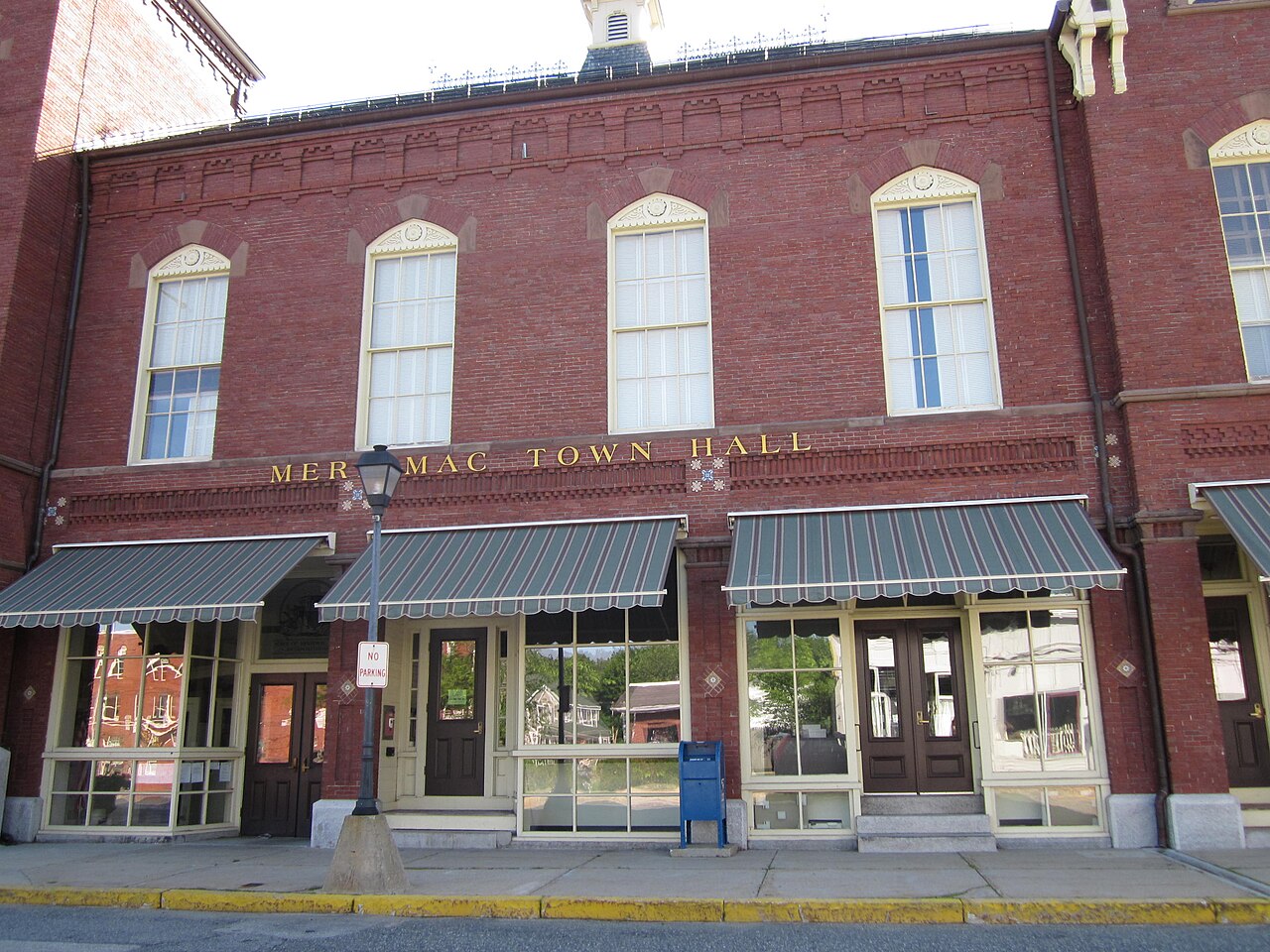
*Via Wikimedia Commons: [Merrimac Town Hall](https://commons.wikimedia.org/wiki/File:Merrimac_Town_Hall.jpg) by Doug Kerr, [CC BY-SA 2.0](https://creativecommons.org/licenses/by-sa/2.0).*
## Geography
When Merrimac was set off as a town, William T. Davis described its territory in D. Hamilton Hurd's *History of Essex County* (1888) as [about three miles long by two and a half miles wide](https://archive.org/details/historyofessexco02hurd), bounded by the Merrimack River, the city of [Haverhill](/t/1945/haverhill-massachusetts), the New Hampshire line and the parent town of Amesbury. The U.S. Census Bureau's 2024 gazetteer gives the town [8.499 square miles of land and 0.399 square miles of water](https://www2.census.gov/geo/docs/maps-data/data/gazetteer/2024_Gazetteer/2024_Gaz_cousubs_national.zip), about 22.0 and 1.0 square kilometres.
Davis described the land as a mix of hill, valley and plain. A range of hills known as Long and Red Oak extends along the south and west, and to the west the summit of Brandy Brow marks the meeting point of four towns in two states ([Hurd, 1888](https://archive.org/details/historyofessexco02hurd)). The town has two historic villages: the centre, once called West Amesbury, and Merrimacport on the river, earlier known as the river village of West Amesbury and as South Amesbury ([Hurd, 1888](https://archive.org/details/historyofessexco02hurd); [Merrill, 1880](https://archive.org/details/historyofamesbur00merr_0)). The town takes its name from the river, which older sources, including the act that created the town, spell "Merrimac" ([Hurd, 1888](https://archive.org/details/historyofessexco02hurd)).
## Early settlement: Jamaco and the West Parish
The land that became Merrimac was part of the large grant first settled by the English as Salisbury, and later part of Amesbury. Essex National Heritage Area dates the first English settlement of the area to [1638](https://essexheritage.org/explore/cities-and-towns/merrimac/), when it belonged to Salisbury, and the town library gives the same year ([Merrimac Public Library](https://merrimaclibrary.org/?p=18233)). Davis was more cautious, writing that the date of settlement of the West Parish [cannot be definitely fixed](https://archive.org/details/historyofessexco02hurd). He records that Edward Cottle lived there "at a very early period", that Samuel Foot and John Pressey were there in 1659 and 1664, and that the Tuxbury, Nichols and Sargent families were settled before 1670.
For a century or more the district was called Jamaco. Davis describes its growth as the fear of Indian raids eased and settlers pushed into outlying land, with families such as the Davis, Kelly and Clement families arriving early in the eighteenth century and Abraham Merrill moving there from Newbury about 1722 ([Hurd, 1888](https://archive.org/details/historyofessexco02hurd)). Small-scale shipbuilding went on at Jamaco: a Thomas Harvey built vessels there on land the town granted him in 1710 ([Hurd, 1888](https://archive.org/details/historyofessexco02hurd); [Merrill, 1880](https://archive.org/details/historyofamesbur00merr_0)). Essex National Heritage Area describes the community of the seventeenth and eighteenth centuries as [mainly agricultural and fishing](https://essexheritage.org/explore/cities-and-towns/merrimac/).
### The church that made a parish
In New England a parish was a district that supported its own church, and Merrimac grew out of one. As the western district grew, its people wanted a meeting-house of their own; after an earlier vote that was reconsidered, the town agreed in 1722 and a meeting-house was built at Jamaco. The West Parish undertook to pay its own minister, and the General Court, the province's legislature, confirmed the division of Amesbury into two precincts in May 1725 ([Hurd, 1888](https://archive.org/details/historyofessexco02hurd); [Merrill, 1880](https://archive.org/details/historyofamesbur00merr_0)). The second church in Amesbury was gathered on 19 May 1726 ([Merrill, 1880](https://archive.org/details/historyofamesbur00merr_0)), and Paine Wingate, a Harvard graduate of 1723 from Hampton, New Hampshire, was ordained as its minister in June 1726; Merrill gives the date as 3 June and Davis as 15 June. He served for nearly sixty years, until his death on 19 February 1786, and is buried in the Merrimac cemetery. His son, also named Paine Wingate, became a judge of New Hampshire's highest court and a representative and senator for that state in Congress ([Hurd, 1888](https://archive.org/details/historyofessexco02hurd)).
Davis gave the church's history a large share of his account because, he wrote, the population and the church were [identical](https://archive.org/details/historyofessexco02hurd): the town grew from the parish. The Congregational church was the only religious society in the district until a Universalist society built a meeting-house in 1836, and a Baptist church was organised at what is now Merrimacport in 1849 ([Hurd, 1888](https://archive.org/details/historyofessexco02hurd)).
## The river village
Merrimacport, on the river, was the parish's trading place. Davis records that brick-making was carried on there at an early date, and that it took part in a [trade with the West Indies](https://archive.org/details/historyofessexco02hurd) of some size, serving as a distribution point for sugar and molasses to neighbouring towns. Earthenware was made at the Port from about 1790; James Chase took up the trade in 1816, and his son Phineas carried it on after his death in 1858. Coopering (barrel-making) was once active there, a tannery was built about 1827, and in 1860 the South Amesbury Wharf Company was formed ([Hurd, 1888](https://archive.org/details/historyofessexco02hurd)).
## The carriage town
Carriage building made Merrimac. Davis wrote that the trade, [upon which the prosperity of Merrimac chiefly depends](https://archive.org/details/historyofessexco02hurd), was begun early in the nineteenth century by Michael Emery of West Newbury, who had learned it in Newburyport. In its early years, he explained, no single shop built a whole carriage: one made bodies, another the running gear, another the iron work and another the trimming and painting, and carriages were assembled by exchanging parts between them. Building carriage bodies and sleigh woodwork remained a separate trade in his day.
The industry gathered capital and suppliers around it. In 1848 the West Amesbury Manufacturing Company was incorporated to make carriages, doors and blinds, and it made carriage wheels and later running gears ([Hurd, 1888](https://archive.org/details/historyofessexco02hurd)). Davis credits John S. Foster with the first use of machinery to make carriage gears; the wheel factory he later ran with partners produced four to five thousand sets of wheels a year before it burned in 1882. Two local firms of importers and dealers in carriage materials, he wrote, had combined sales of nearly a million dollars. Merrill's *History of Amesbury* (1880) noted that the town's carriages were [shipped to nearly all parts of the world](https://archive.org/details/historyofamesbur00merr_0).
Davis listed each carriage maker then in business with its founding year, annual output and workforce. Adding his figures gives 19 firms, 15 in the centre and 4 at Merrimacport, making about 3,100 carriages and about 460 sleighs a year, worth roughly $870,000, and employing about 470 men; the largest, H. G. & H. W. Stevens, employed 100 ([Hurd, 1888](https://archive.org/details/historyofessexco02hurd)). He concluded that Merrimac [may be said to be almost exclusively a carriage town](https://archive.org/details/historyofessexco02hurd), turning out everything from coaches, landaus and coupés to road wagons and sleighs. According to the coachbuilding historian Mark Theobald, [no fewer than seventy-two carriage building plants](http://www.coachbuilt.com/bui/j/judkins/judkins.htm) were operating in the Merrimac and Amesbury area in the 1870s.
## Becoming a town
Several earlier attempts to change Amesbury's boundaries had failed, and, according to Joseph Merrill's *History of Amesbury* (1880), the West Parish had generally opposed them. By the 1870s that had changed. Merrill names a proposed branch railway through the western part of the town, for which Amesbury refused its credit, and the inconvenience of town meetings held alternately at the east and west ends after the town house burned. Together with an offer by William P. Sargent, a West Amesbury native who had built a large carriage business in Boston, to give the new town a town hall, these [united the people in favor of a new town](https://archive.org/details/historyofamesbur00merr_0).
A public meeting at Coliseum Hall on 18 January 1876 and a mass meeting at South Amesbury on 26 January led to petitions to the legislature. The east end of Amesbury largely opposed the division, but an Amesbury town meeting voted 419 to 210 to waive its right to formal notice of the petition. A legislative committee visited on 2 March and reported in favour, and the act incorporating Merrimac passed the legislature on 10 April 1876 and was [signed by the governor the next day](https://archive.org/details/historyofamesbur00merr_0). Merrill gives the new town's population at the last census as 2,171.
The first town meeting, held at Mechanics' Hall on 20 April 1876, chose Bailey Sargent as town clerk and William H. Haskell, S. S. Blodgett and Alexander Smart as selectmen ([Hurd, 1888](https://archive.org/details/historyofessexco02hurd); [Merrill, 1880](https://archive.org/details/historyofamesbur00merr_0)). The town hall, Sargent's gift, was built on a lot at the corner of Main and School Streets bought and given by six residents; its cornerstone was laid on 27 July 1876 and it was dedicated on 13 November 1876. Merrill gives its cost, including the lot, as close to $25,000, describes a hall seating about 600 people, and records a poem written for the dedication by Harriet Prescott Spofford ([Merrill, 1880](https://archive.org/details/historyofamesbur00merr_0)).
The town's library followed. In August 1876 Dr. James R. Nichols, a chemist who had grown up on his father's farm in West Amesbury, offered 1,000 volumes, and the library opened in the town hall on 10 May 1877 ([Merrimac Public Library](https://merrimaclibrary.org/?p=18233); [Merrill, 1880](https://archive.org/details/historyofamesbur00merr_0)).
## Railroad, banks and the Civil War
The West Amesbury Branch Railroad Company was incorporated on 8 May 1868, opened in 1872 and was leased to the Boston and Maine Railroad for 99 years from 1 January 1873 ([Hurd, 1888](https://archive.org/details/historyofessexco02hurd)); Merrill notes that it joined the Boston and Maine at [Newton Junction, N. H.](https://archive.org/details/historyofamesbur00merr_0) The First National Bank of Amesbury, organised in February 1864, was renamed the First National Bank of Merrimac by act of Congress on 27 December 1876, and a savings bank founded in 1871 took the name Merrimac Savings Bank in 1877 ([Hurd, 1888](https://archive.org/details/historyofessexco02hurd)).
In July 1861 Captain Joseph W. Sargent of the West Parish raised a company that became Company E of the Fourteenth Regiment. Davis lists its members and records men who died of disease and wounds and others held at Andersonville and other Confederate prisons ([Hurd, 1888](https://archive.org/details/historyofessexco02hurd)).
## Population and other industry in the 1880s
According to Davis, Merrimac had 2,237 people in 1880 and 2,378 in 1885, and its taxable valuation rose from $968,845 in 1876 to $1,204,136 in 1886 ([Hurd, 1888](https://archive.org/details/historyofessexco02hurd)). Besides carriages, the Bay State Felt Boot and Shoe Company set up in Merrimac in September 1885 to make felt boots and shoes by a patented process, selling mainly in the cold-winter states of the West and northern New England. The town had a weekly newspaper from 1882, under the names *Merrimac Enterprise* and then *Merrimac Budget* ([Hurd, 1888](https://archive.org/details/historyofessexco02hurd)).
## From carriages to automobile bodies
Merrimac's best-known firm made the change from carriages to cars. According to Theobald's history of the J. B. Judkins Company, John B. Judkins, a trimmer from New Hampshire, set up for himself in West Amesbury in 1857 with $300 in capital, and his firm won a gold medal for a carriage shown at the 1876 Centennial Exposition in Philadelphia ([Coachbuilt.com](http://www.coachbuilt.com/bui/j/judkins/judkins.htm)). In 1897 the New York distributors of the Electric Vehicle Company of Hartford, Connecticut, ordered twenty bodies for its electric cars, the firm's first automobile work. For years it built carriages and car bodies side by side, until the last Judkins carriage left the shop in 1910.
In the 1920s Judkins was, with Brunn & Co. of Buffalo, one of the two largest builders of custom and series-built bodies for Lincoln, averaging about 500 bodies a year in its peak years of 1921 to 1932 ([Coachbuilt.com](http://www.coachbuilt.com/bui/j/judkins/judkins.htm)). A separate concern started by the family, the Merrimac Body Company, opened in January 1920 in a former fibre plant, employed close to 100 craftsmen at its height and closed in 1934. In the Depression Judkins's body orders fell far below their 1920s level; from 1936 it also built prefabricated diners sold as Sterling Diners, and it closed in 1942 ([Coachbuilt.com](http://www.coachbuilt.com/bui/j/judkins/judkins.htm)). The town library's Tudor building of 1930, the Thomas H. Hoyt Memorial Library, has stained-glass windows by Charles J. Connick of Boston, commissioned by [Mr. Judkins, an automobile manufacturer in Merrimac](https://merrimaclibrary.org/?p=18233).
## Merrimac today
As of 2024 the Census Bureau estimated Merrimac's population at [6,810](https://www2.census.gov/programs-surveys/popest/datasets/2020-2024/cities/totals/sub-est2024.csv) (1 July 2024), against an April 2020 estimates base of 6,726, roughly 800 people per square mile of land. The town's government includes a town meeting and a Select Board, and its students attend the Pentucket Regional School District and Whittier Regional Vocational Technical High School ([Town of Merrimac](https://townofmerrimac.com/)). As of November 2026 the town's website lists a committee planning the celebration of its 150th anniversary ([Town of Merrimac](https://townofmerrimac.com/)).
The public library moved again in 2004, to a new building at 86 West Main Street on six acres the town bought in 2002 ([Merrimac Public Library](https://merrimaclibrary.org/?p=18233)). Essex National Heritage Area lists two farms in the town among its sites, Sargent Farm on Bear Hill Road and Sunday Farm on Birch Meadow Road ([Essex Heritage](https://essexheritage.org/explore/cities-and-towns/merrimac/)).
## Sources
- William T. Davis, "Merrimac", chapter CXXVI in D. Hamilton Hurd (ed.), *History of Essex County, Massachusetts, with Biographical Sketches of Many of Its Pioneers and Prominent Men*, vol. 2, Philadelphia: J. W. Lewis & Co., 1888, pp. 1535–1549. Internet Archive. https://archive.org/details/historyofessexco02hurd
- Joseph Merrill, *History of Amesbury, Including the First Seventeen Years of Salisbury, to the Separation in 1654; and Merrimac, from Its Incorporation in 1876*, Haverhill: Press of Franklin P. Stiles, 1880. Internet Archive. https://archive.org/details/historyofamesbur00merr_0
- Mark Theobald, "J. B. Judkins Co.", Coachbuilt.com, 2004. http://www.coachbuilt.com/bui/j/judkins/judkins.htm
- Merrimac Public Library, "Library History" (read November 2026). https://merrimaclibrary.org/?p=18233
- Essex National Heritage Area, "Merrimac" (read November 2026). https://essexheritage.org/explore/cities-and-towns/merrimac/
- Town of Merrimac, official website (read November 2026). https://townofmerrimac.com/
- U.S. Census Bureau, 2024 Gazetteer Files, county subdivisions. https://www2.census.gov/geo/docs/maps-data/data/gazetteer/2024_Gazetteer/2024_Gaz_cousubs_national.zip
- U.S. Census Bureau, Population Estimates Program, "Annual Estimates of the Resident Population for Minor Civil Divisions", Vintage 2024 (sub-est2024). https://www2.census.gov/programs-surveys/popest/datasets/2020-2024/cities/totals/sub-est2024.csv
