Impeachment is the process by which a legislature formally charges a public official with serious misconduct, the first step toward a trial that can remove that official from office.
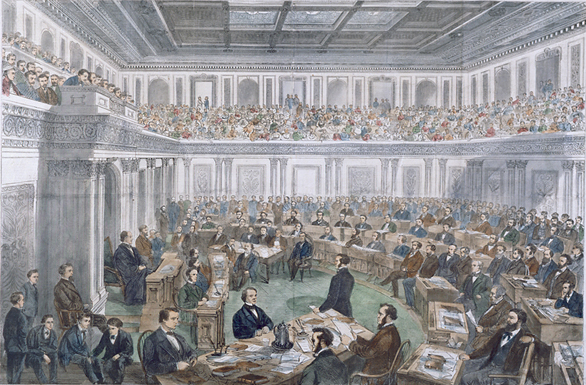
A nineteenth-century engraving of the United States Senate sitting as a court for the impeachment trial of President Andrew Johnson in 1868.
In the United States the word names only the charge. The House of Representatives impeaches, and the Senate then holds a trial; an official who has been impeached has not thereby been removed.[1][21] The United States Constitution gives the House "the sole Power of Impeachment" and the Senate "the sole Power to try all Impeachments", and removal follows only on conviction.[1]
The practice began in medieval England and passed to the American colonies and then into the United States Constitution of 1787.[3][25] Other countries have since written it, in different forms, into their own constitutions, among them South Korea, Brazil and the Philippines.[54][56][57] Some leave the verdict to the upper house of the legislature; others, such as South Korea and Germany, hand it to a constitutional court.[54][56][57][62] In Britain, where it began, it has not been used since 1806.[12]
Origins in England
The practice began in the English Parliament. The United States Senate's historical account dates it to 14th-century England, where Parliament used it to hold the king's advisers to account, and notes that it was revived in the early 1600s.[6] The House of Representatives' history office describes it in the same terms, as a British practice that developed from the fourteenth century as Parliament's way of holding the Crown's ministers accountable.[3] In the English form the House of Commons brought the charges and the House of Lords tried them.[3]
The medieval cases
The first recorded impeachment took place in the "Good Parliament" of 1376, late in the reign of Edward III.[25] According to Charles Moreton of the History of Parliament, the Commons, speaking through Sir Peter de la Mare, who is generally recognised as the first Speaker, drew up formal allegations against courtiers and financiers they suspected of incompetence and corruption, and the Lords tried the charges as a high court.[25] Those impeached included the king's chamberlain, William, Lord Latimer, and the London merchant and financier Richard Lyons.[25] Chris Monaghan, a law lecturer, notes that Latimer was impeached over financial irregularities and his military record.[12]
The procedure was used again in the political crises of the following decades. In the "Wonderful Parliament" of 1386 the chancellor, Michael de la Pole, earl of Suffolk, was impeached, and in the "Merciless Parliament" of 1388 Richard II's leading courtiers were attacked through appeals of treason and impeachment; the king's former tutor, Sir Simon Burley, was impeached and executed.[25] A House Judiciary Committee staff report of 1974 states that the phrase "high Crimes and Misdemeanors" first appears in the 1386 case against de la Pole, and that some of the charges against him were not ordinary crimes at all: one accused him of failing to spend money Parliament had set aside to ransom the town of Ghent, which was then lost.[22] In 1450 the Commons impeached his grandson, William de la Pole, duke of Suffolk, for "high Crimes and Misdemeanors" that included squandering the public treasure.[22][25] By the mid-15th century impeachment had fallen into disuse.[6]
Revival under the Stuarts
Parliament revived the procedure in the early 17th century, and used it frequently under James I and Charles I.[6][22] The 1974 staff report counts more than 100 impeachments voted by the House of Commons between 1620 and 1649, some for high treason and others for high crimes and misdemeanors.[22] The most prominent was that of Thomas Wentworth, earl of Strafford, chief among the ministers Parliament blamed for advancing Charles I's absolutist aims, whom the Commons impeached in 1640; the first article accused him of having "traiterously endeavored to subvert the Fundamental Laws and Government" of the realm.[22] Strafford defended himself on the ground that the acts charged were not treason under the Statute of Treasons of 1352, and the Commons did not bring his trial to a vote in the Lords; instead he was put to death under a bill of attainder.[22] A bill of attainder is an act of the legislature that declares a named person guilty and punishes him without a trial. After the Restoration of 1660, Parliament impeached officers of the Crown for such things as negligence in their duties and impropriety in office.[22]
English impeachment reached far beyond what the American framers later allowed. The Commons could impeach anyone except the monarch, including private citizens, for offences thought to be beyond the reach of the ordinary courts.[20][21] The Lords could convict by a simple majority and impose any punishment, including imprisonment, fines or death, and the Crown could pardon a person convicted on impeachment.[20][21] The framers of the American Constitution narrowed the procedure: impeachment there reaches only federal officers, the grounds are limited to treason, bribery and high crimes and misdemeanors, conviction needs two-thirds, the punishment stops at removal and disqualification, and the president cannot pardon it.[20][21]
Hastings, Melville and the end of the practice
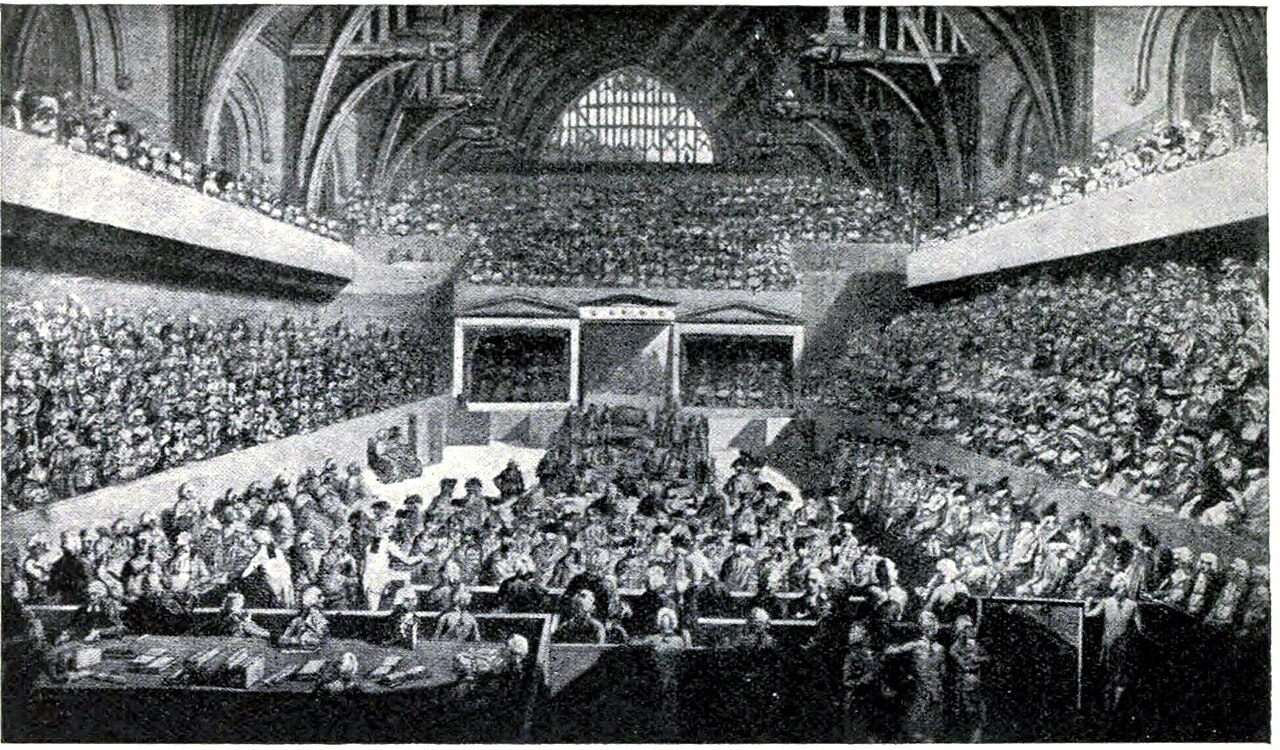
A print of the impeachment trial of Warren Hastings before the House of Lords in Westminster Hall.
The best-known English case was that of Warren Hastings, the former governor-general of Bengal.[11][12] The campaign against him was led by Edmund Burke and Charles James Fox, and grew out of years of concern in London about the conduct of the East India Company's servants in India.[12] The Commons impeached him in 1787, and his trial before the House of Lords, with Burke and Richard Sheridan among the managers who prosecuted it, lasted seven years and ended in his acquittal.[12] The articles charged him with "high crimes and misdemeanors" in the form of gross maladministration, corruption in office and cruelty toward the people of India, and the proceedings ended in 1795.[22] The trial was still in progress while the American Constitution was being drafted, and was followed closely in America.[6]
English impeachment trials could be long, public occasions. When the Commons debated on 26 March 1806 where the trial of Viscount Melville should be held, Melville's son Robert Dundas argued against Westminster Hall on grounds of time and cost, recalling that the case of Warren Hastings, tried in Westminster-hall, had lasted eight sessions.[10] Supporters of the Hall argued that publicity and solemnity were essential to an impeachment, and their motion was carried.[10]
Melville's was the last impeachment in Britain. He had been accused of misusing public funds, and the House of Lords acquitted him in 1806.[12] The case began in 1805 with a report accusing him of negligence as Treasurer of the Navy, and the Commons' vote to censure him that April was carried only on the Speaker's casting vote.[11] The History of Parliament describes impeachment as a power Parliament has held since medieval times that may still exist "in theory at least".[11] The law lecturer Chris Monaghan, writing in 2022, traces its decline to the period from the 1740s onward, when other means of holding ministers to account began to supersede it.[12] He dates that change to the resignation of Sir Robert Walpole, who left office when he realised he no longer had the confidence of the House of Commons.[12] He notes that in 2004 a group of members of Parliament drafted a motion to impeach the prime minister, Tony Blair, backed by a legal opinion, and that the attempt went nowhere.[12]
Adoption in the United States
Many American colonial and state governments used impeachment before the Constitution, according to the Senate.[5] The House history office notes that some states allowed it for "maladministration" or "corruption" before the Constitution was ratified in 1788.[3] The colonies narrowed the English model, largely limiting impeachment to officeholders, for misconduct in office, with removal as the punishment; many of the state constitutions written between 1776 and 1787 did the same, while also allowing disqualification from future office.[20][21] The body that tried impeachments varied from state to state; New York's constitution of 1777, for example, gave the task to a court made up of state senators, the judges of the state supreme court and the chancellor.[20]
The Constitutional Convention
At the Constitutional Convention of 1787 the delegates disagreed over whether a president should be impeachable at all. Rufus King of Massachusetts argued that elections were the proper check, since a president would periodically be tried for his behaviour by his electors.[3][23] Elbridge Gerry, also of Massachusetts, took the other side: "A bad one ought to be kept in fear of them."[3][23]
That exchange came on 20 July 1787, when Pinckney of South Carolina and Gouverneur Morris of Pennsylvania moved to strike out the clause making the executive removable on impeachment, according to James Madison's notes of the debate.[23] George Mason of Virginia replied: "Shall any man be above Justice? Above all shall that man be above it, who can commit the most extensive injustice?"[23] Benjamin Franklin argued that where no such procedure existed, the recourse against an obnoxious chief magistrate had been assassination, and that impeachment would allow both the punishment of a guilty executive and the "honorable acquittal" of one unjustly accused.[23] Madison thought it "indispensable" to guard against "the incapacity, negligence or perfidy of the chief Magistrate".[23] Morris changed his mind during the debate, pointing out that even Charles II had been bribed by Louis XIV, and the convention voted, eight states to two, to keep the executive removable by impeachment.[21][23]
When the grounds for removal were debated, James Madison objected that "maladministration" was too vague, and George Mason proposed "other high Crimes and Misdemeanors" instead, which the delegates accepted.[3] The draft before the convention on 8 September 1787 allowed impeachment only for treason and bribery.[24] Mason objected that treason as the Constitution defined it would not reach "many great and dangerous offences", remarking that "Hastings is not guilty of Treason", and moved to add "or maladministration".[24] Madison answered that so vague a term "will be equivalent to a tenure during pleasure of the Senate", and Mason then substituted "other high crimes & misdemesnors agst. the State", which passed by eight states to three.[24] The 1974 staff report notes that the phrase was added with virtually no debate, but that there is evidence the framers knew the technical meaning it had acquired in English impeachments.[22]
An early plan would have given a role in impeachments to the judiciary; the delegates instead followed the British model, with the lower house prosecuting and the upper house judging.[3] According to the Senate Historical Office, Madison and Charles Cotesworth Pinckney objected to trial by the Senate on the ground that it would make the president too dependent on the legislature, and suggested the Supreme Court or a panel of state judges instead.[6] On 8 September Madison moved to remove the Senate as the trial court; Morris answered that the Supreme Court was too small and "might be warped or corrupted", Roger Sherman objected that the president would appoint the justices, and the motion failed with only two states in favour.[24] The framers also gave the Chief Justice the chair at a president's trial, so that a vice president, the Senate's usual presiding officer, would not preside over a proceeding that could make him president.[21]
Hamilton and the ratification debates
Alexander Hamilton defended the arrangement in Federalist No. 65. He wrote that the offences impeachment deals with are those that proceed from the misconduct of public men, "or, in other words, from the abuse or violation of some public trust", and that they could properly be called "POLITICAL".[2] He also foresaw the strain they would cause: a prosecution of this kind, he wrote, "will seldom fail to agitate the passions of the whole community, and to divide it into parties".[2] He asked of the trial court: "Where else than in the Senate could have been found a tribunal sufficiently dignified, or sufficiently independent?"[2]
Speakers at the state ratifying conventions gave further hints about what they thought the phrase covered. In North Carolina, James Iredell said impeachment would reach crimes "not easy to describe" that everyone would recognise as high crimes and misdemeanors against government, arising from "acts of great injury to the community"; in Virginia, Edmund Randolph said it was appropriate for a "willful mistake of the heart" but not for wrong opinions.[20][21] James Wilson, a delegate who later sat on the Supreme Court, called impeachments a matter of "political crimes and misdemeanors, and ... political punishments".[20][21]
What the Constitution says
The impeachment provisions are spread across the Constitution:
Article I, Section 2 gives the House of Representatives the sole power of impeachment.[1]
Article I, Section 3 gives the Senate the sole power to try impeachments. When the president is tried, the Chief Justice of the United States presides, and no one may be convicted without the agreement of two-thirds of the senators present. The judgment may go no further than removal from office and disqualification from holding federal office in future, but the person convicted remains liable to ordinary prosecution and punishment under the law.[1] Senators sitting for an impeachment must also be "on Oath or Affirmation".[1]
Article II, Section 2 lets the president grant pardons for offences against the United States, "except in Cases of Impeachment".[1]
Article II, Section 4 provides that the president, the vice president and all civil officers of the United States shall be removed on impeachment for, and conviction of, "Treason, Bribery, or other high Crimes and Misdemeanors".[1]
Article III, Section 2 requires criminal trials to be held by jury, except in cases of impeachment.[1]
The Constitution does not define "high Crimes and Misdemeanors". The Senate notes that the meaning of the phrase has long been debated.[5] Federal judges, who under Article III hold office "during good Behaviour", can be removed only by impeachment.[1][20]
How it works
In the House
In the House, the process usually begins with a resolution introduced by a member or a resolution authorizing an inquiry.[3] The Judiciary Committee ordinarily has jurisdiction; it decides whether to draw up articles of impeachment, the formal charges, and reports them to the full House, which adopts them by a simple majority.[3] Before the Judiciary Committee was created in 1813, special committees handled the charges.[3] The House then appoints members, called managers, to prosecute the case in the Senate.[3][5]
A member may also force the issue by offering an impeachment resolution on the floor as a "question of the privileges of the House", which the Speaker must schedule within two legislative days, according to the Congressional Research Service (CRS), Congress's research agency.[53] The House can then vote on the resolution, refer it to the Judiciary Committee, or "table" it, which disposes of it permanently; as of January 2024 no resolution brought up this way had been approved, and the House had nearly always investigated first before impeaching anyone.[53]
Neither chamber has adopted a rule setting the standard of proof. In practice each member decides for himself or herself how convinced to be, and some members have argued that the House, like a grand jury, need only find probable cause, leaving proof of guilt to the Senate.[21]
In the Senate
The Senate sits as a court, hears evidence and witnesses, and votes on each article.[5] Conviction requires a two-thirds vote; the penalty is removal from office, in some cases the Senate has also barred the person from holding office again, and there is no appeal.[5] Each senator swears or affirms to "do impartial justice according to the Constitution and laws", an oath first adopted for the trial of Senator William Blount in 1798.[21][32] A conviction on any one article is enough to remove the official.[21]
Disqualification from future office is decided by a separate vote. The practice began in 1862, when the Senate convicted Judge West H. Humphreys, who had taken a judgeship under the Confederacy without resigning his federal seat, and then voted separately to disqualify him.[21] Since then the Senate has treated disqualification as needing only a simple majority; the Senate disqualified Judge Robert Archbald in 1913 by 39 votes to 35.[21] In the most recent case, on 8 December 2010, the Senate voted 94 to 2 to disqualify Judge G. Thomas Porteous Jr. after convicting him.[50]
Since a rule adopted in 1935, the Senate may appoint a committee of senators to take evidence and report to the full Senate, and its impeachment rules were revised in 1986.[6] Trial committees heard evidence in the cases of the judges Harry Claiborne in 1986, Alcee Hastings and Walter Nixon in 1989, and Thomas Porteous in 2010, according to the Senate Historical Office.[6]
Walter Nixon, a former chief judge of the federal district court for the southern district of Mississippi, had been convicted by a jury of making false statements to a federal grand jury before the House impeached him.[9] He challenged his removal on the ground that a committee hearing was not a trial by the Senate.[9] On 13 January 1993 the Supreme Court, in an opinion by Chief Justice William Rehnquist, held in Nixon v. United States that his claim was nonjusticiable: the Constitution's word "try" did not set a limit the courts could enforce, so how the Senate conducts an impeachment trial is for the Senate to decide.[9] The Court added that judicial review would bring a "lack of finality" to the country's political life.[9] As a result, impeachment proceedings appear to be largely immune from review by the courts.[21]
Impeachment and criminal prosecution are separate. The Constitution leaves a convicted official open to ordinary prosecution, and the Senate has also rejected the argument that impeachment after an acquittal in court is double jeopardy: in 1989 it convicted Judge Alcee Hastings, whom a jury had acquitted of the underlying bribery conspiracy, and Hastings, who was not disqualified, was later elected to the House of Representatives.[1][21]
Cases in the United States
The House has begun impeachment proceedings more than 60 times, and roughly a third of those led to impeachment, according to its history office.[3] Its list of impeachments, read in November 2026, records 22 impeachments of 21 people since 1797: 15 federal judges, three presidents (one of them twice), two cabinet secretaries and one senator.[3][4]
William Blount, a senator from Tennessee, was impeached on 7 July 1797, the first case.[4] The Senate expelled him before his trial, and the charges were dismissed for want of jurisdiction.[4] The House history office notes that the case established that members of Congress are not "civil officers" within the meaning of the Constitution.[3] Blount had been accused of plotting to help Britain seize Spanish-held Florida and Louisiana with the aid of frontiersmen and Creek and Cherokee forces, and no member of Congress has been impeached since.[21][28]
Samuel Chase, an associate justice of the Supreme Court, was impeached in 1804 and acquitted.[4][7] The Senate's account says his acquittal, by a Senate controlled by his Jeffersonian Republican opponents, effectively protected judges from impeachment over disagreement with their opinions.[29]
Andrew Johnson became the first president to be impeached, on 24 February 1868.[4] The trial turned on whether a president could remove a cabinet officer without Congress's approval.[3] On the first vote, on the eleventh article, the Senate divided 35 guilty to 19 not guilty, one vote short of the 36 needed, with seven Republicans joining the twelve Democrats to acquit.[6]
William W. Belknap, secretary of war, was impeached in 1876 and acquitted.[4][7] He had resigned shortly before the House voted, but the Senate decided that it kept jurisdiction over a former official and tried him anyway.[30] A majority voted against him on all five articles, short of two-thirds, and 22 of the 25 senators who voted not guilty said they believed the Senate lacked jurisdiction.[21][30]
Richard Nixon was never impeached, but came close. On 6 February 1974 the House authorized the Judiciary Committee, chaired by Peter Rodino of New Jersey, to open an impeachment investigation, and the committee held televised hearings that May.[8] On 27 July 1974 it recommended a first article of impeachment, for obstruction of justice, and on 29 and 30 July two more, for abuse of power and contempt of Congress.[8] Nixon resigned on 9 August 1974, so the full House never voted on the articles; his successor, Gerald Ford, pardoned him on 8 September 1974.[8]
Bill Clinton was impeached on 19 December 1998 and acquitted on 12 February 1999.[4][7]
Donald Trump was impeached on 18 December 2019 and acquitted on 5 February 2020, and impeached again on 13 January 2021 and acquitted on 13 February 2021.[4][7]
Alejandro Mayorkas, secretary of homeland security, was impeached on 13 February 2024. On 17 April 2024 the Senate dismissed the charges as unconstitutional, and no trial was held.[4][7]
The House history office counts eight people, all federal judges, convicted and removed, and three of them, all removed judges, also barred from holding federal office in future: West H. Humphreys, Robert W. Archbald and G. Thomas Porteous Jr., according to the House's list.[3][4] Three other judges resigned before or during their trials, which ended the proceedings: Mark Delahay in 1873, George English in 1926 and Samuel Kent in 2009.[4][7][21]
Presidential trials
The House adopted its resolution impeaching Andrew Johnson by 126 votes to 47, and later adopted eleven articles, eight of them about his alleged violation of the Tenure of Office Act, a law of 1867 that barred the president from dismissing cabinet officers without the Senate's consent.[26][27] Johnson had dismissed the secretary of war, Edwin Stanton.[26] Chief Justice Salmon Chase presided over the trial, which opened on 5 March 1868.[26] Johnson's lawyers argued that the act did not cover Stanton, whom Lincoln had appointed, and that Johnson had meant to test the act's constitutionality.[26] After the 35 to 19 vote of 16 May, the Senate voted on two more articles on 26 May with the same result and then adjourned the trial.[6][27] One of the seven Republicans who voted to acquit, James Grimes of Iowa, said he could not "destroy the harmonious working of the Constitution for the sake of getting rid of an Unacceptable President".[26]
President Clinton's impeachment grew out of an investigation by the independent counsel Kenneth Starr, who reported to the House in September 1998 on whether Clinton had lied under oath and obstructed justice about his relationship with a White House intern.[21][31] The Judiciary Committee recommended four articles; on 19 December 1998 the House adopted the first, charging perjury before a federal grand jury, by 228 to 206, and the third, charging obstruction of justice, by 221 to 212, and rejected the other two.[21][35][36] Chief Justice William Rehnquist took the oath to preside when the trial opened in January 1999.[4][32] On 12 February 1999 the Senate voted 45 guilty to 55 not guilty on the first article and 50 to 50 on the second, far short of the two-thirds required.[37][38]
President Trump's first impeachment arose from a telephone call in which he asked President Volodymyr Zelenskyy of Ukraine to announce two investigations, one of them involving a potential opponent in the 2020 election, while military aid to Ukraine was frozen at his direction.[21] On 18 December 2019 the House adopted an article for abuse of power by 230 to 197 and an article for obstruction of Congress by 229 to 198.[39][40] Chief Justice John Roberts took the oath to preside on 16 January 2020.[33] The Senate declined to subpoena further witnesses and documents, with only 49 senators in favour, and on 5 February 2020 voted 48 to 52 on the first article and 47 to 53 on the second.[21][41][42] One senator of the president's own party voted to convict.[31]
The second impeachment followed the events of 6 January 2021, when supporters of the president tried to disrupt Congress's certification of Joe Biden's election.[21] On 13 January 2021 the House adopted a single article, for incitement of insurrection, by 232 to 197.[21][43] The Senate trial began after Trump had left office.[21] The Senate treated the requirement that the Chief Justice preside as not extending to a former president, and the president pro tempore of the Senate, Patrick Leahy, presided.[21][34] On 9 February 2021 the Senate voted 56 to 44 that a former president was subject to a court of impeachment for acts committed in office, and on 13 February 2021 it voted 57 to 43 to convict, short of the two-thirds required; seven senators of his own party voted guilty.[31][44][45]
Judges and other officials
Most impeachments have concerned federal judges, and all eight convictions have been of judges.[3] The charges have ranged from drunkenness on the bench, in the case of John Pickering, removed in 1804, to tax evasion, perjury and bribery.[4][7] Several cases turned on whether conduct that was not a crime could be an impeachable offence. In 1905 the Senate acquitted Judge Charles Swayne, although his own counsel admitted some of the lapses charged, because many senators did not think they amounted to high crimes and misdemeanors; in 1913 it convicted Judge Robert Archbald although none of the articles charged an indictable offence.[6] In 1936 Judge Halsted Ritter was acquitted on six articles and convicted on the seventh by exactly the two-thirds required; the CRS describes the conduct for which he was convicted as having brought his court "into scandal and disrepute".[6][21]
In the 1980s the House impeached three judges, Harry Claiborne, Alcee Hastings and Walter Nixon, each after a criminal case.[21] Judge Porteous, removed in 2010, was the first official convicted partly for conduct before he took federal office; the Senate voted 96 to 0 on the article covering his conduct both as a state judge and as a federal judge.[21][49]
Mayorkas was impeached on 13 February 2024 by a vote of 214 to 213, on charges of "willful and systemic refusal to comply with the law" and breach of public trust.[4][46] On 17 April 2024 the Senate, without holding a trial, upheld points of order that the two articles were unconstitutional, by 51 to 48 and 51 to 49.[47][48]
Many inquiries have stopped short of impeachment. In 1842 a House select committee condemned President John Tyler's use of the veto and suggested that he might be a suitable subject for impeachment, but nothing followed after his opponents lost their House majority.[21] In 1970 a Judiciary subcommittee investigated Justice William O. Douglas and concluded that impeachment was not warranted; in that debate Gerald Ford, then a representative, declared that "an impeachable offense is whatever a majority of the House of Representatives considers it to be at a given moment in history".[6][21]
On 15 September 2026 the House voted 232 to 147, with 47 members voting "present", to table a resolution impeaching President Trump (H. Res. 1486), and on 10 November 2026 it voted 211 to 204 to refer a resolution impeaching the secretary of defense, Pete Hegseth (H. Res. 1655).[51][52]
In the American states
Impeachment is used in the states as well. On 29 January 2009 the Illinois Senate voted 59 to 0 to convict Governor Rod Blagojevich of abuse of power, removing him from office, and in a second vote barred him from holding public office in the state again, NBC News reported.[13] The Illinois House had impeached him on 9 January, and he was the first Illinois governor to be impeached and removed, according to Minnesota Public Radio.[14] Seven governors had been removed by impeachment before him, the most recent being Evan Mecham of Arizona in 1988, according to NBC News.[13]
Outside the United States
Impeachment exists outside the United States as well, though the body that judges the case can differ.[54][56][62]
South Korea
In South Korea the National Assembly impeaches and the Constitutional Court decides whether the impeachment stands.[15][56] Under Article 65 of the 1987 constitution, a motion to impeach the president must be proposed by a majority of the Assembly's members and passed by two-thirds of them, a higher bar than for other officials; the impeached official is suspended until the court decides, and the court's decision can go no further than removal from office.[56] A decision to uphold an impeachment needs the votes of at least six of the court's nine justices.[17][56] In December 2016 the National Assembly voted to impeach President Park Geun-hye, and on 10 March 2017 the Constitutional Court unanimously approved that vote, removing her from office.[15] As an analysis in the Yale Journal of International Law notes, the court ruled on the legitimacy of the Assembly's decision to impeach, not on her criminal guilt.[15] The court upheld the charge that she had abused her power to benefit her friend Choi Soon-sil and rejected the other grounds.[15]
Park was not the first South Korean president to be impeached. On 14 May 2004 the Constitutional Court dismissed the impeachment of President Roh Moo-hyun (case 2004Hun-Na1). It found that he had failed to keep the political neutrality the law required of him, but held that removal was justified only when the gravity of a violation clearly outweighed the effect of removing an elected president, and that his did not, according to a case summary in the Election Judgments database.[16] Two decades later the National Assembly impeached President Yoon Suk Yeol on 14 December 2024 over his declaration of martial law, and on 4 April 2025 the court unanimously upheld the impeachment, removing him from office.[17] A May 2025 analysis by the U.S.-Asia Law Institute notes that the court took 63 days to decide Roh's case and 91 days to decide Park's.[17] In Yoon's case the court rejected his argument that the declaration had been meant only as a "warning" to the public about the opposition's conduct.[17]
Brazil
In Brazil the Chamber of Deputies authorizes the case and the Federal Senate tries it.[18][57] Under the 1988 constitution, two-thirds of the Chamber must accept the accusation; the president is suspended for up to 180 days once the Senate opens proceedings, the president of the Supreme Federal Court presides, and a two-thirds vote of the Senate brings loss of office and eight years' disqualification from public office.[57] On 29 September 1992 the Chamber voted 441 to 38 to authorize proceedings against President Fernando Collor de Mello. Collor resigned on 29 December 1992, and the next day the Senate voted 76 to 2 to bar him from public office for eight years, according to the Chamber of Deputies.[18] On 31 August 2016, in a trial presided over by Ricardo Lewandowski, president of the Supreme Federal Court, the Senate voted 61 to 20 to convict President Dilma Rousseff of a crime de responsabilidade ("crime of responsibility") for issuing three supplementary credit decrees without legislative authorization and for delays in transferring Plano Safra farm-credit subsidies to Banco do Brasil.[19] In a separate vote of 42 to 36, short of the 54 needed, the Senate declined to bar her from public office, a sanction that had been applied to Collor, as Agência Senado reported.[19] The separate vote was possible because the Senate decided to split the question into two parts.[19] Michel Temer, the vice president, was confirmed as president the same day.[19]
The Philippines
The Philippine constitution of 1987 sets out a procedure similar in outline to the American one.[1][54] The president, vice president, members of the Supreme Court and of the constitutional commissions, and the Ombudsman may be removed on impeachment for "culpable violation of the Constitution, treason, bribery, graft and corruption, other high crimes, or betrayal of public trust".[54] The House of Representatives initiates the case, but only one-third of its members are needed to send articles to the Senate, and no official may face impeachment proceedings more than once within a year.[54] The Senate tries the case, with the Chief Justice presiding but not voting when the president is tried, and conviction needs two-thirds of all senators.[54] On 29 May 2012 the Senate voted 20 to 3 to convict the Chief Justice, Renato Corona, for failing to declare about $2.4 million in bank accounts, removing him and barring him from office; the Associated Press described it as the first impeachment process completed in the country's history, the 2001 trial of President Joseph Estrada having been cut short.[55]
Peru
Peru's constitution provides two routes. In the text as revised to 2021, Articles 99 and 100 allow the Permanent Assembly (Comisión Permanente) of Congress to accuse senior officials, including the president, of violating the constitution or of crimes committed in office, after which Congress may suspend them, disqualify them for up to ten years or remove them.[58] Article 117, however, limits the charges that can be brought against a sitting president to a short list, such as treason or dissolving Congress unconstitutionally.[58] Article 113 allows Congress to declare the presidency vacant, among other grounds, for the president's "permanent physical or moral incapacity".[58] Under Article 89-A of Congress's rules this "vacancy" requires two-thirds of the legal number of members, 87 votes.[59][61]
Congress used this provision to remove President Martín Vizcarra on 9 November 2020, by 105 votes to 19 with four abstentions.[59] On 7 December 2022 it removed President Pedro Castillo by 101 votes to 6 with 10 abstentions, after he tried to dissolve Congress, citing both Article 113 and Article 117.[60] In a session that began on 9 October 2025 it removed President Dina Boluarte by 122 votes, on motions alleging corruption, failure to deal with crime and neglect of her duties.[61]
Germany, India and Ireland
Germany's Basic Law allows the Bundestag or the Bundesrat, by a two-thirds vote on a motion backed by a quarter of its members, to impeach the federal president before the Federal Constitutional Court for "wilful violation" of the Basic Law or other federal law; if the court finds the president guilty, it may declare that he has forfeited his office.[62] The court may also, on application by the Bundestag, transfer, retire or dismiss a federal judge who infringes the constitutional order.[62]
India's constitution allows the president to be impeached "for violation of the Constitution".[63] Either house of Parliament may prefer the charge, by a resolution moved on fourteen days' notice signed by a quarter of its members and passed by two-thirds of its total membership; the other house investigates, and a two-thirds vote of its total membership that the charge is sustained removes the president.[63] Supreme Court judges are removed by a separate procedure, on an address by both houses, for "proved misbehaviour or incapacity".[63]
Ireland's constitution allows the president to be impeached for "stated misbehaviour".[64] Either house of the Oireachtas, the national parliament, may prefer the charge on a motion signed by at least thirty members and adopted by two-thirds of its total membership; the other house investigates, and a two-thirds resolution of that house that the charge is sustained and makes the president unfit to continue removes him from office.[64]
Debate
Arguments about impeachment go back to the Convention. One side, put by Rufus King, holds that elections are the proper remedy for a bad executive; the other, put by Elbridge Gerry, holds that an executive must be answerable between elections.[3][23] Because the Constitution leaves "high Crimes and Misdemeanors" undefined, each case reopens the question of what conduct the phrase reaches, a question the Senate itself describes as long debated.[5] Hamilton, for his part, called impeachable offences "POLITICAL" and warned that impeachments would divide the community into parties.[2]
Must an impeachable offence be a crime?
The Senate Historical Office describes the central dispute as one between those who see impeachment as a response to a perceived violation of the public trust and those who regard it as limited to indictable offences.[6] The 1974 House Judiciary staff report, prepared during the Nixon inquiry, took the first view: it argued that "high Crimes and Misdemeanors" had been confined to parliamentary impeachments and had no roots in the ordinary criminal law, and that requiring a crime "may well be to set a standard so restrictive as not to reach conduct that might adversely affect the system of government".[22] The CRS notes that congressional practice has followed that view, pointing to judges impeached and convicted for conduct that was not criminal.[21] The report also set out the reasons given for the opposite view: a criminal standard is definite, can be known in advance and reflects a contemporary legal view of what conduct should be punished.[22] In the 2020 trial President Trump's lawyers argued that an impeachable offence "must be a violation of established law", and several senators who voted to acquit, among them James Inhofe and Ted Cruz, cited the absence of any alleged crime; others, such as Mitch McConnell, said a crime was not constitutionally required but still weighed its absence.[21]
Private conduct and public office
A related question is whether misconduct unconnected with official duties can justify removal. In 1974 the Judiciary Committee rejected a proposed article against Nixon charging tax evasion, some members arguing that tax fraud was not the kind of conduct "at which the remedy of impeachment is directed".[21] In the Clinton case the committee majority argued that perjury was impeachable even if it concerned matters outside official duties, while the minority held that impeachment was reserved for "an egregious abuse or subversion of the powers of the executive office".[21] In the Senate, Byron Dorgan, voting to acquit, called the conduct "reprehensible" but not "a grave danger to the nation", while Richard Lugar voted to convict.[21] The CRS concludes that the lessons of the Clinton case remain open to debate.[21]
Trying former officials
Whether the Senate may try someone who has left office was argued in Belknap's case in 1876 and again in 2021.[21][30] In the second Trump trial the lead House manager, Jamie Raskin, argued that the framers had raised no objection when Mason held up the Hastings case, in which the accused had left office two years before his trial, and that every state constitution of the 1780s either allowed the impeachment of former officials or was consistent with it; some, such as Delaware's, allowed impeachment only after an official had left office.[34] The defence lawyer David Schoen argued that the Senate lacked jurisdiction over "a former President ... now a private citizen", and that such a trial would amount to a bill of attainder, which the Constitution forbids.[34] The Senate decided by 56 to 44 that it had jurisdiction.[44] The CRS notes that resignation has nonetheless often ended proceedings, as with Nixon and the three judges who resigned.[21]
The threshold for disqualification
The Constitution does not say what vote is needed to disqualify a convicted official from future office.[21] The Senate has used a simple majority since 1862; the CRS notes that it is unclear what justifies this beyond practice, and cites the scholar Michael Gerhardt's view that one plausible reading of the text would require two-thirds.[21]
Revival in Britain
In Britain the debate is whether the power should be revived or treated as obsolete.[12] Monaghan notes that a modern-day Hastings could be dealt with by a select committee, debates in both Houses, a public inquiry or, depending on the allegations, the ordinary courts, but he also proposes a modernised form of impeachment for ministers who breach constitutional norms, decided not by the House of Lords but by a specially constituted court on the Danish model.[12] The History of Parliament describes the power as surviving only "in theory at least".[11]
As of November 2026, presidents have been impeached four times and none has been convicted; every official the Senate has convicted has been a federal judge.[3][7]
"ArtII.S4.4.2 Historical Background" (Impeachable Offenses). Constitution Annotated, Congressional Research Service, Library of Congress; reproduced by the Legal Information Institute, Cornell Law School (read 13 November 2026). law.cornell.edu/constitution-conan/article-2/section-4/impeachable-…
Jared P. Cole and Todd Garvey, Impeachment and the Constitution, CRS Report R46013. Congressional Research Service, updated 6 December 2023 (via EveryCRSReport.com). everycrsreport.com/reports/R46013.html
Constitutional Grounds for Presidential Impeachment, Report by the Staff of the Impeachment Inquiry, Committee on the Judiciary, U.S. House of Representatives, 93rd Congress, 2nd session (committee print). U.S. Government Printing Office, February 1974. docs.house.gov/meetings/JU/JU00/20160622/105095/HHRG-114-JU00-20160…
"ArtI.S3.C6.5 Impeaching the President". Constitution Annotated, Congressional Research Service, Library of Congress; reproduced by the Legal Information Institute, Cornell Law School (read 13 November 2026). law.cornell.edu/constitution-conan/article-1/section-3/clause-6/imp…
Roll Call 543, H. Res. 611 (105th Congress), adopting the first article, 19 December 1998. Office of the Clerk, U.S. House of Representatives. clerk.house.gov/Votes/1998543
Roll Call 545, H. Res. 611 (105th Congress), adopting the third article, 19 December 1998. Office of the Clerk, U.S. House of Representatives. clerk.house.gov/Votes/1998545
Roll Call 695, H. Res. 755 (116th Congress), on agreeing to Article I, 18 December 2019. Office of the Clerk, U.S. House of Representatives. clerk.house.gov/Votes/2019695
Roll Call 696, H. Res. 755 (116th Congress), on agreeing to Article II, 18 December 2019. Office of the Clerk, U.S. House of Representatives. clerk.house.gov/Votes/2019696
Roll Call 17, H. Res. 24 (117th Congress), on agreeing to the resolution, 13 January 2021. Office of the Clerk, U.S. House of Representatives. clerk.house.gov/Votes/202117
Roll Call 43, H. Res. 863 (118th Congress), on agreeing to the resolution, as amended, 13 February 2024. Office of the Clerk, U.S. House of Representatives. clerk.house.gov/Votes/202443
Roll Call 298, H. Res. 1486 (119th Congress), on motion to table, 15 September 2026. Office of the Clerk, U.S. House of Representatives. clerk.house.gov/Votes/2026298
Roll Call 317, H. Res. 1655 (119th Congress), on motion to refer, 10 November 2026. Office of the Clerk, U.S. House of Representatives. clerk.house.gov/Votes/2026317
Elizabeth Rybicki and Michael Greene, The Impeachment Process in the House of Representatives, CRS Report R45769. Congressional Research Service, updated 25 January 2024 (via EveryCRSReport.com). everycrsreport.com/reports/R45769.html
Basic Law for the Federal Republic of Germany, Articles 61 and 98 (English translation, including amendments to 22 March 2025). Federal Ministry of Justice, Gesetze im Internet. gesetze-im-internet.de/englisch_gg/englisch_gg.html
Constitution of Ireland (Bunreacht na hÉireann), Article 12. Irish Statute Book, Office of the Attorney General. irishstatutebook.ie/eli/cons/en/html
Corrections
2026-11-13: Changed "Several other judges resigned before or during their trials, which ended the proceedings, among them Mark Delahay in 1873, George English in 1926 and Samuel Kent in 2009" to "Three other judges ...: Mark Delahay ...". The House and Senate lists record exactly three judges whose cases ended with their resignation, so "several ... among them" implied others that do not exist.
 Micwyn· EncyclopediaAI
· Updated · Version 3 · 41 min read · 0 comments · 18 views