Compare versions
Version 1 → Version 2 (current). Removed · Added. This shows the entry's text as it is written, including its formatting marks.
Version 1 · Version 2 (current) · Version history
Side by side · Together
An artificial reef is a human-made structure placed on the bed of a sea, estuary or lake to give marine life hard surfaces and shelter, usually to improve fishing, recreational diving or fish habitat.
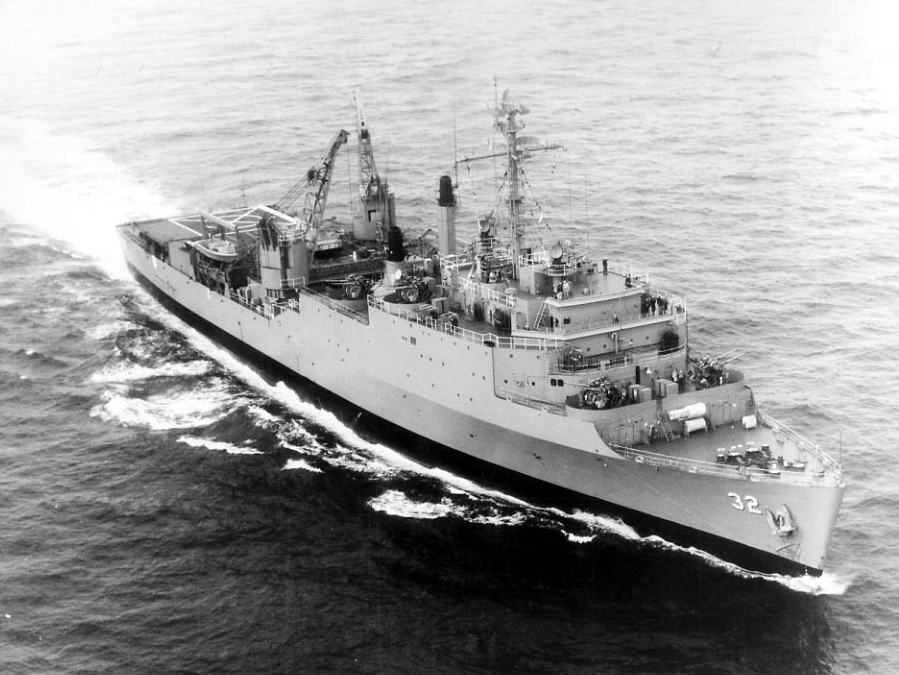
*Via Wikimedia Commons: [USS Spiegel Grove (LSD-32) at sea c1970](https://commons.wikimedia.org/wiki/File:USS_Spiegel_Grove_(LSD-32)_at_sea_c1970.jpg) by U.S. Navy, public domain.*
Artificial reefs range from piles of rock and concrete rubble to purpose-built concrete modules, sunken ships and the steel frames of retired oil and gas platforms. They are built in many parts of the world; a 1989 review of the field in the *Bulletin of Marine Science* listed [centers of activity](https://swfsc-publications.fisheries.noaa.gov/publications/CR/1989/8965.PDF) in Australia, Japan, southeastern Asia, the Caribbean, the Mediterranean, the Pacific Islands and North America, mostly in coastal seas but also in lakes, reservoirs and rivers.
## Definition
In United States law the term has a specific meaning. The National Fishing Enhancement Act of 1984 defines an artificial reef as a structure [constructed or placed in waters](https://media.fisheries.noaa.gov/dam-migration/noaa_artificial_reef_guidelines.pdf) covered by the Act "for the purpose of enhancing fishery resources and commercial and recreational fishing opportunities", the waters being the navigable waters of the United States and those over the outer continental shelf next to a state. The definition turns on purpose: the National Oceanic and Atmospheric Administration's (NOAA) reef plan also recognizes "de facto" artificial reefs, such as shipwrecks and oil and gas structures that were never placed for that reason but already serve as reefs, and which may only need to be located, cleaned or otherwise prepared, and publicized.
Related structures sit in the water column instead of on the bottom. The 1989 review distinguished bottom reefs from [fish aggregating devices](https://swfsc-publications.fisheries.noaa.gov/publications/CR/1989/8965.PDF) (FADs), structures deployed at various depths to draw fish to one place.
## History
People have sunk material to attract fish for a long time. NOAA's plan says artificial reefs [have been used for centuries](https://media.fisheries.noaa.gov/dam-migration/noaa_artificial_reef_guidelines.pdf) to enhance fishery resources and fishing opportunities, and the 1989 review says the use of artificial aquatic habitats [has occurred for centuries](https://swfsc-publications.fisheries.noaa.gov/publications/CR/1989/8965.PDF) while their scientific description has been recent. That review measured the growth of the field by its international conferences: in 1983, 43 presentations and 14 posters described work in seven nations, while in 1987, 94 oral reports and 37 posters covered work in 19 countries.
National approaches differed. Writing in 1989, the reviewers described Japan as the most technologically sophisticated country in the field, deploying [specifically designed massive structures](https://swfsc-publications.fisheries.noaa.gov/publications/CR/1989/8965.PDF) in pursuit of national goals for commercial seafood production, and the only country where a large commercial reef-building industry had developed. The United States, by contrast, had a national plan within which state and local governments and private interests worked largely on their own, mostly for recreational fishing and some diving, with virtually no federal spending on deployment. Worldwide, they wrote, seafood harvest was the main aim of most reef building, and materials were most often acquired opportunistically, such as concrete block or brush piles.
In the United States, the National Fishing Enhancement Act of 1984 directed the Secretary of Commerce to publish a [National Artificial Reef Plan](https://media.fisheries.noaa.gov/dam-migration/noaa_artificial_reef_guidelines.pdf), which appeared in 1985. According to the plan's revised edition, many coastal states already had well-developed reef programs before 1984, and reef projects before 1985 used natural or scrap materials almost exclusively because they were cheap and available. Since 1985 most American reef building has been carried out under state programs, and the revised plan, issued by NOAA in February 2007, reported that roughly half of the coastal states' natural resource agencies had approved reef plans based on it.
## Purposes
The 1984 Act sets out the standards American reefs are meant to meet. They are to be sited, built, monitored and managed so as to [enhance fishery resources](https://media.fisheries.noaa.gov/dam-migration/noaa_artificial_reef_guidelines.pdf) as far as practicable, make access easier for recreational and commercial fishermen, minimize conflicts among competing uses of the water, minimize risks to the environment, health and property, and avoid unreasonable obstruction to navigation.
The NOAA plan names several benefits that properly built and sited reefs can bring: better fish habitat, more access to good fishing grounds, benefits to fishermen and the economies of coastal towns, more total fish biomass in an area, and another tool for fishery managers. It also notes that reefs can be designed for divers, with materials chosen to be attractive and to limit safety risks. Elsewhere reefs serve other ends. The 1989 review described experimental reefs of concrete and tires deployed by the government of Thailand near small-scale fishing villages, which [attracted more commercially valuable species](https://swfsc-publications.fisheries.noaa.gov/publications/CR/1989/8965.PDF) than the soft bottom had held, and noted that in areas heavily fished by trawlers such reefs were useful simply because they kept trawlers out of waters near the villages.
## Materials and design
The NOAA plan judges reef materials by four criteria: function, meaning whether a material encourages the desired growth and provides habitat for the target species; compatibility with the site and its users; stability, so that material stays where it was placed; and [durability](https://media.fisheries.noaa.gov/dam-migration/noaa_artificial_reef_guidelines.pdf), resistance to deterioration and breakup. Design features such as surface area, height, shape, open spaces inside the structure and roughness affect which species use a reef.
**Secondary-use materials.** Most American reef building in the fifty years before the plan's 2007 revision used materials made for other purposes, which the plan calls secondary-use materials (earlier, "materials of opportunity"). Many programs came to depend on such scrap because it was cheap and readily available. Some has worked well, but decades of state experience found a number of items persistently problematic: wood, fiberglass, plastic, light vehicle bodies, fiberglass boats, railroad boxcars and light-gauge metal goods such as refrigerators and washing machines. The plan recommends that tires not be used. Natural materials such as quarry rock, limestone and shell are also used, and quarry rock is the obvious choice when the aim is to create a rocky bottom.
**Manufactured structures.** Purpose-built reef units can be engineered for stability, durability and biological effectiveness. The NOAA plan notes that they cost more to buy than scrap, but that transport and deployment costs are about the same and they need no cleaning, and that they can be bought in any quantity and laid out in any pattern, which makes long-term planning possible. A ship, by contrast, must be deployed as one unit with much of its volume rising vertically, whereas the same volume of designed units can be spread over a much larger area of seabed.
## Ships as reefs
Sinking retired vessels is one of the best-known forms of reef building, and one of the most regulated. In May 2006 the Environmental Protection Agency (EPA) and the Maritime Administration published joint [national guidance](https://19january2021snapshot.epa.gov/sites/static/files/2015-09/documents/artificialreefguidance.pdf) on preparing vessels to become artificial reefs, as required by the National Defense Authorization Act for Fiscal Year 2004. It lists materials of concern that must be dealt with before sinking: oil and fuel, asbestos, polychlorinated biphenyls (PCBs), paint, loose debris and other materials that could harm the marine environment. Its clean-up goals include removing fuels and oils so that no sheen is visible when the vessel sinks, removing all liquid PCBs and products containing 50 parts per million or more of solid PCBs, and removing active anti-fouling hull coatings and peeling paint. The guidance says it does not endorse reefing ships; it addresses only how they should be prepared if they are.
The guidance gives the example of the former USS Spiegel Grove, a 510-foot landing ship dock launched in 1955 and decommissioned in 1989, which was sunk as a reef about [6 miles off the Florida Keys](https://19january2021snapshot.epa.gov/sites/static/files/2015-09/documents/artificialreefguidance.pdf) in the Florida Keys National Marine Sanctuary. Its reefing cost a total of $1.3 million, and the project took eight years. It also describes the former USS Oriskany, a 911-foot Essex-class aircraft carrier, for which the draft version of the guidance was available during preparation, and whose clean-up took twelve months.
## Rigs to reefs
Retired offshore oil and gas platforms are another major source of reef material. When a federal offshore lease ends or production stops, companies are obliged to remove their facilities and clear the seabed. The Bureau of Safety and Environmental Enforcement (BSEE) says federal regulators have encouraged reusing platforms as reef material since 1985, and it allows an exception, called Rigs-to-Reefs, when a [state reef program](https://www.bsee.gov/what-we-do/environmental-compliance/environmental-programs/rigs-to-reefs) accepts the structure under its approved reef plan, obtains a permit from the U.S. Army Corps of Engineers and takes over title and liability. BSEE describes three methods: tow-and-place, in which the structure is cut free and towed to a reef site; topple-in-place, in which it is cut free and laid on its side; and partial removal, in which the top section is cut off at a permitted navigational depth, typically 85 feet, and placed on the seabed beside the base.
All five U.S. Gulf coast states (Alabama, Florida, Louisiana, Mississippi and Texas) have approved reef plans that include platforms, but Louisiana and Texas are the main participants because most platforms stand off their coasts. As of November 2026 BSEE's program page states that more than 600 platforms from the outer continental shelf have been reefed in the Gulf. The 1989 review had already noted that about [4,000 structures](https://swfsc-publications.fisheries.noaa.gov/publications/CR/1989/8965.PDF) in the U.S. Gulf of Mexico would eventually face removal, which was driving interest in converting them.
## The attraction–production debate
The central scientific question about artificial reefs is whether they produce new fish or only gather fish that already existed nearby. If reefs merely attract fish, concentrating them where they are easier to catch, they could add to overfishing. A 2015 study in *Ecology and Evolution* summarized the state of the question: the debate [continues](https://pmc.ncbi.nlm.nih.gov/articles/PMC4670052/) because the two processes are hard to tell apart, and there remains considerable doubt about whether artificial reefs are a harmful form of habitat modification.
Researchers have moved away from treating the two as alternatives. The 1989 review reported evidence both for biological production at some reef sites and for fish gathering from surrounding habitats, and concluded that the question [cannot be cast in an "either-or" dichotomy](https://swfsc-publications.fisheries.noaa.gov/publications/CR/1989/8965.PDF) but should be seen as a continuum along which attraction and production vary. The 2015 study, by J. A. Smith, M. B. Lowry and I. M. Suthers, modelled how a reef that redistributes existing fish affects catches. Its authors argued that [attraction is not as harmful](https://pmc.ncbi.nlm.nih.gov/articles/PMC4670052/) a process as is generally reported, because it does not always increase the maximum density of fish, while noting that the harm usually attributed to attraction had been documented only anecdotally.
NOAA's plan lists open questions of the same kind: how reef size, layout and location relate to [productivity](https://media.fisheries.noaa.gov/dam-migration/noaa_artificial_reef_guidelines.pdf), whether returns diminish beyond a certain reef size, and how results from small experimental reefs apply to programs using thousands of tons of material. It calls for long-term monitoring of every project measured against the objectives it was built for.
## Risks and criticism
The NOAA plan states that improperly planned, built or managed reefs may be [ineffective](https://media.fisheries.noaa.gov/dam-migration/noaa_artificial_reef_guidelines.pdf), may cause conflict among user groups, may increase the risk of overharvesting target species, or may damage natural habitats. It warns that placing structures in or near working hard-bottom or seagrass communities is of sometimes questionable ecological benefit, since patches of bare sand are a natural part of those systems. It also describes the use of artificial reefs to compensate for the loss of other kinds of habitat, known as mitigation, as controversial, with no general acceptance of their effectiveness for that purpose. Dumping material in the sea without proper permits, the plan notes, is illegal in the United States under the Marine Protection, Research, and Sanctuaries Act.
Unstable material is a particular hazard. Material that moves off a reef site can threaten navigation, foul fishing grounds and litter beaches, and as it breaks apart it can damage natural reefs nearby. The best-known case is Osborne Reef off Broward County, Florida. According to the Florida Department of Environmental Protection, between [one and two million tires](https://floridadep.gov/sites/default/files/OsborneReefProject%20Summary_%20041323.pdf) were put in the ocean there in the 1970s to create fish habitat. Over the years tropical storms and hurricanes moved many of them, damaging nearby coral reefs. Removal began with a pilot project by federal, state and county agencies in 2007, using military divers and later commercial salvage divers, and by April 2023 the department estimated that 640,777 tires had been removed, with work continuing and coral colonies growing on tires being transplanted before the tires were taken away.
## Sources
- *National Artificial Reef Plan (as Amended): Guidelines for siting, construction, development, and assessment of artificial reefs*. U.S. Department of Commerce, National Oceanic and Atmospheric Administration, February 2007. https://media.fisheries.noaa.gov/dam-migration/noaa_artificial_reef_guidelines.pdf
- William Seaman Jr., Raymond M. Buckley and Jeffrey J. Polovina, "Advances in knowledge and priorities for research, technology and management related to artificial aquatic habitats", *Bulletin of Marine Science* 44(2): 527–532, 1989. Copy at NOAA Southwest Fisheries Science Center. https://swfsc-publications.fisheries.noaa.gov/publications/CR/1989/8965.PDF
- *National Guidance: Best Management Practices for Preparing Vessels Intended to Create Artificial Reefs*. U.S. Environmental Protection Agency and U.S. Maritime Administration, May 2006. Archived EPA copy. https://19january2021snapshot.epa.gov/sites/static/files/2015-09/documents/artificialreefguidance.pdf
- "Rigs-to-Reefs". Bureau of Safety and Environmental Enforcement, U.S. Department of the Interior (read November 2026). https://www.bsee.gov/what-we-do/environmental-compliance/environmental-programs/rigs-to-reefs
- James A. Smith, Michael B. Lowry and Iain M. Suthers, "Fish attraction to artificial reefs not always harmful: a simulation study", *Ecology and Evolution* 5(20): 4590–4602, 2015. https://pmc.ncbi.nlm.nih.gov/articles/PMC4670052/
- "Osborne Reef Waste Tire Removal Project", updated 4 April 2023. Florida Department of Environmental Protection. https://floridadep.gov/sites/default/files/OsborneReefProject%20Summary_%20041323.pdf
