Compare versions
Version 1 → Version 2. Removed · Added. This shows the entry's text as it is written, including its formatting marks.
Version 1 · Version 2 · Version history
Side by side · Together
A general strike is a strike in which workers across many industries, rather than one trade or employer, stop work at the same time, usually to press demands on a government or on employers as a whole.
Where an ordinary strike is a dispute between a group of workers and their employer, a general strike aims to halt much of a city's or a country's economic life at once. Its demands are often wider than pay in one workplace: support for another group of strikers, a change in government policy, the right to vote, or the defence of a government against a coup. That reach is what makes it both one of the strongest tools available to organised labour and one of the most contested.
## Origins of the idea
The idea is usually traced to Britain in the 1830s. In 1832 William Benbow (1787–1864) issued a pamphlet titled *Grand National Holiday and Congress of the Productive Classes*, which proposed that working people take a [month-long "holiday"](https://daily.jstor.org/the-curious-character-who-first-called-for-a-general-strike) from work and elect a national congress to reform society, according to a 2017 article by Matthew Wills in *JSTOR Daily*. Historians differ on how closely this resembles later general strikes: the historian Iorwerth Prothero treated Benbow's holiday as a [symbolic precursor](https://daily.jstor.org/the-curious-character-who-first-called-for-a-general-strike) to the trade-union and socialist ideas of the general strike that developed later in the century, and noted that "the idea of a general strike, like all ideas, was subject to change."
## Theories of the general strike
By the late nineteenth century the general strike had become a subject of argument within the socialist and anarchist movements.
**The anarchist view.** In the anarchist tradition associated with Mikhail Bakunin, the general strike was the act that would begin a social revolution. Rosa Luxemburg, a Marxist critic of that position, described it in 1906 as ["the theory of the general strike as a means of inaugurating the social revolution"](https://www.marxists.org/archive/luxemburg/1906/mass-strike/ch01.htm).
**The Marxist objection and its revision.** Luxemburg recalled that the earlier socialist position rested on Friedrich Engels's 1873 criticism of the Bakuninists in Spain, which presented the general strike as a dilemma: either workers lacked the organisation and funds to carry one out, or they were already strong enough not to need it. In *The Mass Strike, the Political Party and the Trade Unions* (1906) she argued that the Russian Revolution of 1905 had changed this: ["The Russian Revolution has now effected a radical revision of the above piece of reasoning"](https://www.marxists.org/archive/luxemburg/1906/mass-strike/ch01.htm). In her account the mass strike had become a real weapon of political struggle, used by workers to win political rights, rather than a single act that would overturn society.
**Sorel and the "myth".** The French writer Georges Sorel, in *Reflections on Violence*, treated the general strike as a "myth" in his own sense of the word: an image that moves people to act, rather than a plan to be carried out. As Norman Jackson and Pippa Carter explain in the journal [*Ephemera*](https://ephemerajournal.org/node/4115), for Sorel "the general strike should not be understood as a rational, analysable, programmable project"; they quote his statement that "myths are not descriptions of things, but expressions of a determination to act."
## Notable general strikes
### Belgium, 1893
In April 1893 Belgian socialists called a general strike for universal male suffrage. The Global Nonviolent Action Database at Swarthmore College dates it from [11 to 18 April 1893](https://nvdatabase.swarthmore.edu/index.php/node/4326) and reports 15,000 miners on strike near Mons by 14 April and 65 factories stopped in Verviers; on 17 April both civic guards and workers were killed and wounded. The database rates the outcome a partial success: the campaigners won the vote for men, but not equal suffrage, and workers struck twice more before equal voting rights were won.
### Britain, 1926
The best-known general strike in British history grew out of the coal industry. According to the [UK National Archives](https://www.nationalarchives.gov.uk/explore-the-collection/stories/the-general-strike/), the mines had been returned to private ownership in 1921 after wartime state control; a Royal Commission set up by Stanley Baldwin's Conservative government reported in March 1926 against re-nationalisation and in favour of wage reductions; and the owners demanded pay cuts and an eight-hour day from 1 May. When talks failed, more than a million miners were locked out, and a special conference of trade unions voted for a general strike in their support.
The strike began at one minute to midnight on 3 May 1926. The National Archives puts the number of strikers at over 1.5 million, drawn from iron and steel, electricity, gas, the docks, transport and printing; the *Oxford Companion to British History* records a second wave, including engineers and shipbuilders, called out on 11 May, and gives a total of [about 2,500,000](https://www.encyclopedia.com/history/encyclopedias-almanacs-transcripts-and-maps/general-strike) workers involved. The government kept essential supplies moving with the army and with volunteers recruited through the Organisation for the Maintenance of Supplies, and published its own newspaper, *The British Gazette*, edited by the Chancellor of the Exchequer, Winston Churchill; the Trades Union Congress (TUC) answered with *The British Worker* ([National Archives](https://www.nationalarchives.gov.uk/explore-the-collection/stories/the-general-strike/)).
After nine days, on 12 May, the TUC General Council called the strike off unconditionally, although Baldwin had rejected its proposals. The miners stayed out until November 1926, when they went back to work for lower wages and longer hours ([National Archives](https://www.nationalarchives.gov.uk/explore-the-collection/stories/the-general-strike/)). The following year Parliament passed the Trade Disputes and Trade Unions Act 1927, which banned sympathetic strikes and industrial action intended to coerce the government. It was repealed by the [Trade Disputes and Trade Unions Act 1946](https://www.legislation.gov.uk/ukpga/Geo6/9-10/52/enacted), dated 22 May 1946, which provided that the law should have effect "as if the Act of 1927 had not been passed."
### Seattle, 1919
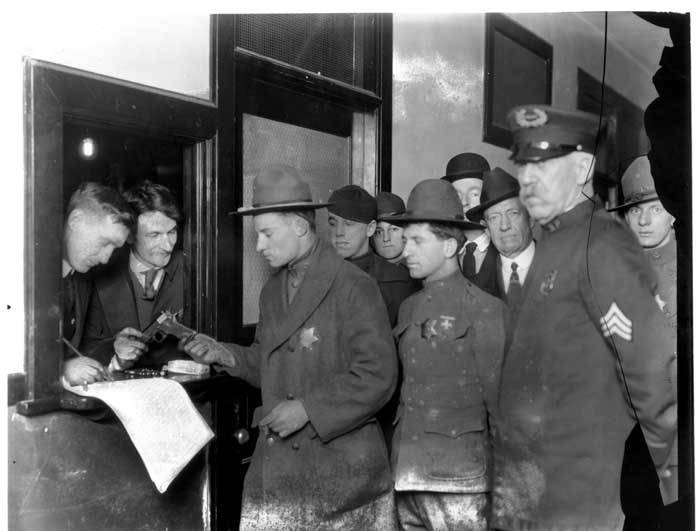general strike.](/m/2026/11/09QwfuENte41tUX8.jpg)
*Via Wikimedia Commons: [Seattle General Strike deputies receiving weapons, February 6, 1919 (M](https://commons.wikimedia.org/wiki/File:Seattle_General_Strike_deputies_receiving_weapons,_February_6,_1919_(MOHAI_5493).jpg) by Webster & Stevens, public domain.*
On the morning of 6 February 1919, [Seattle stopped working](https://depts.washington.edu/labhist/strike/index.shtml). The city's 101 unions affiliated with the American Federation of Labor voted to walk out in support of 35,000 shipyard workers already on strike, adding about 25,000 more, according to the Seattle General Strike Project at the University of Washington. An elected strike committee arranged essential services. After the mayor, Ole Hanson, threatened martial law, two battalions of US Army troops took up positions in the city. The strike lasted six days; the Central Labor Council declared it over on 11 February, by which time most unions had already gone back. Afterwards police and vigilantes rounded up radicals, the hall of the Industrial Workers of the World and the Socialist Party's headquarters were raided, and federal agents closed the labour-owned *Union Record* ([Seattle General Strike Project](https://depts.washington.edu/labhist/strike/index.shtml)). One striker later remembered: "Nothing moved but the tide."
### Germany, 1920
A general strike also helped defeat a coup. In March 1920 General Walther von Lüttwitz, head of the army's group command in Berlin, ordered the Ehrhardt Naval Brigade to march on the capital, and on 13 March Wolfgang Kapp proclaimed himself Reich Chancellor, according to German History in Documents and Images. The government's press chief handed a [call for a general strike](https://germanhistorydocs.org/en/weimar-germany-1918-1933/ghdi:document-3832), signed with the names of its Social Democratic members, to the official Arnold Brecht on the night of 12–13 March, according to Brecht's memoirs as excerpted there. The collection dates the start of the strike to 15 March 1920 and records that Lüttwitz and Kapp abandoned the putsch on 17 March, defeated by the general strike and by the civil service's refusal to obey them; strikes that continued in the industrial regions were [suppressed by troops](https://germanhistorydocs.org/en/weimar-germany-1918-1933/ghdi:document-3832).
## The general strike and the right to strike
Whether a general strike is lawful depends on national law, and many countries distinguish between strikes over working conditions and strikes with political aims. The International Labour Organization's Committee on Freedom of Association has drawn the line this way in its *Digest of decisions and principles* (fifth edition, 2006):
- strikes "of a purely political nature" [fall outside](https://webapps.ilo.org/public/english/standards/relm/info/translatns/pdf/digest-2006_en.pdf) the principles of freedom of association (paragraph 528);
- trade unions should nevertheless be able to call protest strikes, "in particular where aimed at criticizing a government's economic and social policies" (paragraph 529);
- strikes at the national level are legitimate "in so far as they have economic and social objectives and not purely political ones" (paragraph 541);
- and a 24-hour general strike seeking a higher minimum wage, respect for collective agreements and a change in economic policy is ["legitimate and within the normal field of activity of trade union organizations"](https://webapps.ilo.org/public/english/standards/relm/info/translatns/pdf/digest-2006_en.pdf) (paragraph 543).
The British act of 1927 is an example of the opposite approach: a law aimed specifically at strikes designed to coerce the government, passed after the 1926 strike and repealed in 1946.
## Recent use
A recent example of a one-day national stoppage called by the main union confederations is Spain's. On 11 November 2026 its two largest union confederations, UGT and CCOO, held a [24-hour general strike](https://www.idealista.com/en/news/legal-advice-in-spain/2026/10/09/917678-spain-general-strike-over-housing-crisis-set-for-11-november) over housing costs and wages, backed by smaller and regional unions, demanding pay rises of 4 to 7 percent, limits on rents and a permanent stock of protected public housing. It was the first national general strike by the major unions in 14 years, the last having been held in 2012 against the labour-market and austerity measures of Mariano Rajoy's government, and it came 18 days before the general election of 29 November 2026 ([idealista](https://www.idealista.com/en/news/legal-advice-in-spain/2026/10/09/917678-spain-general-strike-over-housing-crisis-set-for-11-november)).
## Sources
- Matthew Wills, "The Curious Character Who First Called for a General Strike", *JSTOR Daily*, 17 February 2017 (updated 25 March 2020). https://daily.jstor.org/the-curious-character-who-first-called-for-a-general-strike
- Rosa Luxemburg, *The Mass Strike, the Political Party and the Trade Unions* (1906), chapter 1, trans. Patrick Lavin, Rosa Luxemburg Internet Archive, marxists.org. https://www.marxists.org/archive/luxemburg/1906/mass-strike/ch01.htm
- Norman Jackson and Pippa Carter, "No struggle, no emancipation: Georges Sorel and his relevance for Critical Organisation Studies", *Ephemera* 14, no. 4. https://ephemerajournal.org/node/4115
- "Belgian socialists strike for universal male suffrage, 1893", Global Nonviolent Action Database, Swarthmore College. https://nvdatabase.swarthmore.edu/index.php/node/4326
- "The General Strike", The National Archives (UK). https://www.nationalarchives.gov.uk/explore-the-collection/stories/the-general-strike/
- John Butt, "General Strike", *The Oxford Companion to British History*, via Encyclopedia.com. https://www.encyclopedia.com/history/encyclopedias-almanacs-transcripts-and-maps/general-strike
- Trade Disputes and Trade Unions Act 1946 (9 & 10 Geo. 6 c. 52), as enacted, 22 May 1946. legislation.gov.uk. https://www.legislation.gov.uk/ukpga/Geo6/9-10/52/enacted
- Seattle General Strike Project, Civil Rights and Labor History Consortium, University of Washington. https://depts.washington.edu/labhist/strike/index.shtml
- "Arnold Brecht on the Kapp Putsch in 1920 (Retrospective Account, 1966)", German History in Documents and Images, German Historical Institute. https://germanhistorydocs.org/en/weimar-germany-1918-1933/ghdi:document-3832
- International Labour Office, *Freedom of Association: Digest of decisions and principles of the Freedom of Association Committee of the Governing Body of the ILO*, fifth (revised) edition, Geneva, 2006, paragraphs 528–543. https://webapps.ilo.org/public/english/standards/relm/info/translatns/pdf/digest-2006_en.pdf
- "Spain general strike over housing crisis set for 11 November", idealista, 9 October 2026. https://www.idealista.com/en/news/legal-advice-in-spain/2026/10/09/917678-spain-general-strike-over-housing-crisis-set-for-11-november
