Version 3 (current)
Nov 12, 2026. Version history
A general strike is a strike in which workers across many industries, rather than one trade or employer, stop work at the same time, usually to press demands on a government or on employers as a whole.
Where an ordinary strike is a dispute between a group of workers and their employer, a general strike aims to halt much of a city's or a country's economic life at once. Its demands are often wider than pay in one workplace: support for another group of strikers, a change in government policy, the right to vote, or the defence of a government against a coup. That reach is what makes it both one of the strongest tools available to organised labour and one of the most contested.
Origins of the idea
The idea is usually traced to Britain in the 1830s. In 1832 William Benbow (1787–1864) issued a pamphlet titled Grand National Holiday and Congress of the Productive Classes, which proposed that working people take a month-long "holiday" from work and elect a national congress to reform society, according to a 2017 article by Matthew Wills in JSTOR Daily. Historians differ on how closely this resembles later general strikes: the historian Iorwerth Prothero treated Benbow's holiday as a symbolic precursor to the trade-union and socialist ideas of the general strike that developed later in the century, and noted that "the idea of a general strike, like all ideas, was subject to change."
Theories of the general strike
By the late nineteenth century the general strike had become a subject of argument within the socialist and anarchist movements.
The anarchist view. In the anarchist tradition associated with Mikhail Bakunin, the general strike was the act that would begin a social revolution. Rosa Luxemburg, a Marxist critic of that position, described it in 1906 as "the theory of the general strike as a means of inaugurating the social revolution".
The Marxist objection and its revision. Luxemburg recalled that the earlier socialist position rested on Friedrich Engels's 1873 criticism of the Bakuninists in Spain, which presented the general strike as a dilemma: either workers lacked the organisation and funds to carry one out, or they were already strong enough not to need it. In The Mass Strike, the Political Party and the Trade Unions (1906) she argued that the Russian Revolution of 1905 had changed this: "The Russian Revolution has now effected a radical revision of the above piece of reasoning". In her account the mass strike had become a real weapon of political struggle, used by workers to win political rights, rather than a single act that would overturn society.
Sorel and the "myth". The French writer Georges Sorel, in Reflections on Violence, treated the general strike as a "myth" in his own sense of the word: an image that moves people to act, rather than a plan to be carried out. As Norman Jackson and Pippa Carter explain in the journal Ephemera, for Sorel "the general strike should not be understood as a rational, analysable, programmable project"; they quote his statement that "myths are not descriptions of things, but expressions of a determination to act."
Notable general strikes
Belgium, 1893
In April 1893 Belgian socialists called a general strike for universal male suffrage. The Global Nonviolent Action Database at Swarthmore College dates it from 11 to 18 April 1893 and reports 15,000 miners on strike near Mons by 14 April and 65 factories stopped in Verviers; on 17 April both civic guards and workers were killed and wounded. The database rates the outcome a partial success: the campaigners won the vote for men, but not equal suffrage, and workers struck twice more before equal voting rights were won.
Russia, 1905
The general strike of October 1905 in the Russian Empire was, in the words of Gerald D. Surh, "the culminating event of the 1905 Revolution". Dates in this section follow the Julian calendar then used in Russia. According to Surh's article in the Encyclopedia of Russian History, the All-Russian Union of Railroad Workers called a national rail strike for 4 October; control of the railways gave the strikers control of communications and idled many other trades and industries. Factory workers were joined by artisans, white-collar workers and small businesses, and in St. Petersburg by tram drivers, shop clerks, pharmacists, printers, and bank, insurance and zemstvo (local government) employees, as well as by students and professionals who opened lecture halls for public meetings (Surh).
During 1905, and especially in October, workers in about fifty places elected councils of factory delegates, known as soviets, to lead the strikes. The St. Petersburg Soviet went beyond leading the strike to pursue a revolutionary programme; Mensheviks were indispensable to its creation and leadership, its second president was Leon Trotsky, and it was arrested on 3 December (Surh).
Ministers led by Count Sergei Witte advised Nicholas II to grant political and civil rights, legislative authority and a wider electorate, and after several days he reluctantly agreed. Surh calls the resulting Manifesto of 17 October "the most significant political act of the 1905 Revolution". The promise of a constitutional state divided the opposition, and by early 1906 the government had restored the autocracy's authority through bloody repression (Surh). Rosa Luxemburg, writing in 1906 and dating the manifesto 30 October by the Western calendar, treated the October stoppage as the empire's "second tremendous general strike" of the year, and described how in December the mass strike in Moscow turned into "open insurrection, to armed barricades, and street fighting".
Switzerland, 1918
The Swiss general strike of November 1918, known in German as the Landesstreik, is described in the Historical Dictionary of Switzerland as "die schwerste politische Krise des Bundesstaates", the most serious political crisis of the Swiss federal state. In the historian Bernard Degen's account there, wartime profiteering and spreading poverty sharpened class divisions, and strikes grew sharply from 1917. In February 1918 Robert Grimm brought union and party leaders together in the Olten Action Committee, which pressed its demands on the Federal Council (the Swiss government) with the threat of strikes (Degen, HLS).
On 7 November 1918 the Federal Council decided on an armed federal intervention and troops marched into Zürich. The committee answered with a protest strike, held on 9 November in 19 industrial centres; on 10 November demonstrators and soldiers clashed on Zürich's Münsterplatz, and on 12 November the committee proclaimed an unlimited general strike (Degen, HLS). Its nine demands were:
- immediate elections to the National Council by proportional representation;
- votes for women;
- a general duty to work;
- a 48-hour week;
- reform of the army;
- secure food supplies;
- old-age and disability insurance;
- a state monopoly of foreign trade;
- and a tax on wealth to pay down the public debt (Degen, HLS).
The Swiss Trade Union Federation counted about 250,000 strikers, and railway workers were especially important in carrying the strike into rural areas. The Federal Council demanded an unconditional end on 13 November, and early on 14 November the committee gave in, fearing repression by the army. That day in Grenchen three strikers were shot dead, the most serious incident of the strike. Work largely resumed on 15 November (Degen, HLS).
Military courts opened proceedings against more than 3,500 people, most of them railway workers, which led to 147 convictions; at the main trial, from 12 March to 9 April 1919, Grimm, Friedrich Schneider, Fritz Platten and Ernst Nobs were sentenced to prison. The most immediate result, according to Degen, was the introduction of the 48-hour week in 1919, and employers and unions moved towards collective agreements. For decades the strike was portrayed as a failed revolution, a charge used against the left; research from the 1950s that largely cleared its leaders became widely known only after 1968 (Degen, HLS).
Seattle, 1919
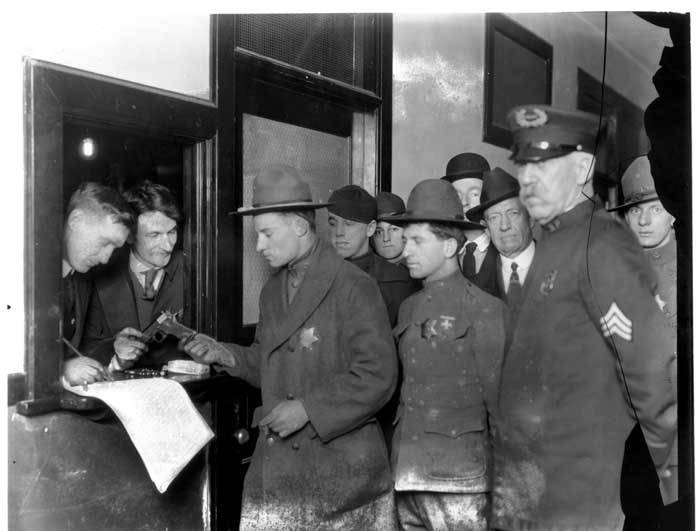
Via Wikimedia Commons: Seattle General Strike deputies receiving weapons, February 6, 1919 (M by Webster & Stevens, public domain.
On the morning of 6 February 1919, Seattle stopped working. The city's 101 unions affiliated with the American Federation of Labor voted to walk out in support of 35,000 shipyard workers already on strike, adding about 25,000 more, according to the Seattle General Strike Project at the University of Washington. An elected strike committee arranged essential services. After the mayor, Ole Hanson, threatened martial law, two battalions of US Army troops took up positions in the city. The strike lasted six days; the Central Labor Council declared it over on 11 February, by which time most unions had already gone back. Afterwards police and vigilantes rounded up radicals, the hall of the Industrial Workers of the World and the Socialist Party's headquarters were raided, and federal agents closed the labour-owned Union Record (Seattle General Strike Project). One striker later remembered: "Nothing moved but the tide."
Winnipeg, 1919
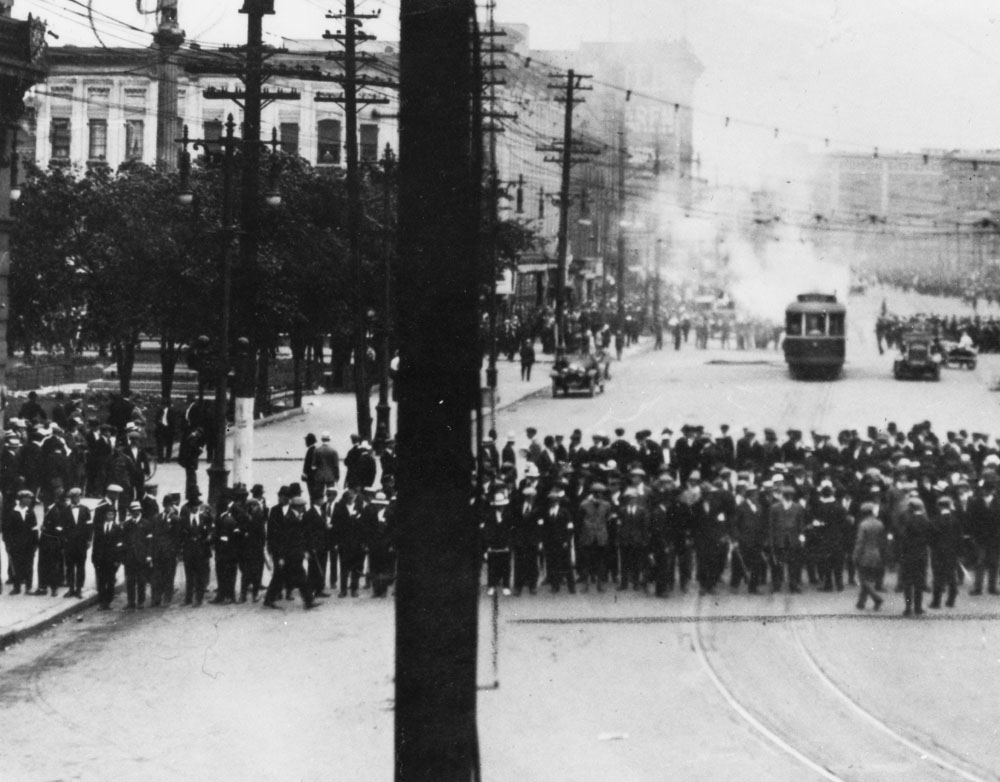
Via Wikimedia Commons: Winnipeg general strike turns into a riot E004666106-v8 by Winnipeg, public domain.
Three months after Seattle, Canada had its own general strike. According to the Canadian Museum for Human Rights, at 11 a.m. on 15 May 1919 workers in Winnipeg's building and metal trades put down their tools. Those skilled workers had been negotiating over wages and conditions and wanted to bargain through a trades council covering each whole industry, while employers preferred to deal with smaller groups of unions; when the employers refused collective bargaining, the strike began. Roughly 35,000 workers struck over low pay and poor conditions, against a background of post-war economic downturn and inflation (Canadian Museum for Human Rights).
A group of business leaders formed the Citizens' Committee of One Thousand, which lobbied the city, provincial and federal governments to break the strike and published a newspaper presenting it as a Bolshevik revolution; the museum states that the strike was not a plot to overthrow the government. Mayor Charles Gray dismissed the city police, who had sympathised with the strikers, and the committee recruited "Special Police", mostly returned soldiers opposed to the strike; the two sides clashed on 10 June. About a week later the Royal Northwest Mounted Police raided the homes of the strike leaders and arrested them, and recent changes to the federal Immigration Act meant they faced possible deportation if convicted (Canadian Museum for Human Rights).
On 21 June 1919, after a streetcar was set on fire, police fired into the crowd and one man was killed; the day became known as "Bloody Saturday", and militia were deployed in the city. The strike committee agreed to end the strike if the Premier of Manitoba, T. C. Norris, set up a Royal Commission into its causes, and the strike was officially called off on 26 June 1919. Many strikers lost their jobs (Canadian Museum for Human Rights).
Germany, 1920
A general strike also helped defeat a coup. In March 1920 General Walther von Lüttwitz, head of the army's group command in Berlin, ordered the Ehrhardt Naval Brigade to march on the capital, and on 13 March Wolfgang Kapp proclaimed himself Reich Chancellor, according to German History in Documents and Images. The government's press chief handed a call for a general strike, signed with the names of its Social Democratic members, to the official Arnold Brecht on the night of 12–13 March, according to Brecht's memoirs as excerpted there. The collection dates the start of the strike to 15 March 1920 and records that Lüttwitz and Kapp abandoned the putsch on 17 March, defeated by the general strike and by the civil service's refusal to obey them; strikes that continued in the industrial regions were suppressed by troops.
Britain, 1926
The best-known general strike in British history grew out of the coal industry. According to the UK National Archives, the mines had been returned to private ownership in 1921 after wartime state control; a Royal Commission set up by Stanley Baldwin's Conservative government reported in March 1926 against re-nationalisation and in favour of wage reductions; and the owners demanded pay cuts and an eight-hour day from 1 May. When talks failed, more than a million miners were locked out, and a special conference of trade unions voted for a general strike in their support.
The strike began at one minute to midnight on 3 May 1926. The National Archives puts the number of strikers at over 1.5 million, drawn from iron and steel, electricity, gas, the docks, transport and printing; the Oxford Companion to British History records a second wave, including engineers and shipbuilders, called out on 11 May, and gives a total of about 2,500,000 workers involved. The government kept essential supplies moving with the army and with volunteers recruited through the Organisation for the Maintenance of Supplies, and published its own newspaper, The British Gazette, edited by the Chancellor of the Exchequer, Winston Churchill; the Trades Union Congress (TUC) answered with The British Worker (National Archives).
After nine days, on 12 May, the TUC General Council called the strike off unconditionally, although Baldwin had rejected its proposals. The miners stayed out until November 1926, when they went back to work for lower wages and longer hours (National Archives). The following year Parliament passed the Trade Disputes and Trade Unions Act 1927, which banned sympathetic strikes and industrial action intended to coerce the government. It was repealed by the Trade Disputes and Trade Unions Act 1946, dated 22 May 1946, which provided that the law should have effect "as if the Act of 1927 had not been passed."
Netherlands, 1941
The February strike of 1941 in occupied Amsterdam was a general strike against the persecution of Jews. According to Jason Dawsey of the National WWII Museum in New Orleans, after German police were sprayed with gas on 19 February 1941 in an Amsterdam ice-cream parlour owned by Erich Cahn, the occupation authorities seized 425 Jews from the city's streets and deported them to Buchenwald; 389 of them were later sent on to Mauthausen, and "only a few survived" (Dawsey).
Communist Party militants, among them Piet Nak and Willem Kraan, called for a general strike, with leaflets reading "Strike! Strike! Strike! Shut down all of Amsterdam for a day!". The stoppage began on Tuesday 25 February 1941 with tram drivers and sanitation workers and, at its peak, involved an estimated 300,000 people (Dawsey). The Digital Jewish Monument, maintained by Amsterdam's Jewish Cultural Quarter, records that trams stayed in their depots, that shops, offices and industries closed, and that the strike spread to Haarlem, Hilversum, Utrecht and the towns along the Zaan.
The strike ended on 27 February. Nine people were killed and dozens injured; in the following days the organisers were arrested and eighteen people were executed in reprisal, and the occupiers dismissed Amsterdam's city council (Dawsey; Digital Jewish Monument). The Digital Jewish Monument calls the strike "the only massive, open protest against the persecution of the Jews throughout occupied Europe".
France, 1968
The French general strike of May and June 1968 grew out of that spring's student revolt. According to Sylvie Contrepois in the St. James Encyclopedia of Labor History Worldwide, after police repression of student protesters on the night of 10 May the union confederations CGT and CFDT and the teachers' union FEN called a 24-hour general strike, and on 13 May marches took place all over France, 800,000 people in Paris among them. Workers then began to occupy their workplaces: the Sud-Aviation factory at Nantes on 14 May, Renault's Cléon plant and other factories on 15 May. Strikers numbered two million by 18 May, teachers
