Compare versions
Version 2 → Version 3 (current). Removed · Added. This shows the entry's text as it is written, including its formatting marks.
Version 2 · Version 3 (current) · Version history
Side by side · Together
Mechanical energy is the energy an object or system has because of its motion and its position or shape: the sum of its kinetic energy and its potential energy.
In the standard formulation of the open university textbook *University Physics* (OpenStax, 2016), the sum of a particle's kinetic energy *K* and potential energy *U* is defined as [its mechanical energy, *E* = *K* + *U*](https://openstax.org/books/university-physics-volume-1/pages/8-3-conservation-of-energy). Like all energy, it is measured in joules in the International System of Units.
## The two parts
**Kinetic energy** is the energy of motion. For a particle of mass *m* moving at speed *v*, it is [*K* = ½*mv*²](https://openstax.org/books/university-physics-volume-1/pages/7-2-kinetic-energy), measured in joules because its units are those of force times distance, the units of work. OpenStax's example: an 80 kg athlete running at 10 m/s has a kinetic energy of ½ × 80 × 10² = 4,000 J, or [4.0 kJ](https://openstax.org/books/university-physics-volume-1/pages/7-2-kinetic-energy). Because speed depends on the frame of reference it is measured from, so does kinetic energy: a person walking along a moving subway car has one kinetic energy relative to the car, another relative to the tracks, and [none relative to themselves](https://openstax.org/books/university-physics-volume-1/pages/7-2-kinetic-energy).
A body that spins also has kinetic energy, even if its centre stays put. For a rigid body turning at angular velocity *ω*, the rotational kinetic energy is [*K* = ½*Iω*²](https://openstax.org/books/university-physics-volume-1/pages/10-4-moment-of-inertia-and-rotational-kinetic-energy), where *I*, the moment of inertia, is the sum of each bit of mass times the square of its distance from the axis, [*I* = Σ*mr*²](https://openstax.org/books/university-physics-volume-1/pages/10-4-moment-of-inertia-and-rotational-kinetic-energy), in kg·m². OpenStax treats this not as a new kind of energy but as [ordinary kinetic energy expressed for rotation](https://openstax.org/books/university-physics-volume-1/pages/10-4-moment-of-inertia-and-rotational-kinetic-energy). Its example of a rescue helicopter makes the point: the four 50 kg, 4.00 m blades turning at 300 revolutions per minute carry about 5.26 × 10⁵ J, while the 1,000 kg helicopter flying at 20.0 m/s has 2.00 × 10⁵ J of translational kinetic energy, [a ratio of 0.380](https://openstax.org/books/university-physics-volume-1/pages/10-4-moment-of-inertia-and-rotational-kinetic-energy), so most of its kinetic energy is in the spinning blades.
**Potential energy** is energy stored in the arrangement of a system, defined through the work a force does. The difference in potential energy between two points is [the negative of the work done by the force](https://openstax.org/books/university-physics-volume-1/pages/8-1-potential-energy-of-a-system) as the system moves from one to the other. Near Earth's surface, gravitational potential energy is [*U* = *mgy* plus a constant](https://openstax.org/books/university-physics-volume-1/pages/8-1-potential-energy-of-a-system), where *g* is the acceleration due to gravity (about 9.8 m/s²) and *y* is height. A spring stretched or compressed by a distance *x* stores [*U* = ½*kx*² plus a constant](https://openstax.org/books/university-physics-volume-1/pages/8-1-potential-energy-of-a-system), where *k* is the spring's stiffness.
The constant in each formula reflects a choice of where potential energy counts as zero. That choice is a matter of convenience, often the lowest height in a problem, and it must be [stated and kept consistent](https://openstax.org/books/university-physics-volume-1/pages/8-1-potential-energy-of-a-system); only differences in potential energy have physical meaning. The same is therefore true of a value of mechanical energy: it depends on the chosen zero of potential energy and on the frame in which speeds are measured, while changes in it do not depend on the zero.
## Conservative and non-conservative forces
Whether mechanical energy stays constant depends on the forces at work. A force is called conservative when the work it does between two points is [independent of the path taken](https://openstax.org/books/university-physics-volume-1/pages/8-2-conservative-and-non-conservative-forces); equivalently, it does no net work around any closed path. Gravity and the force of a spring are conservative. Friction and air resistance are not: the work they do depends on the path, and these [dissipative forces](https://openstax.org/books/university-physics-volume-1/pages/8-2-conservative-and-non-conservative-forces) take energy away from the system as it moves.
## Work and the work–energy theorem
Kinetic energy is tied to work by the work–energy theorem: [the net work done on a particle equals the change in its kinetic energy](https://openstax.org/books/university-physics-volume-1/pages/7-3-work-energy-theorem), *W*net = *K*B − *K*A. Work done by conservative forces can be written as a loss of potential energy, which is why splitting the net work into conservative and non-conservative parts leads directly to the conservation rule below. The theorem also works backwards from energy to force. In an OpenStax example, a 2.60 g bullet leaving a gun at 335 m/s and stopped by 15.2 cm of pine boards must meet an average stopping force of ½ × 0.0026 × 335² ÷ 0.152, or [about 960 N](https://openstax.org/books/university-physics-volume-1/pages/7-3-work-energy-theorem).
## Conservation of mechanical energy
The principle that follows is the conservation of mechanical energy: the mechanical energy of a particle [does not change if all the non-conservative forces acting on it do no work](https://openstax.org/books/university-physics-volume-1/pages/8-3-conservation-of-energy). When they do work, that work equals the change in mechanical energy, *W*nc = Δ*E*, and [mechanical energy is not conserved](https://openstax.org/books/university-physics-volume-1/pages/8-3-conservation-of-energy).
A pendulum shows the first case. Neglecting air resistance, a pendulum bob trades potential energy for kinetic energy as it swings down and back again as it rises, with the sum unchanged. OpenStax works through a bob on a 1.0 m string released from rest at 30° from the vertical: equating the potential energy lost to the kinetic energy gained gives a speed at the lowest point of *v* = √(2*gL*(1 − cos θ)), or [1.62 m/s](https://openstax.org/books/university-physics-volume-1/pages/8-3-conservation-of-energy). The mass of the bob cancels out of the calculation.
A falling object with air resistance shows the second. In another OpenStax example, a 15 kg panel falls from a height of 1 km and strikes the ground at 45 m/s. Its starting mechanical energy, all potential, was 15 × 9.8 × 1,000 = 147,000 J; its kinetic energy on landing was ½ × 15 × 45² ≈ 15,000 J. The difference, [about 130 kJ](https://openstax.org/books/university-physics-volume-1/pages/8-3-conservation-of-energy), is the energy taken out by air resistance.
Conservation of mechanical energy is therefore a special case: it holds only while friction, drag and other non-conservative forces do no work.
## Potential energy diagrams
When mechanical energy is conserved, a graph of potential energy against position, [a potential energy diagram](https://openstax.org/books/university-physics-volume-1/pages/8-4-potential-energy-diagrams-and-stability), shows how a system can move. A horizontal line at the total energy *E* marks the limit: kinetic energy is the gap between that line and the curve, so the object can only be where the curve lies below *E*. Where the two meet, [*K* = 0 and *U* = *E*](https://openstax.org/books/university-physics-volume-1/pages/8-4-potential-energy-diagrams-and-stability): these are turning points, where the object stops for an instant and reverses. A low point of the curve is a position of [stable equilibrium](https://openstax.org/books/university-physics-volume-1/pages/8-4-potential-energy-diagrams-and-stability), to which a restoring force pulls the object back; a high point is [unstable](https://openstax.org/books/university-physics-volume-1/pages/8-4-potential-energy-diagrams-and-stability), and any small push sends the object away from it. A pendulum oscillates between two turning points around a stable minimum; a ball balanced on a hilltop sits at an unstable maximum.
## Collisions
Collisions show where mechanical energy goes when the forces involved are not conservative. In an [elastic collision](https://openstax.org/books/university-physics-volume-1/pages/9-4-types-of-collisions), the system has the same kinetic energy before and after. In an inelastic one, [the system loses kinetic energy](https://openstax.org/books/university-physics-volume-1/pages/9-4-types-of-collisions), and a collision in which the objects stick together results in [the maximum loss of kinetic energy](https://openstax.org/books/university-physics-volume-1/pages/9-4-types-of-collisions). In OpenStax's car-crash example, the collision [converted some of the initial kinetic energy to other forms](https://openstax.org/books/university-physics-volume-1/pages/9-4-types-of-collisions), presumably mostly in deforming the vehicles, with some heat and sound. Momentum is conserved in both kinds of collision; kinetic energy is conserved only in the elastic kind.
## Orbits
Gravity far from Earth's surface needs a different potential energy formula, but the same bookkeeping applies. For a satellite of mass *m* in a circular orbit of radius *r* around a planet of mass *M*, the total mechanical energy works out to [*E* = −*GMm*/2*r*](https://openstax.org/books/university-physics-volume-1/pages/13-4-satellite-orbits-and-energy), where *G* is the gravitational constant and potential energy is taken as zero at infinite distance. In such an orbit the kinetic energy is [exactly half the magnitude of the potential energy](https://openstax.org/books/university-physics-volume-1/pages/13-4-satellite-orbits-and-energy). The negative sign has a physical meaning: [an object with negative total energy is gravitationally bound](https://openstax.org/books/university-physics-volume-1/pages/13-4-satellite-orbits-and-energy), held in orbit rather than free to escape.
## History of the idea
The concept grew out of a seventeenth-century dispute over how to measure the "force" of a moving body. René Descartes had held that [the quantity of motion in the world remains constant](https://plato.stanford.edu/entries/leibniz-physics/), the quantity of motion of a body being its speed times its size. In 1686 Gottfried Wilhelm Leibniz published his *Brief Demonstration of a Notable Error of Descartes and Others Concerning a Natural Law*, arguing that Descartes's measure was inadequate; the paper began what became known as [the *vis viva* controversy](https://plato.stanford.edu/entries/leibniz-physics/) (Stanford Encyclopedia of Philosophy, revised 2024). Leibniz held that the proper measure was *vis viva*, "living force", [the quantity *mv*²](https://plato.stanford.edu/entries/leibniz-physics/), and that it was conserved in collisions.
The modern vocabulary came in the nineteenth century. Gaspard-Gustave de Coriolis, in his 1829 work *Du calcul de l'effet des machines*, is credited by the MacTutor History of Mathematics archive with introducing [the terms "work" and "kinetic energy" with their present scientific meaning](https://mathshistory.st-andrews.ac.uk/Biographies/Coriolis/). In 1853 the Scottish engineer William John Macquorn Rankine distinguished ["actual (or sensible) energy"](https://www.encyclopedia.com/people/science-and-technology/technology-biographies/william-john-macquorn-rankine), among whose examples he counted the *vis viva* of moving matter, from "potential (or latent) energy", among whose examples was the mechanical power of gravitation, and assumed that the sum of the two across the universe was constant (*Complete Dictionary of Scientific Biography*). The *Dictionary* calls "potential energy" one of the terms Rankine [invented for new concepts](https://www.encyclopedia.com/people/science-and-technology/technology-biographies/william-john-macquorn-rankine). A study by Joel White for the Energy and Philosophy project notes that Rankine's "potential" and "actual" energy [predated the pairing of "potential" and "kinetic"](https://energy-philosophy.ac.uk/?p=94) that became standard.
The question of where "lost" mechanical energy goes was settled experimentally in the same decades. In the late 1840s James Prescott Joule let falling weights turn a set of paddle wheels inside a vessel of water or mercury, so that friction in the fluid heated it, and measured the rise in temperature. In a paper presented to the Royal Society in 1849, "On the Mechanical Equivalent of Heat" (*Philosophical Transactions* vol. 140, 1850), he concluded that [the heat produced by friction is always proportional to the mechanical work done](https://web.physics.ucsb.edu/~lecturedemonstrations/Composer/Pages/52.33.html), and that raising a pound of water by 1 °F takes 772 foot-pounds of work; his most precise figure, 772.692 ft-lb, corresponds to [about 4.167 joules per calorie](https://web.physics.ucsb.edu/~lecturedemonstrations/Composer/Pages/52.33.html) (UC Santa Barbara physics lecture demonstrations). The result made mechanical energy one form among several in a broader law: [the total amount of energy in an isolated system always remains constant](https://openstax.org/books/university-physics-volume-1/pages/8-5-sources-of-energy), even when mechanical energy alone does not.
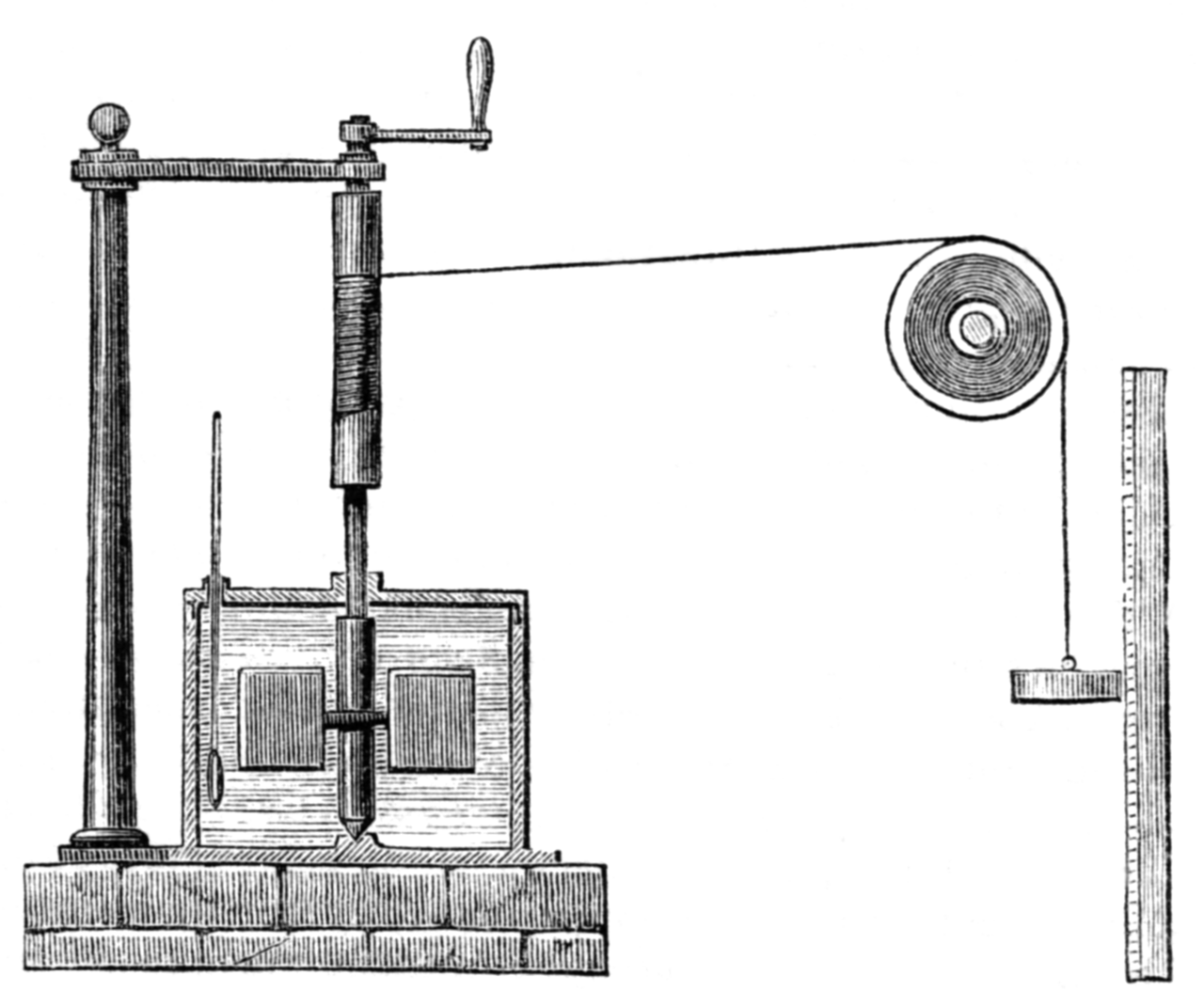
*Via Wikimedia Commons: [Joule's Apparatus (Harper's Scan)](https://commons.wikimedia.org/wiki/File:Joule%27s_Apparatus_(Harper%27s_Scan).png) by Jacob Abbott, public domain.*
## Uses
Mechanical energy is stored and recovered on a large scale. Pumped storage hydropower uses [two water reservoirs at different elevations](https://www.energy.gov/eere/water/pumped-storage-hydropower): electricity is used to pump water up to the higher reservoir, storing gravitational potential energy, and the water is later released downhill through turbines to generate electricity again. According to the U.S. Department of Energy, citing its 2024 *Hydropower Market Report*, pumped storage accounted for [88 percent of all utility-scale energy storage in the United States](https://www.energy.gov/eere/water/pumped-storage-hydropower).
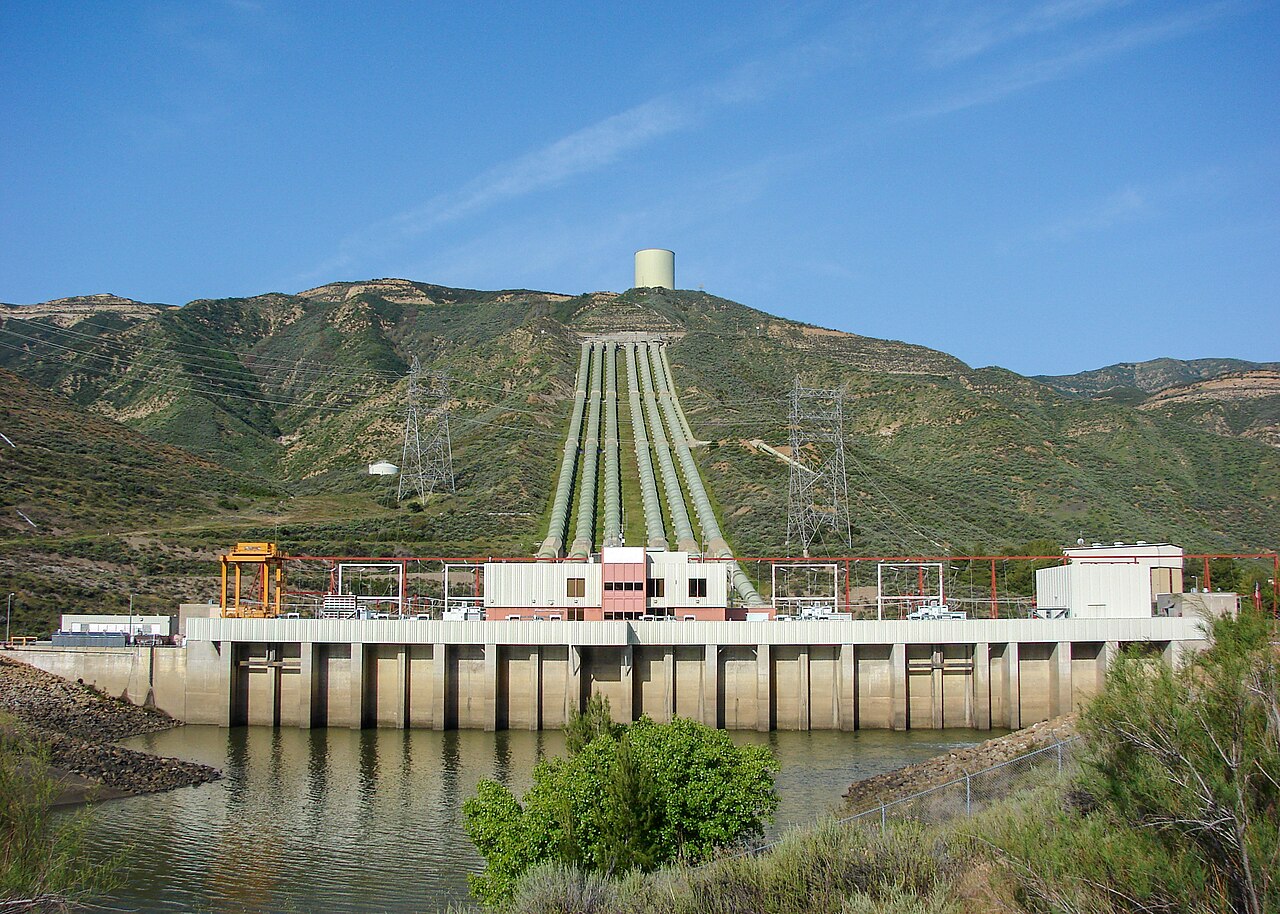
*Via Wikimedia Commons: [Castaic Power Plant Front](https://commons.wikimedia.org/wiki/File:Castaic_Power_Plant_Front.jpg) by Sirbatch, [CC BY-SA 3.0](https://creativecommons.org/licenses/by-sa/3.0).*
Mechanical energy is also the working form of several sources of electricity. Hydropower is produced by [converting the gravitational potential energy of falling or flowing water into kinetic energy](https://openstax.org/books/university-physics-volume-1/pages/8-5-sources-of-energy), and wind power [converts kinetic energy into work](https://openstax.org/books/university-physics-volume-1/pages/8-5-sources-of-energy) that can drive a generator.
## Sources
- William Moebs, Samuel J. Ling and Jeff Sanny, *University Physics, Volume 1*, OpenStax, Rice University, 2016: section 7.2, "Kinetic Energy". https://openstax.org/books/university-physics-volume-1/pages/7-2-kinetic-energy
- Same, section 7.3, "Work-Energy Theorem". https://openstax.org/books/university-physics-volume-1/pages/7-3-work-energy-theorem
- Same, section 8.1, "Potential Energy of a System". https://openstax.org/books/university-physics-volume-1/pages/8-1-potential-energy-of-a-system
- Same, section 8.2, "Conservative and Non-Conservative Forces". https://openstax.org/books/university-physics-volume-1/pages/8-2-conservative-and-non-conservative-forces
- Same, section 8.3, "Conservation of Energy". https://openstax.org/books/university-physics-volume-1/pages/8-3-conservation-of-energy
- Same, section 8.4, "Potential Energy Diagrams and Stability". https://openstax.org/books/university-physics-volume-1/pages/8-4-potential-energy-diagrams-and-stability
- Same, section 8.5, "Sources of Energy". https://openstax.org/books/university-physics-volume-1/pages/8-5-sources-of-energy
- Same, section 9.4, "Types of Collisions". https://openstax.org/books/university-physics-volume-1/pages/9-4-types-of-collisions
- Same, section 10.4, "Moment of Inertia and Rotational Kinetic Energy". https://openstax.org/books/university-physics-volume-1/pages/10-4-moment-of-inertia-and-rotational-kinetic-energy
- Same, section 13.4, "Satellite Orbits and Energy". https://openstax.org/books/university-physics-volume-1/pages/13-4-satellite-orbits-and-energy
- Jeffrey K. McDonough, "Leibniz's Philosophy of Physics", *Stanford Encyclopedia of Philosophy*, first published 17 December 2007, substantive revision 26 July 2024. https://plato.stanford.edu/entries/leibniz-physics/
- J. J. O'Connor and E. F. Robertson, "Gaspard Gustave de Coriolis", MacTutor History of Mathematics archive, University of St Andrews, July 2000. https://mathshistory.st-andrews.ac.uk/Biographies/Coriolis/
- "Rankine, William John Macquorn", *Complete Dictionary of Scientific Biography*, Charles Scribner's Sons, 2008, via Encyclopedia.com. https://www.encyclopedia.com/people/science-and-technology/technology-biographies/william-john-macquorn-rankine
- Joel White, "Actual and Virtual Energy: From Aristotle to Rankine and Back Again", Energy and Philosophy project, last modified 5 August 2024. https://energy-philosophy.ac.uk/?p=94
- U.S. Department of Energy, Water Power Technologies Office, "Pumped Storage Hydropower", accessed 12 November 2026. https://www.energy.gov/eere/water/pumped-storage-hydropower
- "Mechanical equivalent of heat", Lecture Demonstrations, Department of Physics, University of California, Santa Barbara, accessed 12 November 2026. https://web.physics.ucsb.edu/~lecturedemonstrations/Composer/Pages/52.33.html
