Compare versions
Version 3 → Version 4. Removed · Added. This shows the entry's text as it is written, including its formatting marks.
Version 3 · Version 4 · Version history
Side by side · Together
Version 3Version 4
23 unchanged paragraphs
Gross domestic product (GDP) is the monetary value of all final goods and services produced within a country's borders over a given period, such as a quarter or a year. It is the most widely used single measure of the size and growth of an economy.
Gross domestic product (GDP) is the monetary value of all final goods and services produced within a country's borders over a given period, such as a quarter or a year. It is the most widely used single measure of the size and growth of an economy.
The International Monetary Fund's introductory definition is that GDP [measures the monetary value of final goods and services produced in a country in a given period of time](https://www.imf.org/en/Publications/fandd/issues/Series/Back-to-Basics/gross-domestic-product-GDP) (Tim Callen, *Finance & Development*, 2019). "Final" means goods and services bought by their end users, so that something used up in making something else is not counted twice. The U.S. Bureau of Economic Analysis (BEA), which compiles the American figures, puts it in one line: [the value of the final goods and services produced in the United States is the gross domestic product](https://www.bea.gov/resources/learning-center/what-to-know-gdp).
The International Monetary Fund's introductory definition is that GDP [measures the monetary value of final goods and services produced in a country in a given period of time](https://www.imf.org/en/Publications/fandd/issues/Series/Back-to-Basics/gross-domestic-product-GDP) (Tim Callen, *Finance & Development*, 2019). "Final" means goods and services bought by their end users, so that something used up in making something else is not counted twice. The U.S. Bureau of Economic Analysis (BEA), which compiles the American figures, puts it in one line: [the value of the final goods and services produced in the United States is the gross domestic product](https://www.bea.gov/resources/learning-center/what-to-know-gdp).
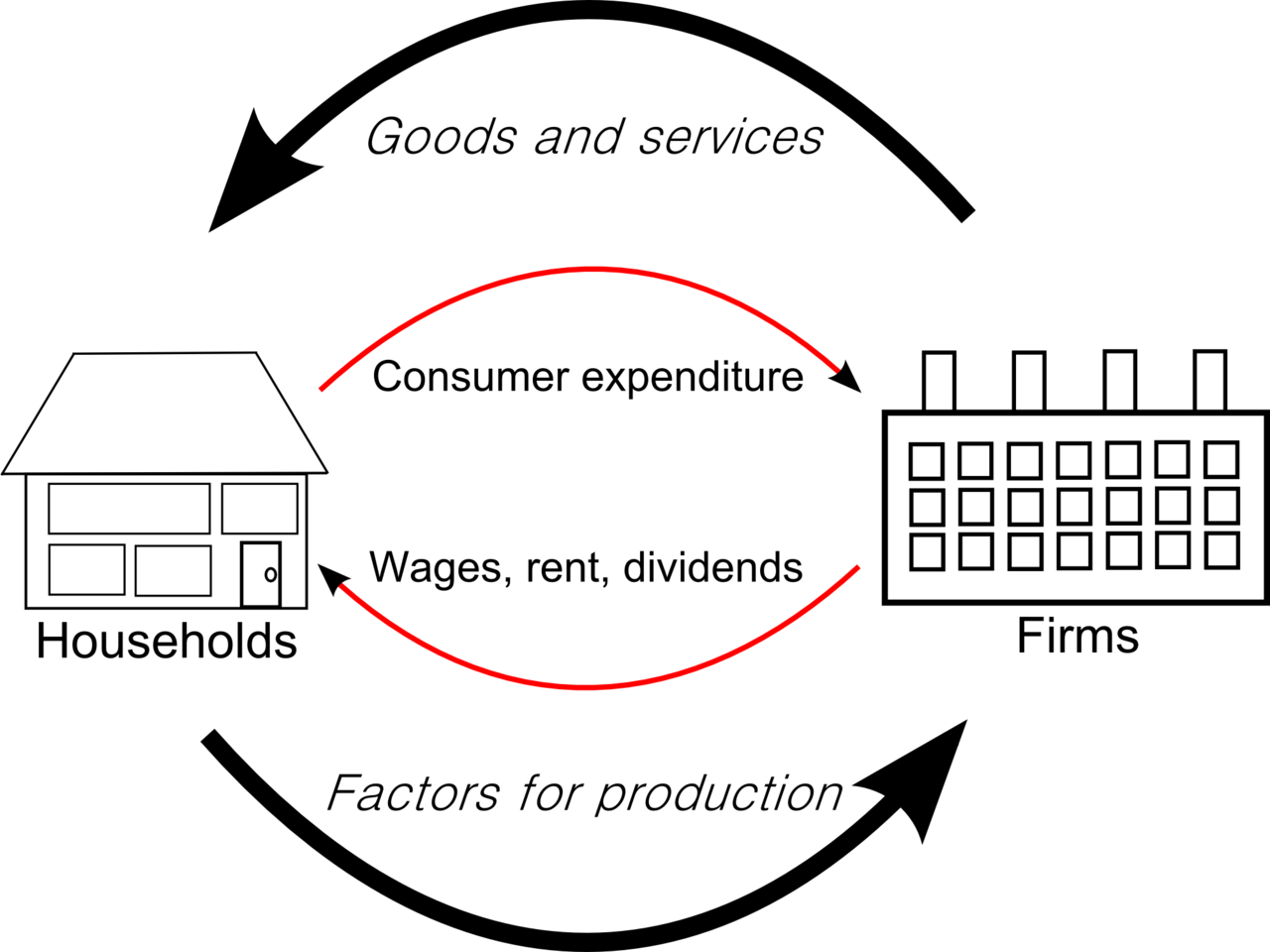

*Via Wikimedia Commons: [Circular flow of goods income](https://commons.wikimedia.org/wiki/File:Circular_flow_of_goods_income.png) by Irconomics, [CC BY-SA 3.0](https://creativecommons.org/licenses/by-sa/3.0).*
*Via Wikimedia Commons: [Circular flow of goods income](https://commons.wikimedia.org/wiki/File:Circular_flow_of_goods_income.png) by Irconomics, [CC BY-SA 3.0](https://creativecommons.org/licenses/by-sa/3.0).*
## What counts as production
## What counts as production
Deciding what GDP includes means drawing a "production boundary" around the activities that count as economic production. The international standard, the United Nations System of National Accounts (SNA), defines production as an activity carried out under the control and responsibility of an institutional unit that [uses inputs of labour, capital, and goods and services to produce outputs](https://www.bea.gov/resources/methodologies/nipa-handbook/pdf/chapter-02.pdf) of goods or services (as quoted in BEA's *NIPA Handbook*, chapter 2, updated December 2024). Under that rule, the growth of trees in an uncultivated forest is not production, but [harvesting the trees is](https://www.bea.gov/resources/methodologies/nipa-handbook/pdf/chapter-02.pdf).
Deciding what GDP includes means drawing a "production boundary" around the activities that count as economic production. The international standard, the United Nations System of National Accounts (SNA), defines production as an activity carried out under the control and responsibility of an institutional unit that [uses inputs of labour, capital, and goods and services to produce outputs](https://www.bea.gov/resources/methodologies/nipa-handbook/pdf/chapter-02.pdf) of goods or services (as quoted in BEA's *NIPA Handbook*, chapter 2, updated December 2024). Under that rule, the growth of trees in an uncultivated forest is not production, but [harvesting the trees is](https://www.bea.gov/resources/methodologies/nipa-handbook/pdf/chapter-02.pdf).
Some activities are left out on purpose. In both the SNA and the U.S. accounts, household work such as [housework, do-it-yourself projects, and care of family members](https://www.bea.gov/resources/methodologies/nipa-handbook/pdf/chapter-02.pdf) is excluded, partly because these activities tend to be self-contained and partly because including them would make the accounts less useful for long-standing purposes such as tracking the business cycle. Illegal activities should in principle be counted, but in the U.S. accounts they are left out in practice because they are conducted out of sight and [data are not available to measure them](https://www.bea.gov/resources/methodologies/nipa-handbook/pdf/chapter-02.pdf).
Some activities are left out on purpose. In both the SNA and the U.S. accounts, household work such as [housework, do-it-yourself projects, and care of family members](https://www.bea.gov/resources/methodologies/nipa-handbook/pdf/chapter-02.pdf) is excluded, partly because these activities tend to be self-contained and partly because including them would make the accounts less useful for long-standing purposes such as tracking the business cycle. Illegal activities should in principle be counted, but in the U.S. accounts they are left out in practice because they are conducted out of sight and [data are not available to measure them](https://www.bea.gov/resources/methodologies/nipa-handbook/pdf/chapter-02.pdf).
Other things with no market price are put in by estimate, a step called imputation. The largest such imputation in the U.S. accounts is [the value of the services provided by owner-occupied housing](https://www.bea.gov/resources/methodologies/nipa-handbook/pdf/chapter-02.pdf): a homeowner is treated as renting the house to themselves, so that GDP does not change according to whether a house is owned or rented.
Other things with no market price are put in by estimate, a step called imputation. The largest such imputation in the U.S. accounts is [the value of the services provided by owner-occupied housing](https://www.bea.gov/resources/methodologies/nipa-handbook/pdf/chapter-02.pdf): a homeowner is treated as renting the house to themselves, so that GDP does not change according to whether a house is owned or rented.
GDP is "gross" because it makes no deduction for the wearing out of buildings and equipment; in the IMF's words, [depreciation is not subtracted](https://www.imf.org/en/Publications/fandd/issues/Series/Back-to-Basics/gross-domestic-product-GDP). It is "domestic" because it counts production inside the country's borders, whoever does it.
GDP is "gross" because it makes no deduction for the wearing out of buildings and equipment; in the IMF's words, [depreciation is not subtracted](https://www.imf.org/en/Publications/fandd/issues/Series/Back-to-Basics/gross-domestic-product-GDP). It is "domestic" because it counts production inside the country's borders, whoever does it.
## Three ways to measure it
## Three ways to measure it
GDP can be reached by three routes that should, in principle, give the same answer.
GDP can be reached by three routes that should, in principle, give the same answer.
- **The production approach** adds up [value added at each stage of production](https://www.imf.org/en/Publications/fandd/issues/Series/Back-to-Basics/gross-domestic-product-GDP), where value added is a producer's total sales minus the cost of the intermediate goods and services it bought in. Counting only the value added at each stage is what keeps intermediate goods from being counted twice.
- **The expenditure approach** adds up [purchases by final users](https://www.imf.org/en/Publications/fandd/issues/Series/Back-to-Basics/gross-domestic-product-GDP): households, businesses investing, governments and buyers abroad.
- **The income approach** adds up [the incomes generated by production](https://www.imf.org/en/Publications/fandd/issues/Series/Back-to-Basics/gross-domestic-product-GDP), chiefly the pay of employees and the operating surplus of companies.
The expenditure approach gives the formula most often quoted. In the U.S. accounts, GDP equals [personal consumption expenditures plus gross private domestic fixed investment plus change in private inventories plus government consumption expenditures and gross investment plus exports minus imports](https://www.bea.gov/resources/methodologies/nipa-handbook/pdf/chapter-02.pdf), often abbreviated as *C* + *I* + *G* + (*X* − *M*). Imports are subtracted not because buying from abroad shrinks an economy, but because imported goods already sit inside the other totals: BEA's example is that consumer spending [includes expenditures on imported cars as well as on domestically produced cars](https://www.bea.gov/resources/methodologies/nipa-handbook/pdf/chapter-02.pdf), so the imported cars have to be taken out again to leave only domestic production.
The expenditure approach gives the formula most often quoted. In the U.S. accounts, GDP equals [personal consumption expenditures plus gross private domestic fixed investment plus change in private inventories plus government consumption expenditures and gross investment plus exports minus imports](https://www.bea.gov/resources/methodologies/nipa-handbook/pdf/chapter-02.pdf), often abbreviated as *C* + *I* + *G* + (*X* − *M*). Imports are subtracted not because buying from abroad shrinks an economy, but because imported goods already sit inside the other totals: BEA's example is that consumer spending [includes expenditures on imported cars as well as on domestically produced cars](https://www.bea.gov/resources/methodologies/nipa-handbook/pdf/chapter-02.pdf), so the imported cars have to be taken out again to leave only domestic production.
The total measured from incomes is called gross domestic income (GDI). In theory, [GDI equals GDP](https://www.bea.gov/resources/methodologies/nipa-handbook/pdf/chapter-02.pdf); in practice the two are built from different source data and never match exactly, and the gap between them is called [the "statistical discrepancy"](https://www.bea.gov/resources/methodologies/nipa-handbook/pdf/chapter-02.pdf). BEA considers its expenditure data generally more reliable than its income data, and also publishes the [equally-weighted average of GDP and GDI](https://www.bea.gov/resources/methodologies/nipa-handbook/pdf/chapter-02.pdf) because reliability studies found the average tracks growth better.
The total measured from incomes is called gross domestic income (GDI). In theory, [GDI equals GDP](https://www.bea.gov/resources/methodologies/nipa-handbook/pdf/chapter-02.pdf); in practice the two are built from different source data and never match exactly, and the gap between them is called [the "statistical discrepancy"](https://www.bea.gov/resources/methodologies/nipa-handbook/pdf/chapter-02.pdf). BEA considers its expenditure data generally more reliable than its income data, and also publishes the [equally-weighted average of GDP and GDI](https://www.bea.gov/resources/methodologies/nipa-handbook/pdf/chapter-02.pdf) because reliability studies found the average tracks growth better.
## Nominal and real GDP
## Nominal and real GDP
GDP measured at the prices of the time is nominal GDP: in the IMF's words, [nominal GDP is collected at current prices](https://www.imf.org/en/Publications/fandd/issues/Series/Back-to-Basics/gross-domestic-product-GDP). Because a rise in nominal GDP can come from higher prices rather than more output, comparisons over time use real GDP, from which [inflation is removed](https://www.imf.org/en/Publications/fandd/issues/Series/Back-to-Basics/gross-domestic-product-GDP) with a price index called a deflator. BEA calls its inflation-adjusted figures [real or "chained" GDP](https://www.bea.gov/resources/learning-center/what-to-know-gdp), after the chain-type indexes it computes [using a Fisher formula](https://www.bea.gov/resources/methodologies/nipa-handbook/pdf/chapter-02.pdf).
GDP measured at the prices of the time is nominal GDP: in the IMF's words, [nominal GDP is collected at current prices](https://www.imf.org/en/Publications/fandd/issues/Series/Back-to-Basics/gross-domestic-product-GDP). Because a rise in nominal GDP can come from higher prices rather than more output, comparisons over time use real GDP, from which [inflation is removed](https://www.imf.org/en/Publications/fandd/issues/Series/Back-to-Basics/gross-domestic-product-GDP) with a price index called a deflator. BEA calls its inflation-adjusted figures [real or "chained" GDP](https://www.bea.gov/resources/learning-center/what-to-know-gdp), after the chain-type indexes it computes [using a Fisher formula](https://www.bea.gov/resources/methodologies/nipa-handbook/pdf/chapter-02.pdf).
## Comparing countries
## Comparing countries
To compare economies of different sizes, GDP is often divided by population to give GDP per capita; the United Nations Human Development Index, for instance, ranks countries using [GDP per capita plus life expectancy, literacy, school enrollment](https://www.imf.org/en/Publications/fandd/issues/Series/Back-to-Basics/gross-domestic-product-GDP). Converting each country's GDP into a common currency raises a further choice. Market exchange rates can be used, or purchasing power parity (PPP) rates, which are the rates needed to buy [the same basket of goods and services in each country](https://www.imf.org/en/Publications/fandd/issues/Series/Back-to-Basics/gross-domestic-product-GDP). PPP conversion typically gives emerging and developing economies a higher dollar GDP than market exchange rates do.
To compare economies of different sizes, GDP is often divided by population to give GDP per capita; the United Nations Human Development Index, for instance, ranks countries using [GDP per capita plus life expectancy, literacy, school enrollment](https://www.imf.org/en/Publications/fandd/issues/Series/Back-to-Basics/gross-domestic-product-GDP). Converting each country's GDP into a common currency raises a further choice. Market exchange rates can be used, or purchasing power parity (PPP) rates, which are the rates needed to buy [the same basket of goods and services in each country](https://www.imf.org/en/Publications/fandd/issues/Series/Back-to-Basics/gross-domestic-product-GDP). PPP conversion typically gives emerging and developing economies a higher dollar GDP than market exchange rates do.
At market exchange rates, World Bank data last updated in November 2026 put world GDP in 2024 at [about $111.7 trillion](https://api.worldbank.org/v2/country/WLD;USA;CHN;IND/indicator/NY.GDP.MKTP.CD?format=json&date=2024) in current U.S. dollars. On the same basis the United States produced about $29.3 trillion, roughly 26 percent of the world total, and China about $18.7 trillion, roughly 17 percent; India's GDP was about $3.8 trillion. The World Bank publishes these series as [GDP (current US$)](https://data.worldbank.org/indicator/NY.GDP.MKTP.CD) in its World Development Indicators.
At market exchange rates, World Bank data last updated in November 2026 put world GDP in 2024 at [about $111.7 trillion](https://api.worldbank.org/v2/country/WLD;USA;CHN;IND/indicator/NY.GDP.MKTP.CD?format=json&date=2024) in current U.S. dollars. On the same basis the United States produced about $29.3 trillion, roughly 26 percent of the world total, and China about $18.7 trillion, roughly 17 percent; India's GDP was about $3.8 trillion. The World Bank publishes these series as [GDP (current US$)](https://data.worldbank.org/indicator/NY.GDP.MKTP.CD) in its World Development Indicators.
## GDP and GNP
## GDP and GNP
Gross national product (GNP) is a close relative that draws its boundary around people rather than territory. In BEA's definitions, GDP [measures the goods and services produced within the country's geographical borders](https://apps.bea.gov/scb/2021/03-march/0321-reprint-gnp.htm), whether by residents or by residents of other countries, while GNP [measures the goods and services produced by only U.S. residents, both domestically and abroad](https://apps.bea.gov/scb/2021/03-march/0321-reprint-gnp.htm). So the output of a foreign-owned factory in the United States is part of U.S. GDP, while what U.S. residents produce abroad is part of U.S. GNP but not of U.S. GDP.
Gross national product (GNP) is a close relative that draws its boundary around people rather than territory. In BEA's definitions, GDP [measures the goods and services produced within the country's geographical borders](https://apps.bea.gov/scb/2021/03-march/0321-reprint-gnp.htm), whether by residents or by residents of other countries, while GNP [measures the goods and services produced by only U.S. residents, both domestically and abroad](https://apps.bea.gov/scb/2021/03-march/0321-reprint-gnp.htm). So the output of a foreign-owned factory in the United States is part of U.S. GDP, while what U.S. residents produce abroad is part of U.S. GNP but not of U.S. GDP.
## History
## History
The idea of adding up a nation's income is much older than GDP. In his 1984 Nobel lecture, the economist Richard Stone traced [the origins of national economic accounting](https://www.nobelprize.org/uploads/2018/06/stone-lecture.pdf) to seventeenth-century England. In 1664 William Petty, a physician, land surveyor and co-founder of the Royal Society, wrote a paper called *Verbum Sapienti*, largely [with the object of making the tax system more equitable](https://www.nobelprize.org/uploads/2018/06/stone-lecture.pdf), in which he gave what Stone called [the first known estimates of what may be called balances of the national economy](https://www.nobelprize.org/uploads/2018/06/stone-lecture.pdf). Petty put the population of England and Wales at 6 million and their yearly expense on food, housing, clothes and other necessaries at £40 million. He estimated the income from land at £8 million and from other property at £7 million, and attributed the remaining £25 million to the labour of the people, a figure Stone noted was [obtained as a residual in order to balance the account](https://www.nobelprize.org/uploads/2018/06/stone-lecture.pdf) rather than estimated independently.
The idea of adding up a nation's income is much older than GDP. In his 1984 Nobel lecture, the economist Richard Stone traced [the origins of national economic accounting](https://www.nobelprize.org/uploads/2018/06/stone-lecture.pdf) to seventeenth-century England. In 1664 William Petty, a physician, land surveyor and co-founder of the Royal Society, wrote a paper called *Verbum Sapienti*, largely [with the object of making the tax system more equitable](https://www.nobelprize.org/uploads/2018/06/stone-lecture.pdf), in which he gave what Stone called [the first known estimates of what may be called balances of the national economy](https://www.nobelprize.org/uploads/2018/06/stone-lecture.pdf). Petty put the population of England and Wales at 6 million and their yearly expense on food, housing, clothes and other necessaries at £40 million. He estimated the income from land at £8 million and from other property at £7 million, and attributed the remaining £25 million to the labour of the people, a figure Stone noted was [obtained as a residual in order to balance the account](https://www.nobelprize.org/uploads/2018/06/stone-lecture.pdf) rather than estimated independently.


20 unchanged paragraphs
*Via Wikimedia Commons: [Sir William Petty, RP-P-OB-32.820](https://commons.wikimedia.org/wiki/File:Sir_William_Petty,_RP-P-OB-32.820.jpg) by Rijksmuseum, [CC0](http://creativecommons.org/publicdomain/zero/1.0/deed.en).*
*Via Wikimedia Commons: [Sir William Petty, RP-P-OB-32.820](https://commons.wikimedia.org/wiki/File:Sir_William_Petty,_RP-P-OB-32.820.jpg) by Rijksmuseum, [CC0](http://creativecommons.org/publicdomain/zero/1.0/deed.en).*
Gregory King, a herald by profession, went further. His table of the income, expenditure and saving of the population of England in 1688 was [divided into twenty-six social classes ranging from temporal lords to vagrants](https://www.nobelprize.org/uploads/2018/06/stone-lecture.pdf), and his comparison of England with France and Holland for 1688 and 1695 was, in Stone's judgement, [the first example of the use of national accounts](https://www.nobelprize.org/uploads/2018/06/stone-lecture.pdf) for income, output, consumer spending, government finance, capital formation, saving, foreign trade and the balance of payments. King's writings survived largely through the writer Charles Davenant, who reproduced many of his estimates in his own books; otherwise they would have [lain in obscurity until 1802](https://www.nobelprize.org/uploads/2018/06/stone-lecture.pdf), when they were rediscovered and published.
Gregory King, a herald by profession, went further. His table of the income, expenditure and saving of the population of England in 1688 was [divided into twenty-six social classes ranging from temporal lords to vagrants](https://www.nobelprize.org/uploads/2018/06/stone-lecture.pdf), and his comparison of England with France and Holland for 1688 and 1695 was, in Stone's judgement, [the first example of the use of national accounts](https://www.nobelprize.org/uploads/2018/06/stone-lecture.pdf) for income, output, consumer spending, government finance, capital formation, saving, foreign trade and the balance of payments. King's writings survived largely through the writer Charles Davenant, who reproduced many of his estimates in his own books; otherwise they would have [lain in obscurity until 1802](https://www.nobelprize.org/uploads/2018/06/stone-lecture.pdf), when they were rediscovered and published.
Official national accounts in the United States date from [the depths of the Great Depression](https://www.bea.gov/news/blog/2012-04-09/gdp-and-national-accounts-one-great-inventions-20th-century). In response to Senate Resolution 220 of the 72nd Congress, the Commerce Department transmitted to the Senate on 4 January 1934 a report, [*National Income, 1929–32*](https://fraser.stlouisfed.org/title/national-income-1929-1932-971), prepared by the economist Simon Kuznets. Its estimates showed the scale of the collapse; total labour income, for example, [declined from 1929 to 1932 by 40 percent](https://fraser.stlouisfed.org/files/docs/publications/natincome_1934/19340104_nationalinc.pdf).
Official national accounts in the United States date from [the depths of the Great Depression](https://www.bea.gov/news/blog/2012-04-09/gdp-and-national-accounts-one-great-inventions-20th-century). In response to Senate Resolution 220 of the 72nd Congress, the Commerce Department transmitted to the Senate on 4 January 1934 a report, [*National Income, 1929–32*](https://fraser.stlouisfed.org/title/national-income-1929-1932-971), prepared by the economist Simon Kuznets. Its estimates showed the scale of the collapse; total labour income, for example, [declined from 1929 to 1932 by 40 percent](https://fraser.stlouisfed.org/files/docs/publications/natincome_1934/19340104_nationalinc.pdf).
The report was also frank about what it left out. It omitted the services of housewives and other family members, while acknowledging that their value [must be imposing indeed](https://fraser.stlouisfed.org/files/docs/publications/natincome_1934/19340104_nationalinc.pdf) across the country's 30 million families, and noted that the omission lowered the figures' value as indexes of productivity at a time when the market economy shrank while activity within the family grew. It warned against reading the totals as a measure of well-being: ["The welfare of a nation can, therefore, scarcely be inferred from a measurement of national income as defined above."](https://fraser.stlouisfed.org/files/docs/publications/natincome_1934/19340104_nationalinc.pdf) The sentence is often quoted without its "therefore", which refers back to the report's list of what its definition of income excluded.
The report was also frank about what it left out. It omitted the services of housewives and other family members, while acknowledging that their value [must be imposing indeed](https://fraser.stlouisfed.org/files/docs/publications/natincome_1934/19340104_nationalinc.pdf) across the country's 30 million families, and noted that the omission lowered the figures' value as indexes of productivity at a time when the market economy shrank while activity within the family grew. It warned against reading the totals as a measure of well-being: ["The welfare of a nation can, therefore, scarcely be inferred from a measurement of national income as defined above."](https://fraser.stlouisfed.org/files/docs/publications/natincome_1934/19340104_nationalinc.pdf) The sentence is often quoted without its "therefore", which refers back to the report's list of what its definition of income excluded.
War gave the accounts their next push. According to BEA, the first annual estimates of gross national product were introduced by 1942 to [facilitate planning for World War II](https://www.bea.gov/news/blog/2012-04-09/gdp-and-national-accounts-one-great-inventions-20th-century) (J. Steven Landefeld, BEA, 2012). For decades GNP was the featured U.S. measure. BEA switched to GDP with its comprehensive update of the accounts at the end of 1991, giving several reasons: GDP was [the primary measure of production in the System of National Accounts](https://apps.bea.gov/scb/2021/03-march/0321-reprint-gnp.htm), it allowed more reliable comparisons across countries, and it was [consistent in coverage with other economic indicators such as employment and productivity](https://apps.bea.gov/scb/2021/03-march/0321-reprint-gnp.htm), such as the monthly [nonfarm payrolls](/t/1723/nonfarm-payrolls) count. BEA dates that revision to [December 1991](https://bea.gov/resources/methodologies/gdp-as-measure-us-production) in its methodology summary and to [November 1991](https://apps.bea.gov/scb/2021/03-march/0321-reprint-gnp.htm) in a 2021 reprint.
War gave the accounts their next push. According to BEA, the first annual estimates of gross national product were introduced by 1942 to [facilitate planning for World War II](https://www.bea.gov/news/blog/2012-04-09/gdp-and-national-accounts-one-great-inventions-20th-century) (J. Steven Landefeld, BEA, 2012). For decades GNP was the featured U.S. measure. BEA switched to GDP with its comprehensive update of the accounts at the end of 1991, giving several reasons: GDP was [the primary measure of production in the System of National Accounts](https://apps.bea.gov/scb/2021/03-march/0321-reprint-gnp.htm), it allowed more reliable comparisons across countries, and it was [consistent in coverage with other economic indicators such as employment and productivity](https://apps.bea.gov/scb/2021/03-march/0321-reprint-gnp.htm), such as the monthly [nonfarm payrolls](/t/1723/nonfarm-payrolls) count. BEA dates that revision to [December 1991](https://bea.gov/resources/methodologies/gdp-as-measure-us-production) in its methodology summary and to [November 1991](https://apps.bea.gov/scb/2021/03-march/0321-reprint-gnp.htm) in a 2021 reprint.
Britain built its accounts during the same war. In 1941, at the instigation of John Maynard Keynes, the government published a White Paper containing [estimates of British national income and expenditure](https://www.nobelprize.org/uploads/2018/06/stone-lecture.pdf) for 1938 and 1940 that James Meade and Richard Stone had worked out as civil servants in the War Cabinet Offices. The Royal Swedish Academy of Sciences later described national accounting as an analytical technique [introduced during the Second World War primarily in the United Kingdom](https://www.nobelprize.org/prizes/economic-sciences/1984/press-release/), inspired by Keynes's work on financing the war. Stone's design was double-entry: each item of revenue or expenditure in one sector's account reappears as expenditure or revenue in another, which provided [a means of cross-checking the statistics](https://www.nobelprize.org/prizes/economic-sciences/1984/press-release/) drawn from different sources. After the war Stone [headed an international group of experts under the auspices of the United Nations](https://www.nobelprize.org/prizes/economic-sciences/1984/press-release/) (initially the League of Nations) to prepare standardized forms of national accounts for international use.
Britain built its accounts during the same war. In 1941, at the instigation of John Maynard Keynes, the government published a White Paper containing [estimates of British national income and expenditure](https://www.nobelprize.org/uploads/2018/06/stone-lecture.pdf) for 1938 and 1940 that James Meade and Richard Stone had worked out as civil servants in the War Cabinet Offices. The Royal Swedish Academy of Sciences later described national accounting as an analytical technique [introduced during the Second World War primarily in the United Kingdom](https://www.nobelprize.org/prizes/economic-sciences/1984/press-release/), inspired by Keynes's work on financing the war. Stone's design was double-entry: each item of revenue or expenditure in one sector's account reappears as expenditure or revenue in another, which provided [a means of cross-checking the statistics](https://www.nobelprize.org/prizes/economic-sciences/1984/press-release/) drawn from different sources. After the war Stone [headed an international group of experts under the auspices of the United Nations](https://www.nobelprize.org/prizes/economic-sciences/1984/press-release/) (initially the League of Nations) to prepare standardized forms of national accounts for international use.
Both founders received the Nobel Memorial Prize in Economic Sciences. Kuznets was awarded it in 1971; the Nobel Prize organisation notes that he [developed methods for calculating the size of a nation's income and changes in it and standardized the concept of gross national product](https://www.nobelprize.org/prizes/economic-sciences/1971/kuznets/facts/). Stone was awarded it in 1984 [for having made fundamental contributions to the development of systems of national accounts](https://www.nobelprize.org/prizes/economic-sciences/1984/stone/facts/).
Both founders received the Nobel Memorial Prize in Economic Sciences. Kuznets was awarded it in 1971; the Nobel Prize organisation notes that he [developed methods for calculating the size of a nation's income and changes in it and standardized the concept of gross national product](https://www.nobelprize.org/prizes/economic-sciences/1971/kuznets/facts/). Stone was awarded it in 1984 [for having made fundamental contributions to the development of systems of national accounts](https://www.nobelprize.org/prizes/economic-sciences/1984/stone/facts/).
The measure's standing is high among its makers. BEA notes that [in 2000, GDP was recognized as one of the great inventions of the 20th century](https://www.bea.gov/news/blog/2012-04-09/gdp-and-national-accounts-one-great-inventions-20th-century), and quotes the economists Paul Samuelson and William Nordhaus, who wrote that national income accounts, though they "may seem to be arcane concepts", are ["truly among the great inventions of the twentieth century."](https://www.bea.gov/news/blog/2012-04-09/gdp-and-national-accounts-one-great-inventions-20th-century)
The measure's standing is high among its makers. BEA notes that [in 2000, GDP was recognized as one of the great inventions of the 20th century](https://www.bea.gov/news/blog/2012-04-09/gdp-and-national-accounts-one-great-inventions-20th-century), and quotes the economists Paul Samuelson and William Nordhaus, who wrote that national income accounts, though they "may seem to be arcane concepts", are ["truly among the great inventions of the twentieth century."](https://www.bea.gov/news/blog/2012-04-09/gdp-and-national-accounts-one-great-inventions-20th-century)
## International standards
## International standards
Countries compile GDP to a common rulebook, the System of National Accounts, written jointly by the United Nations, the IMF, the World Bank, the OECD and the European Commission. In March 2025 the UN Statistical Commission endorsed a new edition, [the 2025 System of National Accounts (2025 SNA)](https://ec.europa.eu/eurostat/en/web/products-eurostat-news/w/cn-20250409-1), together with the seventh edition of the *Balance of Payments Manual*, with an [expanded focus on issues related to well-being and sustainability, digitalisation and globalisation](https://ec.europa.eu/eurostat/en/web/products-eurostat-news/w/cn-20250409-1) (Eurostat, April 2025). BEA's handbook, updated in December 2024, still describes the U.S. accounts with reference to the [2008 SNA](https://www.bea.gov/resources/methodologies/nipa-handbook/pdf/chapter-02.pdf).
Countries compile GDP to a common rulebook, the System of National Accounts, written jointly by the United Nations, the IMF, the World Bank, the OECD and the European Commission. In March 2025 the UN Statistical Commission endorsed a new edition, [the 2025 System of National Accounts (2025 SNA)](https://ec.europa.eu/eurostat/en/web/products-eurostat-news/w/cn-20250409-1), together with the seventh edition of the *Balance of Payments Manual*, with an [expanded focus on issues related to well-being and sustainability, digitalisation and globalisation](https://ec.europa.eu/eurostat/en/web/products-eurostat-news/w/cn-20250409-1) (Eurostat, April 2025). BEA's handbook, updated in December 2024, still describes the U.S. accounts with reference to the [2008 SNA](https://www.bea.gov/resources/methodologies/nipa-handbook/pdf/chapter-02.pdf).
## How it is reported
## How it is reported
GDP figures arrive in stages and are revised. BEA estimates each quarter three times: an [advance estimate, coming about a month after the quarter's end](https://www.bea.gov/resources/learning-center/what-to-know-gdp), followed by second and third estimates that each add source data not available before. U.S. quarterly figures are seasonally adjusted and, unless otherwise stated, [reported at annual rates](https://www.bea.gov/resources/learning-center/what-to-know-gdp): a quarter's growth is expressed as the rate the economy would grow over a full year if it kept that pace. As an example of the U.S. convention, BEA's advance estimate of 29 October 2026 reported that real GDP [increased at an annual rate of 3.4 percent in the third quarter of 2026](https://www.bea.gov/data/gdp/gross-domestic-product).
GDP figures arrive in stages and are revised. BEA estimates each quarter three times: an [advance estimate, coming about a month after the quarter's end](https://www.bea.gov/resources/learning-center/what-to-know-gdp), followed by second and third estimates that each add source data not available before. U.S. quarterly figures are seasonally adjusted and, unless otherwise stated, [reported at annual rates](https://www.bea.gov/resources/learning-center/what-to-know-gdp): a quarter's growth is expressed as the rate the economy would grow over a full year if it kept that pace. As an example of the U.S. convention, BEA's advance estimate of 29 October 2026 reported that real GDP [increased at an annual rate of 3.4 percent in the third quarter of 2026](https://www.bea.gov/data/gdp/gross-domestic-product).
## GDP and recessions
## GDP and recessions
In the United States, recessions are not defined by GDP alone. They are dated by the Business Cycle Dating Committee of the National Bureau of Economic Research (NBER), whose definition is that a recession involves [a significant decline in economic activity that is spread across the economy and lasts more than a few months](https://www.nber.org/research/business-cycle-dating). The committee says there is [no fixed rule about what measures contribute information to the process or how they are weighted](https://www.nber.org/research/business-cycle-dating). For quarterly turning points it uses [the expenditure-side and income-side estimates of real gross domestic product (GDP and GDI)](https://www.nber.org/research/business-cycle-dating); for monthly dating it relies on other indicators, and in recent decades it has put the most weight on [real personal income less transfers and nonfarm payroll employment](https://www.nber.org/research/business-cycle-dating) (see [nonfarm payrolls](/t/1723/nonfarm-payrolls)).
In the United States, recessions are not defined by GDP alone. They are dated by the Business Cycle Dating Committee of the National Bureau of Economic Research (NBER), whose definition is that a recession involves [a significant decline in economic activity that is spread across the economy and lasts more than a few months](https://www.nber.org/research/business-cycle-dating). The committee says there is [no fixed rule about what measures contribute information to the process or how they are weighted](https://www.nber.org/research/business-cycle-dating). For quarterly turning points it uses [the expenditure-side and income-side estimates of real gross domestic product (GDP and GDI)](https://www.nber.org/research/business-cycle-dating); for monthly dating it relies on other indicators, and in recent decades it has put the most weight on [real personal income less transfers and nonfarm payroll employment](https://www.nber.org/research/business-cycle-dating) (see [nonfarm payrolls](/t/1723/nonfarm-payrolls)).
## Criticisms and limits
## Criticisms and limits
GDP was designed to measure production, and its critics' main point is that it is often used as if it measured more. The IMF states plainly that [GDP is not a measure of overall standard of living or well-being](https://www.imf.org/en/Publications/fandd/issues/Series/Back-to-Basics/gross-domestic-product-GDP), and that it can omit or poorly capture environmental damage, the depletion of non-renewable resources, changes in leisure time and the distribution of income.
GDP was designed to measure production, and its critics' main point is that it is often used as if it measured more. The IMF states plainly that [GDP is not a measure of overall standard of living or well-being](https://www.imf.org/en/Publications/fandd/issues/Series/Back-to-Basics/gross-domestic-product-GDP), and that it can omit or poorly capture environmental damage, the depletion of non-renewable resources, changes in leisure time and the distribution of income.
The fullest official statement of these concerns came from the Commission on the Measurement of Economic Performance and Social Progress, set up after [the President of the French Republic, Nicolas Sarkozy](https://unstats.un.org/unsd/broaderprogress/pdf/Stiglitz-Sen-Fitoussi%20Report.pdf), asked for it in February 2008 and chaired by Joseph Stiglitz, with Amartya Sen as chair adviser and Jean-Paul Fitoussi as coordinator. Its 2009 report observed that GDP [mainly measures market production, though it has often been treated as if it were a measure of economic well-being](https://unstats.un.org/unsd/broaderprogress/pdf/Stiglitz-Sen-Fitoussi%20Report.pdf), and that conflating the two can lead to wrong policy decisions. Its recommendations included looking at [income and consumption rather than production](https://unstats.un.org/unsd/broaderprogress/pdf/Stiglitz-Sen-Fitoussi%20Report.pdf) when judging material well-being, giving more prominence to distribution, and broadening income measures to non-market activities. On the last point it echoed Kuznets's 1934 caveat: when services once provided within the family are bought on the market instead, measured income rises and [may give a false impression of a change in living standards](https://unstats.un.org/unsd/broaderprogress/pdf/Stiglitz-Sen-Fitoussi%20Report.pdf).
The fullest official statement of these concerns came from the Commission on the Measurement of Economic Performance and Social Progress, set up after [the President of the French Republic, Nicolas Sarkozy](https://unstats.un.org/unsd/broaderprogress/pdf/Stiglitz-Sen-Fitoussi%20Report.pdf), asked for it in February 2008 and chaired by Joseph Stiglitz, with Amartya Sen as chair adviser and Jean-Paul Fitoussi as coordinator. Its 2009 report observed that GDP [mainly measures market production, though it has often been treated as if it were a measure of economic well-being](https://unstats.un.org/unsd/broaderprogress/pdf/Stiglitz-Sen-Fitoussi%20Report.pdf), and that conflating the two can lead to wrong policy decisions. Its recommendations included looking at [income and consumption rather than production](https://unstats.un.org/unsd/broaderprogress/pdf/Stiglitz-Sen-Fitoussi%20Report.pdf) when judging material well-being, giving more prominence to distribution, and broadening income measures to non-market activities. On the last point it echoed Kuznets's 1934 caveat: when services once provided within the family are bought on the market instead, measured income rises and [may give a false impression of a change in living standards](https://unstats.un.org/unsd/broaderprogress/pdf/Stiglitz-Sen-Fitoussi%20Report.pdf).
The question has since reached the United Nations. On 4 May 2026 the Secretary-General's independent High-level Expert Group on Beyond GDP published [*Counting what counts: A compass of progress for people and planet*](https://unctad.org/publication/counting-what-counts-compass-progress-people-and-planet), which proposes a dashboard of 31 indicators for tracking progress beyond GDP and argues that GDP alone is not enough to measure real progress.
The question has since reached the United Nations. On 4 May 2026 the Secretary-General's independent High-level Expert Group on Beyond GDP published [*Counting what counts: A compass of progress for people and planet*](https://unctad.org/publication/counting-what-counts-compass-progress-people-and-planet), which proposes a dashboard of 31 indicators for tracking progress beyond GDP and argues that GDP alone is not enough to measure real progress.
## Sources
## Sources
- Tim Callen, "Gross Domestic Product: An Economy's All", *Finance & Development* (Back to Basics), International Monetary Fund, 15 June 2019. https://www.imf.org/en/Publications/fandd/issues/Series/Back-to-Basics/gross-domestic-product-GDP
- U.S. Bureau of Economic Analysis, "Gross Domestic Product" (Learning Center), last modified 9 April 2026. https://www.bea.gov/resources/learning-center/what-to-know-gdp
- U.S. Bureau of Economic Analysis, *NIPA Handbook: Concepts and Methods of the U.S. National Income and Product Accounts*, chapter 2, "Fundamental Concepts", updated December 2024. https://www.bea.gov/resources/methodologies/nipa-handbook/pdf/chapter-02.pdf
- U.S. Bureau of Economic Analysis, "Gross Domestic Product" (data page, advance estimate for the third quarter of 2026), 29 October 2026. https://www.bea.gov/data/gdp/gross-domestic-product
- U.S. Bureau of Economic Analysis, "GDP as a Measure of U.S. Production" (100 Years of the Survey of Current Business reprint), *Survey of Current Business*, March 2021. https://apps.bea.gov/scb/2021/03-march/0321-reprint-gnp.htm
- U.S. Bureau of Economic Analysis, "Gross Domestic Product as a Measure of U.S. Production" (methodology summary). https://bea.gov/resources/methodologies/gdp-as-measure-us-production
- J. Steven Landefeld, "GDP and the National Accounts: One of the Great Inventions of the 20th Century", BEA blog, 9 April 2012. https://www.bea.gov/news/blog/2012-04-09/gdp-and-national-accounts-one-great-inventions-20th-century
- Simon Kuznets for the U.S. Department of Commerce, *National Income, 1929–32*, letter from the Acting Secretary of Commerce in response to Senate Resolution 220 (72nd Congress), 4 January 1934, U.S. Government Printing Office, via FRASER, Federal Reserve Bank of St. Louis. https://fraser.stlouisfed.org/title/national-income-1929-1932-971
- Joseph E. Stiglitz, Amartya Sen and Jean-Paul Fitoussi, *Report by the Commission on the Measurement of Economic Performance and Social Progress*, 2009, via United Nations Statistics Division. https://unstats.un.org/unsd/broaderprogress/pdf/Stiglitz-Sen-Fitoussi%20Report.pdf
- Eurostat, "New global standards for macroeconomic statistics", 9 April 2025. https://ec.europa.eu/eurostat/en/web/products-eurostat-news/w/cn-20250409-1
- Richard Stone, "The Accounts of Society", Nobel Memorial Lecture, 8 December 1984, Nobel Prize organisation. https://www.nobelprize.org/uploads/2018/06/stone-lecture.pdf
- Royal Swedish Academy of Sciences, press release on the 1984 Prize in Economic Sciences to Richard Stone, 18 October 1984. https://www.nobelprize.org/prizes/economic-sciences/1984/press-release/
- Nobel Prize organisation, "Simon Kuznets – Facts" (1971 Prize in Economic Sciences). https://www.nobelprize.org/prizes/economic-sciences/1971/kuznets/facts/
- Nobel Prize organisation, "Richard Stone – Facts" (1984 Prize in Economic Sciences). https://www.nobelprize.org/prizes/economic-sciences/1984/stone/facts/
- National Bureau of Economic Research, "Business Cycle Dating" (accessed 12 November 2026). https://www.nber.org/research/business-cycle-dating
- World Bank, World Development Indicators, "GDP (current US$)" (NY.GDP.MKTP.CD), data for 2024, last updated 11 November 2026. https://data.worldbank.org/indicator/NY.GDP.MKTP.CD
- High-level Expert Group on Beyond GDP, *Counting what counts: A compass of progress for people and planet*, United Nations, 4 May 2026 (UNCTAD publication page). https://unctad.org/publication/counting-what-counts-compass-progress-people-and-planet
