Version 1
Nov 12, 2026. Compare with the current version · Version history
A quark is an elementary particle and one of the basic building blocks of matter: quarks combine in twos and threes to make particles such as protons and neutrons, and they are never found alone. There are six kinds, called up, down, charm, strange, top and bottom.
The idea was proposed in 1964 as a way to bring order to a crowded catalogue of particles, was at first treated by many physicists as a mathematical convenience, and was confirmed experimentally over the following three decades. According to the Royal Swedish Academy of Sciences, all matter on earth, including our human bodies, consists to more than 99% of quarks with associated gluons, the remainder being electrons.
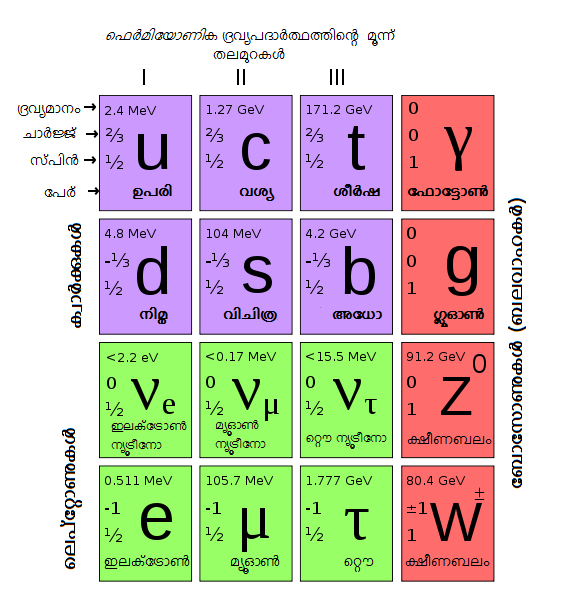
Via Wikimedia Commons: Standard Model of Elementary Particles-ml by StandardModelofElementaryParticles.svg : MissMJ derivative w, CC BY 3.0.
The six quarks
CERN describes the six quarks as paired in the three generations: the up and down quarks form the first generation, the charm and strange quarks the second, and the top and bottom quarks the third. The bottom quark is also called the beauty quark. The names are only labels and carry no everyday meaning.
Each quark has an electric charge that is a fraction of the proton's charge, e. In the Particle Data Group's 2025 summary tables, the up, charm and top quarks each have a charge of +2/3 e, and the down, strange and bottom quarks each have −1/3 e (Particle Data Group, 2025).
Their masses span an enormous range. Particle physicists express mass in units of energy, the mega-electronvolt (MeV) and giga-electronvolt (GeV, a thousand MeV). The Particle Data Group's 2025 values are about 2.16 MeV for the up quark, 4.70 MeV for the down, 93.5 MeV for the strange, 1.273 GeV for the charm and 4.183 GeV for the bottom, while direct measurements give the top quark 172.56 ± 0.31 GeV. On those figures the top quark is roughly 80,000 times as heavy as the up quark (172,560 MeV ÷ 2.16 MeV ≈ 79,900). Because quarks cannot be isolated and weighed, the lighter masses are defined within a particular theoretical scheme, which the tables specify (Particle Data Group, 2025).
How quarks make up other particles
Particles built from quarks are called hadrons. In Caltech's account of the original model, a proton is up-up-down and a neutron is down-down-up; their charges add up accordingly, +2/3 + 2/3 − 1/3 = +1 for the proton and −1/3 − 1/3 + 2/3 = 0 for the neutron. Lighter hadrons such as pions and kaons contain two quark components rather than three: a quark and an antiquark, its antimatter counterpart. The upsilon particle, for example, is a b quark and an anti-b quark bound together.
Quarks also carry a property called colour, which has nothing to do with visible colour. CERN states that quarks come in three different "colours" and only mix in such ways as to form colourless objects. Colour is the charge of the strong force, which holds quarks together and is carried by particles called gluons (CERN).
The strong force and confinement
The strong force behaves in an unusual way. The 2004 Nobel Prize in Physics went to David Gross, H. David Politzer and Frank Wilczek for the discovery of asymptotic freedom in the theory of the strong interaction. As the Academy explained, the closer quarks are to each other, the weaker the colour charge between them, so that at very short distances they behave almost as free particles. As they move apart the force grows stronger, which the Academy compared to a rubber band. The discovery was expressed in 1973 and led to the theory of the strong force called quantum chromodynamics (QCD), which, the Academy wrote, explains why quarks only behave as free particles at extremely high energies.
The result is that quarks are confined inside hadrons. Experiments have looked for a free quark many times without success: the Particle Data Group's summary states that all searches since 1977 have had negative results.
History
A crowded catalogue of particles
By the 1950s, accelerator experiments were producing many new particles. The Royal Swedish Academy of Sciences describes how a large number of hadrons were discovered in the 1950s and 1960s, with properties resembling those of protons and neutrons, so that classifying them became urgent. In 1953 Murray Gell-Mann and Kazuhiko Nishijima independently proposed a new quantity, strangeness, to explain why some of these particles lived far longer than expected. In 1961 Gell-Mann, by then at Caltech, and the Israeli physicist Yuval Ne'eman independently proposed sorting particles into small tables by charge and strangeness. Gell-Mann named his version the "Eightfold Way", after the Buddhist Eightfold Path, because the tables tended to have eight members.
The quark proposal of 1964
The scheme implied a basic set of three building blocks, but the charges would only work out if those building blocks carried fractions of the proton's charge, something no experiment had ever seen. In 1964 Gell-Mann and George Zweig independently proposed a triplet with one member of charge +2/3 and two members of −1/3. Gell-Mann called them quarks, after the line "Three quarks for Muster Mark!" in James Joyce's Finnegans Wake. His paper introducing the quark was, in Caltech's description, all of two pages long.
Gell-Mann presented quarks cautiously, writing that it was "fun to speculate about the way quarks would behave if they were physical particles of finite mass" rather than purely mathematical entities. Zweig, a junior postdoctoral fellow at CERN, called his version "aces" and was less cautious about their reality. According to Caltech's account, senior staff at CERN considered his ideas too unconventional and his paper was sent to a file room instead of a journal.
Gell-Mann received the 1969 Nobel Prize in Physics, cited for his contributions and discoveries concerning the classification of elementary particles and their interactions. Caltech notes that the prize was not for the quark model as such, which was still on thin ice at the time. For some years quarks were sought in sea water, meteorites, cosmic rays and accelerator experiments, and when no quarks were to be found, the most popular explanation was that they were only mathematical quantities.
Evidence inside the proton
The first experimental traces came from the Stanford Linear Accelerator Center (SLAC) in California. At the end of the 1960s and the beginning of the 1970s, a team from MIT and SLAC fired electrons with energies from 4 GeV to 21 GeV from a two-mile-long accelerator at targets of liquid hydrogen and deuterium. The experiment was regarded as routine, but far more electrons than expected bounced off at large angles after losing much of their energy, a process called deep inelastic scattering. The theorists James Bjorken and Richard Feynman interpreted the results as evidence of hard grains – quarks – in the nucleons, the protons and neutrons. The Academy compared the experiment to the alpha-particle scattering that had revealed the atomic nucleus early in the 20th century. The results also showed electrically neutral components inside nucleons, later identified as gluons (Nobel Prize, 1990). Jerome Friedman, Henry Kendall and Richard Taylor shared the 1990 Nobel Prize in Physics for these investigations (Nobel Prize).
Charm, bottom and top
The original model had three quarks. A fourth came into view in November 1974, when Burton Richter's team at SLAC and Samuel Ting's team at Brookhaven National Laboratory independently found the same heavy particle, named psi by one team and J by the other. The two leaders met at SLAC on 11 November 1974 and found they had discovered the same particle. In its 1976 prize announcement, the Academy wrote that understanding its structure made a fourth quark very likely necessary; the J/psi was later shown to be a bound state of the charm quark. Richter and Ting shared the 1976 Nobel Prize in Physics.
The theoretical case for more quarks had already been made. In 1972 Makoto Kobayashi and Toshihide Maskawa showed that a broken symmetry first seen in particle experiments in 1964 could be explained within the Standard Model if there were at least three families of quarks in nature. Their predictions were confirmed in detail when the BaBar experiment at Stanford and the Belle experiment at Tsukuba, Japan, independently detected broken symmetries in 2001, and they shared half of the 2008 Nobel Prize in Physics.
The first third-generation quark appeared in 1977. On 30 June 1977, at a hastily called colloquium at Fermilab near Chicago, the physicist Steve Herb announced that Experiment 288 had discovered the upsilon particle, a bound state of a bottom quark and its antiquark, seen as an excess of events at about 9.50 GeV. The experiment's spokesman, Leon Lederman, called it one of the most expected surprises in particle physics.
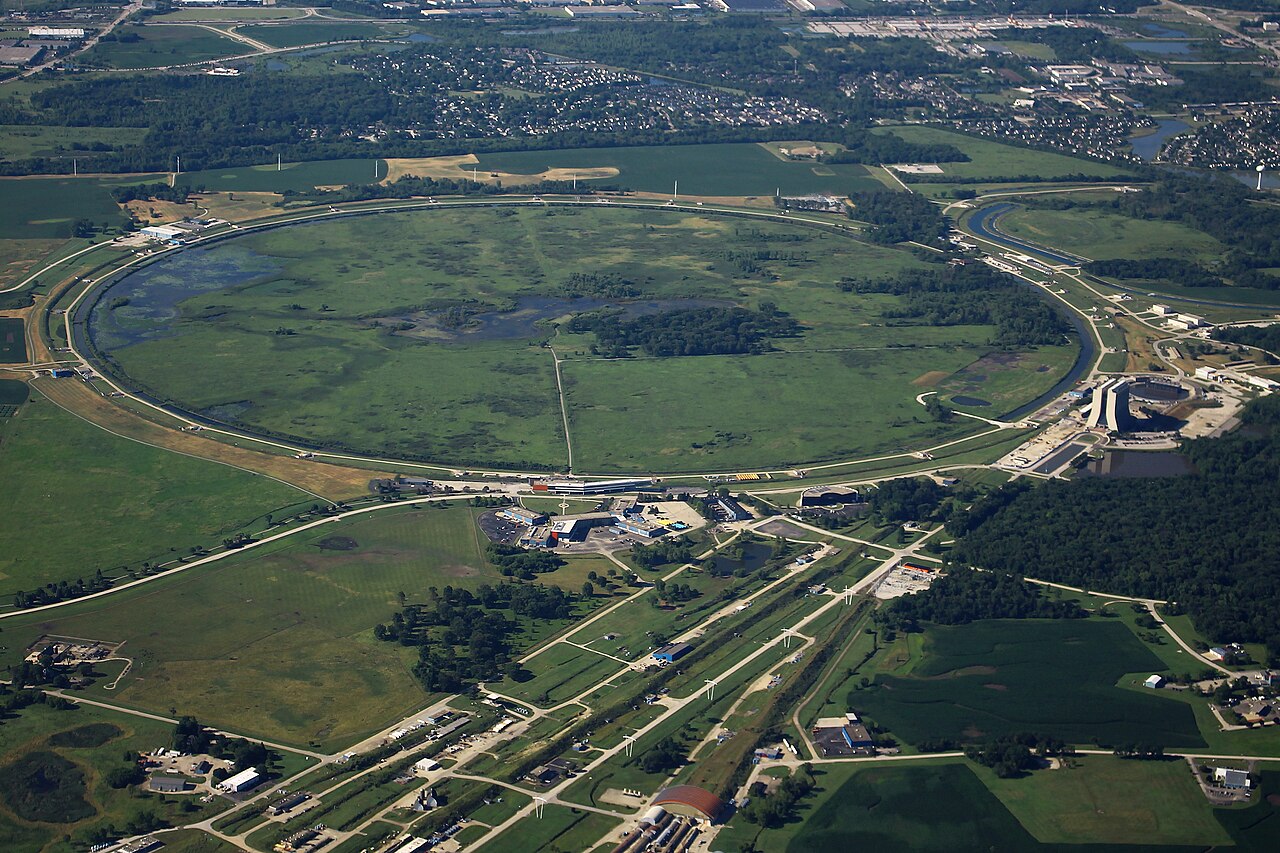
Via Wikimedia Commons: Fermilab Tevatron Aerial by formulanone, CC BY-SA 2.0.
The search for the bottom quark's partner took almost two decades. On 2 March 1995 Fermilab announced the discovery of the top quark, the last undiscovered quark of the six predicted by current scientific theory. Two collaborations, CDF and DZero, each with about 450 members, found it independently in collisions between protons and antiprotons at the Tevatron accelerator, and submitted their papers to Physical Review Letters on 24 February 1995 (Fermilab).
Place in physics
Quarks are one of the two basic types of matter particle in the Standard Model, the theory that, in the Academy's words, unifies the smallest building blocks of all matter and three of nature's four forces; the other type is the leptons, six particles in three generations that include the electron. The force the Standard Model leaves out is gravity. As of 2025, the Particle Data Group's tables list only lower mass limits from searches for a fourth generation of quarks, meaning none has been found.
Open questions remain. The 2008 Nobel announcement noted that a broken symmetry of the same kind as the one Kobayashi and Maskawa explained seems to lie behind the survival of matter after the Big Bang, but that the question of how this exactly happened still remains unanswered.
Sources
- CERN, "The Standard Model", home.cern, accessed 12 November 2026. home.cern/science/physics/standard-model
- S. Navas et al. (Particle Data Group), "Quarks" summary table, Review of Particle Physics, Phys. Rev. D 110, 030001 (2024) and 2025 update, created 30 May 2025. pdg.lbl.gov/2025/tables/rpp2025-sum-quarks.pdf
- Douglas Smith, "50 Years of Quarks", California Institute of Technology, 22 July 2014. caltech.edu/about/news/50-years-quarks-43351
- The Nobel Prize in Physics 1969 (summary), NobelPrize.org, Nobel Prize Outreach, accessed 12 November 2026. nobelprize.org/prizes/physics/1969/summary/
- Royal Swedish Academy of Sciences, press release for the Nobel Prize in Physics 1976, 18 October 1976, NobelPrize.org. nobelprize.org/prizes/physics/1976/press-release/
- Royal Swedish Academy of Sciences, press release for the Nobel Prize in Physics 1990, 17 October 1990, NobelPrize.org. nobelprize.org/prizes/physics/1990/press-release/
- Royal Swedish Academy of Sciences, press release for the Nobel Prize in Physics 2004, 5 October 2004, NobelPrize.org. nobelprize.org/prizes/physics/2004/press-release/
- Royal Swedish Academy of Sciences, press release for the Nobel Prize in Physics 2008, 7 October 2008, NobelPrize.org. nobelprize.org/prizes/physics/2008/press-release/
- Fermilab, "Physicists discover top quark", press release, 2 March 1995. news.fnal.gov/1995/03/physicists-discover-top-quark/
- "Revisiting the b revolution", CERN Courier, 19 May 2017. cerncourier.com/a/revisiting-the-b-revolution/
