Compare versions
Version 1 → Version 2. Removed · Added. This shows the entry's text as it is written, including its formatting marks.
Version 1 · Version 2 · Version history
Side by side · Together
The doomsday equation is a formula for world population growth, published in 1960 by Heinz von Foerster, Patricia Mora and Lawrence Amiot, which fitted two thousand years of population estimates and implied that the number of people would become infinite on Friday, 13 November 2026.
The paper appeared in *Science* on 4 November 1960 under the title ["Doomsday: Friday, 13 November, A.D. 2026"](https://doi.org/10.1126/science.132.3436.1291) (vol. 132, no. 3436, pp. 1291–1295). Its subtitle stated the claim in one line: [at this date human population will approach infinity if it grows as it has grown in the last two millennia](https://doi.org/10.1126/science.132.3436.1291). The authors were [members of the staff of the department of electrical engineering, University of Illinois, Urbana](https://doi.org/10.1126/science.132.3436.1291), and the study was sponsored in part by [the National Institutes of Health](https://doi.org/10.1126/science.132.3436.1291). The date was never a forecast of a physical event. It is the point at which the authors' curve, extended forward, stops giving finite answers.
## The model
The paper starts from the simplest model of a population: if each member has a fixed rate of producing offspring and a fixed chance of dying, the population grows or shrinks exponentially, at a steady percentage rate. The usual refinement, the logistic or ["sigmoid"](https://doi.org/10.1126/science.132.3436.1291) curve, assumes that crowding and competition slow growth as numbers rise, so that the population levels off at a stable size.
Von Foerster and his co-authors proposed the opposite for people. They argued that members of a population able to communicate can form coalitions until the whole population acts, in game-theory terms, [as a single person playing a two-person game with nature as its opponent](https://doi.org/10.1126/science.132.3436.1291). On that view more people make a more effective coalition, so a population's growth rate, which they called its "productivity", should rise as the population grows. They wrote the rate as a weak power of the population size and integrated the result, which gives a curve of the form
> *N* = *K* / (*t*₀ − *t*)^*k*
where *N* is world population, *t* is the year, and *t*₀ is the date at which *N* goes to infinity. The authors named *t*₀ "doomsday", [since it is on that date … that N goes to infinity and that the clever population annihilates itself](https://doi.org/10.1126/science.132.3436.1291). A curve of this kind is called hyperbolic: unlike exponential growth, where the percentage growth rate is fixed, the growth rate itself [increases more and more rapidly as one approaches doomsday](https://doi.org/10.1126/science.132.3436.1291).
## The data and the date
To test the idea, the authors gathered [24 estimates](https://doi.org/10.1126/science.132.3436.1291) of world population from the time of Christ almost to the present, checked them for independence, and dropped estimates that merely repeated one another. Using the method of least squares, they obtained three values: *t*₀ = A.D. [2026.87 ± 5.50 years](https://doi.org/10.1126/science.132.3436.1291), *K* = (1.79 ± 0.14) × 10¹¹, and *k* = 0.990 ± 0.009. The curve fitted the recorded data with a root mean square deviation of [approximately 7 percent](https://doi.org/10.1126/science.132.3436.1291). The fitted value 2026.87 falls in mid-November 2026, and the paper's title names Friday 13 November.
The equation also gives the population's doubling time, which the paper puts at [0.445 times the number of years left until doomsday](https://doi.org/10.1126/science.132.3436.1291). Worked through with the paper's constants, the formula gives about 2.8 billion people in 1960, about 67 years before the critical date, with a doubling time of roughly 30 years; for 2024, under three years before it, the same formula gives about 63 billion people, doubling roughly every 15 months.
The authors noted that the estimate improves as the critical date nears. Charlemagne, with the evidence available to him, [could have predicted doomsday accurately within 300 years](https://doi.org/10.1126/science.132.3436.1291), Elizabeth I within 110 years and Napoleon within 30, while in 1960 the needed extrapolation was only 4 percent beyond the last observation, allowing a prediction [within approximately 10 years](https://doi.org/10.1126/science.132.3436.1291). Run backwards, the formula gives a world population of [about 200,000 individuals](https://doi.org/10.1126/science.132.3436.1291) one million years ago; the authors cautioned that extrapolating much further into the past produces inconsistencies, since it puts a single first human some 200 billion years in the past, far beyond astronomers' estimates of the age of the universe at the time.
## The argument behind it
The paper used its curve to take sides in the debate over population control. It described two camps: "optimists" who expected technology to keep pace with any rate of growth, and "pessimists" who feared resource depletion and the poisoning of the biosphere. Given how closely the curve had held through several technological revolutions, the authors concluded that the optimists were right that people had always developed the technology to feed themselves, but drew a darker conclusion from it, in the paper's best-known sentence: [our great-great-grandchildren will not starve to death. They will be squeezed to death.](https://doi.org/10.1126/science.132.3436.1291)
The remedy they proposed was what they called a ["peoplo-stat"](https://doi.org/10.1126/science.132.3436.1291), a control mechanism that would hold world population at a constant level. Because they assumed no effort would be made to shorten human life spans, they argued that the control had to act on fertility, which in 1960 meant [cutting the birth rate to about half its present value](https://doi.org/10.1126/science.132.3436.1291), or an average family of just over two children. They dismissed space travel as an alternative with the remark that [no re-entry permit to earth can be given these space-trotters](https://doi.org/10.1126/science.132.3436.1291).
## Reception
The paper reached the general press within days. *TIME* reported it on 14 November 1960, quoting the "squeezed to death" line and von Foerster's warning that the gap between birth rate and death rate was [widening every minute](https://time.com/archive/6647875/science-doomsday-in-2026-a-d/); the magazine added that he did not expect the population literally to become infinite, but used the equation to show that accelerating growth would lead to serious trouble and argued that birth control could prevent it.
Among scientists the response was divided. According to the historian Alan MacEachern of Western University, writing in *The Conversation* in September 2026, mathematicians and demographers sent letters to *Science* calling the work ["ridiculous" and "manifestly absurd"](https://theconversation.com/scientists-predicted-friday-13-november-2026-would-be-doomsday-should-you-be-worried-290354), and the authors answered with defences that stood by the mathematics and its conclusions. MacEachern also reports that the equation was cited in textbooks on genetics, ecology and demography, by a witness before a Canadian parliamentary committee in 1963 as a reason chemical pesticides were needed, and in a [1971 U.S. Supreme Court abortion case leading up to Roe v. Wade](https://theconversation.com/scientists-predicted-friday-13-november-2026-would-be-doomsday-should-you-be-worried-290354).
## Later work
The paper's central observation, that over most of history the world's population growth rate has risen with the size of the population, was taken up by economists. In a 1993 paper in the *Quarterly Journal of Economics*, Michael Kremer built a model in which a larger population produces more inventions, and more technology supports a larger population; it predicts that over most of history [the growth rate of population will be proportional to its level](https://doi.org/10.2307/2118405). Kremer tested that prediction [using an approach similar to that of Von Foerster, Mora, and Amiot](https://doi.org/10.2307/2118405), whom he described as having concluded, [presumably in jest](https://doi.org/10.2307/2118405), that population would become infinite in 2026. Unlike the 1960 model, his generalized version predicts that population growth eventually slows, [due not to overpopulation and environmental collapse, but to increased income and declining fertility](https://doi.org/10.2307/2118405): the change demographers call the demographic transition.
## Why the prediction failed
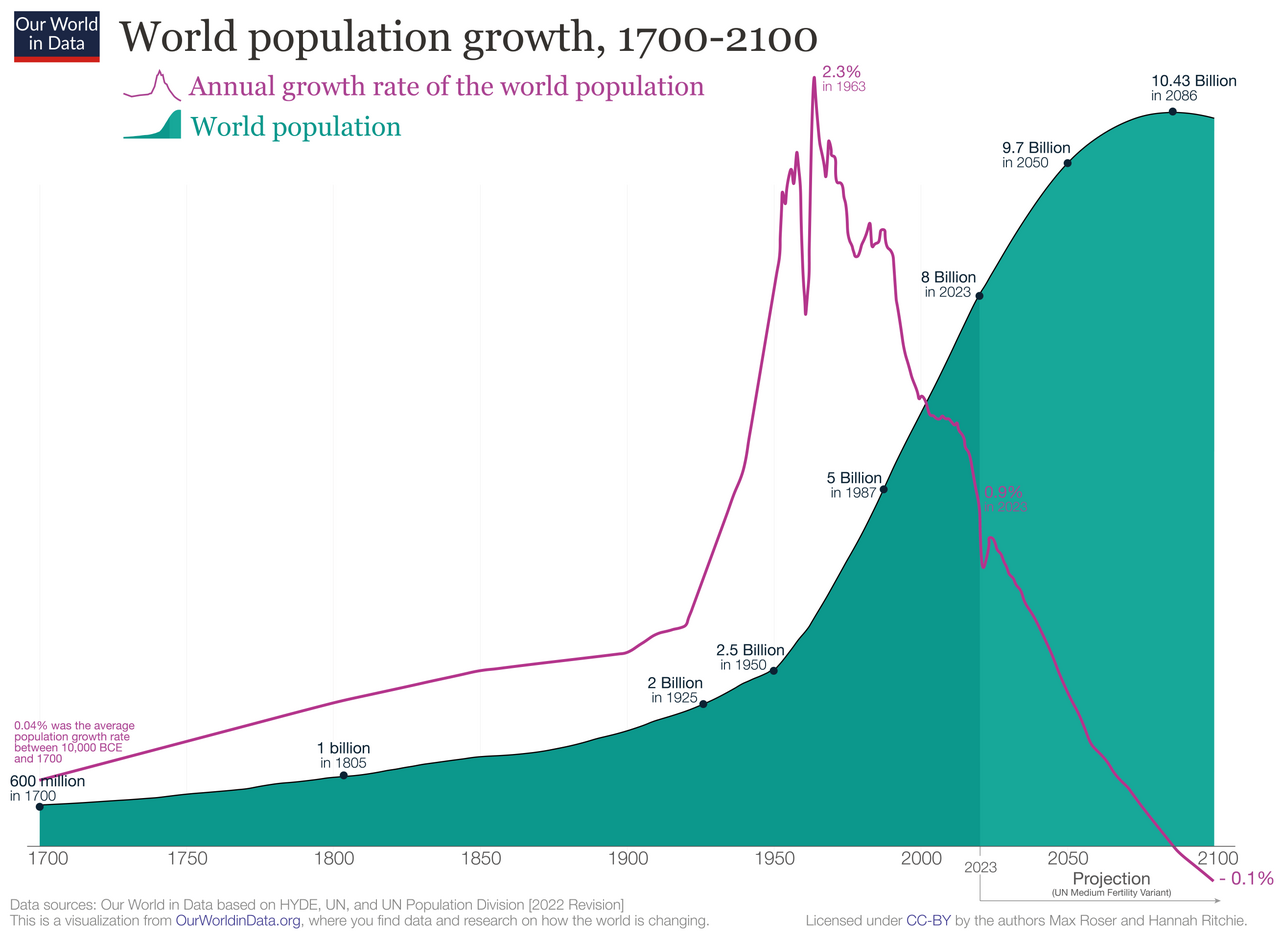
*Via Wikimedia Commons: [World population growth, 1700-2100, 2022 revision](https://commons.wikimedia.org/wiki/File:World_population_growth,_1700-2100,_2022_revision.png) by Max Roser and Hannah Ritchie, [CC BY 4.0](https://creativecommons.org/licenses/by/4.0).*
World population did not follow the curve. The United Nations' *World Population Prospects 2024*, published on 11 July 2024, put world population at [8.2 billion people in 2024](https://www.un.org/sustainabledevelopment/blog/2024/07/press-release-wpp2024/) and projected that it would peak at around 10.3 billion in the mid-2080s; it also reported that women worldwide were having one child fewer, on average, than around 1990. MacEachern dates the divergence from the curve to [around 1993](https://theconversation.com/scientists-predicted-friday-13-november-2026-would-be-doomsday-should-you-be-worried-290354) and notes that the global birth rate is now slightly less than half its 1960 level.
Later commentators attribute the failure to the demographic transition, which Woolhouse notes was [already underway by 1960](https://theconversation.com/why-the-doomsday-prediction-of-1960-matters-today-295817). In *Popular Science* in October 2026, the mathematical biologist Joel Cohen of Rockefeller and Columbia Universities said of world population growth that [the all-time peak happened in the early 1960s](https://www.popsci.com/science/world-end-overpopulation-doomsday-november-2026/), and the economic demographer Dean Spears of the University of Texas called the paper's assumption [based on a misunderstanding of where population growth comes from](https://www.popsci.com/science/world-end-overpopulation-doomsday-november-2026/). The magazine explains that [once most children survive, families tend to have fewer of them](https://www.popsci.com/science/world-end-overpopulation-doomsday-november-2026/), so that the twentieth century's growth was a one-time surge rather than a self-reinforcing loop. The epidemiologist Mark Woolhouse of the University of Edinburgh, writing in *The Conversation* in November 2026, argued that the model's form decided its result in advance, describing an equation [predetermined to give the desired result](https://theconversation.com/why-the-doomsday-prediction-of-1960-matters-today-295817), and that its authors [failed to take into account that people living in richer, healthier and better-educated societies would have fewer children](https://theconversation.com/why-the-doomsday-prediction-of-1960-matters-today-295817).
Readers differ on how seriously the authors meant the date. Kremer took the conclusion to be a jest, and *TIME* reported in 1960 that von Foerster did not expect infinite population; MacEachern, by contrast, argues that the predictions began to fail because the world began to do what the authors recommended, reducing birth rates. Woolhouse notes that 13 November 2026 would have been [von Foerster's 115th birthday](https://theconversation.com/why-the-doomsday-prediction-of-1960-matters-today-295817).
## Sources
- Heinz von Foerster, Patricia M. Mora and Lawrence W. Amiot, "Doomsday: Friday, 13 November, A.D. 2026", *Science*, vol. 132, no. 3436, pp. 1291–1295, 4 November 1960. https://doi.org/10.1126/science.132.3436.1291
- "Science: Doomsday in 2026 A.D.", *TIME*, 14 November 1960. https://time.com/archive/6647875/science-doomsday-in-2026-a-d/
- Michael Kremer, "Population Growth and Technological Change: One Million B.C. to 1990", *Quarterly Journal of Economics*, vol. 108, no. 3, pp. 681–716, August 1993. https://doi.org/10.2307/2118405
- United Nations Department of Economic and Social Affairs, "UN projects world population to peak within this century" (press release on *World Population Prospects 2024*), 11 July 2024. https://www.un.org/sustainabledevelopment/blog/2024/07/press-release-wpp2024/
- Mack DeGeurin, "In 1960, scientists predicted the world would end on November 13, 2026", *Popular Science*, 13 October 2026. https://www.popsci.com/science/world-end-overpopulation-doomsday-november-2026/
- Alan MacEachern, "Scientists predicted 'Friday 13 November 2026' would be 'doomsday.' Should you be worried?", *The Conversation*, 30 September 2026. https://theconversation.com/scientists-predicted-friday-13-november-2026-would-be-doomsday-should-you-be-worried-290354
- Mark Woolhouse, "Why the doomsday prediction of 1960 matters today", *The Conversation*, 11 November 2026. https://theconversation.com/why-the-doomsday-prediction-of-1960-matters-today-295817
