Automatic license plate reader
Camera system that reads vehicle license plates and records when and where each was seen
Camera system that reads vehicle license plates and records when and where each was seen

An automatic license plate reader (ALPR) is a camera system that photographs passing vehicles, uses software to read their license plates, and records each plate number with the time and place it was seen. Police are its main users, and it is also used for traffic enforcement.
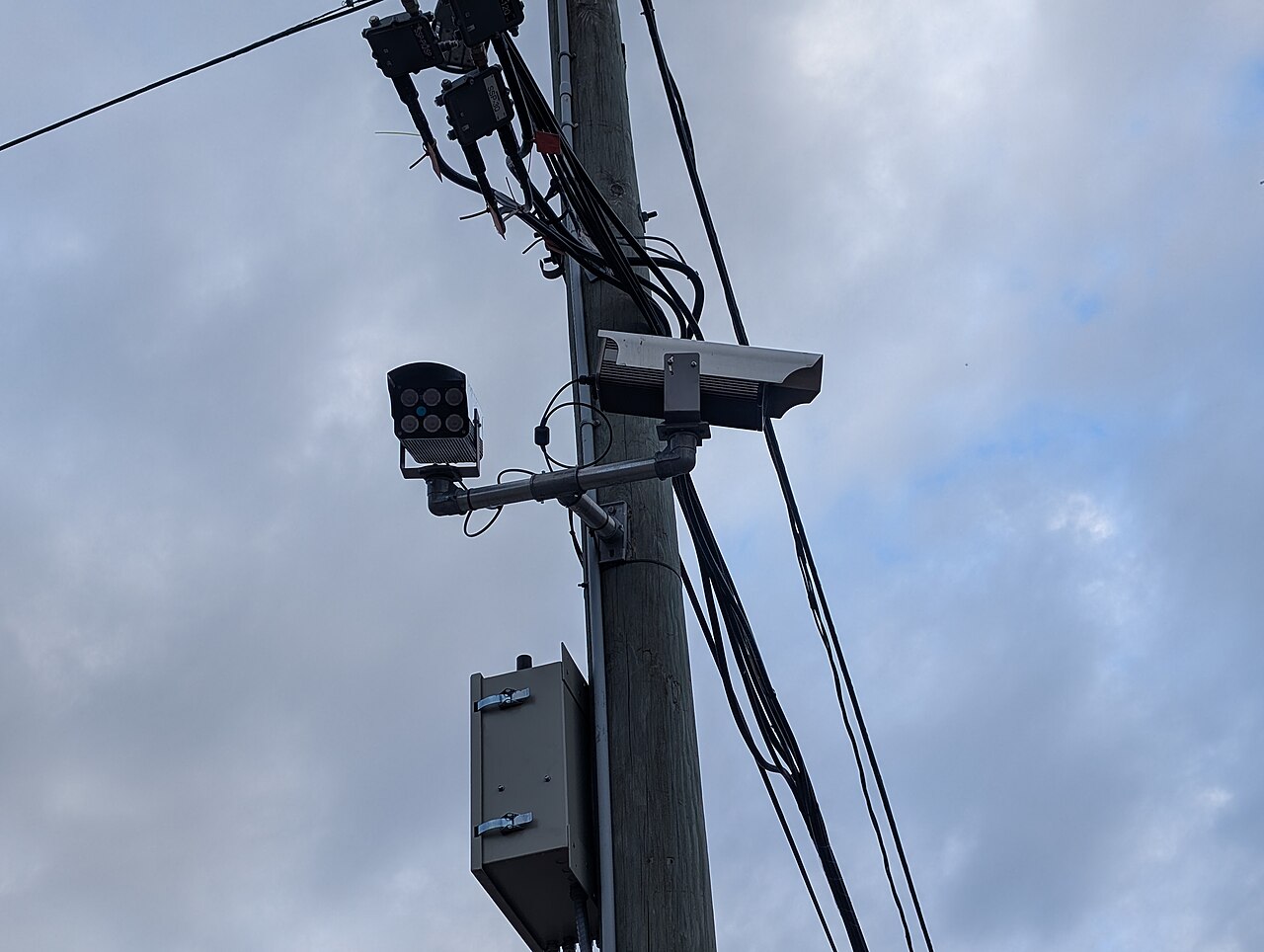
Via Wikimedia Commons: ELSAG Fixed Plate Hunter by Kobenon, CC0.
The same technology is called automatic number plate recognition (ANPR) in the United Kingdom, where a national law enforcement ANPR capability links police cameras across England, Wales, Scotland and Northern Ireland. In the United States, police departments were rapidly expanding their use of the readers by 2013, according to the American Civil Liberties Union (ACLU), and the California State Auditor reported in February 2020 that the majority of California law enforcement agencies collect and use images from them. The readers are valued by police as an investigative tool and criticised by civil-liberties groups as a way of recording the movements of people suspected of nothing.
An ALPR system has two parts: cameras and software. In the description given by the California State Auditor in its 2020 report, cameras are either fixed, mounted to stationary objects, such as light poles, or mobile, mounted on police vehicles. Software extracts the plate number from each image and stores it, with the date, time, and location of the scan and sometimes a partial image of the vehicle, in a searchable database. The ACLU gave a similar account in 2013: the systems photograph every license plate they encounter, read the number, add a time and location stamp and record the result.
The software then compares each plate with lists of vehicles of interest, called hot lists, such as stolen vehicles or vehicles linked to missing persons, and issues an alert, called a hit, when a plate matches (California State Auditor, 2020). Because the record is kept whether or not the plate matches, the auditor described the system as both a real‑time tool for these agencies and an archive of historical images.
Some systems record more than the plate. Meeting materials from Roseburg, Oregon, reported by Oregon Public Broadcasting in November 2026, describe its cameras as capturing images of a vehicle's rear license plate, including make, model and color, without video or facial recognition. The auditor found that two California agencies were adding names, addresses, dates of birth, and criminal charges to their ALPR systems.
The first use is the live alert, the hit that tells officers a car on a hot list has passed a camera. The second is the search of stored records. The California State Auditor wrote that personnel can search the accumulated images to determine the vehicles present at particular locations and to track vehicles' movements in order to develop leads.
The UK Home Office's national standards state that ANPR is used to help detect, deter and disrupt criminality at local, regional and national level, including against travelling criminals, organised crime groups and terrorists, and that it provides lines of enquiry and evidence in the investigation of crime. Uses have spread beyond policing. In an October 2023 letter to the Secretary of State for Transport, the UK's Biometrics and Surveillance Camera Commissioner noted that traffic management schemes such as Ultra Low Emission Zones depend on a reliable and comprehensive ANPR camera network, and that members of an advisory group he chaired had raised concerns about the creeping extension of ANPR functions into non-policing areas.
The numbers are large. The commissioner's 2023 letter repeated his predecessor's account of the largest non-military database in the UK: cameras covering approximately 15,400 traffic lanes and submitting between 75 and 80 million reads a day, occasionally more than 80 million. The commissioner expected the total could reach 100m reads each day by the end of 2024 on the trend since 2019.
In the United States, the California State Auditor found that the Los Angeles Police Department had accumulated 320 million images over several years, of which only 400,000 produced an immediate match against a hot list; in the auditor's words, 99.9 percent of the stored images were of vehicles not on a hot list when photographed. The ACLU's 2013 report, based on about 26,000 pages of records from police and other agencies, gave a similar picture: in Maryland, for every million plates read, only 47 (0.005 percent) were potentially linked to a stolen car or a person wanted for a serious crime.
Readers can misread plates, and plates can be disguised. The UK commissioner wrote in 2023 that even at an accuracy rate of 97 percent, UK volumes meant up to 2.4 million inaccurate reads per day, with a risk of penalty notices being wrongly sent to innocent motorists. He also described how easily the system can be defeated, with reflective tape, so-called stealth plates and cloned plates copied from other vehicles, and cited one recent estimate that one in fifteen drivers might already be using anti-ANPR technology.
Research on whether the readers reduce crime is limited and so far mixed at best. A randomized experiment by Cynthia Lum and colleagues, published in the Journal of Experimental Criminology in December 2011, assigned 15 of 30 crime hot spots in two adjacent jurisdictions to police patrols using readers. It found that small numbers of such patrols do not seem to generate either a general or offense-specific deterrent effect, while noting limitations and caveats.
A later study by Christopher Koper and colleagues, published in the same journal in 2021, compared 785 patrols at 33 hot spots in a large suburban jurisdiction, made by officers with and without readers. Reader use increased stolen vehicle recoveries but not arrests, and did not change the chance of a new call while officers were present or the timing of the next one. The authors concluded that the study provides little clear evidence for the crime prevention efficacy of using readers in general patrol, and called for testing of other ways of deploying them. Both studies were funded by the U.S. National Institute of Justice. Both tested readers on patrol; neither abstract reports on searches of stored records after a crime, a use police also cite: Roseburg's police chief, for example, has said the cameras gave his department leads in cases including an ATM theft, burglaries, a child abduction and a kidnapping.
Supporters argue that a license plate is displayed in public. The California State Auditor summarised that position, that the images are collected in public places where there is no reasonable expectation of privacy, while concluding that the use and retention of the images still raises privacy concerns. In Roseburg, a city councillor said alerts from the cameras were really helpful to our police department and that he thought they reduced the number of officers needed to investigate crime.
Critics object to the archive rather than the alert. The report's lead author, ACLU staff attorney Catherine Crump, said in 2013 that the scanners were creating government location tracking systems recording the movements of many millions of innocent Americans, while adding that the ACLU did not object to using them to flag cars that are stolen or belong to fugitives. The ACLU also warned that officers could misuse the records to monitor people such as ex-spouses and neighbours (California State Auditor, 2020).
The auditor's review of four agencies (Fresno, Los Angeles, Marin County and Sacramento County) found gaps on several of these points. None had a policy containing all the information required by state law, and Los Angeles has not developed an ALPR policy at all. Three shared images widely, Sacramento with over a thousand entities across the United States, without always checking that recipients were public agencies with a need for the data. Retention ran from one year at Fresno to at least five years at Los Angeles, although staff at three of the agencies typically searched for images zero to six months old.
Rules vary widely by place and change often; the examples here are dated. In 2013 the ACLU found retention ranging from 48 hours (the Minnesota State Patrol) to no deletion policy at all, and noted that Maine and Arkansas had passed laws limiting how long police could keep records of innocent drivers (ACLU, 2013). California's Senate Bill 34, effective in 2016, required agencies using the systems to adopt detailed usage and privacy policies covering purpose, access, sharing, security and retention. According to Oregon Public Broadcasting, an Oregon law passed in 2026 placed new restrictions on the cameras, including limitations on how long data can be retained.
In the UK, the Home Office standards as updated on 10 November 2026 require read records in the national databases to be deleted 12 months after capture, and records in local systems after 90 days, unless kept under the rules for criminal investigations. In his 2023 letter, the commissioner described the government's Surveillance Camera Code of Practice as the sole legal instrument directly governing ANPR camera systems and noted that a bill then before Parliament would abolish it.
 Get Micwyn on your home screenIts own icon, full screen, and notifications.