Compare versions
Version 1 → Version 2 (current). Removed · Added. This shows the entry's text as it is written, including its formatting marks.
Version 1 · Version 2 (current) · Version history
Side by side · Together
Version 1Version 2 (current)
21 unchanged paragraphs
The Organization of the Petroleum Exporting Countries (OPEC) is a permanent intergovernmental organization of oil-exporting states, founded in Baghdad in 1960, whose members coordinate their petroleum policies and set production targets in an effort to stabilize world oil prices.[2][3]
The Organization of the Petroleum Exporting Countries (OPEC) is a permanent intergovernmental organization of oil-exporting states, founded in Baghdad in 1960, whose members coordinate their petroleum policies and set production targets in an effort to stabilize world oil prices.[2][3]
Since the departure of the United Arab Emirates in May 2026, OPEC has had eleven members: Algeria, the Republic of the Congo, Equatorial Guinea, Gabon, Iran, Iraq, Kuwait, Libya, Nigeria, Saudi Arabia and Venezuela.[17] Its members produced about 35 percent of the world's crude oil in 2025, a share that would have been about 31 percent without the United Arab Emirates, which left the organization on 1 May 2026.[4] A wider grouping known as OPEC+ joins OPEC's members with other large exporters, of which Russia is the biggest.[3]
Since the departure of the United Arab Emirates in May 2026, OPEC has had eleven members: Algeria, the Republic of the Congo, Equatorial Guinea, Gabon, Iran, Iraq, Kuwait, Libya, Nigeria, Saudi Arabia and Venezuela.[17] Its members produced about 35 percent of the world's crude oil in 2025, a share that would have been about 31 percent without the United Arab Emirates, which left the organization on 1 May 2026.[4] A wider grouping known as OPEC+ joins OPEC's members with other large exporters, of which Russia is the biggest.[3]
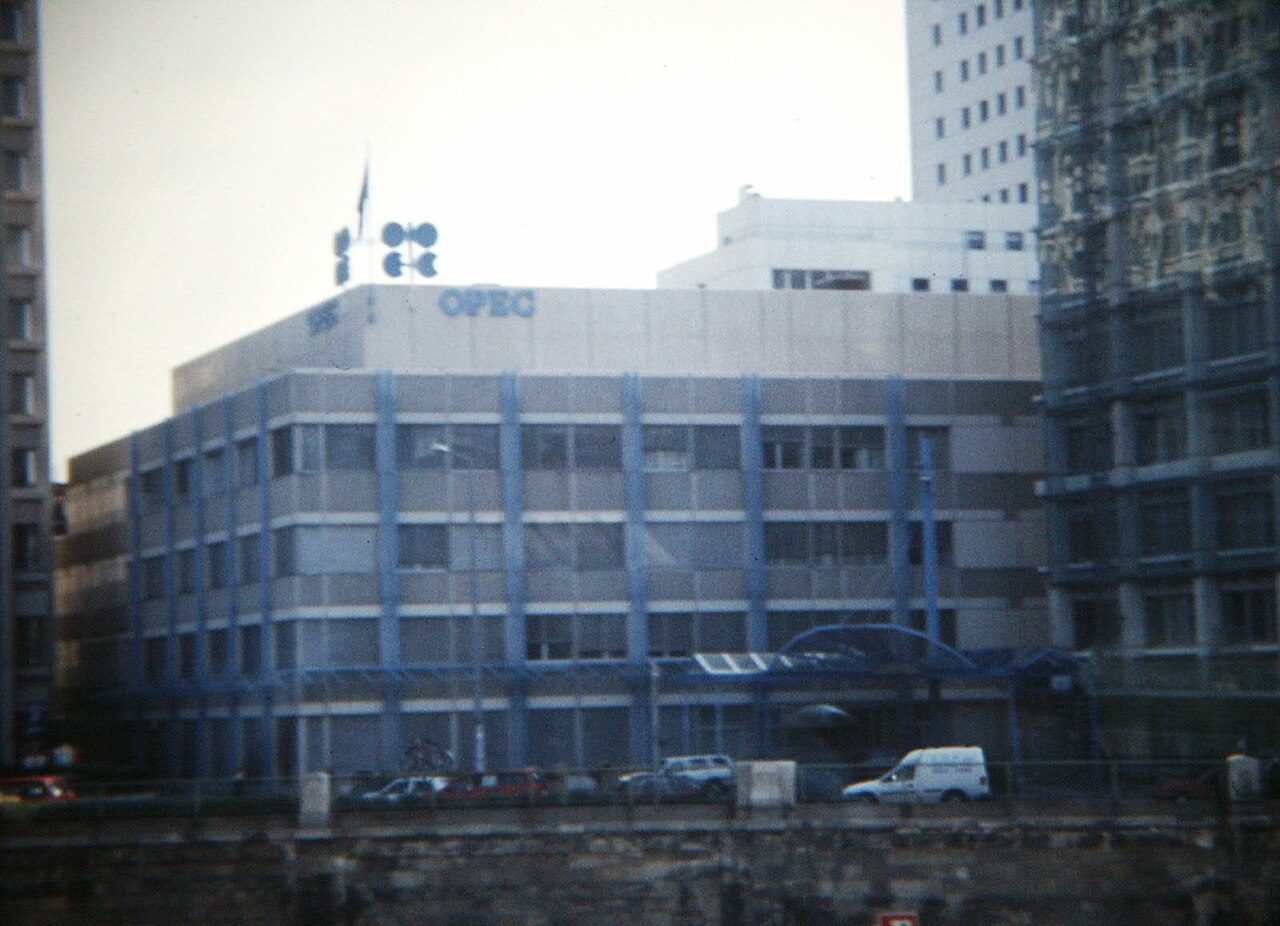

*Via Wikimedia Commons: [Vienna OPEC Headquarters (9812748993)](https://commons.wikimedia.org/wiki/File:Vienna_OPEC_Headquarters_(9812748993).jpg) by Gary Todd from Xinzheng, China, [CC0](http://creativecommons.org/publicdomain/zero/1.0/deed.en).*
*Via Wikimedia Commons: [Vienna OPEC Headquarters (9812748993)](https://commons.wikimedia.org/wiki/File:Vienna_OPEC_Headquarters_(9812748993).jpg) by Gary Todd from Xinzheng, China, [CC0](http://creativecommons.org/publicdomain/zero/1.0/deed.en).*
## Founding
## Founding
OPEC was created at a conference held in Baghdad from 10 to 14 September 1960, at the invitation of Iraq, by representatives of Iran, Iraq, Kuwait, Saudi Arabia and Venezuela.[1] The heads of the five delegations who signed the resolutions included Fuad Rouhani for Iran, Abdulla al-Tariki for Saudi Arabia and J. P. Pérez Alfonzo for Venezuela.[1]
OPEC was created at a conference held in Baghdad from 10 to 14 September 1960, at the invitation of Iraq, by representatives of Iran, Iraq, Kuwait, Saudi Arabia and Venezuela.[1] The heads of the five delegations who signed the resolutions included Fuad Rouhani for Iran, Abdulla al-Tariki for Saudi Arabia and J. P. Pérez Alfonzo for Venezuela.[1]
The conference's resolutions set out why the five governments acted. They described their countries as financing development programmes mainly from petroleum exports and relying heavily on oil income to balance their budgets, called petroleum "a wasting asset" that had to be replaced by other assets as it was used up, and said that fluctuations in its price disrupted those programmes.[1] The first resolution declared that the members could "no longer remain indifferent" to the way the oil companies had been changing prices, and that they would demand that the companies keep prices steady and try to restore them to the levels in force before recent reductions.[1] It also committed the members to study a system for stabilizing prices "by, among other means, the regulation of production", with regard for the interests of both producing and consuming nations.[1] The second resolution formed a permanent body, the Organization of the Petroleum Exporting Countries, and said that any country with "a substantial net export of Crude Petroleum" could join if all five founders agreed.[1]
The conference's resolutions set out why the five governments acted. They described their countries as financing development programmes mainly from petroleum exports and relying heavily on oil income to balance their budgets, called petroleum "a wasting asset" that had to be replaced by other assets as it was used up, and said that fluctuations in its price disrupted those programmes.[1] The first resolution declared that the members could "no longer remain indifferent" to the way the oil companies had been changing prices, and that they would demand that the companies keep prices steady and try to restore them to the levels in force before recent reductions.[1] It also committed the members to study a system for stabilizing prices "by, among other means, the regulation of production", with regard for the interests of both producing and consuming nations.[1] The second resolution formed a permanent body, the Organization of the Petroleum Exporting Countries, and said that any country with "a substantial net export of Crude Petroleum" could join if all five founders agreed.[1]
The agreement came into force on 1 October 1960.[1] Qatar was admitted on 15 January 1961, and Libya and Indonesia on 7 July 1962; the agreement was registered with the United Nations in November 1962.[1]
The agreement came into force on 1 October 1960.[1] Qatar was admitted on 15 January 1961, and Libya and Indonesia on 7 July 1962; the agreement was registered with the United Nations in November 1962.[1]
## Aims and structure
## Aims and structure
OPEC's founding charter, the Statute, was first approved by the organization's Conference in Caracas in January 1961.[2] Its second article states the organization's principal aim as "the coordination and unification of the petroleum policies of Member Countries" and the safeguarding of their interests, individually and collectively.[2] The same article charges the organization with finding ways to stabilize prices in international oil markets "with a view to eliminating harmful and unnecessary fluctuations", while giving due regard to a steady income for producers, an efficient and regular supply to consuming nations, and a fair return to those who invest in the industry.[2]
OPEC's founding charter, the Statute, was first approved by the organization's Conference in Caracas in January 1961.[2] Its second article states the organization's principal aim as "the coordination and unification of the petroleum policies of Member Countries" and the safeguarding of their interests, individually and collectively.[2] The same article charges the organization with finding ways to stabilize prices in international oil markets "with a view to eliminating harmful and unnecessary fluctuations", while giving due regard to a steady income for producers, an efficient and regular supply to consuming nations, and a fair return to those who invest in the industry.[2]
The Statute gives the organization three organs: the Conference, the Board of Governors and the Secretariat.[2] The Conference, made up of delegations from the member countries, is the supreme authority; each full member has one vote, and all decisions other than procedural ones require the unanimous agreement of the full members.[2] The Conference holds two ordinary meetings a year and may hold extraordinary ones.[2] English is the official language.[2] The Secretariat is in Vienna, Austria.[2][10]
The Statute gives the organization three organs: the Conference, the Board of Governors and the Secretariat.[2] The Conference, made up of delegations from the member countries, is the supreme authority; each full member has one vote, and all decisions other than procedural ones require the unanimous agreement of the full members.[2] The Conference holds two ordinary meetings a year and may hold extraordinary ones.[2] English is the official language.[2] The Secretariat is in Vienna, Austria.[2][10]
Membership is open to any country with a substantial net export of crude oil whose interests are fundamentally similar to those of the members, if three-quarters of the full members accept it, including all five founders.[2] A member may withdraw by giving notice to the Conference; under the Statute the withdrawal takes effect at the start of the next calendar year, provided the member's financial obligations are settled.[2]
Membership is open to any country with a substantial net export of crude oil whose interests are fundamentally similar to those of the members, if three-quarters of the full members accept it, including all five founders.[2] A member may withdraw by giving notice to the Conference; under the Statute the withdrawal takes effect at the start of the next calendar year, provided the member's financial obligations are settled.[2]
## Production targets and spare capacity
## Production targets and spare capacity
OPEC tries to influence prices mainly by setting production targets, limits on how much oil each member may produce.[3] Formal quotas for individual members date from the early 1980s: the political scientist Jeff Colgan gives 1982, and a 1999 article by the Federal Reserve Bank of St. Louis gives March 1983.[8][9]
OPEC tries to influence prices mainly by setting production targets, limits on how much oil each member may produce.[3] Formal quotas for individual members date from the early 1980s: the political scientist Jeff Colgan gives 1982, and a 1999 article by the Federal Reserve Bank of St. Louis gives March 1983.[8][9]
The U.S. Energy Information Administration (EIA) notes that, historically, prices have tended to rise when OPEC cuts its targets, but also that members do not always keep to the targets they agree, which can weaken the organization's effect on prices.[3] The EIA also points out that prices reflect expectations of future supply and demand, and that changes in OPEC's targets can lag behind changing market conditions.[3]
The U.S. Energy Information Administration (EIA) notes that, historically, prices have tended to rise when OPEC cuts its targets, but also that members do not always keep to the targets they agree, which can weaken the organization's effect on prices.[3] The EIA also points out that prices reflect expectations of future supply and demand, and that changes in OPEC's targets can lag behind changing market conditions.[3]
A central part of OPEC's position is spare capacity, which the EIA defines as production that can be brought online within 30 days and sustained for at least 90 days.[3] OPEC members together hold almost all of the world's spare capacity, and Saudi Arabia, the organization's largest producer and the world's largest crude oil exporter, has historically held the largest share of it.[3] Ample spare capacity is a cushion against supply disruptions; when it is thin, prices tend to carry a higher risk premium.[3] In 2025 Saudi Arabia produced 9.3 million barrels a day and had an estimated 11.6 million barrels a day of effective capacity, according to EIA estimates.[4]
A central part of OPEC's position is spare capacity, which the EIA defines as production that can be brought online within 30 days and sustained for at least 90 days.[3] OPEC members together hold almost all of the world's spare capacity, and Saudi Arabia, the organization's largest producer and the world's largest crude oil exporter, has historically held the largest share of it.[3] Ample spare capacity is a cushion against supply disruptions; when it is thin, prices tend to carry a higher risk premium.[3] In 2025 Saudi Arabia produced 9.3 million barrels a day and had an estimated 11.6 million barrels a day of effective capacity, according to EIA estimates.[4]
## The oil shocks of the 1970s
## The oil shocks of the 1970s
OPEC's influence grew in the years after its founding. According to an essay published by the Federal Reserve, oil supplies from outside OPEC were falling as a share of the world total, so OPEC's share grew, and this, together with greater participation rights in the industry, gave it much more influence over pricing than before.[6] The State Department's Office of the Historian records that OPEC had been demanding higher prices and a bigger share of revenue from the foreign oil companies, and that years of negotiation had already unsettled the pricing system before 1973.[5]
OPEC's influence grew in the years after its founding. According to an essay published by the Federal Reserve, oil supplies from outside OPEC were falling as a share of the world total, so OPEC's share grew, and this, together with greater participation rights in the industry, gave it much more influence over pricing than before.[6] The State Department's Office of the Historian records that OPEC had been demanding higher prices and a bigger share of revenue from the foreign oil companies, and that years of negotiation had already unsettled the pricing system before 1973.[5]
During the Arab-Israeli war of 1973, Arab oil producers imposed an embargo on the United States in retaliation for its resupply of Israel's military, cut production, and extended the embargo to the Netherlands, Portugal and South Africa.[5] The Federal Reserve essay dates the embargo on the United States to 19 October 1973 and attributes it to the Organization of Arab Petroleum Exporting Countries (OAPEC), a separate body of Arab producers; the State Department's account describes the same actors as the Arab members of OPEC.[6][5] The cuts nearly quadrupled the price of oil, from $2.90 a barrel before the embargo to $11.65 a barrel in January 1974.[6] The embargo was lifted in March 1974, but the higher prices remained.[6][5]
During the Arab-Israeli war of 1973, Arab oil producers imposed an embargo on the United States in retaliation for its resupply of Israel's military, cut production, and extended the embargo to the Netherlands, Portugal and South Africa.[5] The Federal Reserve essay dates the embargo on the United States to 19 October 1973 and attributes it to the Organization of Arab Petroleum Exporting Countries (OAPEC), a separate body of Arab producers; the State Department's account describes the same actors as the Arab members of OPEC.[6][5] The cuts nearly quadrupled the price of oil, from $2.90 a barrel before the embargo to $11.65 a barrel in January 1974.[6] The embargo was lifted in March 1974, but the higher prices remained.[6][5]
In the United States the shock led to the Strategic Petroleum Reserve, a national 55-mile-per-hour speed limit, fuel economy standards, and, on a proposal by Secretary of State Henry Kissinger, the creation of the International Energy Agency.[5]
In the United States the shock led to the Strategic Petroleum Reserve, a national 55-mile-per-hour speed limit, fuel economy standards, and, on a proposal by Secretary of State Henry Kissinger, the creation of the International Energy Agency.[5]
A second shock followed the Iranian revolution. Iran was a founding member of OPEC, and by January 1979 its oil output had fallen by 4.8 million barrels a day, about 7 percent of world production at the time.[7][1] Oil prices more than doubled between April 1979 and April 1980.[7] The Federal Reserve essay notes that the physical shortfall may not have been the most important factor, and that fear of further disruption and precautionary buying also pushed prices up; real oil prices began a long decline from mid-1980.[7]
A second shock followed the Iranian revolution. Iran was a founding member of OPEC, and by January 1979 its oil output had fallen by 4.8 million barrels a day, about 7 percent of world production at the time.[7][1] Oil prices more than doubled between April 1979 and April 1980.[7] The Federal Reserve essay notes that the physical shortfall may not have been the most important factor, and that fear of further disruption and precautionary buying also pushed prices up; real oil prices began a long decline from mid-1980.[7]
## The 1980s: quotas and the price collapse of 1986
After the second shock, the oil price fell for years and OPEC's members cut output to defend it. The economist Dermot Gately, writing in the Brookings Papers on Economic Activity in 1986, counted the restrictions made between 1979 and 1985: the largest percentage cutbacks were borne by Saudi Arabia (more than 60 percent of its 1979 output), Kuwait (almost 60 percent) and Libya (almost 50 percent).[19] He wrote that during 1983 to 1985 OPEC's revenue was below its mid-1970s level and less than half what it had been in 1980 and 1981.[19]
In the first half of 1986, Gately recorded, crude oil prices fell to about $12 a barrel, back to their 1974 level.[19] He described the collapse as the result of a decision by Saudi Arabia and some of its neighbours to increase their share of the oil market, taken in early 1986 after years of what he called futile attempts to get OPEC partners to observe their production quotas and share the burden of restriction more equitably: the Saudis and their allies undertook to produce their "fair share" and let the price fall.[19] From August 1985 to mid-1986 OPEC's output rose by about 4 million barrels a day, or about 25 percent, with more than half of the increase coming from Saudi Arabia.[19]
The pricing method changed at the same time. In the last quarter of 1985 many OPEC countries adopted "netback" pricing, under which the price of crude oil was set from the prices at which the refined products were sold, plus a guaranteed margin for the refiners.[19] The economist M. A. Adelman, in his published comment on Gately's paper, described the Saudi move as selling the country's full quota by "discounting without limit" from November 1985, and compared it with January 1983, when Saudi Arabia broke up an OPEC meeting and within two months the rest of the organization had agreed to quotas; this time, he wrote, it took nine months, many meetings and a price fall of 50 percent.[19]
The burden fell unevenly. For Saudi Arabia, Gately found, revenue fell only slightly, because the 50 percent price decline was almost offset by the larger volume; for OPEC as a whole it fell sharply.[19] Gately, who finished his paper after an OPEC agreement reached in Geneva in August 1986 to restrict output, expected that agreement to succeed, and wrote that the collapse by no means represented the death of OPEC, as had often been proclaimed.[19]
5 unchanged paragraphs
## Membership changes
## Membership changes
The membership has changed many times. The United Arab Emirates joined in 1967, through the emirate of Abu Dhabi.[4][16] Indonesia left in 2008, rejoined in January 2016 and withdrew again in November 2016; Ecuador was a member from 1978 to 1992 and again from 2007 to 2020.[17]
The membership has changed many times. The United Arab Emirates joined in 1967, through the emirate of Abu Dhabi.[4][16] Indonesia left in 2008, rejoined in January 2016 and withdrew again in November 2016; Ecuador was a member from 1978 to 1992 and again from 2007 to 2020.[17]
Qatar, a member since 1961, announced on 3 December 2018 that it would leave in January 2019.[13] Its energy minister, Saad Sherida al-Kaabi, said the country wanted to concentrate on natural gas, of which it was the world's largest exporter in liquefied form, and called Qatar "a small player in OPEC"; its oil output in 2017 was about 607,000 barrels a day, just under 2 percent of OPEC's total.[13] Qatar said the move was unrelated to the diplomatic blockade it then faced from Saudi Arabia, the United Arab Emirates, Egypt and Bahrain, though some analysts disagreed.[13]
Qatar, a member since 1961, announced on 3 December 2018 that it would leave in January 2019.[13] Its energy minister, Saad Sherida al-Kaabi, said the country wanted to concentrate on natural gas, of which it was the world's largest exporter in liquefied form, and called Qatar "a small player in OPEC"; its oil output in 2017 was about 607,000 barrels a day, just under 2 percent of OPEC's total.[13] Qatar said the move was unrelated to the diplomatic blockade it then faced from Saudi Arabia, the United Arab Emirates, Egypt and Bahrain, though some analysts disagreed.[13]
Angola left on 1 January 2024.[14] Its oil minister, Diamantino Azevedo, said membership no longer served the country's interests; the decision followed a dispute over the OPEC+ production targets for 2024, set in June 2023, which lowered the targets of nine of the group's 23 countries, Angola among them.[14] Angola was then producing about 1.19 million barrels a day, out of an OPEC total of about 28 million.[14]
Angola left on 1 January 2024.[14] Its oil minister, Diamantino Azevedo, said membership no longer served the country's interests; the decision followed a dispute over the OPEC+ production targets for 2024, set in June 2023, which lowered the targets of nine of the group's 23 countries, Angola among them.[14] Angola was then producing about 1.19 million barrels a day, out of an OPEC total of about 28 million.[14]
On 28 April 2026 the United Arab Emirates announced that it would leave both OPEC and OPEC+ with effect from 1 May.[16][4] The Associated Press reported that the country had pushed back against production quotas it considered too low, while its energy minister, Suhail al-Mazrouei, said the decision did not stem from a dispute with Saudi Arabia.[16] The government described the decision as reflecting its "long-term strategic and economic vision and evolving energy profile".[16] The country had been the third-largest member by production capacity, behind Saudi Arabia and Iraq, producing 3.4 million barrels a day in 2025 with an estimated effective capacity of 4.2 million.[4] The departure came during the U.S.-Israeli war with Iran, which had closed the Strait of Hormuz, through which about one-fifth of the world's oil supply passes.[16][15]
On 28 April 2026 the United Arab Emirates announced that it would leave both OPEC and OPEC+ with effect from 1 May.[16][4] The Associated Press reported that the country had pushed back against production quotas it considered too low, while its energy minister, Suhail al-Mazrouei, said the decision did not stem from a dispute with Saudi Arabia.[16] The government described the decision as reflecting its "long-term strategic and economic vision and evolving energy profile".[16] The country had been the third-largest member by production capacity, behind Saudi Arabia and Iraq, producing 3.4 million barrels a day in 2025 with an estimated effective capacity of 4.2 million.[4] The departure came during the U.S.-Israeli war with Iran, which had closed the Strait of Hormuz, through which about one-fifth of the world's oil supply passes.[16][15]
## The price fall of 2014 to 2016
A second large fall began in mid-2014. The U.S. Energy Information Administration (EIA) put the monthly average Brent price (the benchmark for much of the world's crude oil) at $112 a barrel in June 2014 and $62 in December of that year, and noted that most of 2014's growth in world oil production came from outside OPEC, particularly in North America, while OPEC's own output fell.[21][22] A report by the Congressional Research Service (CRS) described the same fall in daily prices: Brent and the U.S. benchmark WTI peaked in the last week of June 2014 at $113.74 and $107.04 a barrel, and stood at $57.86 and $53.46 as 2015 began.[20] It also recorded that U.S. crude output had risen from about 5 million barrels a day in 2008 to almost 9 million in December 2014.[20]
OPEC's ministers met on 27 November 2014, and the CRS report states that the organization "chose not to take any action to prevent further cuts in the price of oil".[20] According to the report, Saudi Arabia, Kuwait and the United Arab Emirates supported keeping output steady, while Iran, Venezuela and Nigeria objected.[20] The CRS also observed that cuts to support the price would have fallen mainly on Saudi Arabia, and that a high price could encourage U.S. shale oil and other non-OPEC producers to keep expanding.[20]
Prices stayed low through the following year. The EIA reported that Brent averaged $58 a barrel through July 2015, against $109 over the same months of 2014, and that it held between $55 and $65 for six straight months from February to July 2015.[22] A later EIA analysis found that OPEC members earned $404 billion in net oil export revenue in 2015, 46 percent less than the $753 billion of 2014 and the lowest figure since 2004, and that the monthly average Brent price had reached $38 a barrel in December 2015.[23] The cooperation agreement of December 2016 described under OPEC+ below followed this period.
8 unchanged paragraphs
## OPEC+
## OPEC+
OPEC+ grew out of the Declaration of Cooperation, signed at a meeting at the OPEC Secretariat in Vienna on 10 December 2016.[10] OPEC's members had agreed on 30 November 2016 to reduce their production by 1.2 million barrels a day from 1 January 2017, and eleven other producers (Azerbaijan, Bahrain, Brunei, Equatorial Guinea, Kazakhstan, Malaysia, Mexico, Oman, Russia, Sudan and South Sudan) agreed to a combined reduction of 558,000 barrels a day.[10] The declaration set up a Joint Ministerial Monitoring Committee of three OPEC members and two of the other producers, chaired by Kuwait with Russia as alternate chair.[10] The reductions, first set for six months, were extended in May 2017 for a further nine months.[10]
OPEC+ grew out of the Declaration of Cooperation, signed at a meeting at the OPEC Secretariat in Vienna on 10 December 2016.[10] OPEC's members had agreed on 30 November 2016 to reduce their production by 1.2 million barrels a day from 1 January 2017, and eleven other producers (Azerbaijan, Bahrain, Brunei, Equatorial Guinea, Kazakhstan, Malaysia, Mexico, Oman, Russia, Sudan and South Sudan) agreed to a combined reduction of 558,000 barrels a day.[10] The declaration set up a Joint Ministerial Monitoring Committee of three OPEC members and two of the other producers, chaired by Kuwait with Russia as alternate chair.[10] The reductions, first set for six months, were extended in May 2017 for a further nine months.[10]
The grouping's largest test came in 2020, when efforts to contain the coronavirus caused a steep fall in demand for oil.[12] A report by the Congressional Research Service noted that oil prices had fallen nearly 60 percent since January and that some regional prices were below $10 a barrel, after OPEC+ had failed to agree on a recommendation to cut production further.[11] In April 2020 OPEC and ten partner countries agreed to cut output by an initial 9.7 million barrels a day from May 2020, tapering through April 2022, with Iran, Libya and Venezuela exempt because of sanctions or domestic instability.[12][11] OPEC's total crude production fell by 6.0 million barrels a day from April to May 2020, the largest monthly decline since 1993, according to the EIA.[12]
The grouping's largest test came in 2020, when efforts to contain the coronavirus caused a steep fall in demand for oil.[12] A report by the Congressional Research Service noted that oil prices had fallen nearly 60 percent since January and that some regional prices were below $10 a barrel, after OPEC+ had failed to agree on a recommendation to cut production further.[11] In April 2020 OPEC and ten partner countries agreed to cut output by an initial 9.7 million barrels a day from May 2020, tapering through April 2022, with Iran, Libya and Venezuela exempt because of sanctions or domestic instability.[12][11] OPEC's total crude production fell by 6.0 million barrels a day from April to May 2020, the largest monthly decline since 1993, according to the EIA.[12]
In 2025 OPEC+ produced about 46 percent of the world's crude oil, a share that would have been closer to 42 percent without the United Arab Emirates.[4] OPEC's monthly report for November 2026 put the group's October output at 41.23 million barrels a day, up about 2.04 million from September, as Saudi Arabia raised its production to 10.563 million barrels a day.[18]
In 2025 OPEC+ produced about 46 percent of the world's crude oil, a share that would have been closer to 42 percent without the United Arab Emirates.[4] OPEC's monthly report for November 2026 put the group's October output at 41.23 million barrels a day, up about 2.04 million from September, as Saudi Arabia raised its production to 10.563 million barrels a day.[18]
## Debate over OPEC's power
## Debate over OPEC's power
OPEC is often called a cartel, a group of producers that limits output to raise prices, but how far it acts as one is disputed. On one side, the EIA's account of crude oil prices treats OPEC's production targets and spare capacity as an important influence on prices.[3] On the other, a 1999 article by Adam Zaretsky of the Federal Reserve Bank of St. Louis observed that OPEC's actual production had almost always been greater than its targets, and concluded that, like other cartels, it had trouble enforcing its agreements.[9]
OPEC is often called a cartel, a group of producers that limits output to raise prices, but how far it acts as one is disputed. On one side, the EIA's account of crude oil prices treats OPEC's production targets and spare capacity as an important influence on prices.[3] On the other, a 1999 article by Adam Zaretsky of the Federal Reserve Bank of St. Louis observed that OPEC's actual production had almost always been greater than its targets, and concluded that, like other cartels, it had trouble enforcing its agreements.[9]
Colgan, writing in the journal *International Organization* in 2014, ran four empirical tests and found that OPEC had little or no effect on its members' production levels.[8] He argued that the idea of OPEC as a cartel is a "rational myth" serving the organization's main function, which in his account is to bring its members political benefits such as international prestige, and he found that membership was associated with greater diplomatic recognition by other states.[8] He also noted that some members went for long periods without quotas; Iraq, for example, had none from 1998 to the time of writing.[8]
Colgan, writing in the journal *International Organization* in 2014, ran four empirical tests and found that OPEC had little or no effect on its members' production levels.[8] He argued that the idea of OPEC as a cartel is a "rational myth" serving the organization's main function, which in his account is to bring its members political benefits such as international prestige, and he found that membership was associated with greater diplomatic recognition by other states.[8] He also noted that some members went for long periods without quotas; Iraq, for example, had none from 1998 to the time of writing.[8]
## Sources
## Sources
1. "Agreement concerning the creation of the Organization of Petroleum Exporting Countries (OPEC). Done at Baghdad, on 14 September 1960", United Nations Treaty Series, No. 6363 (registered 6 November 1962), copy hosted by Yale University. https://energyhistory.yale.edu/files/2023/06/Opec-Treaty-September-14-1960.pdf
2. OPEC Secretariat, *OPEC Statute*, 2012 edition (original text approved January 1961). https://storage.googleapis.com/sz-media-files/docs/0aef1139-bc11-411e-8455-8f28cd31776b.pdf
3. U.S. Energy Information Administration, "What drives crude oil prices: Supply OPEC" (read 13 November 2026). https://www.eia.gov/finance/markets/crudeoil/supply-opec.php
4. U.S. Energy Information Administration, "UAE's exit from OPEC+ reduced the group's share of crude oil production and capacity", Today in Energy, 23 June 2026. https://www.eia.gov/todayinenergy/detail.php?id=67804
5. Office of the Historian, U.S. Department of State, "Oil Embargo, 1973–1974", Milestones in the History of U.S. Foreign Relations. https://history.state.gov/milestones/1969-1976/oil-embargo
6. Federal Reserve History, "Oil Shock of 1973–74", 22 November 2013. https://www.federalreservehistory.org/essays/oil-shock-of-1973-74
7. Federal Reserve History, "Oil Shock of 1978–79", 22 November 2013. https://www.federalreservehistory.org/essays/oil-shock-of-1978-79
8. Jeff D. Colgan, "The Emperor Has No Clothes: The Limits of OPEC in the Global Oil Market", *International Organization* 68, no. 3 (July 2014): 599–632, Cambridge University Press (author's accepted manuscript, March 2013). https://www.ourenergypolicy.org/wp-content/uploads/2013/08/OPEC-Colgan.2013Mar.Copyedit-IO.pdf
9. Adam M. Zaretsky, "Cartels: Breaking Up Ain't Hard to Do", *The Regional Economist*, Federal Reserve Bank of St. Louis, 1 July 1999. https://www.stlouisfed.org/publications/regional-economist/july-1999/cartels-breaking-up-aint-hard-to-do
10. OPEC, *Declaration of Cooperation: OPEC and non-OPEC*, texts of 10 December 2016 and 30 November 2017, copy hosted by the Instituto de Relaciones Internacionales, Universidad Nacional de La Plata. https://www.iri.edu.ar/wp-content/uploads/2018/12/RI55-SG-Documentos-OPEC-Declaration-of-Cooperation-OPEC-and-non-OPEC.pdf
11. Congressional Research Service, "Low Oil Prices: Prospects for Global Oil Market Balance", Insight IN11286, 26 March 2020, revised 17 April 2020. https://www.everycrsreport.com/reports/IN11286.html
12. U.S. Energy Information Administration, "OPEC+ agreement to reduce production contributes to global oil market rebalancing", Today in Energy, 23 September 2020. https://www.eia.gov/todayinenergy/detail.php?id=45236
13. "Qatar to withdraw from OPEC in January 2019", Al Jazeera, 3 December 2018. https://www.aljazeera.com/economy/2018/12/3/qatar-to-withdraw-from-opec-in-january-2019
14. "Angola to leave OPEC in 2024", *Oil & Gas Journal*, 28 December 2023. https://www.ogj.com/general-interest/economics-markets/article/14303147/angola-to-leave-opec-in-2024
15. Conglin Xu, "United Arab Emirates to leave OPEC", *Oil & Gas Journal*, 28 April 2026. https://www.ogj.com/general-interest/economics-markets/news/55373888/united-arab-emirates-to-leave-opec-group
16. Associated Press, "United Arab Emirates says it will leave OPEC effective May 1", 28 April 2026, via ABC7 News. https://abc7news.com/story/united-arab-emirates-says-will-leave-opec-effective-may-1/18986097/
17. "UAE leaves OPEC: Which other countries have left the world oil cartel?", The New Arab, 28 April 2026 (updated 29 April 2026). https://www.newarab.com/news/which-other-countries-have-left-opec-uae-announces-exit
18. "Oil production near pre-Iran war levels, OPEC says", Al Jazeera, 11 November 2026. https://www.aljazeera.com/news/2026/11/11/oil-production-near-pre-iran-war-levels-opec-says
19. Dermot Gately, "Lessons from the 1986 Oil Price Collapse", *Brookings Papers on Economic Activity* 1986, no. 2, Brookings Institution, with comments by M. A. Adelman and James M. Griffin. https://www.brookings.edu/wp-content/uploads/1986/06/1986b_bpea_gately_adelman_griffin.pdf
20. Robert Pirog, "Lower Oil Prices 2015", Congressional Research Service, Insight IF10026, updated 6 January 2015. https://www.everycrsreport.com/files/2015-01-06_IF10026_3c7c81823e41ebfcbec338ed5559c8267bc0cb82.html
21. U.S. Energy Information Administration, "Crude oil prices down sharply in fourth quarter of 2014", Today in Energy, 6 January 2015. https://www.eia.gov/todayinenergy/detail.php?id=19451
22. U.S. Energy Information Administration, "Growing global liquids inventories reflect lower crude oil prices", Today in Energy, 24 August 2015. https://www.eia.gov/todayinenergy/detail.php?id=22632
23. U.S. Energy Information Administration, "OPEC members' net oil export revenue in 2015 drops to lowest level since 2004", Today in Energy, 26 August 2016. https://www.eia.gov/todayinenergy/detail.php?id=27692
