Tirzepatide
A weekly injected medicine that activates the GIP and GLP-1 hormone receptors, sold as Mounjaro and Zepbound
📖 Dictionary: tirzepatide · 📚 Library
A weekly injected medicine that activates the GIP and GLP-1 hormone receptors, sold as Mounjaro and Zepbound
📖 Dictionary: tirzepatide · 📚 Library

Tirzepatide is a prescription medicine that switches on the body's receptors for two gut hormones, GIP and GLP-1. Made by Eli Lilly and given as a weekly injection, it is sold as Mounjaro for type 2 diabetes and, in the United States, as Zepbound for weight management and sleep apnea.
Tirzepatide is a receptor agonist, a substance that binds to a receptor on cells and activates it as the body's own signal would. The US prescribing information for Mounjaro describes it as a once-weekly agonist of two receptors: the receptor for glucose-dependent insulinotropic polypeptide (GIP) and the receptor for glucagon-like peptide-1 (GLP-1).[1] The European Medicines Agency (EMA) explains that both GIP and GLP-1 are hormones produced in the gut, which bind to receptors in the pancreas, the brain and elsewhere in the body.[2] MedlinePlus, the consumer health service of the US National Library of Medicine, places tirzepatide in the class of medicines called incretin mimetics and lists its US brand names as Mounjaro and Zepbound.[3]
Its US approvals are split between the two brands. As of November 2026, Mounjaro's label covers improving blood sugar control in adults and in children aged 10 and older with type 2 diabetes, alongside diet and exercise, and reducing the risk of major cardiovascular events (death from heart or blood-vessel causes, non-fatal heart attack or non-fatal stroke) in adults with type 2 diabetes at high risk of such events.[1] Zepbound's label covers reducing excess body weight and keeping it off over the long term in adults with obesity, or with overweight and at least one weight-related condition, and treating moderate to severe obstructive sleep apnea in adults with obesity, in both cases together with a reduced-calorie diet and more physical activity.[4] In the European Union, Mounjaro is authorised for both the diabetes and the weight-management uses.[2]
Tirzepatide is a peptide, a short chain of amino acids. According to the Mounjaro prescribing information, its sequence is based on that of GIP, with several changes: an unusual amino acid, aminoisobutyric acid, at positions 2 and 13, an amide group at the end of the chain, and a lysine at position 20 joined through a linker to a fatty acid with 20 carbon atoms.[1] The label gives its molecular weight as 4813.53 daltons and its formula as C225H348N48O68.[1]
The fatty acid matters for how long the drug lasts. The label states that it lets tirzepatide bind to albumin, a protein in blood plasma, which prolongs its half-life (the time it takes for half of a dose to leave the body).[1] About 99% of the drug in the blood is bound to albumin, and the elimination half-life is about five days, which the label says is what enables dosing once a week.[1] The body breaks the molecule down by cutting the peptide chain, by beta-oxidation of the fatty acid and by splitting the amide bonds; intact tirzepatide is not found in urine or faeces.[1]
The Mounjaro label states that tirzepatide selectively binds to and activates both the GIP and the GLP-1 receptors, the targets of the body's own hormones.[1] It increases both the first, rapid phase and the second, sustained phase of insulin release from the pancreas, and lowers levels of glucagon, the pancreatic hormone that raises blood sugar.[1] Both effects are glucose-dependent: they depend on how much sugar is in the blood.[1]
The label lists further effects observed in studies. Tirzepatide increased insulin sensitivity, meaning the body's tissues responded more strongly to insulin, in a study after 28 weeks of treatment.[1] It slows gastric emptying, the rate at which food leaves the stomach; the delay is largest after the first dose and becomes smaller over time.[1] It lowers blood sugar both when fasting and after meals, decreases food intake and reduces body weight in people with type 2 diabetes.[1] The EMA summarises the result in plain terms: targeting the two receptors increases the insulin the pancreas releases in response to food, and also reduces appetite.[2] MedlinePlus similarly says that slower stomach emptying may reduce appetite and lead to weight loss.[3]
Because tirzepatide acts on two receptors, it is described as a dual agonist, unlike semaglutide, which acts on the GLP-1 receptor alone.[5] Lilly's scientists designed it to test a specific question: whether the metabolic action of GIP adds to the benefits already seen with drugs acting only on the GLP-1 receptor.[6]
Tirzepatide was developed by Eli Lilly and Company under the code name LY3298176.[6] An early description, published by Lilly researchers and a Duke University colleague in Molecular Metabolism in December 2018, describes it as a fatty-acid-modified peptide with activity at both receptors, designed for injection under the skin once a week.[6] In laboratory tests it activated signalling through both receptors, and in mice it reduced body weight and food intake significantly more than a drug acting on the GLP-1 receptor alone.[6] The same paper reported phase 1 studies, the first tests in people, in which 142 people received LY3298176, dulaglutide (an existing GLP-1 drug) or placebo; the commonest side effects were gastrointestinal, dose-dependent and mild to moderate.[6]
A phase 2 trial, published in The Lancet in November 2018, randomly assigned 318 people with type 2 diabetes between May 2017 and March 2018 to one of four doses of LY3298176, to dulaglutide or to placebo for 26 weeks.[7] HbA1c, the share of haemoglobin in the blood with sugar attached and a measure of blood-sugar control, fell by up to 1.94 percentage points with LY3298176 compared with 1.21 with dulaglutide and 0.06 with placebo.[7][2] Body weight changed by between −0.9 kg and −11.3 kg across the LY3298176 groups, compared with −2.7 kg with dulaglutide.[7] Gastrointestinal events rose with dose, reaching 66.0% of participants at the highest dose against 42.6% with dulaglutide and 9.8% with placebo.[7]
The US Food and Drug Administration (FDA) first approved tirzepatide, as Mounjaro, on 13 May 2022, as a new molecular entity.[8] Its label states that its effect on blood sugar in adults with type 2 diabetes was established in five trials, SURPASS-1 to SURPASS-5, in which it was compared with placebo, semaglutide and two long-acting insulins, insulin degludec and insulin glargine.[1]
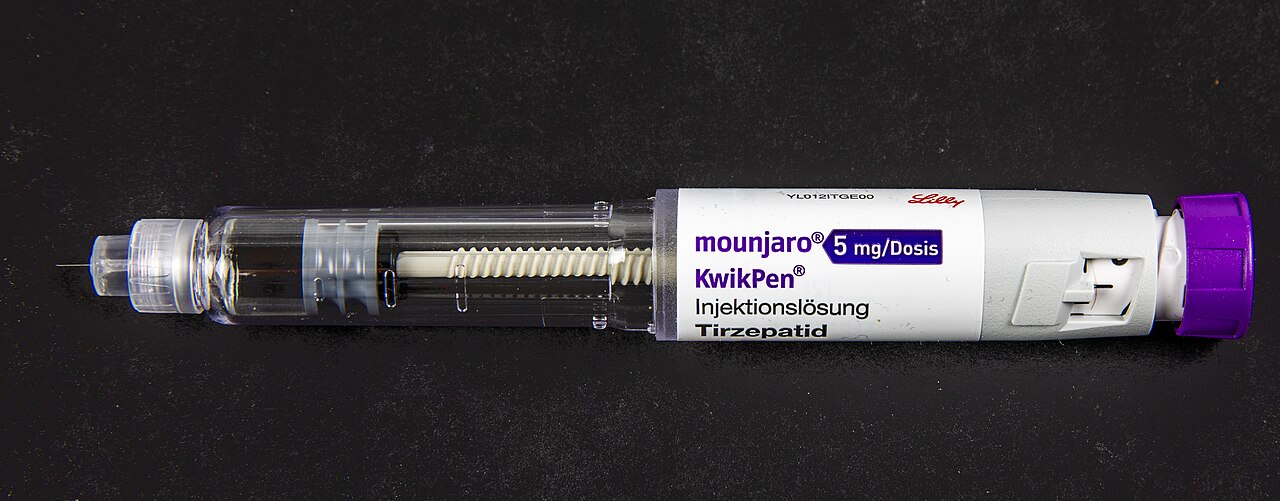
Via Wikimedia Commons: Lilly mounjaro KwikPen Tirzepatid 5 mg per dose rate-9441 by Raimond Spekking, CC BY-SA 4.0.
On 8 November 2023 the FDA approved tirzepatide a second time, as Zepbound, for chronic weight management in adults with obesity (a body mass index, or BMI, of 30 kg/m² or more) or with overweight (a BMI of 27 or more) and at least one weight-related condition such as high blood pressure, type 2 diabetes or high cholesterol.[9] The agency noted that about 70% of American adults have obesity or overweight, and that the application had received Priority Review and Fast Track designations.[9]
On 20 December 2024 the FDA approved Zepbound for moderate to severe obstructive sleep apnea in adults with obesity, calling it the first drug treatment option for certain patients with the condition.[10] Obstructive sleep apnea occurs when the upper airway becomes blocked during sleep, causing pauses in breathing; the FDA noted that it is more common in people with overweight or obesity and that weight reduction is linked to improvement.[10] This use received Fast Track, Priority Review and Breakthrough Therapy designations.[10]
Later changes extended Mounjaro's uses. The FDA's approval records list a new patient population on 19 December 2025, and the label's record of recent major changes shows children aged 10 and older with type 2 diabetes added in December 2025.[8][1] On 27 August 2026 the FDA approved a new indication for Mounjaro: reducing the risk of cardiovascular death, non-fatal heart attack or non-fatal stroke in adults with type 2 diabetes who are at high risk of those events.[8][1]
Mounjaro received a marketing authorisation valid throughout the EU on 15 September 2022, held by Eli Lilly Nederland B.V.[2] On 9 November 2023 the EMA's human medicines committee (CHMP) recommended extending its use to weight management, including weight loss and weight maintenance, in adults with a BMI of 30 or more, or of 27 to under 30 with at least one weight-related condition.[11] As of November 2026, the EMA's summary describes Mounjaro as used for type 2 diabetes in adults, adolescents and children aged 10 and above, and for weight management in adults.[2] Trial results in obstructive sleep apnoea and in heart failure with preserved ejection fraction are described in the product information rather than listed as separate indications.[2]
The diabetes trials carry the name SURPASS and the weight-management trials the name SURMOUNT.[1][12] SURPASS-1, SURPASS-2, SURPASS-CVOT, SURMOUNT-1, SURMOUNT-OSA, SURMOUNT-5 and SUMMIT were all funded by Eli Lilly.[13][5][14][12][15][16][17]
SURPASS-1 was a 40-week trial of 478 adults whose type 2 diabetes was not controlled by diet and exercise alone, run between June 2019 and October 2020 at 52 centres in India, Japan, Mexico and the United States.[13] Published in The Lancet in July 2021, it found that HbA1c fell by 1.87 to 2.07 percentage points across the three tirzepatide doses, against a rise of 0.04 with placebo, and that body weight fell by 7.0 to 9.5 kg.[13] No clinically significant or severe hypoglycaemia (low blood sugar) was reported with tirzepatide.[13]
SURPASS-2 compared tirzepatide directly with semaglutide in 1,879 people with type 2 diabetes over 40 weeks, in an open-label trial, meaning participants knew which drug they received.[5] Published in the New England Journal of Medicine (NEJM) in August 2021, it found that HbA1c fell by 2.01 to 2.30 percentage points with the three tirzepatide doses and by 1.86 with semaglutide, so that every tirzepatide dose was judged both non-inferior and superior.[5] Weight loss was greater with tirzepatide, by 1.9 to 5.5 kg depending on dose.[5] Nausea was reported by 17 to 22% of tirzepatide recipients and 18% of semaglutide recipients, and serious adverse events by 5 to 7% and 3% respectively.[5]
SURPASS-CVOT, a cardiovascular outcomes trial, compared tirzepatide with dulaglutide, a GLP-1 drug already shown to reduce cardiovascular events, in 13,299 people with type 2 diabetes and atherosclerotic cardiovascular disease (disease caused by fatty build-up in the arteries).[14] Published in NEJM in December 2025, it found that the combined outcome of cardiovascular death, heart attack or stroke occurred in 12.2% of the tirzepatide group and 13.1% of the dulaglutide group, a hazard ratio of 0.92 (95.3% confidence interval 0.83 to 1.01).[14] Tirzepatide met the trial's test for non-inferiority, but superiority over dulaglutide was not shown.[14] More gastrointestinal adverse events were seen with tirzepatide.[14] The US label reports a median follow-up of 210.1 weeks and states that superiority to dulaglutide was not established.[1]
SURMOUNT-1 enrolled 2,539 adults with obesity, or with overweight and a weight-related complication, who did not have diabetes, and followed them for 72 weeks.[12] Published in NEJM in July 2022, it reported an average weight change of −15.0%, −19.5% and −20.9% on the three tirzepatide doses, against −3.1% on placebo; 85 to 91% of tirzepatide recipients lost at least 5% of their weight, against 35% on placebo.[12] Side effects leading participants to stop treatment occurred in 4.3 to 7.1% of the tirzepatide groups and 2.6% of the placebo group.[12] The FDA's account of the two trials behind Zepbound's approval gives an average loss, at the highest dose, of 18% of body weight more than placebo in adults without diabetes and 12% more than placebo in adults with type 2 diabetes.[9]
A three-year extension of SURMOUNT-1, published in NEJM in March 2025, followed 1,032 participants who had prediabetes as well as obesity.[18] After 176 weeks, average weight change was −12.3% to −19.7% across the tirzepatide doses and −1.3% on placebo, and type 2 diabetes was diagnosed in 1.3% of the tirzepatide groups against 13.3% on placebo.[18] Seventeen weeks after treatment stopped, the figures were 2.4% and 13.7%.[18]
SURMOUNT-4, published in JAMA in January 2024, tested what happens when treatment stops.[19] All 783 participants first received tirzepatide for 36 weeks, losing on average 20.9% of their weight; 670 were then randomly assigned to continue it or switch to placebo for another 52 weeks.[19] Those who continued lost a further 5.5% of their weight, while those switched to placebo regained 14.0%.[19] The authors concluded that withdrawing tirzepatide led to substantial regain of lost weight.[19]
SURMOUNT-OSA consisted of two 52-week trials in adults with moderate to severe obstructive sleep apnea and obesity: one in people not using positive airway pressure (PAP) therapy, in which a machine keeps the airway open with pressurised air, and one in people who were.[15] The main measure was the apnea–hypopnea index (AHI), the number of pauses and shallow breaths per hour of sleep, which averaged 51.5 and 49.5 at the start.[15] Published in NEJM in October 2024, the trials found that tirzepatide reduced the AHI by 20.0 and 23.8 events per hour more than placebo in the two trials, and also reduced body weight, blood pressure and a marker of inflammation.[15]
SUMMIT tested tirzepatide in 731 people with obesity and heart failure with preserved ejection fraction, a form of heart failure in which the ejection fraction, the share of blood the heart pumps out with each beat, is not reduced; the trial required it to be at least 50%.[17] Published in NEJM in January 2025, after a median follow-up of 104 weeks, it found that cardiovascular death or a worsening heart-failure event occurred in 9.9% of the tirzepatide group and 15.3% of the placebo group (hazard ratio 0.62).[17] Worsening heart-failure events occurred in 8.0% against 14.2%, while cardiovascular deaths were few, 2.2% against 1.4% (hazard ratio 1.58, 95% confidence interval 0.52 to 4.83).[17] Scores on a quality-of-life questionnaire improved more with tirzepatide, and 6.3% of the tirzepatide group stopped treatment because of adverse events, against 1.4% on placebo.[17]
Two Lilly-funded, open-label trials have compared tirzepatide head to head with semaglutide. In type 2 diabetes, SURPASS-2 found larger falls in HbA1c and body weight with tirzepatide over 40 weeks, as described above.[5]
SURMOUNT-5, published in NEJM in July 2025, compared the two drugs for weight loss in 751 adults with obesity but without type 2 diabetes, each given at the highest dose the participant could tolerate for 72 weeks.[16] Average weight change was −20.2% with tirzepatide and −13.7% with semaglutide, and waist circumference fell by 18.4 cm and 13.0 cm respectively.[16] Participants on tirzepatide were more likely to lose at least 10%, 15%, 20% and 25% of their weight.[16] In both groups the commonest adverse events were gastrointestinal, mostly mild to moderate and mostly during the period when the dose was being increased.[16]
Both US labels carry a boxed warning about thyroid C-cell tumours.[1][4] In a two-year study in rats, tirzepatide caused a dose-dependent increase in thyroid C-cell tumours, both benign and cancerous; the label states that it is unknown whether it causes such tumours, including medullary thyroid carcinoma, in humans, because the relevance of the rat findings to people has not been determined.[1] The labels list as contraindications (situations in which a drug is not to be used) a personal or family history of medullary thyroid carcinoma, multiple endocrine neoplasia syndrome type 2 (an inherited condition that causes tumours of hormone-producing glands), and known serious hypersensitivity to tirzepatide or the product's ingredients.[1][4] The Mounjaro label also states that routine blood calcitonin tests or thyroid ultrasound are of uncertain value for early detection of this cancer.[1]
As of its August 2026 revision, the Mounjaro label lists warnings and precautions for acute pancreatitis (inflammation of the pancreas), low blood sugar when used with insulin or with medicines that make the pancreas release insulin, serious allergic reactions, acute kidney injury from fluid loss, severe gastrointestinal reactions, complications of diabetic retinopathy (eye damage from diabetes) in people with a history of it, acute gallbladder disease, inhalation of stomach contents during general anaesthesia or deep sedation, and the sharing of multi-dose pens between patients.[1] The Zepbound label carries a similar list.[4]
According to the Mounjaro label, the commonest adverse reactions, reported in at least 5% of patients, are nausea, diarrhoea, decreased appetite, vomiting, constipation, indigestion and abdominal pain.[1] The Zepbound label adds injection-site reactions, fatigue, allergic reactions, burping, hair loss and gastro-oesophageal reflux to its list.[4] Reports received after approval, which the label notes cannot reliably establish frequency or cause, include anaphylaxis, pancreatitis that was sometimes fatal, blockage of the bowel, and kidney failure sometimes requiring dialysis.[1] The label also states that tirzepatide delays stomach emptying and so may affect the absorption of medicines taken by mouth, including oral contraceptives, and that animal studies suggest it may cause harm to a fetus.[1]
One warning has been withdrawn. The Zepbound label, like those of other GLP-1 weight-loss drugs, originally carried a warning about suicidal behaviour and ideation. On 13 January 2026 the FDA asked for it to be removed from the labels of Saxenda, Wegovy and Zepbound, after a review that began in July 2023.[20] The agency reported that a meta-analysis of 91 placebo-controlled trials with 107,910 patients, and a study in its Sentinel database comparing more than 2.2 million new users of GLP-1 drugs and of another class of diabetes medicines, showed no increased risk.[20] The Zepbound label records the warning as removed in February 2026.[4]
Demand outstripped supply in the United States. The FDA states that tirzepatide injection was in shortage from 2022 because of increased demand, and that on 2 October 2024 it determined the shortage was resolved.[21] After a lawsuit, the agency re-evaluated that decision and on 19 December 2024 again found the shortage resolved.[21] The decision affected compounding pharmacies, which make their own versions of medicines: the FDA gave state-licensed pharmacies until 18 February 2025 and larger outsourcing facilities until 19 March 2025 before ending its period of enforcement discretion for them, and a federal court in Texas denied the challengers' request for a preliminary injunction on 5 March 2025.[21] As of the page's 1 April 2026 update, the FDA stated that tirzepatide was not on its drug shortage list.[21]
The FDA stresses that compounded drugs are not FDA approved and are not reviewed for safety, effectiveness or quality.[22] As of 31 May 2026 it had received more than 730 reports of adverse events associated with compounded tirzepatide, a figure it considers likely to be an undercount.[22] It has also reported fraudulent compounded products with false labels and adverse events among patients prescribed compounded semaglutide or tirzepatide at doses above those in the approved label.[22]
Several matters remain unsettled in the sources. The human relevance of the thyroid tumours seen in rats has not been determined.[1] SURMOUNT-4 showed that much of the weight lost was regained after treatment stopped.[19] In cardiovascular disease, SURPASS-CVOT showed tirzepatide to be non-inferior to an active comparator, not superior.[14]
The World Health Organization's first guideline on these medicines for obesity, issued on 1 December 2025, covers liraglutide, semaglutide and tirzepatide.[23] It makes a conditional recommendation that they may be used by adults, excluding pregnant women, for the long-term treatment of obesity, and gives as reasons for not making it stronger the limited data on long-term efficacy and safety, on maintenance and on stopping treatment, along with cost, health-system readiness and fairness of access.[23] The WHO projected that, even with rapid growth in production, these therapies would reach fewer than 10% of those who could benefit by 2030, and warned that demand had fuelled falsified and substandard products.[23]
This entry explains; it is not medical advice. Ask a doctor or pharmacist about your own health.
 Get Micwyn on your home screenIts own icon, full screen, and notifications.