Version 7
Nov 15, 2026. Compare with the current version · Version history
The Boeing 747 is a four-engine wide-body jet airliner, first flown in 1969, that carried more than 400 passengers on its early long-distance routes and became known as the "jumbo jet".[1]
Origins and the Pan Am order
Boeing's market research concluded that air-passenger growth would be dramatic and that an aircraft holding more than 300 passengers was needed.[2] Juan Trippe, president of Pan American World Airways (Pan Am), discussed the idea with Boeing president William Allen in the fall of 1965, and the two signed a letter of intent that December.[2] Trippe asked for a jet more than twice the size of the 707, and Allen initially doubted the idea.[1] In April 1966 Pan Am formally ordered 23 passenger and two freight aircraft, a contract worth $550 million.[2] HistoryLink describes it as the most expensive single order an airline had placed up to that time, and says Trippe required delivery within three years.[1]
Joe Sutter, moved over from the 737 program, became chief engineer; Mal Stamper headed the project as general manager once full design began.[1][2]
Design
Trippe first wanted a double-deck cabin. Boeing argued that a second deck would complicate the 90-second passenger-evacuation requirement set by the U.S. Federal Aviation Administration (FAA) and cut cargo capacity, and it settled on a single-deck wide-body fuselage.[1][2] The raised "hump" holds the flight deck. It sits above the cabin so that the nose can swing upward on a hinge, letting cargo containers be loaded straight in on freighter versions.[1][2] Pan Am declined a crew rest area in the hump and gave the space to passengers, which became a bar and lounge.[1]
The engine was the JT9D, a high-bypass turbofan (an engine in which most of the air bypasses the core) developed with Pratt & Whitney and Pan Am, and first tested by the end of 1966.[1] Boeing also used fault tree analysis, a method of forecasting possible failures, which the Centennial of Flight Commission says was first applied to an airliner on the 747.[2]
Building the 747 at Everett
Boeing built a new assembly plant at Paine Field in Everett, Washington, with construction beginning in summer 1966.[1] The company opened the major assembly buildings in 1967 to build the 747, and Guinness World Records recognized the factory as the largest building in the world that year; Boeing describes it as the largest building by volume.[3] The Centennial of Flight Commission gives the plant's volume at 200 million cubic feet (5.7 million cubic metres) and its cost at $200 million, within a total program investment of $2 billion that employed 50,000 people and 1,500 subcontractors.[2]
First flight and entry into service
The first 747 was rolled out on 30 September 1968, by which time 26 airlines had ordered the type.[1] It first flew on 9 February 1969 from Paine Field, with Jack Waddell, Brien Wygle and Jesse Wallick at the controls; it climbed to 15,000 feet and flew for more than an hour and a quarter.[1] Flight testing used five aircraft, logging more than 1,400 hours over 1,013 flights, and the FAA certified the type on 30 December 1969.[1] The first flight came after a target date of 17 December 1968.[2]
The JT9D engines proved underpowered for the aircraft's weight, and about 30 completed planes were parked at the Boeing plant in early 1970 awaiting fixes; the problems took a year to solve.[2] Pan Am nonetheless began service on 22 January 1970 on its New York–London route.[1]
Variants
HistoryLink and the Centennial of Flight Commission describe these developments:
- The 747-200 had more powerful engines and greater range, and the 747SP, launched in 1976, was shortened for still greater range.[1]
- The 747-300 of the 1980s extended the upper deck by 23 feet (7 metres).[2]
- The 747-400, designed from 1985 and first flown on 29 April 1988, had an extended upper deck and 6-foot (1.8-metre) winglets, and entered service in 1989 with a range above 7,500 nautical miles.[1][2]
- The 1,000th 747 entered production in 1993.[2]
- Two modified 747s carried the Space Shuttle orbiter for NASA.[1]
Freighters
Boeing delivered the first wide-body freighter, a 747-200, to Lufthansa on 10 March 1972.[10] Boeing's own history of its freighters singles out the 747's nose door, which lets large objects be loaded straight into the fuselage, as what expanded the cargo capacity of air freight.[10] The first 747-400 freighter was delivered to Cargolux in 1993, according to Boeing's picture captions.[10] Boeing quotes Darren Hulst, its vice president of commercial marketing, saying that "the ability to ship more goods by air changed global trade overnight".[10]
Space Shuttle carrier and Air Force One
NASA flew two modified 747s as Shuttle Carrier Aircraft, which carried a Space Shuttle orbiter on top of the fuselage.[6] NASA 905, a 747-123 built in 1970, was obtained from American Airlines in 1974; Boeing modified it after wake-vortex studies, and it then returned to NASA for the 1977 Approach and Landing Tests, which comprised eight captive flights and five free flights with the prototype orbiter Enterprise.[6] NASA 911, a 747-100SR-46 built in 1973, came from Japan Air Lines in 1989 and was delivered to NASA on 20 November 1990 after modification.[6] The conversion added three struts on top of the fuselage (two aft, one forward) to hold the orbiter, and two extra vertical stabilizers, one at each end of the horizontal stabilizer, to improve directional stability.[6]
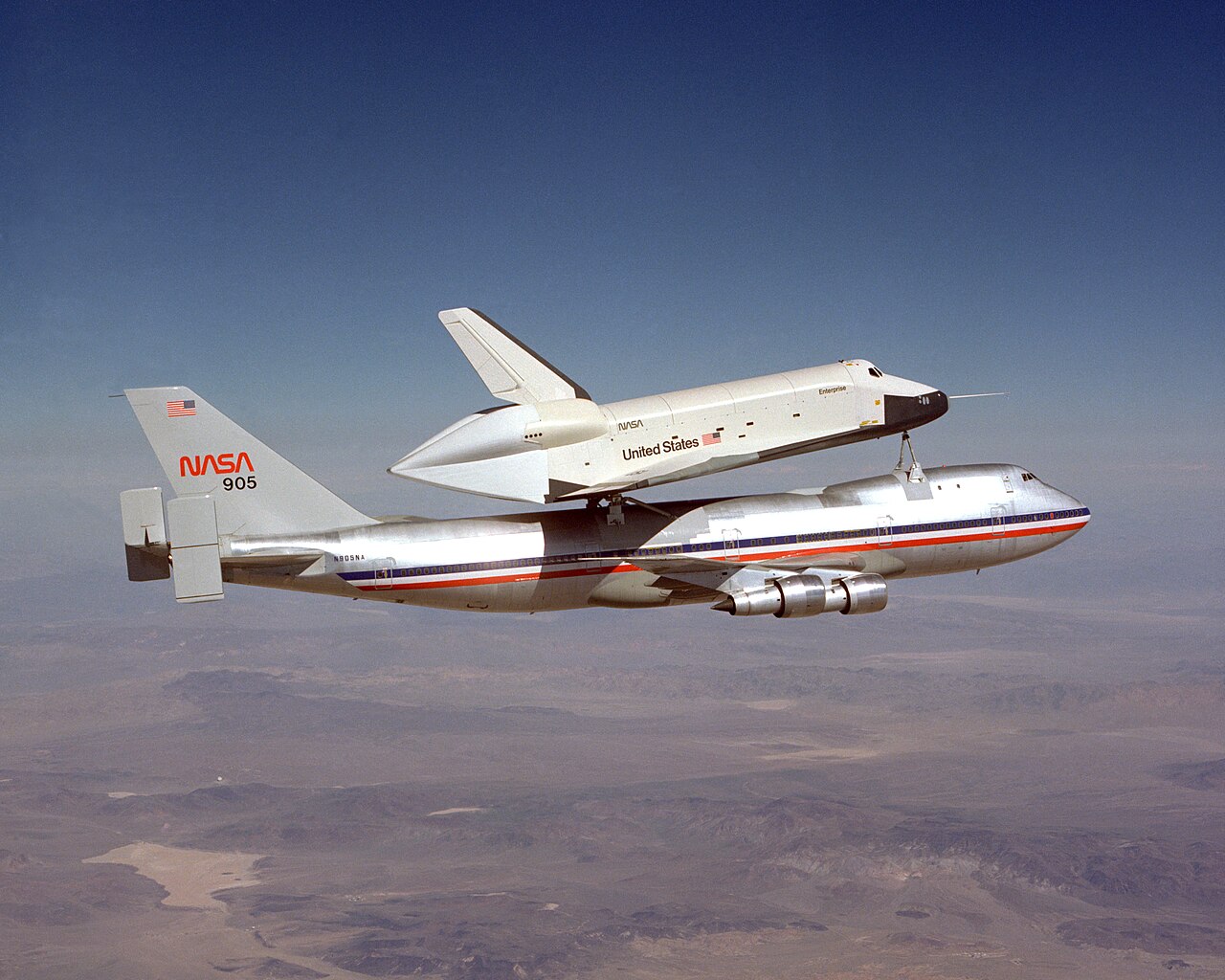
Via Wikimedia Commons: OV-101-CaptiveFlights by NASA, public domain.
NASA 905 flew 70 of the 87 ferry missions of the shuttle program's operational phase.[6] NASA 911 retired on 8 February 2012 after 33,004 flight hours, and NASA 905 retired in late 2012 after 11,018 flight hours over 42 years.[6]
The U.S. Air Force's VC-25A, the presidential aircraft with the call sign Air Force One, is a 747-200B; two were built by Boeing, first flew as Air Force One on 6 September 1990, and entered service on 8 December 1990.[7] As of November 2026, Air & Space Forces Magazine lists their replacement, the VC-25B, as two 747-8 Intercontinental aircraft being modified under a $3.9 billion Boeing contract from 2020, with delivery planned for 2028 and 2029.[7]
The Tenerife collision, 1977
On 27 March 1977 two 747s, KLM flight 4805 and Pan Am's Clipper 1736, collided on the runway at Los Rodeos Airport on Tenerife in the Canary Islands, in fog; Time reported 583 deaths, then the worst toll in aviation history.[11][12] The cockpit transcript published by NOVA, taken from the official Spanish accident report, shows the KLM crew saying they were waiting for air traffic clearance, then the captain saying "we're now at takeoff" and starting the takeoff roll while the Pan Am aircraft was still on the runway.[11] The KLM crew saw the Pan Am aircraft coming out of the fog about nine seconds before impact, too late to avoid it.[11]
An 18-month Spanish government investigation named as the fundamental cause the KLM captain's decision to take off without clearance from the tower.[12] The report also cited a long delay and a KLM rule against crew overtime, which may have pushed the captain to hurry, together with weather, a radio whistle that may have garbled transmissions, and imprecise wording by the tower and crews.[12] The Dutch Aviation Service called the report "very one-sided".[12] The finding concerned crew and air-traffic procedure; neither source attributes the collision to a fault in the aircraft type.[11][12]
Decline
HistoryLink notes that the 1973 oil crisis worsened Boeing's difficulties because of the amount of fuel the 747 burned.[1] Later, more fuel-efficient twin-engine aircraft such as the Boeing 777 and the Airbus A330 became cheaper to operate, and airlines fitted more seats into their aircraft.[1] The Airbus A380, launched in 2007, was the first aircraft to rival the 747 in size.[1] By the mid-2010s orders had fallen enough that Boeing said it might end production within a few years, and in 2020 the COVID-19 pandemic led many airlines to retire their 747 fleets.[1] As of 2021, HistoryLink reported that most 747s still flying carried freight, while a few Asian passenger airlines still operated the type.[1]
The 747-8
Boeing launched the 747-8 program in November 2005, offering a stretched freighter and a passenger version called the 747-8 Intercontinental.[8] On 6 December 2006 Lufthansa announced an order for 20 Intercontinentals plus 20 purchase rights, the first airline order for the passenger version.[8] In that announcement Boeing described the Intercontinental as 5.6 metres (18.3 feet) longer than the 747-400, with 467 seats in a typical three-class layout and a range of 14,815 kilometres (8,000 nautical miles); these were Boeing's figures at the time of the order, not measured results.[8] Boeing also claimed 16% lower fuel consumption and CO2 emissions than the 747-400s it would replace.[8]
Lufthansa received the first Intercontinental at Paine Field in May 2012, and on 1 June 2012 Flight 416 flew from Frankfurt to Dulles International Airport near Washington, D.C., the first paying-passenger flight of the type.[9] Lufthansa's three-class layout held 362 seats, and the stretch allowed 51 more passengers than the 747-400, according to the report of that flight.[9] By then Boeing had booked 36 Intercontinental orders and 70 freighter orders since the 2005 launch.[9]
End of production
Boeing delivered its final 747, a 747-8 Freighter, to Atlas Air Worldwide, the largest operator of the type, at Everett in a ceremony on Tuesday 31 January 2023.[4][5] Boeing counted 1,574 747s built.[4][5] AirlineRatings puts the number of major variants at 17.[5] The sale of the last four aircraft to Atlas Air had been confirmed in January 2021.[1]
Sources
- "Boeing 747 Jumbo Jet", HistoryLink. historylink.org/file/21243
- "Boeing 747", U.S. Centennial of Flight Commission. centennialofflight.net/essay/Aerospace/Boeing_747/Aero21.htm
- "Boeing Celebrates the Everett Factory's 40th Anniversary", Boeing media room, 1 May 2007. boeing.mediaroom.com/2007-05-01-Boeing-Celebrates-the-Everett-Facto…
- "Last Boeing 747 Delivered", AVweb, February 2023. avweb.com/aviation-news/last-boeing-747-delivered/
- "Boeing, Atlas Celebrate Last 747 Delivery", AirlineRatings, 2023. airlineratings.com/news/boeing-atlas-celebrate-last-747-delivery
- "NASA Armstrong Fact Sheet: Shuttle Carrier Aircraft", NASA. nasa.gov/centers-and-facilities/armstrong/nasa-armstrong-fact-sheet…
- "VC-25", Air & Space Forces Magazine, accessed November 2026. airandspaceforces.com/weapons/vc-25/
- "Boeing, Lufthansa Announce Order for 747-8 Intercontinental", Boeing media room, 6 December 2006. boeing.mediaroom.com/2006-12-06-Boeing-Lufthansa-Announce-Order-for…
- "Lufthansa flies first passenger 747-8 jet", HeraldNet, 1 June 2012. heraldnet.com/business/lufthansa-flies-first-passenger-747-8-jet/
- "Fifty Years of Freighters", Boeing, March 2022. boeing.com/features/2022/03/fifty-years-of-freighters
- "The Deadliest Plane Crash", NOVA, PBS (cockpit transcript from the Spanish accident report). pbs.org/wgbh/nova/planecrash/minutes.html
- "A chilling plane crash report", Time (archive). time.com/archive/6845953/disasters-flashback
