Compare versions
Version 3 → Version 5 (current). Removed · Added. This shows the entry's text as it is written, including its formatting marks.
Version 3 · Version 5 (current) · Version history
Side by side · Together
Version 3Version 5 (current)
11 unchanged paragraphs
The Embraer 175 (E175) is a twin-engine jet airliner built by Embraer of Brazil, certified under the type designation ERJ 170-200 and in airline service since 2005.[1][2]
The Embraer 175 (E175) is a twin-engine jet airliner built by Embraer of Brazil, certified under the type designation ERJ 170-200 and in airline service since 2005.[1][2]
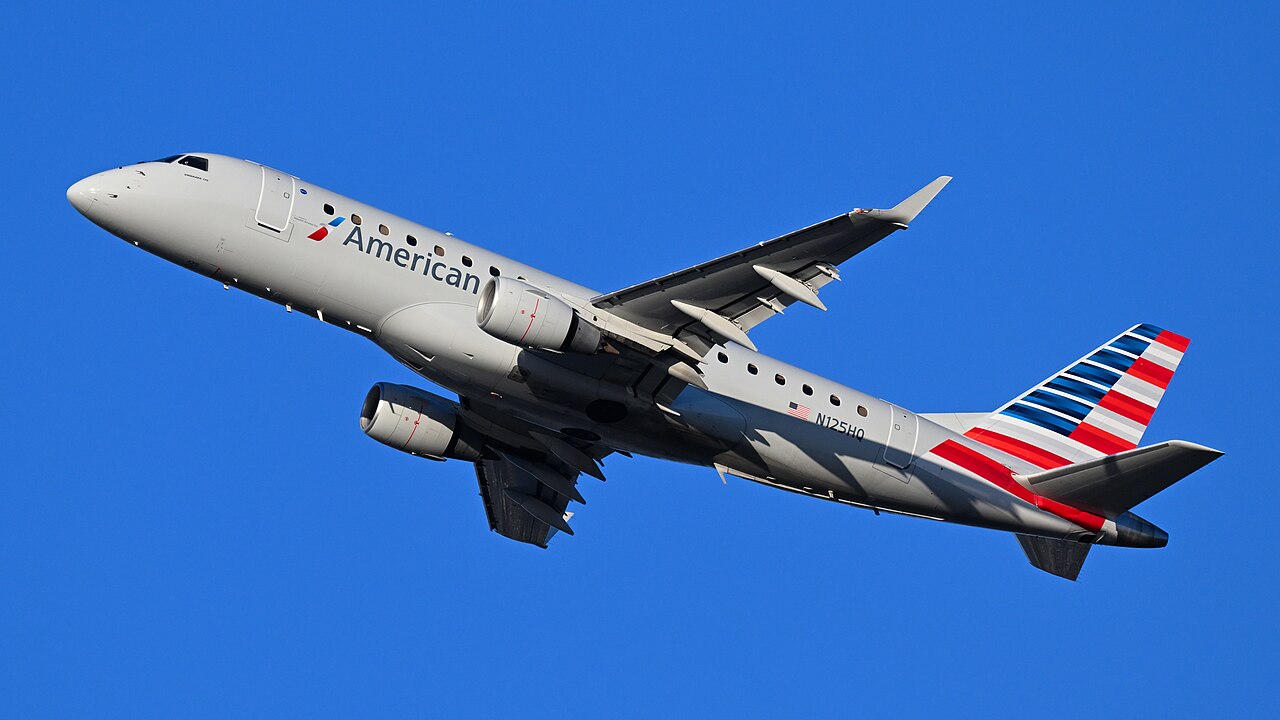

*Via Wikimedia Commons: [American Eagle (Republic) Embraer 175 N125HQ departing Boston April 20](https://commons.wikimedia.org/wiki/File:American_Eagle_(Republic)_Embraer_175_N125HQ_departing_Boston_April_2025.jpg) by 4300streetcar, [CC BY 4.0](https://creativecommons.org/licenses/by/4.0).*
*Via Wikimedia Commons: [American Eagle (Republic) Embraer 175 N125HQ departing Boston April 20](https://commons.wikimedia.org/wiki/File:American_Eagle_(Republic)_Embraer_175_N125HQ_departing_Boston_April_2025.jpg) by 4300streetcar, [CC BY 4.0](https://creativecommons.org/licenses/by/4.0).*
## Names and designations
## Names and designations
The aircraft's official model designation in regulators' documents is ERJ 170-200, which comes in standard (STD) and long-range (LR) versions. The European Union Aviation Safety Agency (EASA) data sheet notes that Embraer's marketing literature calls it the "Embraer 175", and states that such names are strictly marketing designations and not part of the official model designations.[1] Transport Canada's operational evaluation report likewise pairs the ERJ 170-200 with the marketing name E175, and groups it with the E170 (ERJ 170-100) and E190 (ERJ 190-100) as the first-generation "E-Jets".[2]
The aircraft's official model designation in regulators' documents is ERJ 170-200, which comes in standard (STD) and long-range (LR) versions. The European Union Aviation Safety Agency (EASA) data sheet notes that Embraer's marketing literature calls it the "Embraer 175", and states that such names are strictly marketing designations and not part of the official model designations.[1] Transport Canada's operational evaluation report likewise pairs the ERJ 170-200 with the marketing name E175, and groups it with the E170 (ERJ 170-100) and E190 (ERJ 190-100) as the first-generation "E-Jets".[2]
The type certificate holder is Embraer S.A., of São José dos Campos, Brazil, and the certifying authority is Brazil's civil aviation agency, ANAC.[1] Pilots of the E170, E175 and E190 share one type rating, designated "E170", with differences training between the types.[2]
The type certificate holder is Embraer S.A., of São José dos Campos, Brazil, and the certifying authority is Brazil's civil aviation agency, ANAC.[1] Pilots of the E170, E175 and E190 share one type rating, designated "E170", with differences training between the types.[2]
## Design
## Design
The E175 is a low-wing jet with a conventional tail and two high-bypass turbofan engines on pylons under the wings. Its fuselage, wing, tail-plane and fin are aluminium alloy, while the ailerons, flaps, spoilers, elevator and rudder are composite. The landing gear is a retractable tricycle type with twin wheels and carbon brakes.[1]
The E175 is a low-wing jet with a conventional tail and two high-bypass turbofan engines on pylons under the wings. Its fuselage, wing, tail-plane and fin are aluminium alloy, while the ailerons, flaps, spoilers, elevator and rudder are composite. The landing gear is a retractable tricycle type with twin wheels and carbon brakes.[1]
The EASA data sheet lists the following for the ERJ 170-200:[1]
The EASA data sheet lists the following for the ERJ 170-200:[1]
- Length 31.68 m (103 ft 11 in), span 26.0 m (85 ft 4 in), height 9.82 m (32 ft 3 in) and wing area 72.72 m².
- Two General Electric CF-34-8E5 or CF-34-8E5A1 turbofan engines, and a Hamilton Sundstrand APS2300 auxiliary power unit.
- A maximum operating altitude of 12,497 m (41,000 ft).
- A maximum seating capacity of 88 passengers, and a minimum flight crew of two.
- A maximum take-off mass of 38,790 kg for the LR version, or 40,370 kg for aircraft with a particular factory or retrofit modification (service bulletin 170-00-0016).
The same sheet gives the shorter ERJ 170-100 (the E170) a length of 29.9 m and a maximum seating capacity of 80, so the E175 is 1.78 m longer than the E170 (31.68 m minus 29.9 m).[1] The prototype made its first flight in June 2003, according to a trade-press report.[4]
The same sheet gives the shorter ERJ 170-100 (the E170) a length of 29.9 m and a maximum seating capacity of 80, so the E175 is 1.78 m longer than the E170 (31.68 m minus 29.9 m).[1] The prototype made its first flight in June 2003, according to a trade-press report.[4]
## Development
Embraer launched the ERJ-170 and ERJ-190 family, of which the E175 is a member, in June 1999. Flightglobal reported on 13 June 1999 that Swiss regional airline Crossair had selected the two types and would be their launch customer, having also evaluated the Fairchild-Dornier 728JET and 928JET; the article put Embraer's investment in developing the 170/190 family at $850 million.[11] Machine Design reported in August 1999 that the order was for 30 EJR-170s and 30 EJR-190-200s with options on 100 more, together with 15 smaller EJR-145s, and that the whole Crossair fleet renewal was potentially worth $4.9 billion to Embraer.[12] The prototype of the family's first member, the Embraer 170, flew on 19 February 2002 from São José dos Campos for about two and a half hours, powered by General Electric CF34-8E engines, according to a GE press release of 20 February 2002.[13] The longer E175 followed it into certification (see below).
9 unchanged paragraphs
## Certification
## Certification
According to the EASA data sheet, Embraer applied to ANAC for certification of the ERJ 170-200 on 1 September 2000. ANAC issued the type certificate on 22 December 2004, and the European validation, recommended by the Joint Aviation Authorities, followed on 7 January 2005.[1] The shorter ERJ 170-100 had been certified earlier, on 19 February 2004.[1] ANAC's certification basis is Brazil's RBHA 25, which corresponds to the U.S. Federal Aviation Regulations part 25 for transport-category airplanes.[1]
According to the EASA data sheet, Embraer applied to ANAC for certification of the ERJ 170-200 on 1 September 2000. ANAC issued the type certificate on 22 December 2004, and the European validation, recommended by the Joint Aviation Authorities, followed on 7 January 2005.[1] The shorter ERJ 170-100 had been certified earlier, on 19 February 2004.[1] ANAC's certification basis is Brazil's RBHA 25, which corresponds to the U.S. Federal Aviation Regulations part 25 for transport-category airplanes.[1]
For operations, a joint operational evaluation board assessed the differences between the E170 and the E175 in December 2004.[2] Transport Canada accepted the findings of the Joint Aviation Authorities' evaluation report on the two types dated 17 March 2005, along with a U.S. Federal Aviation Administration report.[2]
For operations, a joint operational evaluation board assessed the differences between the E170 and the E175 in December 2004.[2] Transport Canada accepted the findings of the Joint Aviation Authorities' evaluation report on the two types dated 17 March 2005, along with a U.S. Federal Aviation Administration report.[2]
## Entry into service
## Entry into service
Transport Canada's report states that the E175 entered service in 2005, the year after the E170.[2] Air Canada was the launch operator. A trade report dated 2 August 2005 said Embraer had begun deliveries of the E175 to Air Canada, which had ordered 15 and received three, in a 73-seat layout.[3] Another report gives Air Canada's entry into service as 19 July 2005.[4]
Transport Canada's report states that the E175 entered service in 2005, the year after the E170.[2] Air Canada was the launch operator. A trade report dated 2 August 2005 said Embraer had begun deliveries of the E175 to Air Canada, which had ordered 15 and received three, in a 73-seat layout.[3] Another report gives Air Canada's entry into service as 19 July 2005.[4]
## Orders and deliveries
## Orders and deliveries
By March 2020, Embraer had 800 firm orders for the E175 and had delivered 637 of them, according to an aviation trade report; the same report described it as the best-selling variant of the E-Jet family, ahead of the E190.[4] Embraer's second-quarter 2025 results release listed 1,000 firm E175 orders, 792 deliveries and a firm-order backlog of 208 aircraft.[5] Embraer's reported milestone of 1,000 E175 units sold since its 2005 launch was repeated in trade coverage of the same results.[6] In that quarter Embraer also reported a firm order from the U.S. regional airline SkyWest for 60 E175 aircraft, with purchase rights for 50 more.[5]
By March 2020, Embraer had 800 firm orders for the E175 and had delivered 637 of them, according to an aviation trade report; the same report described it as the best-selling variant of the E-Jet family, ahead of the E190.[4] Embraer's second-quarter 2025 results release listed 1,000 firm E175 orders, 792 deliveries and a firm-order backlog of 208 aircraft.[5] Embraer's reported milestone of 1,000 E175 units sold since its 2005 launch was repeated in trade coverage of the same results.[6] In that quarter Embraer also reported a firm order from the U.S. regional airline SkyWest for 60 E175 aircraft, with purchase rights for 50 more.[5]
## The U.S. regional market and scope clauses
## The U.S. regional market and scope clauses
Most E175s fly in the United States, where the model was described in 2020 as the most popular regional aircraft.[4] Part of the reason is the "scope clause", a provision in the pilot contracts of large U.S. airlines that limits how much flying can be given to regional partners. A 2017 analysis by Leeham News described the common limits as a maximum of 76 seats and a maximum take-off weight of 86,000 lb, and said the E175 fits under them while the larger E175-E2 exceeds the weight limit.[7] The same analysis said Embraer planned to keep building the first-generation E175 as long as needed to meet the scope limits.[7] A 2020 report said the E175-E2 had no customers at that time, being larger and heavier than the scope clause allowed.[4] Contract terms can change at each negotiation, so the figures above are those reported in 2017 and 2020, not a statement of current agreements.
Most E175s fly in the United States, where the model was described in 2020 as the most popular regional aircraft.[4] Part of the reason is the "scope clause", a provision in the pilot contracts of large U.S. airlines that limits how much flying can be given to regional partners. A 2017 analysis by Leeham News described the common limits as a maximum of 76 seats and a maximum take-off weight of 86,000 lb, and said the E175 fits under them while the larger E175-E2 exceeds the weight limit.[7] The same analysis said Embraer planned to keep building the first-generation E175 as long as needed to meet the scope limits.[7] A 2020 report said the E175-E2 had no customers at that time, being larger and heavier than the scope clause allowed.[4] Contract terms can change at each negotiation, so the figures above are those reported in 2017 and 2020, not a statement of current agreements.
## The E175-E2
The E175-E2 is a redesigned second-generation version of the E175, the smallest of the three second-generation E-Jets (the "E2" family), which also includes the E190-E2 and E195-E2.[14][15] AVweb reported that the E190-E2 received type certificates from ANAC, the FAA and EASA in February 2018, and that the E195-E2 was certified afterwards.[15]
The first E175-E2 made its maiden flight from São José dos Campos on 12 December 2019, taking off at 11:07 local time and flying for two hours and 18 minutes, according to Aviation Week.[14] The same report said it began a flight-test campaign expected to last 24 months, using three aircraft, and that the type has a new wing, full fly-by-wire controls, new landing gear and Pratt & Whitney PW1700G geared turbofan engines, with about 75 percent of its systems new.[14][15] Embraer's stated seating was 80 passengers in two classes or up to 90 in a single class, one row more than the first-generation aircraft, and its claimed advantages over the first-generation E175 were up to 16 percent less fuel burn and up to 25 percent lower maintenance cost per seat.[14][15] These are Embraer's own claims as relayed by the trade press, not measured in-service figures.
As of the February 2025 reports below, the E175-E2 had not entered service. A trade report of 26 February 2025 said Embraer had extended its pause in E175-E2 development and expected to resume development activities within four years, that is, by 2029, with no entry-into-service date set.[16] The report gave the reason as the U.S. scope clause (see above): the E175-E2 seats up to 90 and has a maximum take-off weight of nearly 99,000 lb (44,800 kg), above the 86,000 lb (39,000 kg) limit.[16] It also said an earlier pause, announced in February 2022 for three years, had put entry into service at 2027 to 2028, and that the E175-E2's firm orders (100 at the time) had been removed from Embraer's backlog in 2018.[16] Flightglobal's headline of the same date says Embraer postponed the programme "by another four years"; only its opening paragraph could be read, and it describes the type as "effectively shelved."[17]
4 unchanged paragraphs
## Operators
## Operators
Almost all of the largest E175 fleets belong to U.S. regional airlines that fly under contract for the big network carriers. SkyWest Airlines, based in Utah, was described in a June 2025 report as the largest E175 owner and operator in the world; the report gave its fleet as 263 E175s with 16 more on order, and said it flies for Alaska Airlines, Delta Air Lines and United Airlines.[8] The same report put SkyWest's June 2025 order for 60 more E175s at $3.6 billion at list price, with options on 50 more and deliveries beginning in 2027.[8] An earlier order, reported in October 2023, covered 19 new E175s to fly for United.[9]
Almost all of the largest E175 fleets belong to U.S. regional airlines that fly under contract for the big network carriers. SkyWest Airlines, based in Utah, was described in a June 2025 report as the largest E175 owner and operator in the world; the report gave its fleet as 263 E175s with 16 more on order, and said it flies for Alaska Airlines, Delta Air Lines and United Airlines.[8] The same report put SkyWest's June 2025 order for 60 more E175s at $3.6 billion at list price, with options on 50 more and deliveries beginning in 2027.[8] An earlier order, reported in October 2023, covered 19 new E175s to fly for United.[9]
Republic Airways is the other large U.S. operator. A November 2022 report said it had 165 E175s in operation, a count that included aircraft owned by Delta (30) and by United (12), and that it had cut its firm E175 orders by 31 to 69.[10] These counts are dated and differ in what they include, so they are not a current census of either fleet.
Republic Airways is the other large U.S. operator. A November 2022 report said it had 165 E175s in operation, a count that included aircraft owned by Delta (30) and by United (12), and that it had cut its firm E175 orders by 31 to 69.[10] These counts are dated and differ in what they include, so they are not a current census of either fleet.
## Sources
## Sources
1. EASA, Type-Certificate Data Sheet No. EASA.IM.A.001 for Embraer ERJ-170, Issue 13, 31 January 2022. https://www.easa.europa.eu/en/downloads/7525/en
2. Transport Canada Civil Aviation, Operational Evaluation Report: Embraer S.A. E-Jets Aircraft Series, Revision 1, 3 November 2023. https://tc.canada.ca/sites/default/files/2023-12/OE_EMBRAER_E170_E-JETS_OE_REPORT_REVISION_1_0.pdf
3. Flightglobal, "Air Canada receives E-175", 2 August 2005. https://www.flightglobal.com/air-canada-receives-e-175/61966.article
4. airdata news, "Embraer's best-selling commercial aircraft, E175, reaches 15 years in service", 20 July 2020. https://www.airdatanews.com/embraers-best-selling-commercial-aircraft-e175-reaches-15-years-in-service/
5. Embraer, press release "All-time high - Embraer finished 2Q25 with a US$29.7 billion backlog", 21 July 2025 (copy at World Airline News, 22 July 2025). https://worldairlinenews.com/2025/07/22/all-time-high-embraer-finished-2q25-with-a-us29-7-billion-backlog/
6. Aviation Week, "Embraer finished 2Q25 with a US$29.7 billion backlog", July 2025. https://aviationweek.com/aerospace/embraer-finished-2q25-us297-billion-backlog
7. Leeham News and Analysis, "The regional market and scope clauses", 17 January 2017. https://leehamnews.com/2017/01/18/regional-market-scope-clauses/
8. American Machinist, "Top Operator Orders 60 Regional Jets from Embraer", 20 June 2025. https://americanmachinist.com/news/article/55298228/top-operator-orders-60-regional-jets-embraer
9. Flightglobal, "SkyWest orders 19 new E175s to fly on behalf of United", 26 October 2023 (opening paragraph only; the article is paywalled). https://www.flightglobal.com/fleets/skywest-orders-19-new-e175s-to-fly-on-behalf-of-united/155566.article
10. ch-aviation, "US's Republic Airways cuts 31 E175 orders", 14 November 2022. https://www.ch-aviation.com/news/121449-uss-republic-airways-cuts-31-e175-orders
11. "Crossair order adds to Embraer success story", Flightglobal, 13 June 1999. https://flightglobal.com/crossair-order-adds-to-embraer-success-story/26649.article
12. "From Barrel Rolls to Business Deals at the Paris Air Show", Machine Design, 19 August 1999. https://www.machinedesign.com/archive/barrel-rolls-business-deals-paris-air-show
13. "GE CF34 Engines Power Flawless First Flight of Embraer 170", GE Aviation press release, 20 February 2002. https://www.geaerospace.com/press-release/cf34-engine-family/ge-cf34-engines-power-flawless-first-flight-embraer-170
14. Aviation Week, "First E175-E2 Jet Completes Its Maiden Flight", 13 December 2019. https://aviationweek.com/business-aviation/first-e175-e2-jet-completes-its-maiden-flight
15. AVweb, "Embraer Flies First E175-E2", 17 December 2019. https://avweb.com/?p=123115
16. airdata news, "Embraer freezes E175-E2 aircraft until at least 2029", 26 February 2025. https://airdatanews.com/embraer-freezes-e175-e2-aircraft-until-at-least-2029
17. Flightglobal, "Embraer postpones E175-E2 programme by another four years", 26 February 2025 (opening paragraph only; the article is paywalled). https://www.flightglobal.com/airframers/embraer-postpones-e175-e2-programme-by-another-four-years/161958.article
