Version 2
Nov 15, 2026. Compare with the current version · Version history
The Boeing 737 is a family of jet airliners built by Boeing, first certified by the U.S. Federal Aviation Administration (FAA) in 1967 and extended since then into a dozen derivative models.[2][3]
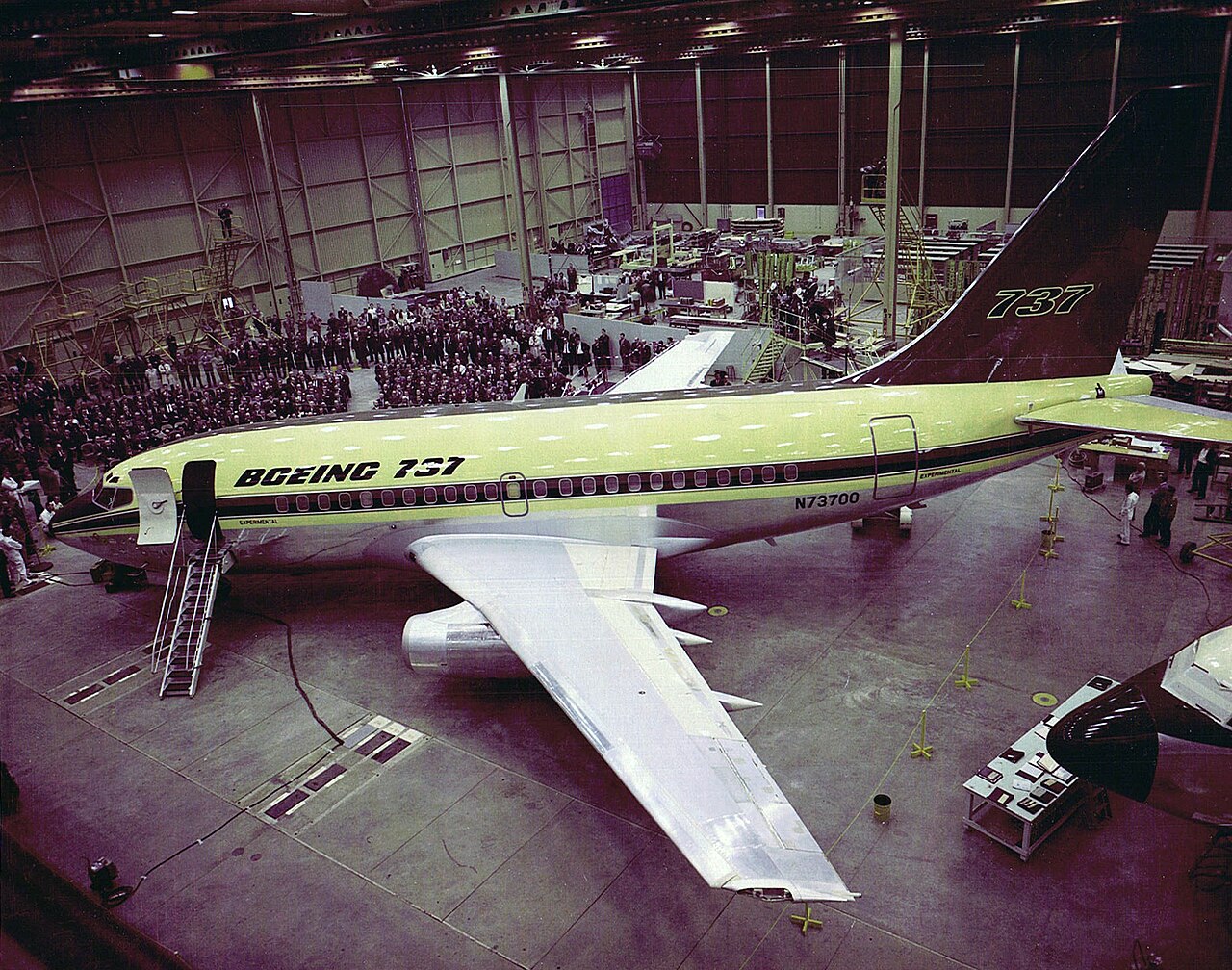
Via Wikimedia Commons: First Boeing 737-100 by Gordon Werner, CC BY-SA 2.0.
Origins
In 1964 Boeing's leaders were divided over whether to build a small regional jetliner. Douglas was already ahead with the DC-9, and several European manufacturers had rival aircraft, so the decision was delayed.[1] Engineer Jack Steiner pressed for a commitment to the 737, going around Boeing's chief executive, Bill Allen, to lobby board members directly, and the board approved the program.[1]
One history of the design says Steiner's team built the 737 on the layout of the 727 and gave it the same fuselage diameter as the 707 and 727, and credits Joe Sutter with hanging the engines under the wings rather than on the tail, as was then usual.[2] The same account says Boeing offered the 737 for sale as a formal program in November 1964, against the BAC-111, the DC-9 and the Sud Caravelle.[2]
Lufthansa ordered 21 aircraft of the first version, the 737-100, on 19 February 1965.[2] Another account says Lufthansa placed its order only after Boeing promised not to cancel the program for lack of orders.[1] United Air Lines followed a couple of months later with an order for 40. It wanted a larger aeroplane, so Boeing stretched the design into the 737-200, the first of what the article counts as twelve commercial versions.[1] Orders for the 737 in 1965 totalled 83, against 209 for the DC-9.[1]
Building and certifying the first aircraft
The first airframes were assembled in the summer of 1966 in Plant II at Boeing Field, and the official rollout took place on 17 January 1967.[2] The prototype, serial number 19437 and registered N73700, first flew on 9 April 1967 for about two and a half hours, with Brien Wygle and Lew Wallick as test pilots.[2] The test and certification program used six aircraft, four 737-100s and two 737-200s; the two -200 test aircraft, both for United, first flew on 8 and 31 August 1967.[2]
The FAA issued the type certificate (A16-WE) on 15 December 1967, and Lufthansa took delivery of the first 737 on 28 December 1967.[2]
Slow sales and recovery
The DC-9 regularly outsold the 737 for the next few years.[1] According to Peter Morton, the 737's marketing manager from 1969 to 1974, Boeing's leaders considered selling the program to a Japanese manufacturer. Morton led a task force that recommended keeping it, arguing that the 737 could serve remote airports and carry mixed loads of passengers and cargo. On 13 September 1972 a 737-200 landed on a grass airstrip at Hope, British Columbia, to show it could operate from rough fields, which Morton said helped revive sales.[1] Early-1970s orders from Sabena (ten aircraft), three jointly operated Brazilian airlines and the U.S. Navy were, in the same account, vital to keeping the program alive.[1] Boeing introduced the 737-200 Advanced in 1971, with more capacity and range.[1]
Deregulation of U.S. airlines in the late 1970s raised demand: Boeing sold 37 aircraft in 1977 and 145 in 1978.[1] The 737-200 went out of production in 1988 after more than 1,000 had been built, and two years later the 737 became the best-selling commercial jet.[1] Later versions included the 300, 400 and 500 (the "Classics") in the 1980s, the Next Generation models (600 to 900) and the 737 MAX.[1] A 2016 newspaper article put the 737 at about a quarter of the world's passenger jets, with the Airbus A320 as the second best-selling jetliner.[1]
The Next Generation models
Southwest Airlines launched the Next-Generation 737 program in November 1993 with an order for 63 737-700s.[7][8] The program covered the 737-600, -700 and -800, which use CFM56-7 engines made by CFMI, a joint venture of General Electric and Snecma.[7] Boeing said the CFM56-7 had 10 percent higher thrust capability than the CFM56-3C engines on the 737s then in production.[7] The redesigned wing was 25 percent larger, at 1,340 square feet, and carried 30 percent more fuel, a total of 6,878 U.S. gallons; Boeing estimated a range of about 3,000 nautical miles, up to 900 nautical miles more than the 737s then in production.[7]
The first 737-700 flew on 9 February 1997, taking off from Renton Municipal Airport and landing at Boeing Field in Seattle after 3 hours and 35 minutes. By then 24 airlines had ordered 523 737-600, -700 and -800 aircraft, which Boeing described as a sales record before a first rollout.[7] The same release expected Southwest to take its first delivery in October 1997; in the event the airline took the first 737-700 at Boeing Field on 17 December 1997, after a three-year effort to win certification from the FAA that included more than 20,000 engineering laboratory and airplane tests.[8] Boeing then counted orders for Next-Generation 737s from 36 customers.[8] All figures in this section are Boeing's own, from its press releases of the time.
The 737 MAX
In December 2010 Airbus launched the A320neo, a version of its A320 with new engines that promised up to 15 percent greater fuel efficiency.[3] The House Transportation and Infrastructure Committee's 2020 report records that Boeing at first downplayed the threat, and cites a Boeing press release of 30 August 2011 titled "Boeing Launches 737 New Engine Family with Commitments for 496 Airplanes from Five Airlines"; American Airlines said it was pleased to be the first airline to commit, pledging 100 737-800s and 100 737 MAX aircraft.[3] The report counts the MAX as the twelfth derivative model of the 737. It was certified by the FAA in March 2017 and entered passenger service in May 2017 with Malindo Air of Malaysia.[3]
On 29 October 2018 Lion Air flight 610 crashed into the Java Sea 13 minutes after takeoff from Jakarta, killing all 189 people aboard, and one Indonesian rescue diver died during recovery work.[3] On 10 March 2019 Ethiopian Airlines flight 302 crashed six minutes after takeoff from Addis Ababa, killing all 157 aboard, including eight U.S. citizens.[3] In both accidents a faulty angle-of-attack sensor and the triggering of MCAS, a flight-control feature Boeing developed to handle stability issues caused by the MAX's new, larger engines and their placement relative to the earlier 737 NG, were involved.[3] In all, 346 people died.[4]
The FAA grounded the 737 MAX on 13 March 2019, three days after the Ethiopian crash and after China, the European Union and Canada, among others, had acted.[3] The House committee investigated for about 18 months, reviewing an estimated 600,000 pages of documents, and issued a 238-page final report on 16 September 2020.[4] Among its findings, a Boeing test pilot took more than 10 seconds in a simulator to diagnose and respond to an uncommanded MCAS activation and called the condition "catastrophic", while federal guidelines assume a response within four seconds.[4] The FAA lifted the grounding on 18 November 2020, saying it was satisfied with software and other fixes and new pilot training, about 20 months after the aircraft had been grounded.[5]
Alaska Airlines flight 1282
On 5 January 2024 a Boeing 737-9, operating as Alaska Airlines flight 1282, lost its left mid exit door plug while climbing through about 14,830 feet after takeoff from Portland, Oregon. The sudden loss of cabin pressure injured one flight attendant and seven passengers, all slightly, and the crew landed the aircraft safely at Portland.[6] On 24 June 2025 the U.S. National Transportation Safety Board (NTSB) found the probable cause to be that Boeing had not provided adequate training, guidance and oversight so that its manufacturing personnel could consistently follow the parts-removal process meant to ensure removed bolts were reinstalled. It named the FAA's surveillance and audit planning, which did not adequately identify or ensure Boeing addressed repeated and systemic nonconformances, as a contributing factor, and made 19 new recommendations to the FAA and Boeing.[6]
Sources
- Dan Catchpole, "Almost cancelled, the Boeing 737 has endured 49 years", The Daily Herald (Everett, Washington), 26 March 2016. heraldnet.com/news/almost-cancelled-the-boeing-737-has-endured-49-y…
- "The Early History of the Boeing 737", rbogash.com (undated). rbogash.com/737early.html
- U.S. House Committee on Transportation and Infrastructure, "Final Committee Report: The Design, Development & Certification of the Boeing 737 MAX", September 2020. democrats-transportation.house.gov/imo/media/doc/final_boeing_737_m…
- U.S. House Committee on Transportation and Infrastructure, press release on the final report on the Boeing 737 MAX, 16 September 2020. democrats-transportation.house.gov/news/press-releases/after-18-mon…
- American Institute of Aeronautics and Astronautics, "737 Max Cleared to Fly by FAA", 18 November 2020. aiaa.org/2020/11/18/737-max-cleared-to-fly-by-faa/
- National Transportation Safety Board, investigation DCA24MA063, Alaska Airlines flight 1282 (report AIR-25-04). ntsb.gov/investigations/Pages/DCA24MA063.aspx
- Boeing, "Boeing Next-Generation 737 Takes to the Skies", news release, 9 February 1997. boeing.mediaroom.com/1997-02-09-Boeing-Next-Generation-737-Takes-to…
- Boeing, "First Boeing 737-700 Goes to Southwest Airlines", news release, 17 December 1997. boeing.mediaroom.com/1997-12-17-First-Boeing-737-700-Goes-to-Southw…
