Compare versions
Version 4 → Version 11 (current). Removed · Added. This shows the entry's text as it is written, including its formatting marks.
Version 4 · Version 11 (current) · Version history
Side by side · Together
Christmas is the Christian festival of the birth of Jesus, kept in the Latin West on 25 December since at least the fourth century.[1][2]
## The birth in the Gospels
Only two of the four Gospels describe the birth of Jesus. In Luke, a decree from the emperor Augustus that "all the world should be registered" brings Joseph and the pregnant Mary to Bethlehem; she gives birth to her firstborn son, wraps him in cloth and lays him in a manger "because there was no place in the guest room".[16] The passage ties the events to the time when Quirinius was governor of Syria but gives no calendar date, and the words "stable" and "inn" do not appear in the New Revised Standard Version Updated Edition text; a footnote there offers "their room" as an alternative to "guest room".[16] An angel then announces the birth to shepherds in the nearby fields, and the shepherds visit the child.[16]
Matthew tells a different part of the story. Magi (a word the same translation's footnote renders as "astrologers") come "from the east" to Jerusalem asking for the child born king of the Jews, and the star leads them to Bethlehem, where they enter the house, see the child with his mother and offer gold, frankincense and myrrh.[17] Matthew does not give the number of magi or call them kings.[17] Having been warned in a dream, the magi go home by another road. King Herod, who had learned from them when the star appeared, orders the killing of all children in and around Bethlehem "two years old or under", and Joseph takes the child and Mary to Egypt until Herod's death.[17]
## The date of 25 December
The earliest surviving reference to 25 December as the day of Jesus' birth is in the Chronography of 354, an illustrated codex compiled in Rome in that year as a gift for a Christian aristocrat.[2] Its list of martyrs' days marks 25 December as the day Christ was born in Bethlehem of Judea; the Latin entry reads "natus Christus in Betleem Iudeae".[1][3] That list was first composed in 336.[3] Because it names no martyrs after 336, the first Christmas celebration at Rome is presumed to date from that year.[2] One reading of the same evidence is more cautious: it shows that the date was asserted in 336, not that anyone celebrated it then.[3]
No earlier Christian text gives a date for the birth.[3] Writers of the second and third centuries did not agree on one: Clement of Alexandria named 20 May and 20–21 April rather than 25 December.[1] By the fourth century 25 December had become the dominant date in the Latin West.[1]
Two kinds of explanation are offered for why that date was chosen.
**A calculation from the date of conception or death.** Some scholars, among them Louis Duchesne and Thomas Talley, proposed that the date was derived from 25 March: Tertullian, writing around the year 200, placed the crucifixion on that day, and nine months after a conception on 25 March is 25 December.[1] Another account credits Sextus Julius Africanus, in the early third century, with the claim that Jesus was conceived on 25 March.[3] The National Geographic article calls this "one hypothesis" and notes that early writers did not describe their methods.[1]
**A link to Roman midwinter festivals.** The calendar in the same Chronography marks 25 December with the annotation "N INVICTI CM XXX", read as *Natalis Invicti*, the birthday of the Unconquered Sun, with thirty chariot races.[2] The emperor Aurelian had built a temple to the sun god Sol after his return to Rome in the 270s.[2] The link between that temple and the festival is itself disputed: the Catholic Answers article, citing the scholar Steven Hijmans, says it cannot be documented that Aurelian established an annual festival on 25 December.[4] The Encyclopaedia Romana likewise notes that the Sol Invictus date is presumed, and that Hijmans argues the pagan festival may have been tied to 25 December only after Christians were already keeping their feast then.[2] Saturnalia, the other festival often named, began on 17 December and even in its longest form ended on 23 December, and no early Christian writer connects it with Christmas.[1] The National Geographic article concludes that the evidence points to theological and solar symbolism rather than a direct borrowing from any single pagan festival.[1]
Epiphany on 6 January, twelve days after 25 December, was fixed as a Christian feast in the fourth century and came to mark Jesus' birth in Eastern Christianity, while Western Christianity associates it with the visit of the Magi.[3] The *Chronicon Paschale*, a Byzantine chronicle, placed the birth on 6 January.[1]
## Christmas on other dates
Churches that keep Christmas on 25 December of the Julian calendar celebrate it on 7 January by the Gregorian calendar used in most of the world.[9] The Julian calendar, introduced by Julius Caesar, overestimated the length of the solar year by about 11 minutes, so it slowly drifted out of step with the seasons.[8] Pope Gregory XIII reformed it in 1582, removing 10 days; the change took effect in Catholic countries that year, in Britain in 1752 and in Greece in 1923.[9] The Orthodox Church did not accept the Gregorian reform.[8] By 1923 the two calendars differed by 13 days, which puts a Christmas kept on Julian 25 December 13 days after 25 December.[8]
In May 1923 a Pan-Orthodox Congress in Constantinople considered a revised Julian calendar proposed by the Serbian scientist Milutin Milanković, which shares its dates with the Gregorian calendar.[8] The Orthodox churches of Greece, Cyprus and Romania adopted it and now keep Christmas on 25 December.[8] According to the Religion Media Centre, most Eastern Orthodox churches use the revised calendar today, while six churches, among them the Russian and Serbian, still use the Julian one; because the Russian Church is so large, just under half of Eastern Orthodox Christians still follow it.[9] National Geographic names Russia and Egypt among the churches that declined the revision, and says that the 7 January date will move to 8 January in 2100 as the calendars drift further apart.[8]
In 1923 a Pan-Orthodox Congress in Constantinople considered a revised Julian calendar proposed by the Serbian scientist Milutin Milanković, which shares its dates with the Gregorian calendar.[8] The Orthodox churches of Greece, Cyprus and Romania adopted it and now keep Christmas on 25 December.[8] According to the Religion Media Centre, most Eastern Orthodox churches use the revised calendar today, while six churches, among them the Russian and Serbian, still use the Julian one; because the Russian Church is so large, just under half of Eastern Orthodox Christians still follow it.[9] National Geographic names Russia and Egypt among the churches that declined the revision, and says that the 7 January date will move to 8 January in 2100 as the calendars drift further apart.[8]
Other traditions have their own dates. The Coptic, Ethiopian and Eritrean Orthodox Tewahedo churches keep Christmas on 25 December in the Julian calendar, which is 7 January in the Gregorian system, and the Armenian Apostolic Church, which follows the Gregorian calendar, celebrates the Nativity and Theophany together on 6 January.[9]
## Advent and the Christmas season
In the Roman Catholic calendar as set out in the 1969 General Norms for the Liturgical Year, Christmas is not a single day but a season. Advent, the preparation, begins with Evening Prayer I of the Sunday falling on or closest to 30 November and ends before Evening Prayer I of Christmas.[15] The norms give Advent "a twofold character": it prepares for Christmas, which recalls Christ's first coming, and it also turns the mind towards his Second Coming at the end of time.[15]
The Christmas season itself runs from Evening Prayer I of Christmas until the Sunday after Epiphany or after 6 January, inclusive.[15] The Sunday falling after 6 January is the feast of the Baptism of the Lord, which closes the season.[15]
## Suppression in England
In England the Puritans, who wanted worship stripped of what they saw as unscriptural custom, turned against the festival during the civil wars. In June 1647 Parliament abolished the feast days of Christmas, Easter and Whitsun; the National Army Museum says Parliament wanted 25 December kept as "a time of fasting and humiliation".[6] The University of Reading historian Rachel Foxley describes the 1647 measure as banning those days because they had been "superstitiously used and observed", and replacing them with a monthly day of recreation on the second Tuesday.[7]
Enforcement fell partly to the army. According to the National Army Museum, soldiers broke up church services and public celebrations, seized food being cooked for Christmas in London, and enforced bans on holly, ivy and carol singing.[6] Most people did not stop celebrating, and over several years there were demonstrations and even riots on Christmas Day.[6] Foxley notes that the ban "tended to fail so dismally": on 24 December 1647 the House of Commons ordered London's militia committees to protect those who closed their shops for Christmas from "Affronts, Abuses, and Prejudices", and in 1650 the Council of State complained of widespread shop closures in London and Westminster.[7] In 1657 soldiers broke up an Anglican Christmas service attended by the diarist John Evelyn.[7]
The sources differ on how far the Lord Protector, Oliver Cromwell, was personally involved. The National Army Museum says that as Lord Protector, from December 1653 until his death in September 1658, he supported enforcing the measures,[6] while Foxley places the crackdown under his Protectorate without attributing specific orders to him.[7] When Charles II was restored in 1660, the traditional celebration of Christmas was fully restored.[6]
## Bans and public holidays in the United States
Christmas was not always welcomed. In Boston, celebrating it was outlawed from 1659 to 1681, and anyone showing Christmas spirit was fined five shillings.[5] Christmas became a United States federal holiday in 1870; History.com gives the date as 26 June 1870.[5]
## The nineteenth-century revival
In the early 1800s, class conflict and unemployment led to Christmas riots; in 1828 New York's city council created the city's first police force in response to one.[5] In 1819 Washington Irving published *The Sketch Book of Geoffrey Crayon, Gent.*, which portrayed a squire welcoming peasants into his home for the holiday, and History.com notes that many historians say Irving "invented" tradition with this account.[5] By the nineteenth century, Americans had shifted Christmas from a raucous carnival holiday to a family-centred day of peace and nostalgia, and it became a socially acceptable occasion to give children attention and gifts.[5]
In Britain, Charles Dickens's *A Christmas Carol* was released by Chapman and Hall on 19 December 1843, after Dickens handed out presentation copies on 17 December.[11] The first run of 6,000 copies, priced at five shillings, sold out by Christmas Eve, though Dickens's profits were only about £726 even after many later printings.[11]
## The Christmas Truce of 1914
In the first Christmas of the First World War, soldiers on parts of the Western Front stopped fighting without orders. On 7 December 1914 Pope Benedict XV had asked the warring nations to hold a Christmas truce, "that the guns may fall silent at least upon the night the angels sang"; the governments officially ignored the appeal.[13][14] The truces that followed were local and unauthorised. German soldiers decorated their trenches with fir trees and sang carols, British troops sang in reply, and on Christmas morning the men met outside the trenches and exchanged greetings and gifts such as rum and cigars.[12]
How far the truce spread is uncertain. TIME's account says about 100,000 people are believed to have taken part, that it was widespread but not universal, and that in many places firing continued.[14] History.com says the number is unknown because the cease-fires were small, haphazard and unauthorised.[13] Football is the best-known part of the story, but the evidence is thinner than the legend: historians have verified a kickabout at Wulvergem, Belgium, from letters by Corporal Albert Wyatt and Sergeant Frank Naden, and another match at Frélinghien, France, and National Geographic says the games were fewer and smaller than once believed.[12] TIME likewise says organised matches were unlikely, though several accounts mention informal games with makeshift balls.[14]
Senior officers disapproved. A memorandum of 5 December 1914 from General Sir Horace Smith-Dorrien, commanding the British Second Corps, told divisional commanders to prohibit "friendly intercourse with the enemy".[14] National Geographic reports that commanders were horrified by the newspaper coverage and in the next three Christmases issued orders to prevent further fraternisation.[12] The truce did not last: in some places fighting resumed later on Christmas Day itself, in others not until after New Year's Day.[14]
## The nativity scene and the Greccio celebration
The Christmas crib, a model or living tableau of the manger scene, is traditionally traced to Francis of Assisi at the Italian town of Greccio about three years before his death. The oldest account is by Thomas of Celano, who wrote his *Life of St. Francis* in 1229.[18] Francis asked a local man named John to prepare in advance what he wanted; a manger and hay were set up and an ox and an ass were led to the place, and Francis celebrated Mass over the manger, dressed as a Levite, sang the gospel and preached.[18] Celano says Francis saw a little child lying lifeless in the manger and woke him, which he reads as Christ being awakened in hearts that had forgotten him, and that hay kept from the crib was afterwards said to heal animals.[18]
Bonaventure's later *Legenda Maior* tells the same event and adds that Francis first asked the pope for permission, so that the scene would not be taken for a novelty.[19] In Bonaventure's version it is the knight John of Greccio who reports seeing a beautiful little boy asleep in the crib; no living child is described as being placed there.[19]
## Customs: cards, trees, crackers and Santa Claus
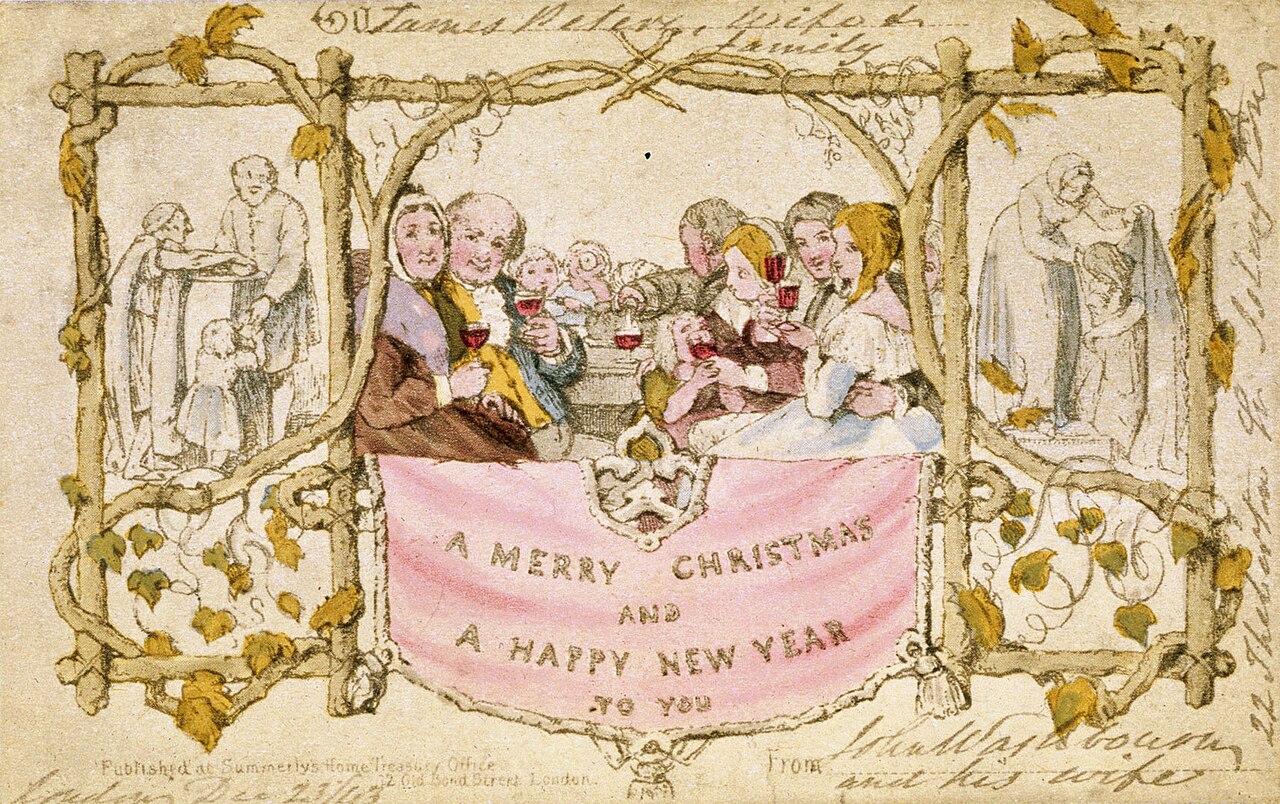
*Via Wikimedia Commons: [Firstchristmascard](https://commons.wikimedia.org/wiki/File:Firstchristmascard.jpg), public domain.*
**Cards.** Sir Henry Cole, the first director of the Victoria and Albert Museum, introduced the Christmas card in 1843; he commissioned J. C. Horsley to design the scene and had 1,000 printed.[10] History.com likewise dates the first official card in England to 1843.[5]
**Trees.** History.com says decorated trees date back to Germany in the Middle Ages, and that German and other European settlers popularised them in America by the early nineteenth century.[5] The Victoria and Albert Museum credits Prince Albert, who was born in Germany, with introducing the decorated tree to Britain, and notes that in 1848 the *Illustrated London News* published an engraving of the royal family around a tree "bedecked with ornaments".[10] History.com adds that candles were the popular decoration until 1882, when Edward Hibberd Johnson strung bulbs around a tree in New York.[5]
**Crackers.** According to the Victoria and Albert Museum, the sweetshop owner Tom Smith invented the Christmas cracker in the 1840s, inspired by French bonbons, and perfected its "bang" in the 1860s.[10]
**Santa Claus.** History.com traces the legend to St Nicholas, a monk born in what is now Turkey around AD 280 who gave away his inherited wealth and became known as the protector of children and sailors.[5] In the late eighteenth century Dutch families in New York honoured "Sint Nikolaas", and the nickname "Sinter Klaas" is the source of the name "Santa Claus".[5] Clement Clarke Moore's 1822 poem "A Visit from St. Nicholas" describes Santa flying from house to house on a reindeer-driven sled, and in 1881 the cartoonist Thomas Nast drew on that poem to create the image of Old Saint Nick that is familiar today.[5]
## Sources
1. National Geographic, "Was Christmas moved to eclipse Rome's Saturnalia festival?", https://www.nationalgeographic.com/history/article/christmas-jesus-birthday-ancient-rome-saturnalia-sol-invictus (accessed 15 November 2026).
2. Encyclopaedia Romana, University of Chicago, "Natalis Invicti" (Sol Invictus), https://penelope.uchicago.edu/encyclopaedia_romana/calendar/invictus.html (accessed 15 November 2026).
3. Early Christian History, "Christmas in Early Christianity", https://earlychristianhistory.info/early-xmas.html (accessed 15 November 2026).
4. Jon Sorensen, "Why is Christmas on December 25?", Catholic Answers Magazine, 25 December 2023 (updated 21 January 2025), https://www.catholic.com/magazine/online-edition/why-december-25
5. History.com Editors, "History of Christmas", https://www.history.com/topics/holidays/history-of-christmas (accessed 15 November 2026).
6. National Army Museum, web page on the Puritan ban on Christmas (undated), https://www.nam.ac.uk/explore/war-christmas (accessed 15 November 2026).
7. Rachel Foxley, "Christmas under Cromwell", University of Reading History blog, 11 December 2015, https://unireadinghistory.com/2015/12/11/christmas-under-cromwell/ (accessed 15 November 2026).
8. Erin Blakemore, "Why some Orthodox churches celebrate Christmas on January 7", National Geographic, 26 December 2019 (updated 30 December 2022), https://www.nationalgeographic.com/history/article/why-celebrate-christmas-january (accessed 15 November 2026).
9. John Newton, "Explainer: Why do churches celebrate Christmas and Easter on different dates?", Religion Media Centre, 5 March 2025, https://religionmediacentre.org.uk/news/explainer-why-do-churches-celebrate-christmas-and-easter-on-different-dates/ (accessed 15 November 2026).9. John Newton, "Explainer: Why do churches celebrate Christmas and Easter on different dates?", Religion Media Centre, 5 March 2025, https://religionmediacentre.org.uk/news/explainer-why-do-churches-celebrate-christmas-and-easter-on-different-dates/ (accessed 15 November 2026).
10. Victoria and Albert Museum, "Victorian Christmas traditions", last updated 17 April 2024, https://www.vam.ac.uk/articles/victorian-christmas-traditions (accessed 15 November 2026).
11. Erin Allen, "Highlighting the Holidays: A Tale of Two Publishings", Library of Congress blog, 17 December 2015, https://blogs.loc.gov/loc/2015/12/highlighting-the-holidays-a-tale-of-two-publishings/ (accessed 15 November 2026).
12. Editors of National Geographic, "The Christmas Truce of 1914: What historians say really happened", 20 December 2023, https://www.nationalgeographic.com/premium/article/christmas-truce-world-war-i (accessed 15 November 2026).
13. A. J. Baime and Volker Janssen, article on the Christmas truce of 1914, History.com, 29 October 2018 (updated 5 May 2026), https://www.history.com/articles/christmas-truce-1914-world-war-i-soldier-accounts (accessed 15 November 2026).
14. Naina Bajekal, "Silent Night: The Story of the World War I Christmas Truce of 1914", TIME, 24 December 2014, https://time.com/3643889/christmas-truce-1914/ (accessed 15 November 2026).
15. Sacred Congregation for Divine Worship, "General Norms for the Liturgical Year and the Calendar", 21 March 1969 (nos. 33, 38 to 40; text as reproduced by CatholicCulture.org), https://www.catholicculture.org/culture/library/view.cfm?id=5932 (accessed 15 November 2026).
16. Luke 2:1-20, New Revised Standard Version Updated Edition (National Council of Churches), Bible Gateway, https://www.biblegateway.com/passage/?search=Luke+2%3A1-7&version=NRSVUE (accessed 16 November 2026).
17. Matthew 1:18-2:23, New Revised Standard Version Updated Edition (National Council of Churches), Bible Gateway, https://www.biblegateway.com/passage/?search=Matthew+1%3A18-25%3BMatthew+2%3A1-12&version=NRSVUE (accessed 16 November 2026).
18. Thomas of Celano, *Life of St. Francis of Assisi*, Book I, ch. XXX (1229), "Greccio", Franciscan Brothers of Peace, https://brothersofpeace.org/news-events/blog/284-greccio-text (accessed 16 November 2026).
19. Bonaventure, *Legenda Maior*, as quoted in "The Origins of the Christmas Crib in the life of St. Francis of Assisi" (Paulist Press, 1994), Appleseeds.org, https://www.appleseeds.org/greccio.htm (accessed 16 November 2026).
