Compare versions
Version 2 → Version 3. Removed · Added. This shows the entry's text as it is written, including its formatting marks.
Version 2 · Version 3 · Version history
Side by side · Together
Starship is a two-stage launch system developed by SpaceX and designed to be fully reusable: a Super Heavy booster carries an upper stage, called the ship, that can transport cargo or crew.[4]
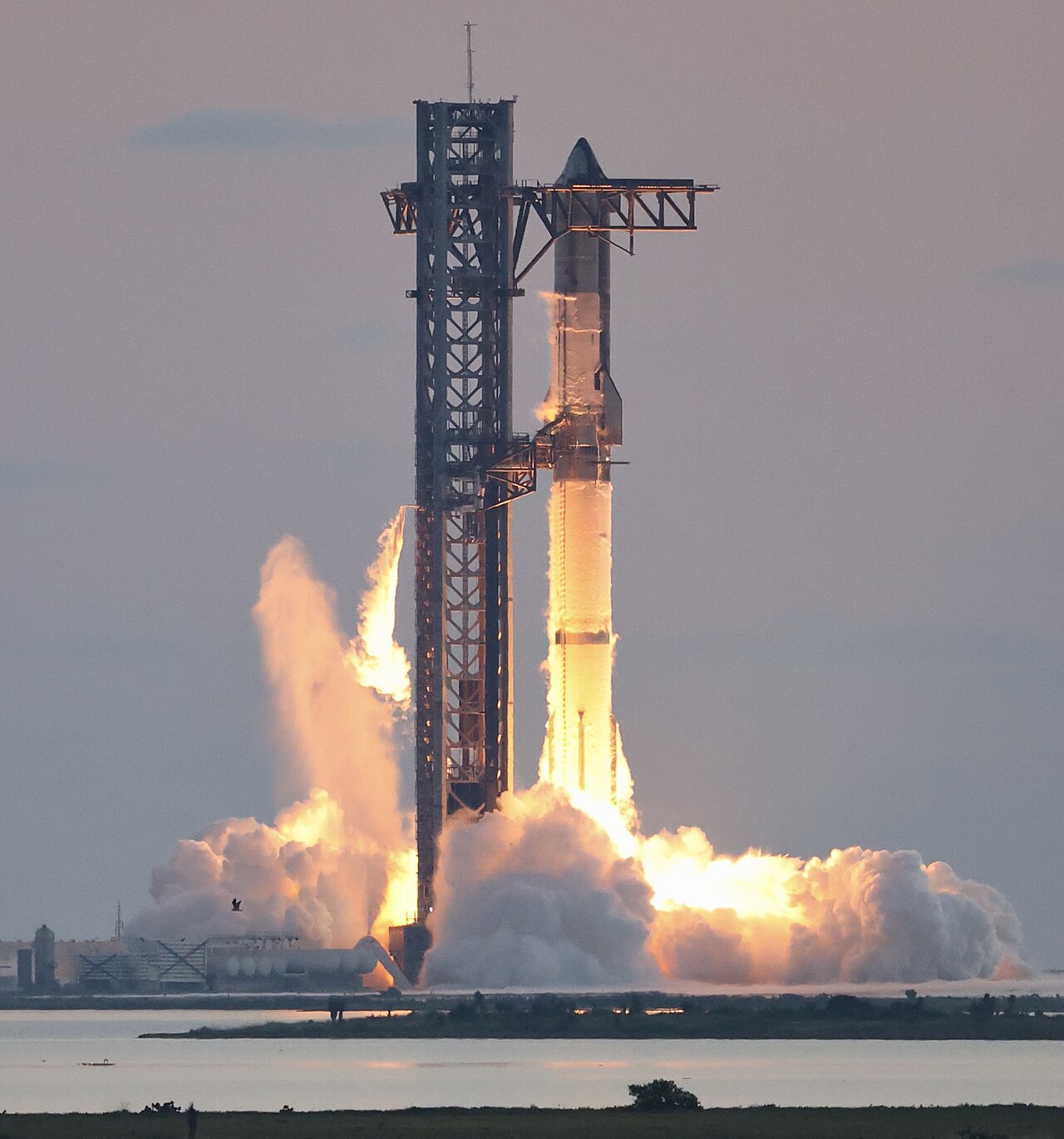
*Via Wikimedia Commons: [SpaceX Starship ignition during IFT-5](https://commons.wikimedia.org/wiki/File:SpaceX_Starship_ignition_during_IFT-5.jpg) by Steve Jurvetson, [CC BY 2.0](https://creativecommons.org/licenses/by/2.0).*
## Design
The Super Heavy booster is powered by 33 Raptor engines that burn liquid methane and liquid oxygen, and the ship has six Raptor engines.[1][4] On Starship's third flight test, on March 14, 2024, the two stages separated about three minutes after launch by "hot staging", in which the ship's engines start while it is still attached to the booster.[1] The booster is designed to return to the launch site and be caught by the launch tower.[8] The tower's catching arms are described in the entry on [Mechazilla](/t/2267/mechazilla).
A redesigned Version 3 (V3) first flew on May 22, 2026. SpaceQ reported that the fully stacked V3 stands 124 metres (407 feet) tall and holds more than 5.2 million kilograms of liquid methane and liquid oxygen.[5] Its booster uses 33 Raptor 3 engines, an integrated hot-stage ring, and three grid fins, each 50% larger, in place of four.[5] The ship keeps six Raptor engines, three at sea level and three optimized for vacuum, and gains four docking ports intended for propellant transfer in orbit.[5]
## Selection as a lunar lander and the first flight test
On April 16, 2021, NASA announced that it had chosen SpaceX to continue developing a commercial human lander for the Artemis program, under a firm-fixed-price, milestone-based contract with a total award value of $2.89 billion.[9] The lander was to take two astronauts from lunar orbit to the surface, where they would join crew members who had travelled aboard the Orion spacecraft.[9]
Starship's first fully integrated flight test, with the ship stacked on the Super Heavy booster, launched on April 20, 2023, and ended in an explosion.[11] An account of the investigation's findings, published by Spaceflight Now, said that fires from leaking propellant in the aft end of the booster cut the link to the primary flight computer, which silenced most of the booster's engines and led to a loss of control.[10] The Autonomous Flight Safety System, the system that destroys a vehicle that strays from its planned path, was activated, and after an unexpected delay the vehicle was destroyed 237.474 seconds after engine ignition.[10]
The Federal Aviation Administration (FAA) announced on September 8, 2023 that it had closed its mishap investigation, which gave SpaceX 63 corrective actions to complete before a second test flight.[10] The FAA said the closure did not mean SpaceX could immediately resume launches from Boca Chica, and the corrective actions included redesigns of vehicle hardware and the launch pad and further analysis and testing of safety-critical systems.[11] The FAA's report was not released, because it contains proprietary information.[10]
## Flight tests
Starship is developed through repeated flight tests rather than a single qualification campaign. The third test flight, on March 14, 2024, included a demonstration of transferring cryogenic (super-cooled) propellant between tanks inside the ship during its coast phase.[1]
Flights 7, 8 and 9, in early 2025, were failures; Flight 10, in August 2025, and Flight 11, on October 13, 2025, were successes.[3] On Flight 11 the booster made a planned soft landing in the Gulf of Mexico, the ship splashed down in the Indian Ocean about an hour and six minutes after liftoff, and eight Starlink simulators were deployed.[3] That flight was the last of the first version of the vehicle, and every test flight up to then had been suborbital.[3]
Flight 12, on May 22, 2026, was the first V3 flight, from Launch Pad 2 at Starbase.[5] The booster did not relight enough engines for its boostback burn (the burn that turns it back toward the launch site) and crashed into the Gulf of Mexico.[5] The ship lost one vacuum-optimized engine soon after ignition but reached its planned suborbital trajectory, deployed 22 satellites (20 Starlink mass simulators and two modified V2 Mini satellites), and made a controlled splashdown in the Indian Ocean about 1 hour 6 minutes after launch.[5] The Federal Aviation Administration (FAA) concluded its mishap investigation, and a report published on July 13, 2026 gave "heat effects on propulsion system components during ascent" and "erroneous engine alarm system settings" as the two most probable causes.[6] The same report said five of the booster's 33 engines could not reignite.[6]
Flight 13 launched on July 24, 2026, after an automatic abort on July 16.[7] All 33 booster engines ignited, but during the landing burn only some of the 13 engines meant for splashdown relit and the booster hit the Gulf of Mexico hard.[7] The ship relit one engine in space, relit its three landing engines during reentry, and settled onto the water intact; it deployed 20 Starlink V3 satellites.[7]
Flight 14, on September 28, 2026 at 7:48 a.m. Central time, was the first Starship flight to reach orbit, at about 17,500 miles per hour.[8] One of the ship's six engines failed during ascent, and about 22 minutes into the flight managers judged it safe to continue to orbit.[8] SpaceX had planned a flight of about 10 hours and six orbits, at an altitude of about 170 miles, and cut it to three hours; the report does not say why.[8] The ship deployed 26 Starlink V3 satellites.[8] The booster simulated a landing offshore in the Gulf of Mexico rather than returning to be caught.[8] This entry covers flights through Flight 14.
## Role in the Artemis lunar program
NASA selected a version of Starship as a human landing system, the vehicle that would carry astronauts between lunar orbit and the Moon's surface. In 2024 NASA described the plan as landing astronauts near the Moon's south pole on the Artemis III and Artemis IV missions.[1]
On October 23, 2026, NASA announced that it had redefined Artemis III to demonstrate rendezvous and docking in low Earth orbit between the Orion spacecraft and test versions of both landers, in 2027, and that neither lander provider had been assigned a specific lunar landing mission.[2] NASA stated a goal of returning astronauts to the lunar surface in 2028, and said it would decide which company is selected first for that landing based on lander readiness.[2] Under the revised plan the Starship lander waits for Orion in Earth orbit, the two dock, and the lander then performs a trans-lunar injection burn (the burn that sends the pair toward the Moon).[2] The other lander in the program is Blue Origin's.[8]
Refuelling is central to the plan: SpaceX intends to use several "tanker" Starships to transfer propellant to a waiting "depot" Starship, and NASA said this would be demonstrated during an uncrewed demonstration mission.[2]
## Sources
1. NASA, "NASA Artemis Mission Progresses with SpaceX Starship Test Flight," March 14, 2024. https://www.nasa.gov/directorates/esdmd/artemis-campaign-development-division/human-landing-system-program/nasa-artemis-mission-progresses-with-spacex-starship-test-flight/
2. NASA, "NASA, Partners Accelerate Lander Development for 2028 Moon Missions," October 23, 2026. https://www.nasa.gov/missions/artemis/nasa-partners-accelerate-lander-development-for-2028-moon-missions/
3. SpacePolicyOnline, "Another Successful Starship Test Flight as SpaceX Readies a New Version," October 13–14, 2025. https://spacepolicyonline.com/news/another-successful-starship-test-flight-as-spacex-readies-a-new-version/
4. Scientific American, "SpaceX's Starship Succeeds in Final Test Flight of 2025," October 13, 2025. https://scientificamerican.com/article/spacexs-starship-succeeds-in-final-test-flight-of-2025
5. SpaceQ, "Starship flight 12 validates V3 reentry systems despite early booster termination," May 2026. https://spaceq.ca/starship-flight-12-validates-v3-reentry-systems-despite-early-booster-termination/
6. Aviation News (aviationnews.eu), "FAA Closes Starship Investigation, Clearing SpaceX for Next Launch with Starlink Payload," July 13, 2026. https://aviationnews.eu/news/2026/07/faa-closes-starship-investigation-clearing-spacex-for-next-launch-with-starlink-payload/
7. Astronomy magazine, "SpaceX launches Starship test flight 'lucky number 13'," July 2026. https://www.astronomy.com/space-exploration/spacex-launches-starship-test-flight-lucky-number-13/
8. OPB (NPR), "SpaceX's Starship launches on first orbital mission from Texas," September 28, 2026. https://www.opb.org/article/2026/09/28/spacexs-starship-launches-on-first-orbital-mission-from-texas/
9. NASA, "As Artemis Moves Forward, NASA Picks SpaceX to Land Next Americans on Moon," April 16, 2021. https://www.nasa.gov/news-release/as-artemis-moves-forward-nasa-picks-spacex-to-land-next-americans-on-moon/
10. Spaceflight Now, "FAA concludes Starship mishap investigation, 63 corrective actions needed before second flight," September 8, 2023. https://spaceflightnow.com/2023/09/08/faa-concludes-starship-mishap-investigation-63-corrective-actions-needed-before-second-flight/
11. Via Satellite, "FAA's Mishap Investigation Into Starship Launch Ends With 63 Action Items," September 8, 2023. https://www.satellitetoday.com/launch/2023/09/08/faas-mishap-investigation-into-starship-launch-ends-with-63-action-items/
