Version 1
Nov 17, 2026. Compare with the current version · Version history
A mosquito is a small flying insect whose females bite people and animals to take blood, and some kinds spread diseases such as malaria, dengue and West Nile fever.[1][4]
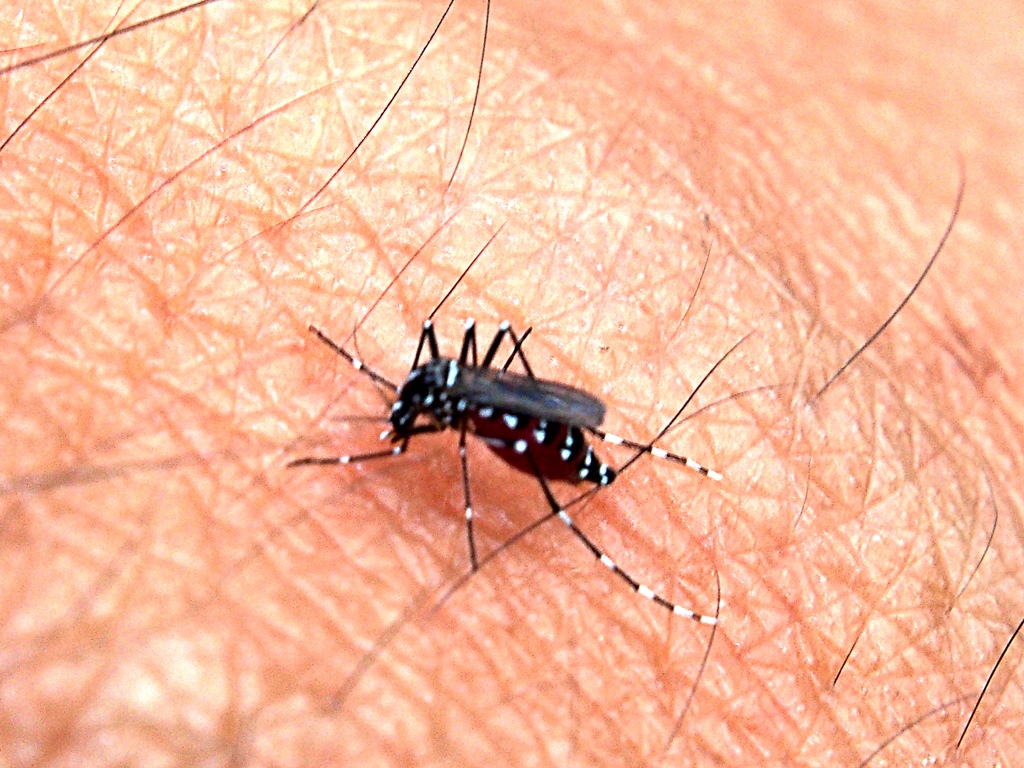
Via Wikimedia Commons: Aedes aegypti mosquito by John Ragai from Petaling Jaya, Malaysia, CC BY 2.0.
Overview
The U.S. Centers for Disease Control and Prevention (CDC) states that more than 3,700 types of mosquito are found worldwide.[1] Both sexes feed on flower nectar and fruit juices, but only females take blood from people and animals, because they need a blood meal to produce eggs; males cannot pierce skin.[1]
Most mosquitoes are not carriers of human disease. The ones that matter to public health are those that act as a vector, which the CDC defines as an animal, insect or tick that spreads germs to people or animals that can make them sick.[1]
Life cycle
Mosquitoes pass through four stages: egg, larva, pupa and adult. The first three live in water.[2][3] Details differ between kinds, and the CDC's own pages for two groups show it.
Culex. The CDC's life-cycle sheet for Culex pipiens, Cx. quinquefasciatus and Cx. tarsalis (dated 11 July 2022) says a female lays eggs one at a time on the surface of fresh or stagnant water, and the eggs stick together in a floating raft of 100 to 300.[2] Most eggs hatch within 48 hours.[2] The larvae, often called "wigglers", feed on material in the water and shed their skin several times; they can become pupae in as few as 5 days.[2] Pupae do not feed, and an adult emerges and flies away within 2 to 3 days.[2] From egg to adult takes about 7 to 10 days.[2]
Aedes. The CDC says female Aedes lay eggs on the inner walls of containers, above the waterline. The eggs stick to the wall and can survive drying for up to 8 months, hatching when rain or a sprinkler covers them with water.[3] An egg takes 7 to 10 days to become an adult.[3]
After a blood meal, females look for water in which to lay eggs.[2][3]
Diseases
The World Health Organization (WHO) lists the diseases spread by three mosquito genera in its fact sheet on vector-borne diseases (26 September 2024):[4]
- Aedes: chikungunya, dengue, lymphatic filariasis, Rift Valley fever, yellow fever and Zika.
- Anopheles: lymphatic filariasis, malaria and O'nyong'nyong virus.
- Culex: Japanese encephalitis, lymphatic filariasis and West Nile fever.
The same fact sheet says vector-borne diseases, which include those carried by ticks, flies and other animals as well as mosquitoes, make up more than 17% of all infectious diseases and cause more than 700,000 deaths a year.[4] That figure is not for mosquitoes alone.
Malaria is spread mostly by the bites of some infected female Anopheles mosquitoes, according to the WHO's malaria fact sheet of 4 December 2025, which estimates 282 million cases and 610,000 deaths in 2024.[5]
Behaviour and range
The CDC describes differences in habits. Culex usually do not fly far, though they have been known to fly up to 2 miles (3.2 km), and some prefer to bite birds, biting people when other animals are not near.[2] Aedes aegypti and Ae. albopictus travel only a few blocks in their lifetime; Ae. aegypti prefers to live near and bite people, indoors and outdoors, while Ae. albopictus lives outdoors.[3]
Sources
- About Mosquitoes. Centers for Disease Control and Prevention (undated page, read 17 November 2026). cdc.gov/mosquitoes/about/index.html
- Mosquito Life Cycle: Culex pipiens, Cx. quinquefasciatus, and Cx. tarsalis. Centers for Disease Control and Prevention, 11 July 2022. cdc.gov/mosquitoes/pdfs/culexlifecycle-p.pdf
- Life cycle of Aedes mosquitoes. Centers for Disease Control and Prevention (undated page, read 17 November 2026). cdc.gov/mosquitoes/about/life-cycles/aedes.html
- Vector-borne diseases (fact sheet). World Health Organization, 26 September 2024. who.int/news-room/fact-sheets/detail/vector-borne-diseases
- Malaria (fact sheet). World Health Organization, 4 December 2025. who.int/news-room/fact-sheets/detail/malaria
