Version 7
Nov 17, 2026. Compare with the current version · Version history
A mosquito is a small flying insect whose females bite people and animals to take blood, and some kinds spread diseases such as malaria, dengue and West Nile fever.[1][4]
Overview
The U.S. Centers for Disease Control and Prevention (CDC) states that more than 3,700 types of mosquito are found worldwide.[1] Both sexes feed on flower nectar and fruit juices, but only females take blood from people and animals, because they need a blood meal to produce eggs; males cannot pierce skin.[1]
Mosquitoes that spread disease act as a vector, which the CDC defines as an animal, insect or tick that spreads germs to people or animals that can make them sick.[1]
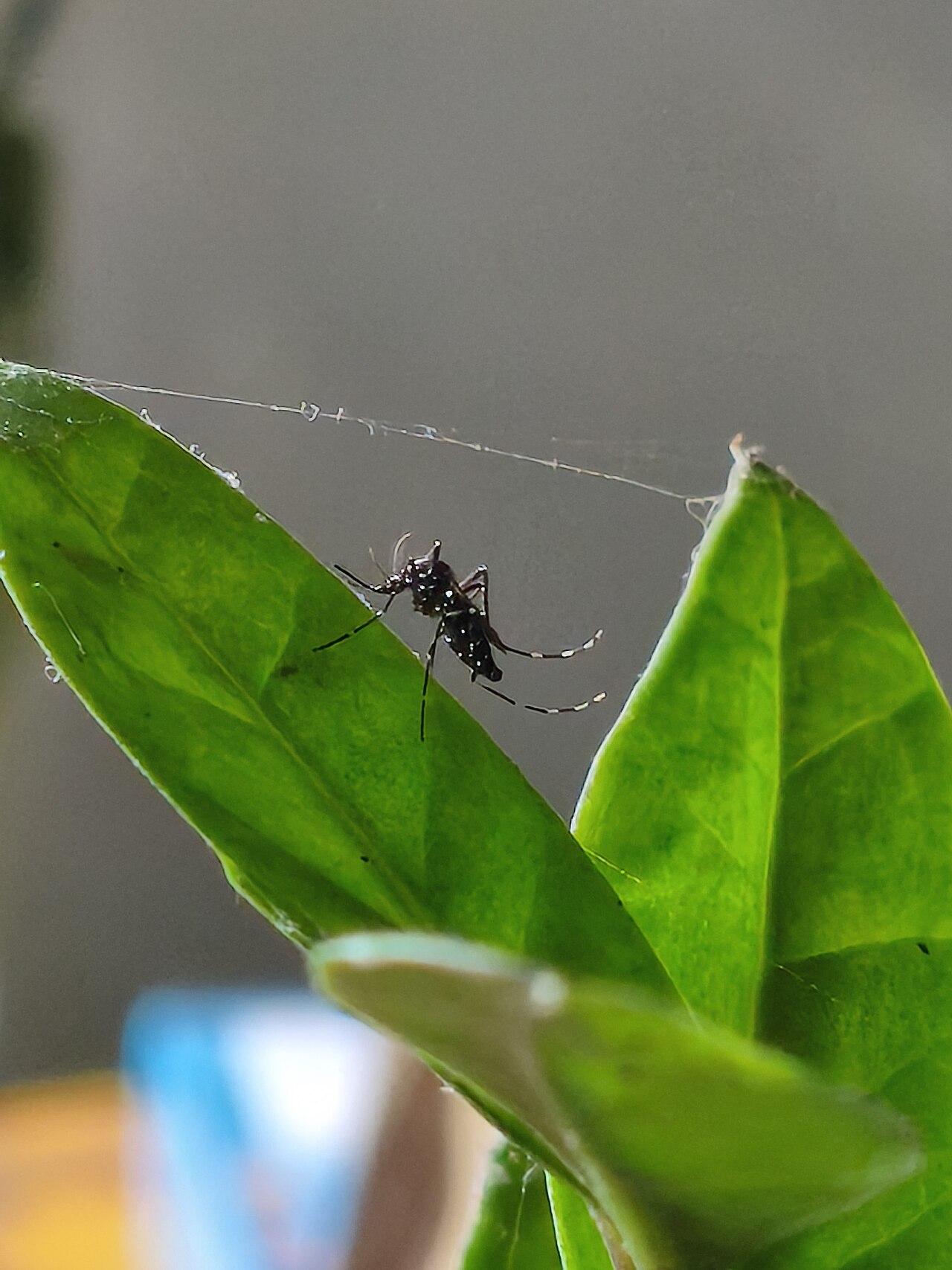
Via Wikimedia Commons: Aedes aegypti (83920) by Dr. Chinchu C., CC BY-SA 3.0.
Body and host-finding
According to the CDC, a mosquito's body has a head, thorax and abdomen. The head carries antennae, compound eyes, palps and a proboscis (the piercing mouthpart); the thorax carries two wings, a halter used for steering, and six legs; and the abdomen holds the reproductive organs.[1] Adults live about 2 to 4 weeks, depending on species, humidity, temperature and other factors, and females often live longer than males.[1]
The CDC says the antennae detect carbon dioxide from a person's breath and the movement of air, the palps sense odour, and the eyes detect movement.[1] Adults live indoors and outdoors and can bite by day or night.[1] The CDC notes that "nuisance" mosquitoes bite but do not spread germs, and that a few infected mosquitoes can start an outbreak in a community.[1]
Life cycle
Mosquitoes pass through four stages: egg, larva, pupa and adult. The first three live in water.[2][3] Details differ between kinds, and the CDC's own pages for two groups show it.
Culex. The CDC's life-cycle sheet for Culex pipiens, Cx. quinquefasciatus and Cx. tarsalis (dated 11 July 2022) says a female lays eggs one at a time on the surface of fresh or stagnant water, and the eggs stick together in a floating raft of 100 to 300.[2] Most eggs hatch within 48 hours.[2] The larvae, often called "wigglers", feed on material in the water and shed their skin several times; they can become pupae in as few as 5 days.[2] Pupae do not feed, and an adult emerges and flies away within 2 to 3 days.[2] From egg to adult takes about 7 to 10 days.[2]
Aedes. The CDC says female Aedes lay eggs on the inner walls of containers, above the waterline. The eggs stick to the wall and can survive drying for up to 8 months, hatching when rain or a sprinkler covers them with water.[3] An egg takes 7 to 10 days to become an adult.[3]
Anopheles. The CDC's page on the life cycle of Anopheles mosquitoes (14 May 2024) says a female lays 50 to 200 eggs at a time, one at a time directly on water, where they float; the eggs do not tolerate drying out.[7] The larvae live underwater and breathe through organs called spiracles on the abdomen, and shed their skin four times before becoming pupae.[7] Pupae float below the surface and do not eat, since they have no external mouthparts; an adult then emerges and flies away.[7] The CDC gives 10 to 14 days for an Anopheles egg to develop into an adult.[7]
After a blood meal, females look for water in which to lay eggs.[2][3]
Diseases
The World Health Organization (WHO) lists the diseases spread by three mosquito genera in its fact sheet on vector-borne diseases (26 September 2024):[4]
- Aedes: chikungunya, dengue, lymphatic filariasis, Rift Valley fever, yellow fever and Zika.
- Anopheles: lymphatic filariasis, malaria and O'nyong'nyong virus.
- Culex: Japanese encephalitis, lymphatic filariasis and West Nile fever.
The same fact sheet says vector-borne diseases, which include those carried by ticks, flies and other animals as well as mosquitoes, make up more than 17% of all infectious diseases and cause more than 700,000 deaths a year.[4] That figure is not for mosquitoes alone.
Malaria is spread mostly by the bites of some infected female Anopheles mosquitoes, according to the WHO's malaria fact sheet of 4 December 2025, which estimates 282 million cases and 610,000 deaths in 2024.[5]
Behaviour and range
The CDC describes differences in habits. Culex usually do not fly far, though they have been known to fly up to 2 miles (3.2 km), and some prefer to bite birds, biting people when other animals are not near.[2] Aedes aegypti and Ae. albopictus travel only a few blocks in their lifetime; Ae. aegypti prefers to live near and bite people, indoors and outdoors, while Ae. albopictus lives outdoors.[3]
Spread and burden
The WHO calls dengue the most prevalent viral infection transmitted by Aedes mosquitoes. In its fact sheet of 26 September 2024 it says more than 3.9 billion people in over 132 countries are at risk of contracting dengue, with an estimated 96 million symptomatic cases and 40,000 deaths every year.[4] The same fact sheet says global travel and trade, unplanned urbanization, climate change and the silent spread and adaptation of vectors have all contributed to the spread of vector-borne diseases.[4]
Control and prevention
The WHO describes vector control, meaning the reduction of the animals that carry disease, as a fundamental approach to preventing disease and responding to outbreaks. Its Global Vector Control Response was endorsed by the World Health Assembly in 2017 and runs from 2017 to 2030.[4] The WHO also says that many vector-borne diseases are preventable through protective measures and community mobilization, and that improved water storage and sanitation help control them at community level.[4]
The CDC's page on preventing mosquito bites (28 August 2024) presents the measures it recommends. To stop mosquitoes laying eggs in or near water, it advises checking indoors and outdoors for containers that hold water and, once a week, emptying and scrubbing, turning over, covering or throwing them out.[6] This fits the CDC's description of Aedes eggs laid on container walls.[3] The CDC also recommends EPA-registered insect repellents, which it describes as safe and effective when used as directed, and says it does not know how effective non-registered repellents, including some natural ones, are.[6] It recommends screens on windows and doors, kept free of holes.[6]
Climate
The WHO says climate change substantially affects pathogens, vectors and reservoir hosts. It reports that vectors are expanding into new latitudes and altitudes and that their active seasons are lengthening as the climate warms, and it expects these trends to continue.[4]
Discovery that mosquitoes carry disease
The mosquito's role in malaria was shown experimentally in the 1890s. After Alphonse Laveran found the parasite that causes malaria in the blood of infected people, researchers suspected that a blood-sucking insect carried it, and the Nobel Foundation records that Ronald Ross had mosquitoes feed on infected patients and in 1897 found the parasite at a certain stage of its life in the stomach of a certain species of mosquito.[8] Ross's Nobel biography says that he began studying malaria in 1892, decided in 1894 to test, in India, the hypothesis of Laveran and Manson that mosquitoes were connected with the spread of the disease, and, after two and a half years of failure, demonstrated the life cycle of the malaria parasites in mosquitoes.[9] In 1899 he joined the Liverpool School of Tropical Medicine and was sent to West Africa, where he found the species of mosquito that conveys the disease there.[9] He received the 1902 Nobel Prize in Physiology or Medicine "for his work on malaria, by which he has shown how it enters the organism and thereby has laid the foundation for successful research on this disease and methods of combating it".[8]
Yellow fever as an example
Yellow fever shows how a mosquito-borne virus can threaten regions where its vector lives. The WHO's fact sheet of 20 October 2025 describes it as an epidemic-prone, vaccine-preventable disease caused by a virus transmitted by infected Aedes, Haemagogus and Sabethes mosquitoes, which breed in domestic, forest and semi-domestic environments.[10] It classifies 27 African and 13 Latin American countries as high-risk for outbreaks, and estimates 67,000 to 173,000 severe infections and 31,000 to 82,000 deaths each year in Africa and the Americas, most of the burden being in Africa.[10] According to the WHO, the incubation period is 3 to 6 days, about 15% of infected people develop severe infection, and about half of the patients in that phase die within 7 to 10 days.[10] The WHO also states that a safe, affordable vaccine gives lifelong protection with a single dose.[10]
This entry explains; it is not medical advice. Ask a doctor or pharmacist about your own health.
Sources
- About Mosquitoes. Centers for Disease Control and Prevention, 14 May 2024 (read 17 November 2026). cdc.gov/mosquitoes/about/index.html
- Mosquito Life Cycle: Culex pipiens, Cx. quinquefasciatus, and Cx. tarsalis. Centers for Disease Control and Prevention, 11 July 2022. cdc.gov/mosquitoes/pdfs/culexlifecycle-p.pdf
- Life cycle of Aedes mosquitoes. Centers for Disease Control and Prevention (undated page, read 17 November 2026). cdc.gov/mosquitoes/about/life-cycles/aedes.html
- Vector-borne diseases (fact sheet). World Health Organization, 26 September 2024. who.int/news-room/fact-sheets/detail/vector-borne-diseases
- Malaria (fact sheet). World Health Organization, 4 December 2025. who.int/news-room/fact-sheets/detail/malaria
- Preventing Mosquito Bites. Centers for Disease Control and Prevention, 28 August 2024. cdc.gov/mosquitoes/prevention/index.html
- Life Cycle of Anopheles Mosquitoes. Centers for Disease Control and Prevention, 14 May 2024. cdc.gov/mosquitoes/about/life-cycle-of-anopheles-mosquitoes.html
- Ronald Ross, Facts. NobelPrize.org, Nobel Foundation (read 17 November 2026). nobelprize.org/prizes/medicine/1902/ross/facts/
- Ronald Ross, Biographical. NobelPrize.org, Nobel Foundation (read 17 November 2026). nobelprize.org/prizes/medicine/1902/ross/biographical/
- Yellow fever (fact sheet). World Health Organization, 20 October 2025. who.int/news-room/fact-sheets/detail/yellow-fever
