Compare versions
Version 1 → Version 2 (current). Removed · Added. This shows the entry's text as it is written, including its formatting marks.
Version 1 · Version 2 (current) · Version history
Side by side · Together
The walnut twig beetle (*Pityophthorus juglandis*) is a tiny bark beetle, native to the southwestern United States and northern Mexico, that carries the fungus behind thousand cankers disease of walnut trees.[1]
## Biology
The beetle is about the size of a grain of rice.[3] It was named by Blackman,[1] and was first described in 1928 from western New Mexico.[2] Adults spend the winter in the thick outer bark of trunks and emerge in late April and early May.[2] Males start new colonies and release pheromones (chemical signals) that attract females;[2] in a nuptial chamber cut into the phloem, the living inner bark that carries sugars, a male is joined by two or more females for feeding and reproduction.[1] Parent beetles first enter the upper crown of a host tree through openings in the bark such as lenticels (small pores), leaf scars and corky furrows.[1] Despite its common name, the beetle is never solely a twig-infesting insect: it also colonizes the largest branches and the main stem of large trees in advanced decline.[1]
Larvae feed in the phloem and bark rather than the sapwood, until late in the disease.[2] A generation takes about six to seven weeks, and two, possibly three, generations are produced in a season.[2] Utah State University Extension describes the life cycle as not fully understood.[3]
The beetle can reproduce in many species of walnut (*Juglans*) and in several species of wingnut (*Pterocarya*), but not in hickory or pecan (*Carya*).[1] Monitoring relies on funnel traps baited with the beetle's aggregation pheromone.[1]
## Native range and spread
The beetle's native host is Arizona walnut (*Juglans major*) in Arizona, New Mexico and Chihuahua, Mexico.[1][3] Specimens were first collected in 1896 in New Mexico, in 1907 in Arizona and in 1959 in California, but forest entomologists never considered it a major pest of walnut trees.[1]
That changed with a run of walnut deaths in the western United States. In the early 1990s, mortality now attributed to thousand cankers disease was noted along the Wasatch Mountains of Utah and in Oregon's Willamette Valley.[1] The Colorado State University Extension FAQ places the earliest suspected cluster in Utah and western Colorado in the early to mid-1990s and says it was often misdiagnosed as drought damage.[2] The beetle was first associated with dying walnuts in Utah County, Utah, in 1997, and later with mortality in New Mexico's Española Valley (2001) and in Boulder, Colorado (2003).[1] The disease was first detected in California in 2008, in Yolo and Solano Counties, although the beetle's collection history suggests it had been present in that state continuously from 1959 to the 1990s.[1]
The first detections in the eastern United States were in Knoxville, Tennessee, in July 2010, Richmond, Virginia, in May 2011, and Doylestown, Pennsylvania, in August 2011.[1] Researchers have proposed that nearly the whole western United States was invaded from a "bridgehead" population in California.[1] By 2019 the beetle had been recorded in at least 129 counties of the conterminous United States.[1] It was discovered in northern Italy in 2013, in black walnut and Persian walnut, and has since spread more widely there, to Tuscany.[1]
Missouri enacted the first state quarantine on walnut movement in 2010, and the Colorado State University FAQ notes that there is no national quarantine.[2] As of 8 November 2018, 18 US states had interstate quarantines for the disease.[1]
## Thousand cankers disease
The disease is caused by the fungus *Geosmithia morbida*, which the beetle carries and deposits in the cambium (the growing layer under the bark) as it lays eggs.[3] The beetle is the only insect currently known to transmit the fungus between trees, and the fungus is consistently found with it.[2] Its origin is unknown; the Colorado State University FAQ says it probably also occurs on native walnut species.[2] Where beetle numbers are high, the many feeding and breeding galleries are colonized by the fungus, and the resulting cankers (dead patches of bark and phloem) merge and girdle branches and stems.[1] The cankers are shallow and confined to the phloem, so they rarely show on the outside of the tree.[2]
Early signs are yellowing leaves and a thinning crown, followed by the death of larger limbs.[2][3] Symptoms may not appear until the tree has been attacked for several years.[3] In Rocky Mountain states, black walnut trees have usually died within three years of the first crown symptoms,[2] but a 2019 review found that decline and mortality in several settings developed gradually, and in some eastern Tennessee street trees crown condition was stable or improved over several years.[1]
Species differ in susceptibility. According to the Colorado State University FAQ, black walnut (*Juglans nigra*) is highly susceptible and the main species of concern, northern and southern California walnuts are intermediately susceptible, Persian walnut is fairly resistant, and Arizona walnut, the beetle's native host, is highly resistant.[2] Greenhouse tests found that the pathogen infects walnut and butternut but not pecan or hickory.[1]
## Management and movement of wood
No known means reliably controls the disease, and trees showing symptoms cannot be saved by known treatments, according to the Colorado State University FAQ.[2] It reports that trunk sprays of permethrin or bifenthrin have had at most limited effectiveness, and that soil-applied imidacloprid has had at most negligible effectiveness.[2] Utah State University Extension says that once the fungus has colonized the tissue, management is difficult, and it names prevention as the best strategy in Utah: detecting the beetle early, not moving infested firewood, and promptly destroying infested trees.[3] The same page reports "some success" from spring injections of emamectin benzoate with propiconazole by some tree care professionals, for trees that were healthy or had borer holes but no dieback.[3]
Because the beetle travels in wood, the Colorado State University FAQ advises that wood from affected trees stay local, and says logs can remain infectious for at least 15 months after cutting, while milled, bark-free lumber will not support the beetle.[2] It describes chipping as one of the best ways to make wood safe, since chips become unsuitable for the beetle within months, whereas whole logs take years.[2]
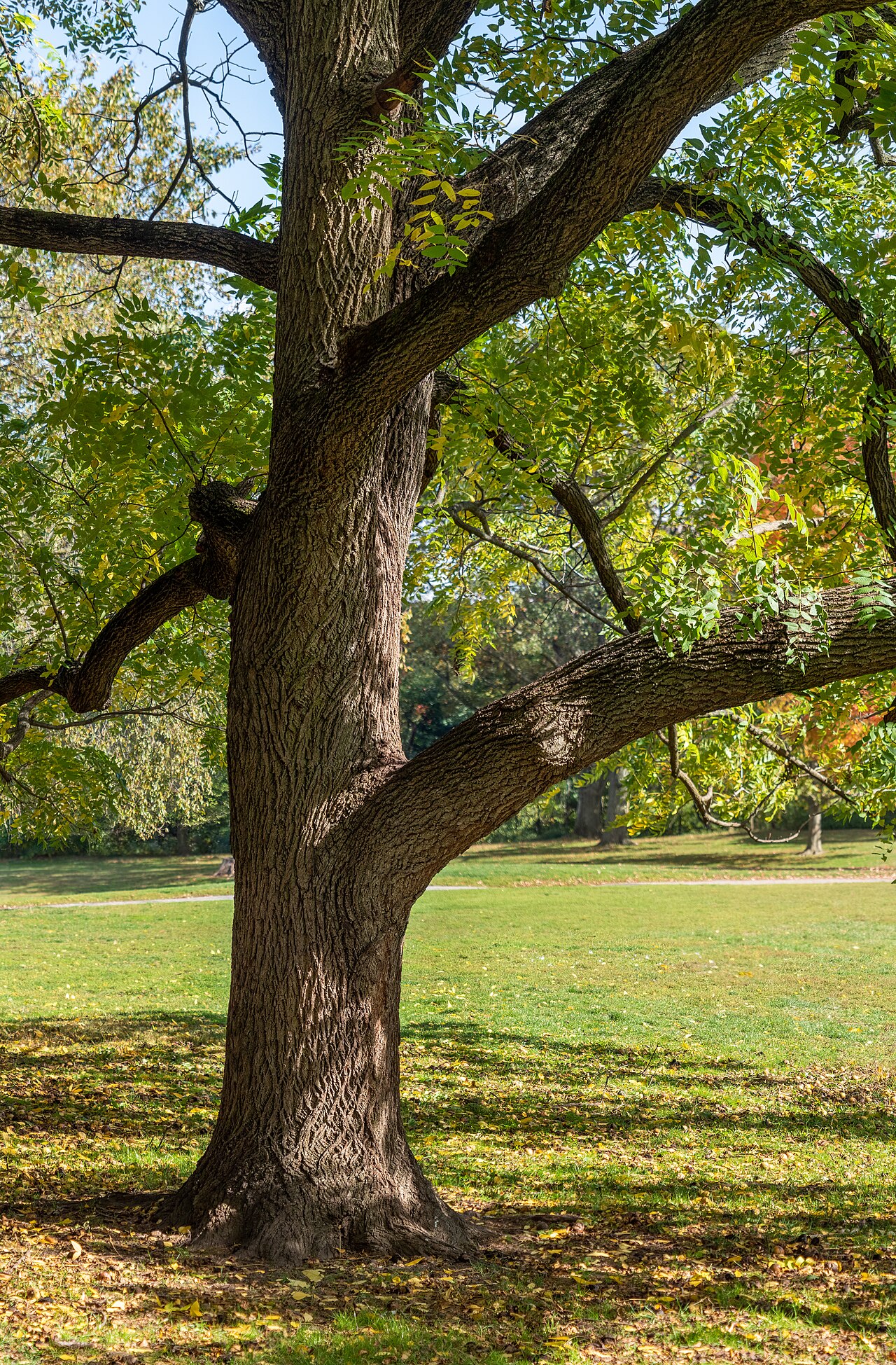
*Via Wikimedia Commons: [Black walnut in Prospect Park (92401p)](https://commons.wikimedia.org/wiki/File:Black_walnut_in_Prospect_Park_(92401p).jpg) by Rhododendrites, [CC BY-SA 4.0](https://creativecommons.org/licenses/by-sa/4.0).*
The stakes are commercial as well as ecological: the FAQ describes black walnut as the most commercially valuable walnut species and names Indiana and Missouri as major US producers of black walnut wood products, and it says planting more black walnut is not currently recommended where the disease is present.[2]
## Sources
1. Seybold, S. J., Klingeman, W. E., Hishinuma, S. M., Coleman, T. W. and Graves, A. D. "Status and Impact of Walnut Twig Beetle in Urban Forest, Orchard, and Native Forest Ecosystems." *Journal of Forestry* 117(2): 152–163, March 2019. USDA Forest Service / Oxford University Press. doi:10.1093/jofore/fvy081. [https://www.fs.usda.gov/psw/publications/seybold/psw_2019_seybold001.pdf](https://www.fs.usda.gov/psw/publications/seybold/psw_2019_seybold001.pdf)
2. Cranshaw, W. and Tisserat, N. "Thousand Cankers Disease of Walnut FAQ." Colorado State University Extension (page undated; accessed 17 November 2026). [https://extension.colostate.edu/?p=10322](https://extension.colostate.edu/?p=10322)
3. Nischwitz, C. and Murray, M. "Thousand Cankers Disease of Walnut." Utah State University Extension, May 2025. [https://extension.usu.edu/planthealth/research/thousand-cankers-disease-walnut](https://extension.usu.edu/planthealth/research/thousand-cankers-disease-walnut)
