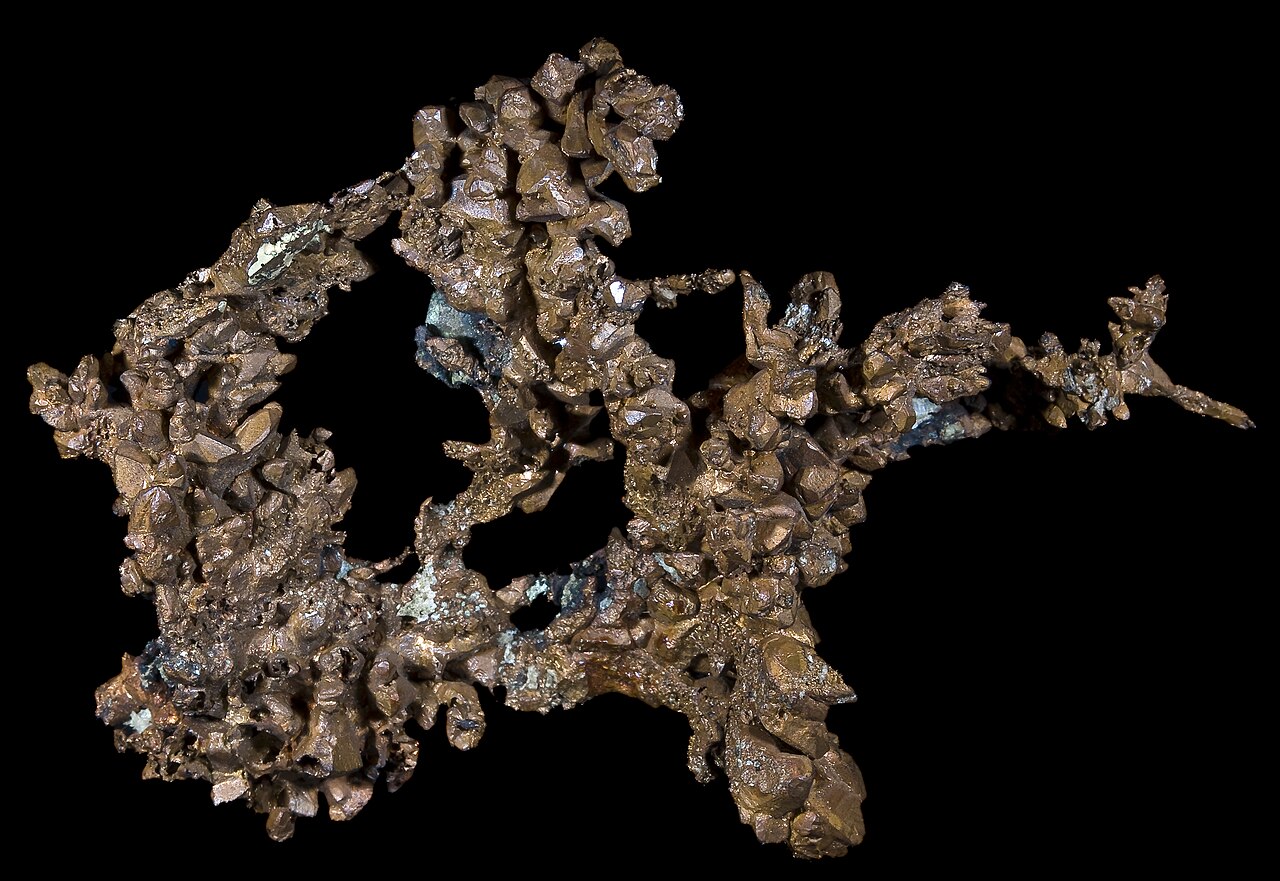
Copper is the chemical element with atomic number 29 and the symbol Cu, a metal known since prehistoric times and used mostly in electrical wiring and equipment.[1][3][4]
This entry is about the element. Its relative atomic mass is 63.546, it is in group 11 of the periodic table, and it is a solid at room temperature.[1]
Properties
The Royal Society of Chemistry lists copper's melting point as 1084.62 °C (1357.77 K), its boiling point as 2560 °C (2833 K), and its density as 8.96 g/cm³.[1] Its standard atomic weight is 63.546(3), unchanged since 1969 according to the atomic weights commission of the International Union of Pure and Applied Chemistry, which says the uncertainty covers natural variations of up to about 0.15 percent in the isotopic abundances.[3] NIST gives the same value.[2]
Isotopes
Copper has two stable isotopes. The Royal Society of Chemistry gives the natural proportions as 69.15 percent for copper-63 and 30.85 percent for copper-65, and NIST gives them as 0.6915(15) and 0.3085(15).[1][2]
Name and history
The element has been known since prehistoric times, and no discoverer is credited.[1][3] Its name and its symbol both come from the Latin cuprum, from Cyprium aes, "a metal from Cyprus."[1][3] The Royal Society of Chemistry notes that bronze, copper alloyed with tin, gave its name to the Bronze Age.[1]
Where it comes from
The Royal Society of Chemistry says copper is obtained from its ores and minerals by smelting, leaching and electrolysis, gives its crustal abundance as 27 parts per million, and lists Chile, Peru and China as the top three producers.[1] The US Geological Survey says copper ranks third, after iron and aluminum, in quantity consumed, and that it is readily recycled.[4]
Uses
The Royal Society of Chemistry says most copper is used in electrical equipment such as wiring and motors, and lists construction (roofing and plumbing), industrial machinery and coins among its other uses, along with copper sulfate as an agricultural poison and algicide.[1] The US Geological Survey says electrical uses account for about three quarters of total copper use and that building construction is the largest single market.[4] The Royal Society of Chemistry also says copper is an essential element for living things.[1]