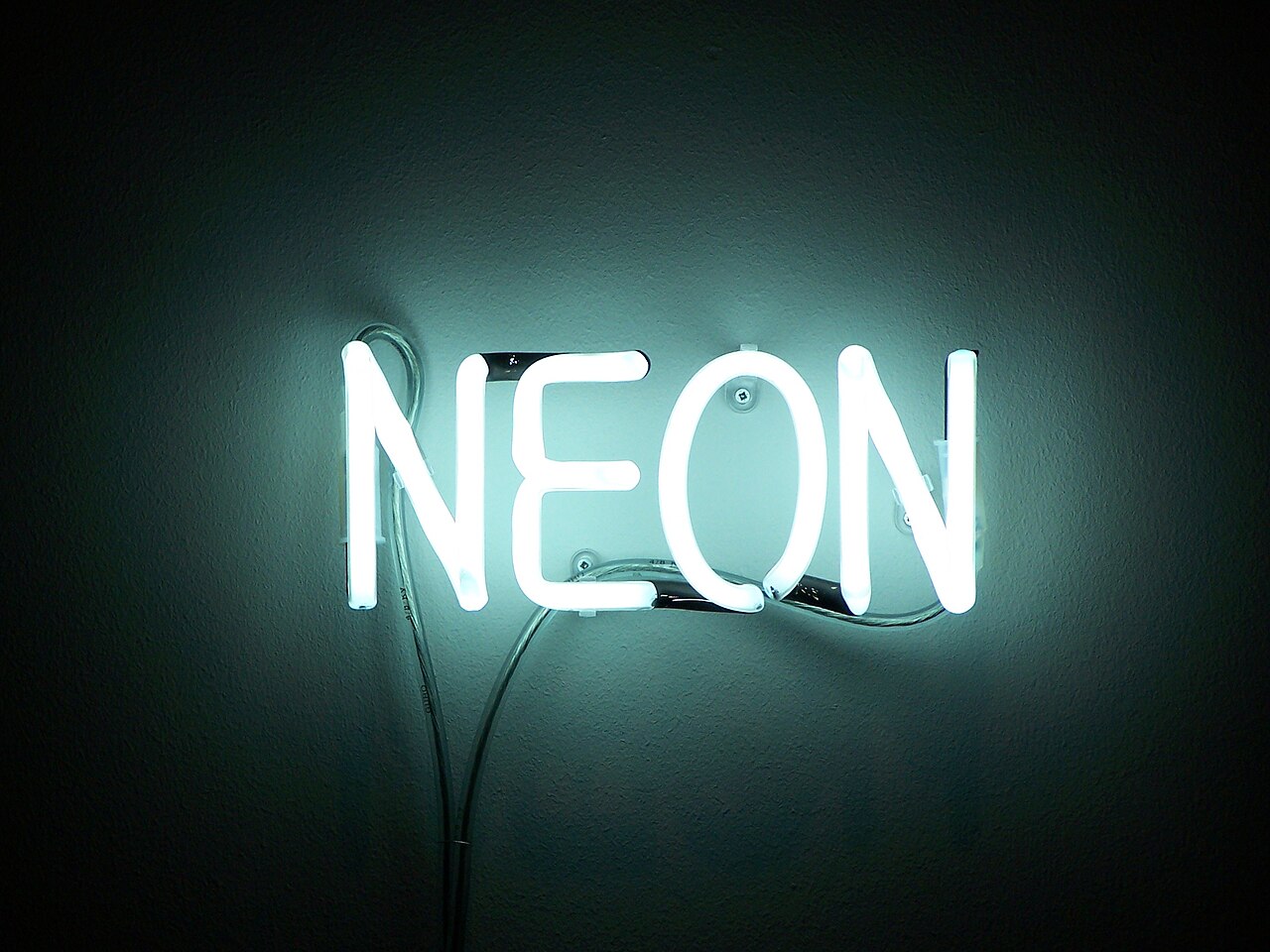
Neon is the chemical element with atomic number 10 and the symbol Ne, a noble gas in group 18 of the periodic table whose largest use is in advertising signs.[1]
A neon sign.
Via Wikimedia Commons: Neon by Lestat (Jan Mehlich), CC BY-SA 3.0.
This entry is about the element. Its relative atomic mass is 20.180, it is in group 18 of the periodic table, and it is a gas at room temperature.[1] For its place in the table and its basic facts, see the [periodic table page for Neon](/element/Q654/neon).
Properties
The Royal Society of Chemistry lists neon's melting point as −248.59 °C (24.56 K), its boiling point as −246.046 °C (27.104 K), and its density as 0.000825 g/cm³.[1] Its standard atomic weight is 20.1797(6) since 1985 according to the atomic weights commission of the International Union of Pure and Applied Chemistry, which says the value refers to neon in the atmosphere.[3][2]
Isotopes
Neon has three stable isotopes. The Royal Society of Chemistry gives their natural proportions as 90.48 percent for neon-20, 0.27 percent for neon-21 and 9.25 percent for neon-22, and NIST gives 0.9048(3), 0.0027(1) and 0.0925(3).[1][2]
Discovery and name
Sir William Ramsay and Morris Travers discovered neon in 1898. The Royal Society of Chemistry says the gas, obtained by evaporating solid argon, gave a brilliant red glow in the spectrometer; the atomic weights commission says it was found in liquefied air from its bright orange spectral lines.[1][3] The name comes from the Greek neos, "new."[1][3]
Where it comes from
The Royal Society of Chemistry says neon is the fifth most abundant element in the universe and makes up just 18 parts per million of the atmosphere, and that it is extracted by fractional distillation of liquid air.[1]
Uses
The Royal Society of Chemistry says the largest use of neon is in the neon signs used for advertising, and lists high-voltage indicators, lightning arresters, lasers, diving equipment and use as a cryogenic refrigerant. It says neon has no known biological role and is non-toxic.[1]