Compare versions
Version 1 → Version 2 (current). Removed · Added. This shows the entry's text as it is written, including its formatting marks.
Version 1 · Version 2 (current) · Version history
Side by side · Together
Vanadium is the chemical element with atomic number 23 and the symbol V, a metal in group 5 of the periodic table, about 80 percent of which goes into steel as an additive.[1]
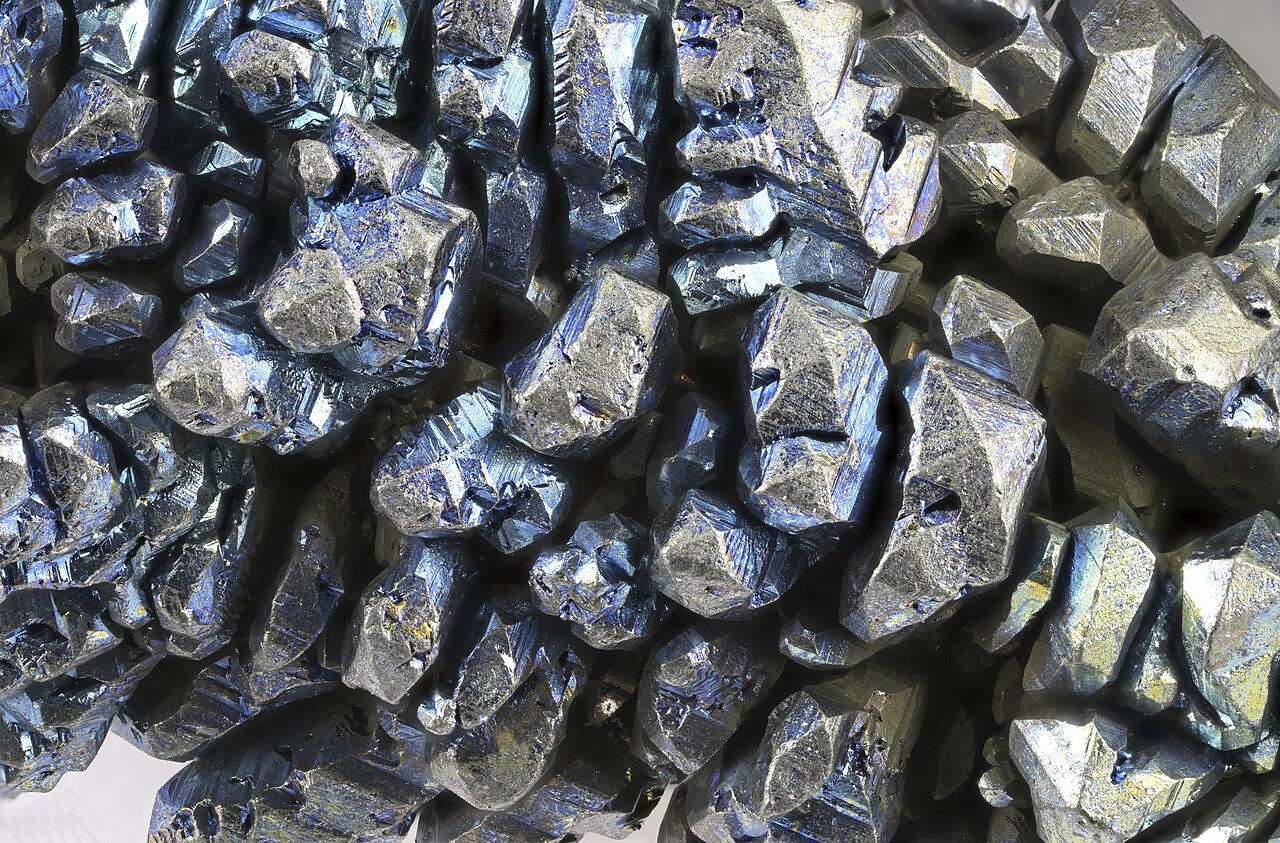
*Via Wikimedia Commons: [Vanadium Crystals - 5x Macro](https://commons.wikimedia.org/wiki/File:Vanadium_Crystals_-_5x_Macro.jpg) by Chaotic42, [CC BY-SA 4.0](https://creativecommons.org/licenses/by-sa/4.0).*
This entry is about the element. Its relative atomic mass is 50.942, it is in group 5 of the periodic table, and it is a solid at room temperature.[1] For its place in the table and its basic facts, see the [periodic table page for Vanadium](/element/Q722/vanadium).
## Properties
The Royal Society of Chemistry lists vanadium's melting point as 1910 °C (2183 K), its boiling point as 3407 °C (3680 K), and its density as 6.0 g/cm³.[1] Its standard atomic weight is 50.9415(1), unchanged since 1977 according to the atomic weights commission of the International Union of Pure and Applied Chemistry; NIST gives the same value.[3][2]
## Isotopes
Vanadium has two naturally occurring isotopes. The Royal Society of Chemistry gives their proportions as 0.25 percent for vanadium-50, which is very slightly radioactive, and 99.75 percent for vanadium-51, and NIST gives 0.00250(4) and 0.99750(4).[1][2]
## Discovery and name
The Spanish-Mexican mineralogist Andrés Manuel del Río found the element in 1801 in the mineral vanadinite; the atomic weights commission says he named it erythronium. French chemists thought it was chromium. Nils Gabriel Sefström rediscovered it, in 1831 according to the Royal Society of Chemistry and in 1830 according to the commission, and Henry Roscoe made the pure metal in 1869.[1][3] The name comes from *Vanadis*, an old Norse name for the goddess Freyja, because of the element's many beautiful multi-coloured compounds.[1][3]
## Where it comes from
The Royal Society of Chemistry gives vanadium's crustal abundance as 138 parts per million. The metal is made by reducing vanadium(V) oxide with calcium in a pressure vessel, and South Africa, China and Russia are listed as the top three producers, without a date.[1]
## Uses
The Royal Society of Chemistry says about 80 percent of vanadium goes into steel as an additive, and lists armour plate, axles, tools, alloys for nuclear reactors, vanadium pentoxide as a pigment and catalyst, and superconducting magnets. It says vanadium is essential to some species, including humans, in very small amounts, and that in some compounds it can become toxic.[1]
## Sources
1. Royal Society of Chemistry, "Vanadium - Element information, properties and uses," Periodic Table (undated page). https://periodic-table.rsc.org/element/23/vanadium
2. National Institute of Standards and Technology, "Atomic Weights and Isotopic Compositions for Vanadium" (undated page). https://physics.nist.gov/cgi-bin/Compositions/stand_alone.pl?ele=V
3. Commission on Isotopic Abundances and Atomic Weights (IUPAC), "Atomic Weight of Vanadium" (page © 2007-2015). https://www.ciaaw.org/vanadium.htm
