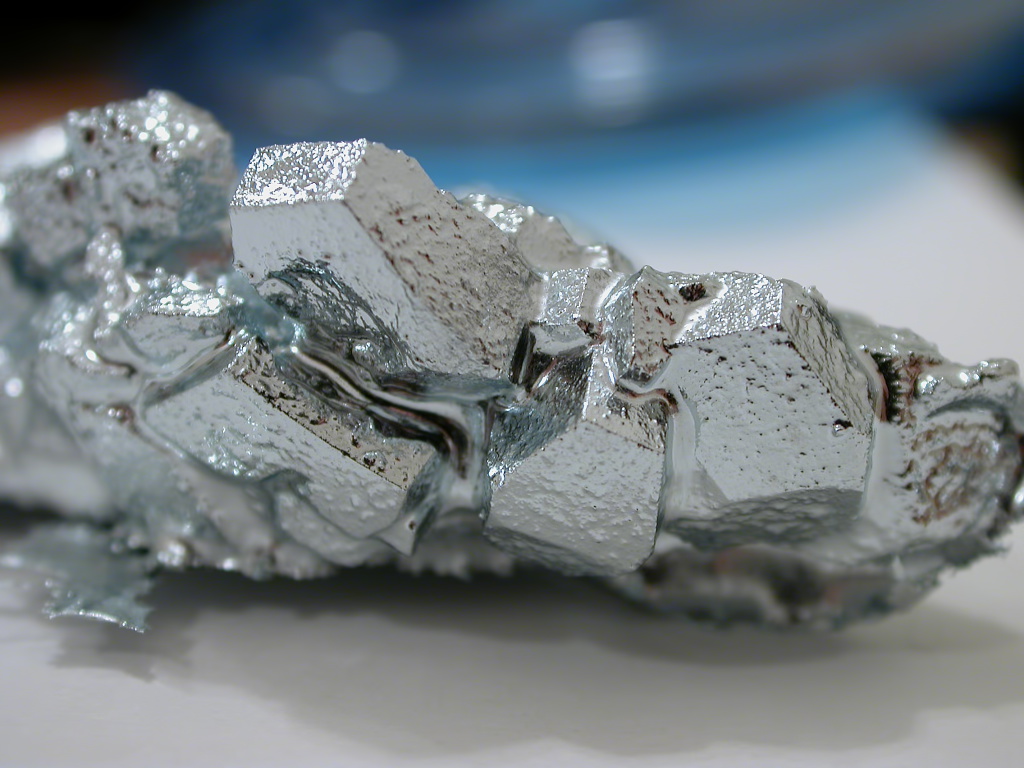
Gallium is the chemical element with atomic number 31 and the symbol Ga, a metal in group 13 of the periodic table that melts at 29.7646 °C, close to room temperature, and is used in semiconductors and LEDs.[1]
This entry is about the element. Its relative atomic mass is 69.723, it is in group 13 of the periodic table, and it is a solid at room temperature.[1] For its place in the table and its basic facts, see the [periodic table page for Gallium](/element/Q861/gallium).
Properties
The Royal Society of Chemistry lists gallium's melting point as 29.7646 °C (302.9146 K), its boiling point as 2229 °C (2502 K), and its density as 5.91 g/cm³.[1] Its standard atomic weight is 69.723(1), unchanged since 1987 according to the atomic weights commission of the International Union of Pure and Applied Chemistry, which notes significant variation in the ratio of gallium-69 to gallium-71 in commercial high-purity gallium; NIST gives the same value.[3][2]
Isotopes
Gallium has two stable isotopes. The Royal Society of Chemistry gives their natural proportions as 60.108 percent for gallium-69 and 39.892 percent for gallium-71, and NIST gives 0.60108(9) and 0.39892(9).[1][2]
Discovery and name
The French chemist Paul-Émile Lecoq de Boisbaudran discovered gallium in 1875 in the mineral zinc blende, the atomic weights commission says. The Royal Society of Chemistry says he saw a new violet line in the spectrum of zinc from zinc blende, that Mendeleev had predicted the element, and that he had isolated and purified the metal by November 1875; the commission dates the first isolation to 1878, by Lecoq de Boisbaudran and Émile-Clément Jungflesch.[1][3] The name comes from Gallia, the Latin name for France.[1][3]
Where it comes from
The Royal Society of Chemistry gives gallium's crustal abundance as 16 parts per million. It says gallium is mainly produced as a by-product of zinc refining, and lists China, Germany and Kazakhstan as the top three producers, without a date.[1]
Uses
The Royal Society of Chemistry lists gallium arsenide semiconductors and solar panels, including those on the Mars Exploration Rover; red LEDs; gallium nitride for blue and green LEDs; low-melting alloys; and high-temperature thermometers. It says gallium has no known biological role and is non-toxic.[1]