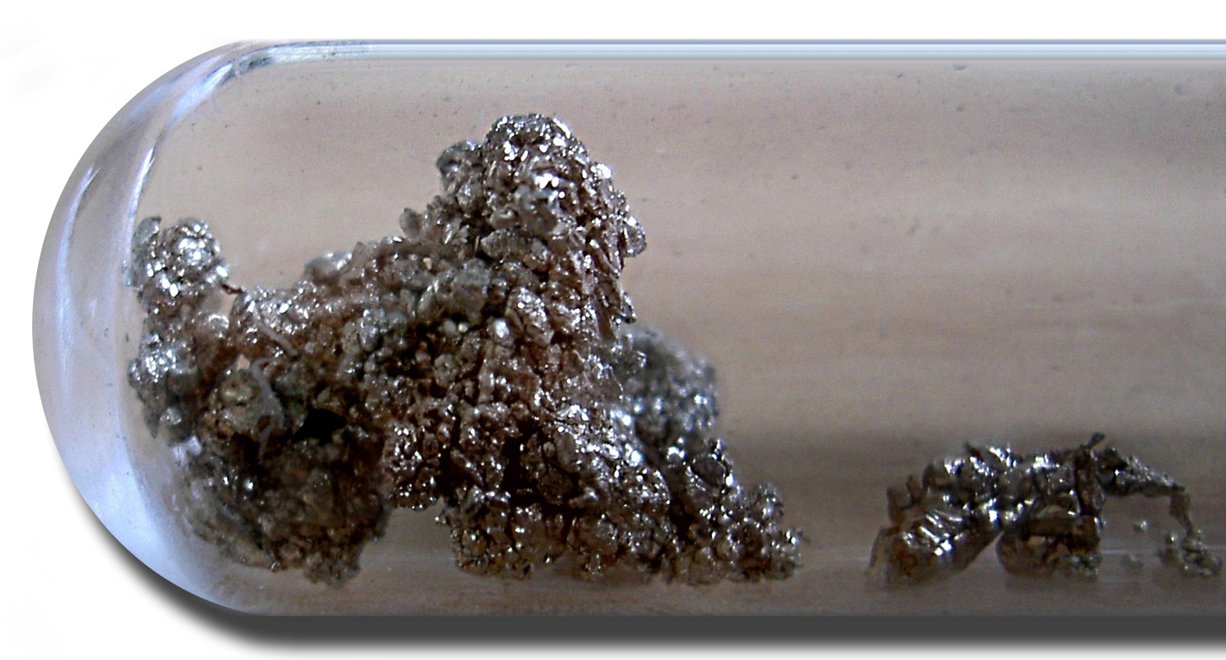
Strontium is the chemical element with atomic number 38 and the symbol Sr, a metal in group 2 of the periodic table, named after the village of Strontian in Scotland and used for the red colour in fireworks and flares.[1][3]
This entry is about the element. Its relative atomic mass is 87.62, it is in group 2 of the periodic table, and it is a solid at room temperature.[1] For its place in the table and its basic facts, see the [periodic table page for Strontium](/element/Q938/strontium).
Properties
The Royal Society of Chemistry lists strontium's melting point as 777 °C (1050 K), its boiling point as 1377 °C (1650 K), and its density as 2.64 g/cm³.[1] Its standard atomic weight is 87.62(1), unchanged since 1969 according to the atomic weights commission of the International Union of Pure and Applied Chemistry, which says the ratio of strontium-87 to strontium-86 varies with the decay of rubidium-87 and prevents a more precise standard value; NIST gives the same value.[3][2]
Isotopes
Strontium has four stable isotopes. The Royal Society of Chemistry gives their natural proportions as 0.56 percent for strontium-84, 9.86 percent for strontium-86, 7 percent for strontium-87 and 82.58 percent for strontium-88, and NIST gives 0.0056(1), 0.0986(1), 0.0700(1) and 0.8258(1).[1][2] The commission says the variation of strontium-87 is the basis of rubidium-strontium dating of rocks.[3]
Discovery and name
The Royal Society of Chemistry credits Adair Crawford, an Edinburgh doctor, with discovering strontium in 1790, after he investigated an unusual rock from a lead mine at Strontian, Scotland, which he named strontia; Thomas Charles Hope proved in 1791 that it was a new element, and Humphry Davy isolated the metal in 1808.[1] The atomic weights commission instead credits the Scottish chemist and physician Thomas Charles Hope, who observed the element's brilliant red flame colour, with discovering it in 1792, and the English chemist Humphry Davy with first isolating it in 1808.[3]
Where it comes from
The Royal Society of Chemistry gives strontium's crustal abundance as 320 parts per million and says China is now the leading producer, with Spain and Mexico also among the top three, without a date. The metal is made by electrolysis of molten strontium chloride and potassium chloride, or by reducing strontium oxide with aluminium in a vacuum.[1]
Uses
The Royal Society of Chemistry lists red colour in fireworks and flares, ferrite magnets, refining zinc, strontium aluminate in glow-in-the-dark paints and plastics, and strontium chloride in toothpaste. It says strontium has no biological role in humans and is non-toxic, and that strontium-90, an isotope in nuclear fallout with a half-life of 28 years, is absorbed by bone tissue.[1]