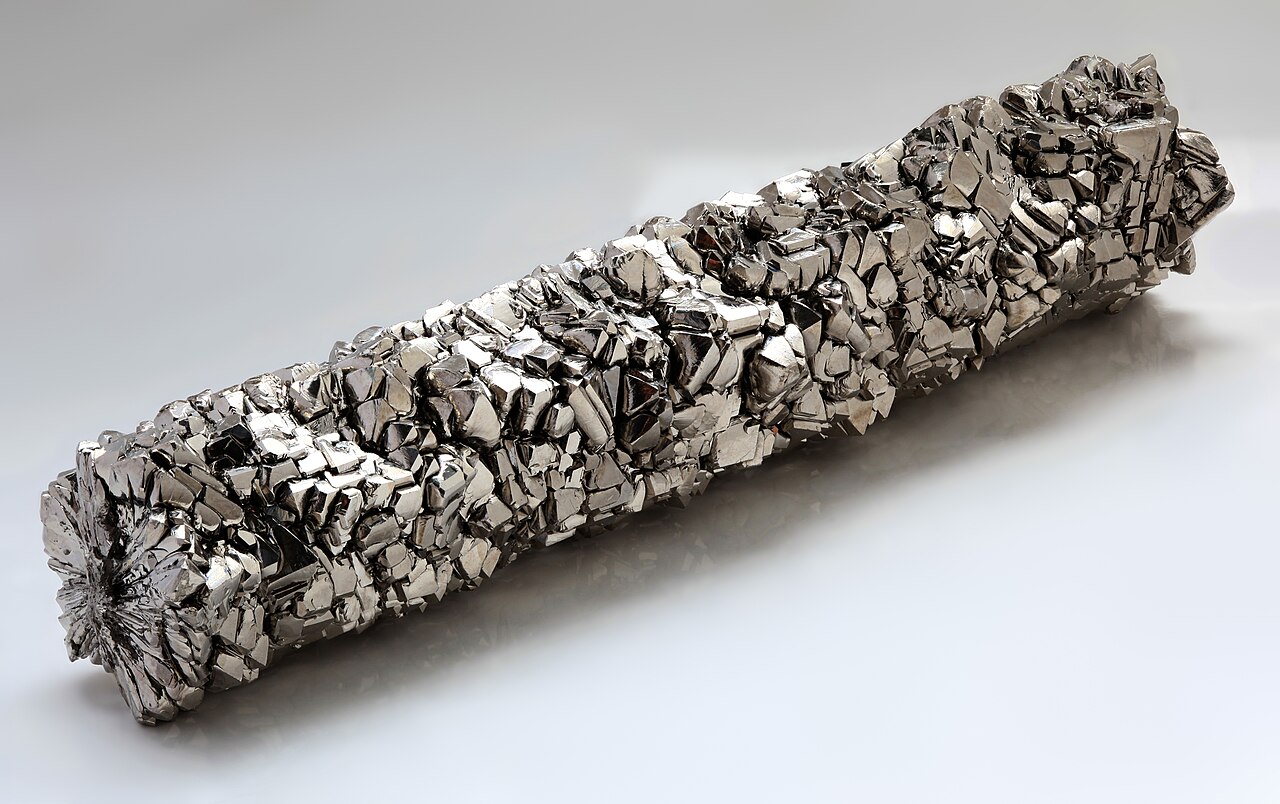
Zirconium is the chemical element with atomic number 40 and the symbol Zr, a metal in group 4 of the periodic table, more than 90 percent of which is used in nuclear reactors.[1]
This entry is about the element. Its relative atomic mass is 91.224, it is in group 4 of the periodic table, and it is a solid at room temperature.[1] For its place in the table and its basic facts, see the [periodic table page for Zirconium](/element/Q1038/zirconium).
Properties
The Royal Society of Chemistry lists zirconium's melting point as 1854 °C (2127 K), its boiling point as 4406 °C (4679 K), and its density as 6.52 g/cm³.[1] Its relative atomic mass is given as 91.224 by the Royal Society of Chemistry and NIST, while the atomic weights commission of the International Union of Pure and Applied Chemistry has recommended 91.222 ± 0.003 since 2024, after new isotope measurements.[1][2][3]
Isotopes
Zirconium has five naturally occurring isotopes. The Royal Society of Chemistry gives their proportions as 51.45 percent for zirconium-90, 11.22 percent for zirconium-91, 17.15 percent for zirconium-92, 17.38 percent for zirconium-94 and 2.8 percent for zirconium-96, and NIST gives the same figures as fractions; the commission's values differ slightly in the last digits.[1][2][3]
Discovery and name
The German chemist Martin Klaproth discovered zirconium in 1789 by analysing the mineral zircon and separating its earth, zirconia. Humphry Davy failed to isolate the metal by electrolysis in 1808, and Berzelius isolated it in impure form in 1824.[1][3] The commission says the pure metal was first made in 1914 by D. Lely Jr. and L. Hamburger; the Royal Society of Chemistry gives 1925, by van Arkel and de Boer.[1][3] The name is traced to a Persian word, zargun, "gold-coloured" by the Royal Society of Chemistry and to an Arabic word, zargun, "gold-like" by the commission.[1][3]
Where it comes from
The Royal Society of Chemistry gives zirconium's crustal abundance as 132 parts per million. Zircon is converted to zirconium chloride and reduced with magnesium, and Australia, South Africa and China are listed as the top three producers, without a date.[1]
Uses
The Royal Society of Chemistry says more than 90 percent of zirconium is used in nuclear reactor cladding and tubing, and lists zirconium oxide ceramics and crucibles, cosmetics and antiperspirants, and zircon pigments. It says zirconium has no known biological role and low toxicity.[1]