Compare versions
Version 1 → Version 2 (current). Removed · Added. This shows the entry's text as it is written, including its formatting marks.
Version 1 · Version 2 (current) · Version history
Side by side · Together
Version 1Version 2 (current)
11 unchanged paragraphs
Samarium is the chemical element with atomic number 62 and the symbol Sm, a metal in the lanthanide series, named after the mineral samarskite and used in samarium-cobalt magnets.[1]
Samarium is the chemical element with atomic number 62 and the symbol Sm, a metal in the lanthanide series, named after the mineral samarskite and used in samarium-cobalt magnets.[1]
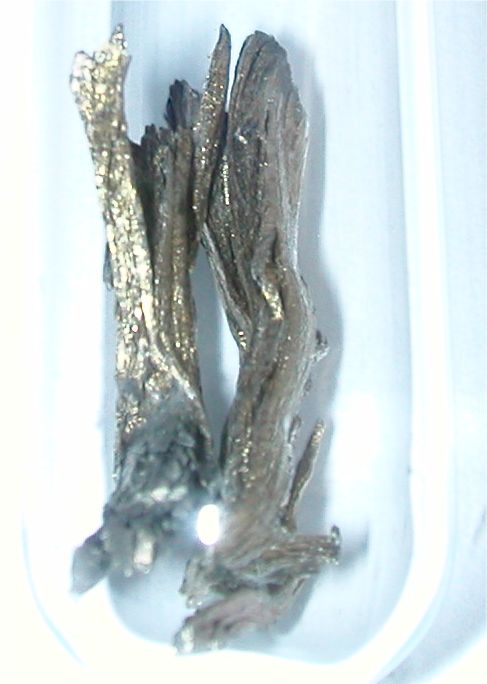

*Via Wikimedia Commons: [Samarium 1](https://commons.wikimedia.org/wiki/File:Samarium_1.jpg) by Tomihahndorf, public domain.*
*Via Wikimedia Commons: [Samarium 1](https://commons.wikimedia.org/wiki/File:Samarium_1.jpg) by Tomihahndorf, public domain.*
This entry is about the element. Its relative atomic mass is 150.36, it is one of the lanthanides in the periodic table, and it is a solid at room temperature.[1] For its place in the table and its basic facts, see the [periodic table page for Samarium](/element/Q1819/samarium).
This entry is about the element. Its relative atomic mass is 150.36, it is one of the lanthanides in the periodic table, and it is a solid at room temperature.[1] For its place in the table and its basic facts, see the [periodic table page for Samarium](/element/Q1819/samarium).
## Properties
## Properties
The Royal Society of Chemistry lists samarium's melting point as 1072 °C (1345 K), its boiling point as 1794 °C (2067 K), and its density as 7.52 g/cm³.[1] Its standard atomic weight is 150.36(2), unchanged since 2005 according to the atomic weights commission of the International Union of Pure and Applied Chemistry; NIST gives the same value.[3][2]
The Royal Society of Chemistry lists samarium's melting point as 1072 °C (1345 K), its boiling point as 1794 °C (2067 K), and its density as 7.52 g/cm³.[1] Its standard atomic weight is 150.36(2), unchanged since 2005 according to the atomic weights commission of the International Union of Pure and Applied Chemistry; NIST gives the same value.[3][2]
## Isotopes
## Isotopes
Samarium has seven naturally occurring isotopes. The Royal Society of Chemistry gives their proportions as 3.07 percent for samarium-144, 14.99 percent for samarium-147, 11.24 percent for samarium-148, 13.82 percent for samarium-149, 7.38 percent for samarium-150, 26.75 percent for samarium-152 and 22.75 percent for samarium-154, and NIST gives the same figures as fractions. Samarium-147 and samarium-148 are radioactive with very long half-lives, about 106 billion and 7 quadrillion years.[1][2][3]
Samarium has seven naturally occurring isotopes. The Royal Society of Chemistry gives their proportions as 3.07 percent for samarium-144, 14.99 percent for samarium-147, 11.24 percent for samarium-148, 13.82 percent for samarium-149, 7.38 percent for samarium-150, 26.75 percent for samarium-152 and 22.75 percent for samarium-154, and NIST gives the same figures as fractions. Samarium-147 and samarium-148 are radioactive with very long half-lives, about 106 billion and 7 quadrillion years.[1][2][3]
## Discovery and name
## Discovery and name
The French chemist Paul-Émile Lecoq de Boisbaudran discovered samarium in 1879, according to the Royal Society of Chemistry and the atomic weights commission, after extracting didymium from the mineral samarskite and observing that its precipitate came down in two stages. The commission adds that the Swiss chemist Marc Delafontaine had originally discovered it in 1878 and called it decipium.[1][3] The name comes from samarskite, the mineral from which it was first isolated, which the commission says was named for Colonel Samarski, a Russian mine official.[1][3]
The French chemist Paul-Émile Lecoq de Boisbaudran discovered samarium in 1879, according to the Royal Society of Chemistry and the atomic weights commission, after extracting didymium from the mineral samarskite and observing that its precipitate came down in two stages. The commission adds that the Swiss chemist Marc Delafontaine had originally discovered it in 1878 and called it decipium.[1][3] The name comes from samarskite, the mineral from which it was first isolated, which the commission says was named for Colonel Samarski, a Russian mine official.[1][3]
## Where it comes from
## Where it comes from
The Royal Society of Chemistry gives samarium's crustal abundance as 0.3 parts per million. It is separated from monazite and bastnaesite by ion exchange and solvent extraction, and the metal can be produced by reducing the oxide with barium; China, Russia and Malaysia are listed as the top three producers, without a date.[1]
The Royal Society of Chemistry says samarium is separated from monazite and bastnaesite by ion exchange and solvent extraction, and the metal can be produced by reducing the oxide with barium.[1]
4 unchanged paragraphs
## Uses
## Uses
The Royal Society of Chemistry lists samarium-cobalt magnets for microwave applications and headphones, calcium fluoride doping for optical lasers, infrared-absorbing glass, a neutron absorber in reactors, the oxide in glass and ceramics, and carbon-arc lighting. It says samarium has no known biological role and low toxicity.[1]
The Royal Society of Chemistry lists samarium-cobalt magnets for microwave applications and headphones, calcium fluoride doping for optical lasers, infrared-absorbing glass, a neutron absorber in reactors, the oxide in glass and ceramics, and carbon-arc lighting. It says samarium has no known biological role and low toxicity.[1]
## Sources
## Sources
1. Royal Society of Chemistry, "Samarium - Element information, properties and uses," Periodic Table (undated page). https://periodic-table.rsc.org/element/62/samarium
2. National Institute of Standards and Technology, "Atomic Weights and Isotopic Compositions for Samarium" (undated page). https://physics.nist.gov/cgi-bin/Compositions/stand_alone.pl?ele=Sm
3. Commission on Isotopic Abundances and Atomic Weights (IUPAC), "Atomic Weight of Samarium" (page © 2007-2015). https://www.ciaaw.org/samarium.htm
