Version 1
Nov 19, 2026. Compare with the current version · Version history
Europium is the chemical element with atomic number 63 and the symbol Eu, a metal in the lanthanide series that is named after the continent of Europe.[1][3]
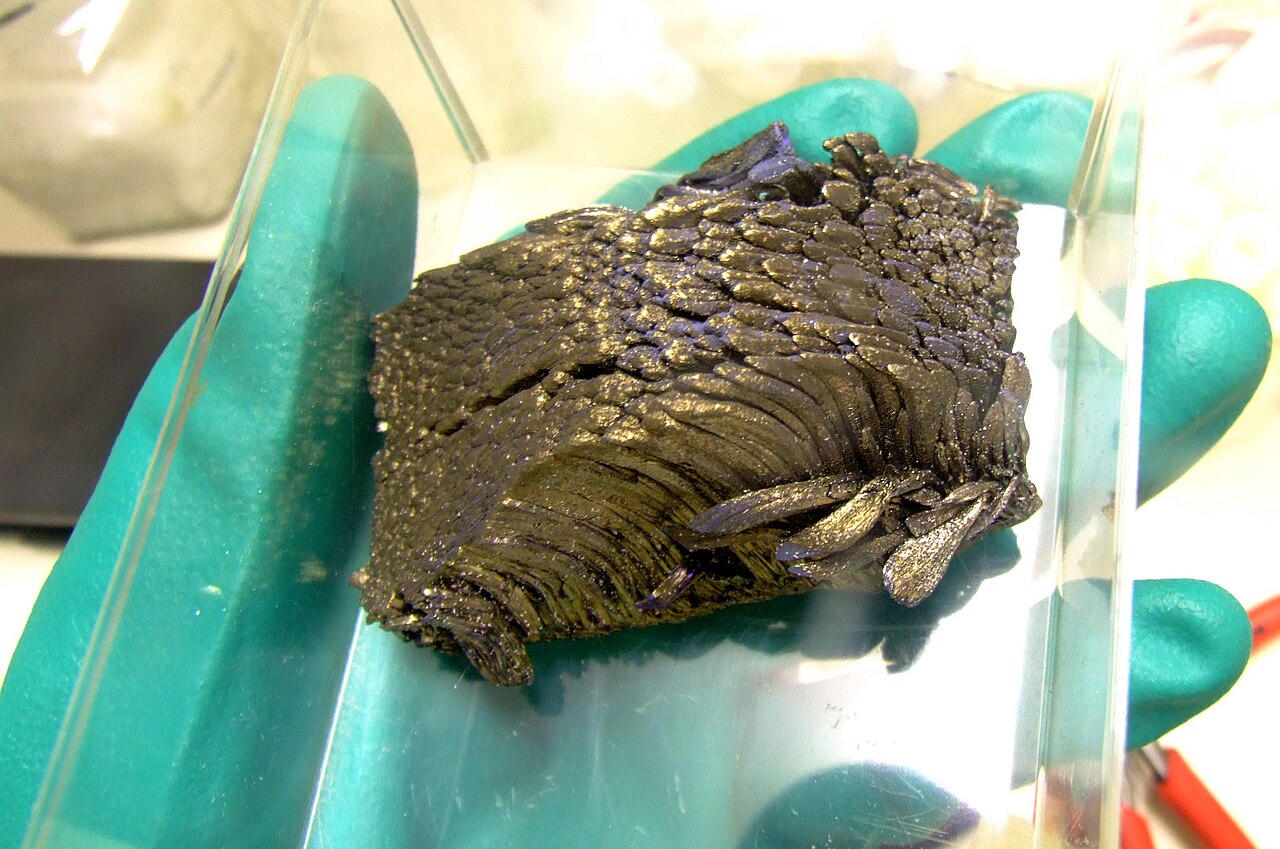
Via Wikimedia Commons: Eu-Block by Alchemist-hp ( pse-mendelejew.de ), CC BY-SA 3.0 de.
This entry is about the element. Its relative atomic mass is 151.964, it is one of the lanthanides in the periodic table, and it is a solid at room temperature.[1] For its place in the table and its basic facts, see the [periodic table page for Europium](/element/Q1396/europium).
Properties
The Royal Society of Chemistry lists europium's melting point as 822 °C (1095 K), its boiling point as 1529 °C (1802 K), and its density as 5.24 g/cm³.[1] Its standard atomic weight is 151.964(1), unchanged since 1995 according to the atomic weights commission of the International Union of Pure and Applied Chemistry; NIST gives the same value.[3][2]
Isotopes
Europium has two naturally occurring isotopes. The Royal Society of Chemistry gives their proportions as 47.81 percent for europium-151 and 52.19 percent for europium-153, and NIST gives 0.4781(6) and 0.5219(6). The Royal Society of Chemistry lists europium-151 as radioactive with a very long half-life, while the atomic weights commission describes europium as having only two stable isotopes.[1][2][3]
Discovery and name
The French chemist Eugène-Anatole Demarçay separated europium from samarium in magnesium-samarium nitrate in 1896, according to the atomic weights commission, and first isolated it in 1901, the date the Royal Society of Chemistry gives for the discovery. The Royal Society of Chemistry says he did so by painstaking crystallisation.[1][3] The name derives from the continent of Europe.[1][3]
Where it comes from
The Royal Society of Chemistry gives europium's crustal abundance as 0.3 parts per million. It is obtained from monazite and bastnaesite, usually by heating europium(III) oxide with excess lanthanum under vacuum; China, Russia and Malaysia are listed as the top three producers, without a date.[1]
Uses
The Royal Society of Chemistry lists the printing of euro banknotes, in which europium glows red under ultraviolet light, low-energy light bulbs, neutron absorbers in reactor control rods, europium-doped plastic laser material and thin superconducting alloys. It says europium has no known biological role and low toxicity.[1]
Sources
- Royal Society of Chemistry, "Europium - Element information, properties and uses," Periodic Table (undated page). periodic-table.rsc.org/element/63/europium
- National Institute of Standards and Technology, "Atomic Weights and Isotopic Compositions for Europium" (undated page). physics.nist.gov/cgi-bin/Compositions/stand_alone.pl?ele=Eu
- Commission on Isotopic Abundances and Atomic Weights (IUPAC), "Atomic Weight of Europium" (page © 2007-2015). ciaaw.org/europium.htm
