Version 2 (current)
Nov 19, 2026. Version history
Dysprosium is the chemical element with atomic number 66 and the symbol Dy, a metal in the lanthanide series whose name comes from the Greek for "hard to get at."[1][3]
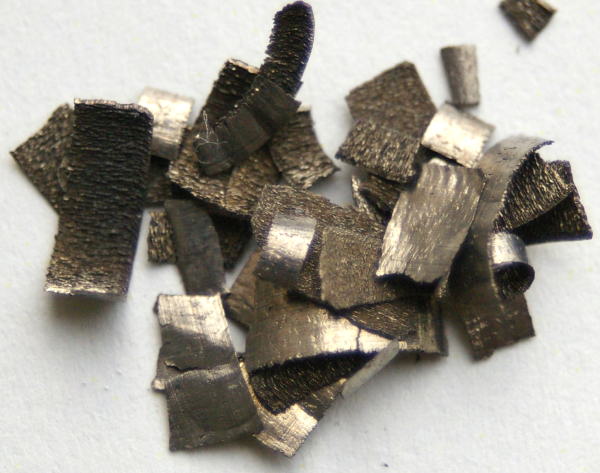
Via Wikimedia Commons: Dy chips by Materialscientist at en.wikipedia, CC BY-SA 3.0.
This entry is about the element. Its relative atomic mass is 162.500, it is one of the lanthanides in the periodic table, and it is a solid at room temperature.[1] For its place in the table and its basic facts, see the [periodic table page for Dysprosium](/element/Q1843/dysprosium).
Properties
The Royal Society of Chemistry lists dysprosium's melting point as 1412 °C (1685 K), its boiling point as 2567 °C (2840 K), and its density as 8.55 g/cm³.[1] Its standard atomic weight is 162.500(1), unchanged since 2001 according to the atomic weights commission of the International Union of Pure and Applied Chemistry; NIST gives the same value.[3][2]
Isotopes
Dysprosium has seven stable isotopes. The Royal Society of Chemistry gives their natural proportions as 0.056 percent for dysprosium-156, 0.095 percent for dysprosium-158, 2.329 percent for dysprosium-160, 18.889 percent for dysprosium-161, 25.475 percent for dysprosium-162, 24.896 percent for dysprosium-163 and 28.26 percent for dysprosium-164, and NIST gives the same figures as fractions.[1][2]
Discovery and name
The Swiss chemist Marc Delafontaine found dysprosium in the mineral samarskite in 1878 and called it philippia, according to the atomic weights commission, which says the French chemist Paul-Émile Lecoq de Boisbaudran rediscovered it in 1886 and was then credited with the discovery, and that the French chemist Georges Urbain first isolated it in 1906. The Royal Society of Chemistry credits Boisbaudran, working in Paris, and says pure samples were not available until Spedding's ion-exchange work around 1950.[1][3] The name comes from the Greek dysprositos, "hard to get at," owing to the difficulty of separating it from holmium.[1][3]
Where it comes from
The Royal Society of Chemistry gives dysprosium's crustal abundance as 0.3 parts per million. It is extracted from monazite and bastnaesite by ion exchange and solvent extraction, or by reducing dysprosium trifluoride with calcium; China, Russia and Malaysia are listed as the top three producers, without a date.[1]
Uses
The Royal Society of Chemistry says the main use of dysprosium is in alloys for neodymium-based magnets, such as those in wind turbines and electric vehicles, and lists dysprosium iodide in halide discharge lamps and a dysprosium oxide-nickel cermet in nuclear reactor control rods. It says dysprosium has no known biological role and low toxicity.[1]
Sources
- Royal Society of Chemistry, "Dysprosium - Element information, properties and uses," Periodic Table (undated page). periodic-table.rsc.org/element/66/dysprosium
- National Institute of Standards and Technology, "Atomic Weights and Isotopic Compositions for Dysprosium" (undated page). physics.nist.gov/cgi-bin/Compositions/stand_alone.pl?ele=Dy
- Commission on Isotopic Abundances and Atomic Weights (IUPAC), "Atomic Weight of Dysprosium" (page © 2007-2015). ciaaw.org/dysprosium.htm
