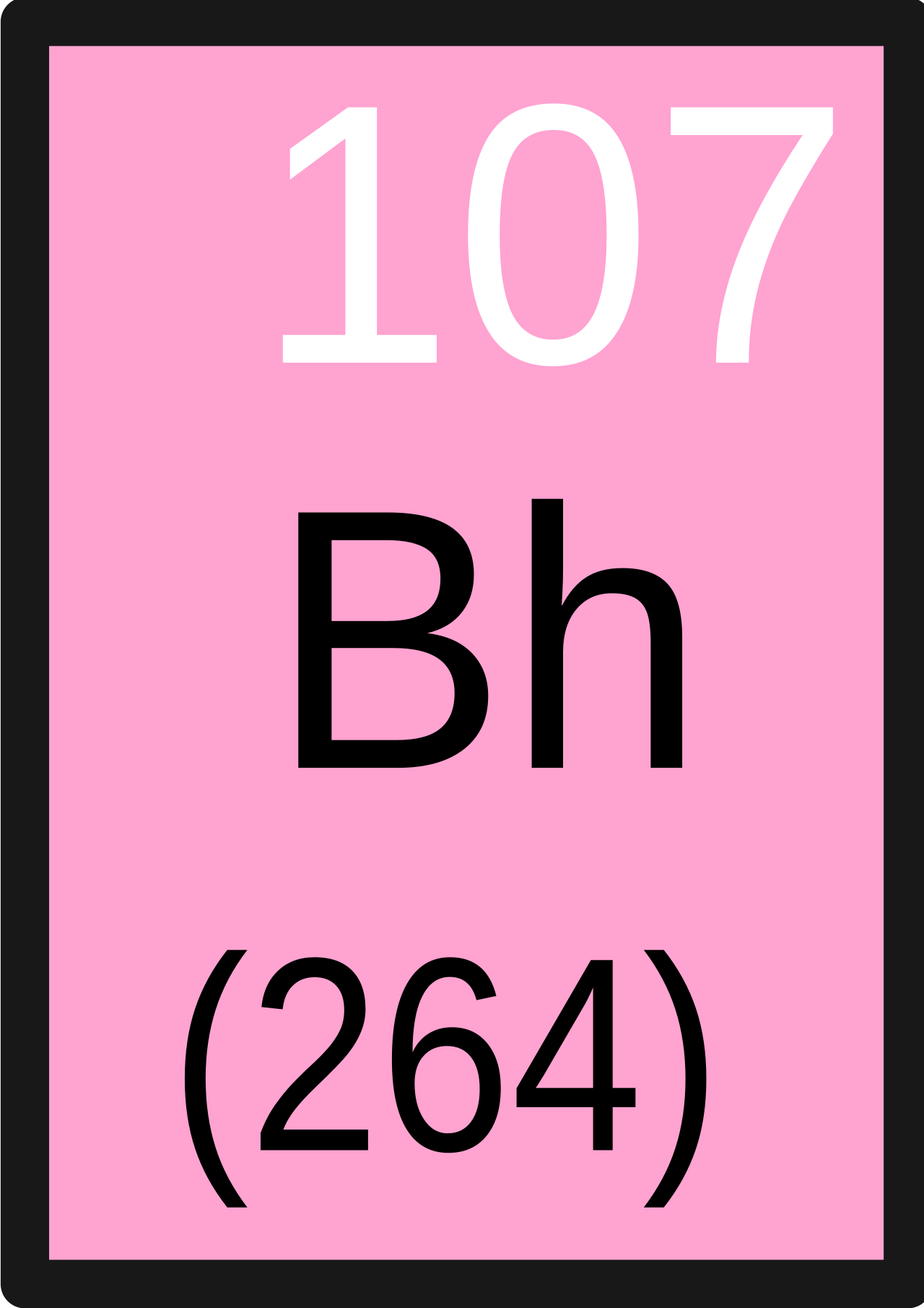
Bohrium is the chemical element with atomic number 107 and the symbol Bh, a highly radioactive metal in group 7 of the periodic table that is named after the Danish atomic physicist Niels Bohr.[1]
This entry is about the element. Its relative atomic mass is [270], it is in group 7 of the periodic table, and it is a solid at room temperature.[1] For its place in the table and its basic facts, see the [periodic table page for Bohrium](/element/Q1249/bohrium).
Properties
The Royal Society of Chemistry gives no melting point, boiling point or density for bohrium. It prints the relative atomic mass in square brackets as [270], and NIST does the same, because bohrium has no stable isotopes and so no standard atomic weight.[1][2]
Isotopes
Bohrium has no stable isotopes. The Royal Society of Chemistry lists bohrium-272 with a half-life of about 10 seconds, and NIST gives its mass.[1][2]
Discovery and name
The Royal Society of Chemistry credits Peter Armbruster, Gottfried Münzenberg and colleagues with discovering bohrium in 1981. It says that a team at Dubna led by Yuri Oganessian bombarded bismuth with chromium in 1975 and filed a claim, that in 1981 a team at Darmstadt, Germany, made a single atom of an isotope by the same method, and that the International Union of Pure and Applied Chemistry said the Darmstadt team should be awarded the discovery while the Dubna team were probably the first.[1]
How it is made
The Royal Society of Chemistry says bohrium does not occur naturally and is created by the so-called cold fusion method, bombarding bismuth with chromium atoms.[1]
Uses
The Royal Society of Chemistry says that at present bohrium is of research interest only. It says it has no known biological role.[1]