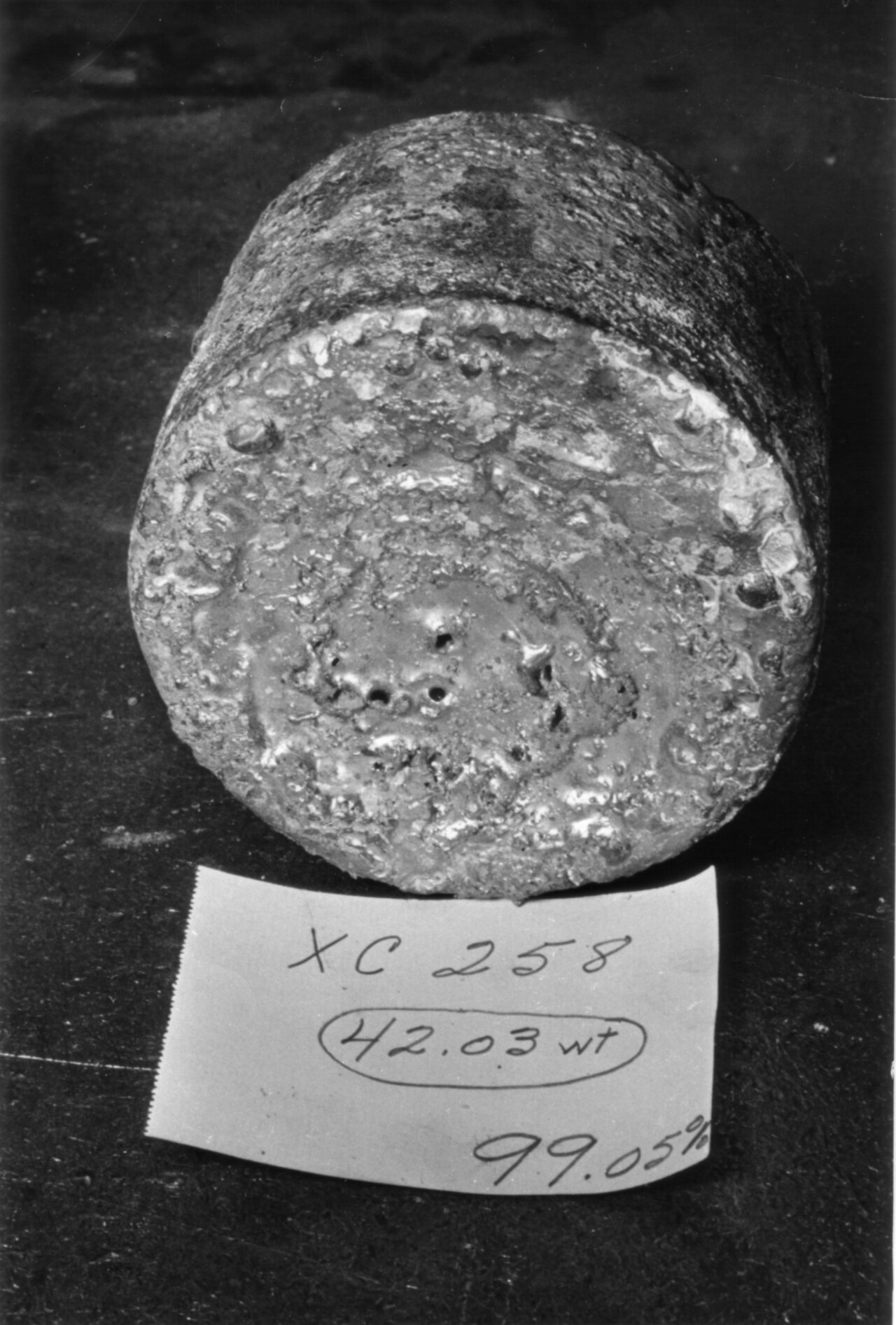
Uranium is the chemical element with atomic number 92 and the symbol U, a radioactive metal in the actinide series that is the fuel of nuclear power and is named after the planet Uranus.[1]
This entry is about the element. Its relative atomic mass is 238.029, it is one of the actinides in the periodic table, and it is a solid at room temperature.[1] For its place in the table and its basic facts, see the [periodic table page for Uranium](/element/Q1098/uranium).
Properties
The Royal Society of Chemistry lists uranium's melting point as 1135 °C, its boiling point as 4131 °C, and its density as 19.1 g/cm³.[1] Its standard atomic weight is 238.02891(3), unchanged since 1999 according to the atomic weights commission of the International Union of Pure and Applied Chemistry, which notes that the value is affected by depleted or enriched material and by anomalies at the Oklo natural nuclear reactor in Gabon; NIST gives the same value.[3][2]
Isotopes
Natural uranium is almost entirely uranium-238, with a proportion of 99.2742 percent according to the Royal Society of Chemistry, and uranium-235 at 0.7204 percent and uranium-234 at 0.0054 percent. NIST gives 0.992742(10), 0.007204(6) and 0.000054(5). The atomic weights commission says all uranium isotopes are alpha emitters.[1][2][3]
Discovery and name
The German chemist Martin Heinrich Klaproth discovered uranium in 1789, according to the atomic weights commission. The Royal Society of Chemistry says he precipitated the oxide from pitchblende but could not reduce it to the metal; the French chemist Eugène Peligot isolated the first uranium metal in Paris in 1841 by heating uranium tetrachloride with potassium, and Becquerel discovered its radioactivity in 1896.[1][3] The name is that of the planet Uranus.[1][3]
Where it comes from
The Royal Society of Chemistry says uranium occurs in the minerals uraninite (pitchblende), brannerite and carnotite, and also in phosphate rock and monazite sands, and that world production is about 41,000 tonnes a year, without a date. The ore is converted to purified oxide, called yellowcake, and Kazakhstan, Canada and Australia are listed as the top three producers.[1]
Uses
The Royal Society of Chemistry lists nuclear fuel for generating electricity, enriched in uranium-235; the material from which other transuranium elements are made; nuclear submarines and weapons; and depleted uranium as ballast and counterweights and in ammunition and armour. It says uranium has no known biological role and is a toxic metal.[1]
This entry explains; it is not medical advice. Ask a doctor or pharmacist about your own health.