Version 2 (current)
Nov 20, 2026. Version history
World War II was the global war fought from 1939 to 1945, in which Germany, Italy and Japan, known as the Axis, fought the Allies, among them Britain, France, the Soviet Union and the United States, and which ended with Japan's formal surrender on September 2, 1945.[1][4]
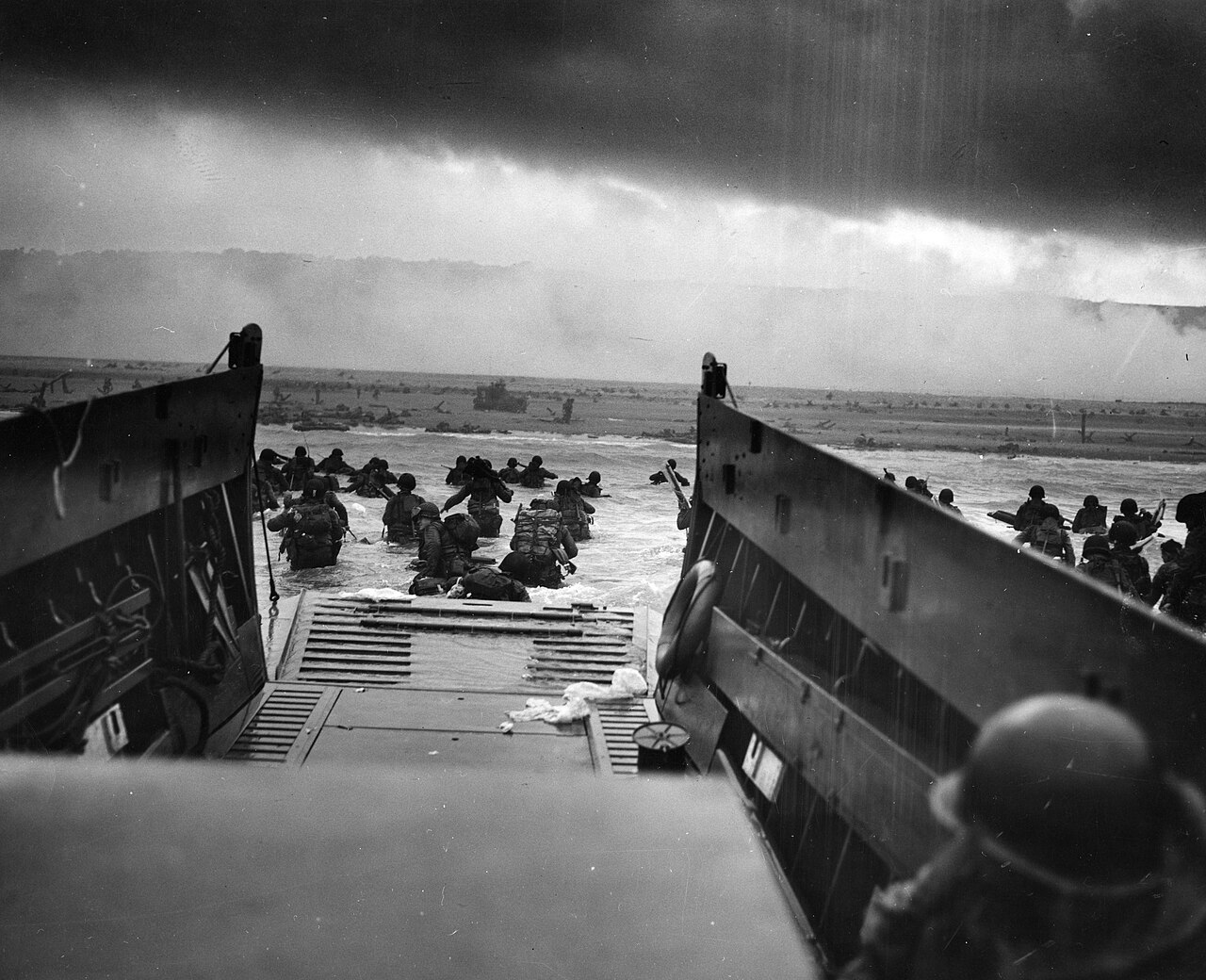
Via Wikimedia Commons: Into the Jaws of Death - Troops of the 1st Infantry Division come asho by Robert F. Sargent, United States Coast Guard Signal Corps Ar, public domain.
The United States Holocaust Memorial Museum says that World War II began on September 1, 1939, and lasted six years.[1] The National WWII Museum's table of worldwide deaths lists about 15 million battle deaths, 25 million battle wounded and 45 million civilian deaths, and notes that casualty estimates vary widely between sources.[10]
Road to war
The museum's timeline begins with Japan's invasion of Manchuria on September 18, 1931, and Japan's invasion of China on July 7, 1937. In 1938 came the German annexation of Austria, the Anschluss, on March 11 to 13, and the Munich agreement on September 29.[1] On August 23, 1939 Germany and the Soviet Union signed a non-aggression pact.[1] The State Department's history of the period adds that Japan signed the Tripartite Pact with Germany and Italy on September 27, 1940.[4]
The war in Europe
Germany invaded Poland on September 1, 1939, and on September 3 Great Britain and France declared war on Germany.[1] From May 10 to June 22, 1940 Germany attacked in the west, ending in France's armistice.[1] Germany invaded the Soviet Union on June 22, 1941.[1] While the United States was not yet at war, the State Department says that President Roosevelt signed a "Destroyers for Bases" agreement on September 2, 1940, and proposed what became Lend-Lease on December 17, 1940; Lend-Lease supplied more than 30 countries, with some $50 billion in assistance.[5]
The Allies met at a series of wartime conferences, according to the State Department: the Atlantic Charter meeting in August 1941, Casablanca in January 1943, Cairo and Tehran in November 1943, Yalta in February 1945 and Potsdam in July 1945.[6] The Allies landed in Sicily on July 10, 1943, Rome was liberated on June 4, 1944, and Allied troops began landing on the beaches of Normandy at 6:30 on the morning of June 6, 1944, D-Day, part of the larger Operation Overlord.[1][11][12] A Soviet offensive began on January 12, 1945.[1]
The war in the Pacific
Japan attacked the American fleet at Pearl Harbor on December 7, 1941, and the United States declared war on Japan the next day.[1][4] The museum's timeline lists the Battle of Midway in June 1942 and the Guadalcanal campaign, from August 7, 1942 to February 9, 1943.[1]
The end of the war
The Holocaust Museum says Adolf Hitler committed suicide on April 30, 1945. Germany signed an unconditional surrender at Reims on May 7, and it took effect on May 8 at 11:01 p.m.; a second document was signed in Berlin on May 8, which in Moscow was already after midnight on May 9.[1] The State Department says Germany surrendered on May 8.[8]
At Yalta, from February 4 to 11, 1945, Stalin guaranteed that the Soviet Union would declare war on Japan within six months.[6][7] The Allied leaders met at Potsdam from July 17 to August 2, 1945, and the State Department notes that the United States had successfully detonated the first atomic bomb on July 16.[8] The United States dropped an atomic bomb on Hiroshima on August 6 and on Nagasaki on August 9, and the Soviet Union declared war on Japan on August 8.[1] Japan agreed in principle to unconditional surrender on August 14, and formally surrendered on September 2, 1945, ending the war.[1]
The Holocaust
The Holocaust Museum states that six million Jewish men, women and children were murdered. Its breakdown by method gives approximately 2.7 million deaths in killing centers, about 2 million in mass shootings, between 800,000 and 1,000,000 in ghettos and in labor and concentration camps, and at least 250,000 through other violence, and it says its statistics were calculated using a number of different sources.[2] The Museum also gives figures for other groups who were persecuted and killed: around 3.3 million Soviet prisoners of war, around 1.8 million ethnic Poles, and at least 250,000, possibly as many as 500,000, Roma.[2]
Justice and the postwar order
The London Agreement and Charter establishing the International Military Tribunal were signed on August 8, 1945. The tribunal opened in Nuremberg on November 20, 1945, heard its last arguments on September 1, 1946, and delivered its verdict on October 1, 1946. Twenty-four defendants had been indicted and 22 stood trial: 19 were convicted, three acquitted and 12 sentenced to death, and ten were hanged on October 16, 1946.[3]
Representatives of 50 nations met in San Francisco from April to June 1945 to complete the Charter of the United Nations. The United States Senate approved it on July 28, 1945 by a vote of 89 to 2, and the United Nations came into existence on October 24, 1945, after 29 nations had ratified the Charter.[9]
Deaths by country
The National WWII Museum lists total military and civilian deaths of about 24 million for the Soviet Union, 20 million for China, 6.6 to 8.8 million for Germany, 5.6 million for Poland, 2.6 to 3.1 million for Japan, 567,600 for France, 450,700 for the United Kingdom and 418,500 for the United States, and warns that estimates vary widely.[10]
Sources
- United States Holocaust Memorial Museum, "World War II Dates and Timeline," last edited November 15, 2021. encyclopedia.ushmm.org/content/en/article/world-war-ii-key-dates
- United States Holocaust Memorial Museum, "How Many People Did the Nazis Murder?" last edited September 26, 2023. encyclopedia.ushmm.org/content/en/article/documenting-numbers-of-vi…
- United States Holocaust Memorial Museum, "International Military Tribunal at Nuremberg," last edited October 17, 2025. encyclopedia.ushmm.org/content/en/article/international-military-tr…
- US Department of State, Office of the Historian, "Japan, China, the United States and the Road to Pearl Harbor, 1937-41" (undated). history.state.gov/milestones/1937-1945/pearl-harbor
- US Department of State, Office of the Historian, "Lend-Lease and Military Aid to the Allies in the Early Years of World War II" (undated). history.state.gov/milestones/1937-1945/lend-lease
- US Department of State, Office of the Historian, "Wartime Conferences, 1941-1945" (undated). history.state.gov/milestones/1937-1945/war-time-conferences
- US Department of State, Office of the Historian, "The Yalta Conference, 1945" (undated). history.state.gov/milestones/1937-1945/yalta-conf
- US Department of State, Office of the Historian, "The Potsdam Conference, 1945" (undated). history.state.gov/milestones/1937-1945/potsdam-conf
- US Department of State, Office of the Historian, "The Formation of the United Nations, 1945" (undated). history.state.gov/milestones/1937-1945/un
- The National WWII Museum, "Research Starters: Worldwide Deaths in World War II" (undated). nationalww2museum.org/students-teachers/student-resources/research-…
- The National WWII Museum, "Research Starters: D-Day" (undated). nationalww2museum.org/students-teachers/student-resources/research-…
- US National Archives, "Records Relating to D-Day," last reviewed July 9, 2025. archives.gov/research/military/ww2/d-day.html
