Compare versions
Version 2 → Version 3 (current). Removed · Added. This shows the entry's text as it is written, including its formatting marks.
Version 2 · Version 3 (current) · Version history
Side by side · Together
The attack on Pearl Harbor was the Japanese air raid on the United States Pacific Fleet and nearby airfields on Oahu, Hawaii, on Sunday, December 7, 1941, which brought the United States into [World War II](https://micwyn.com/t/2855/world-war-ii).[1][2][8][11]
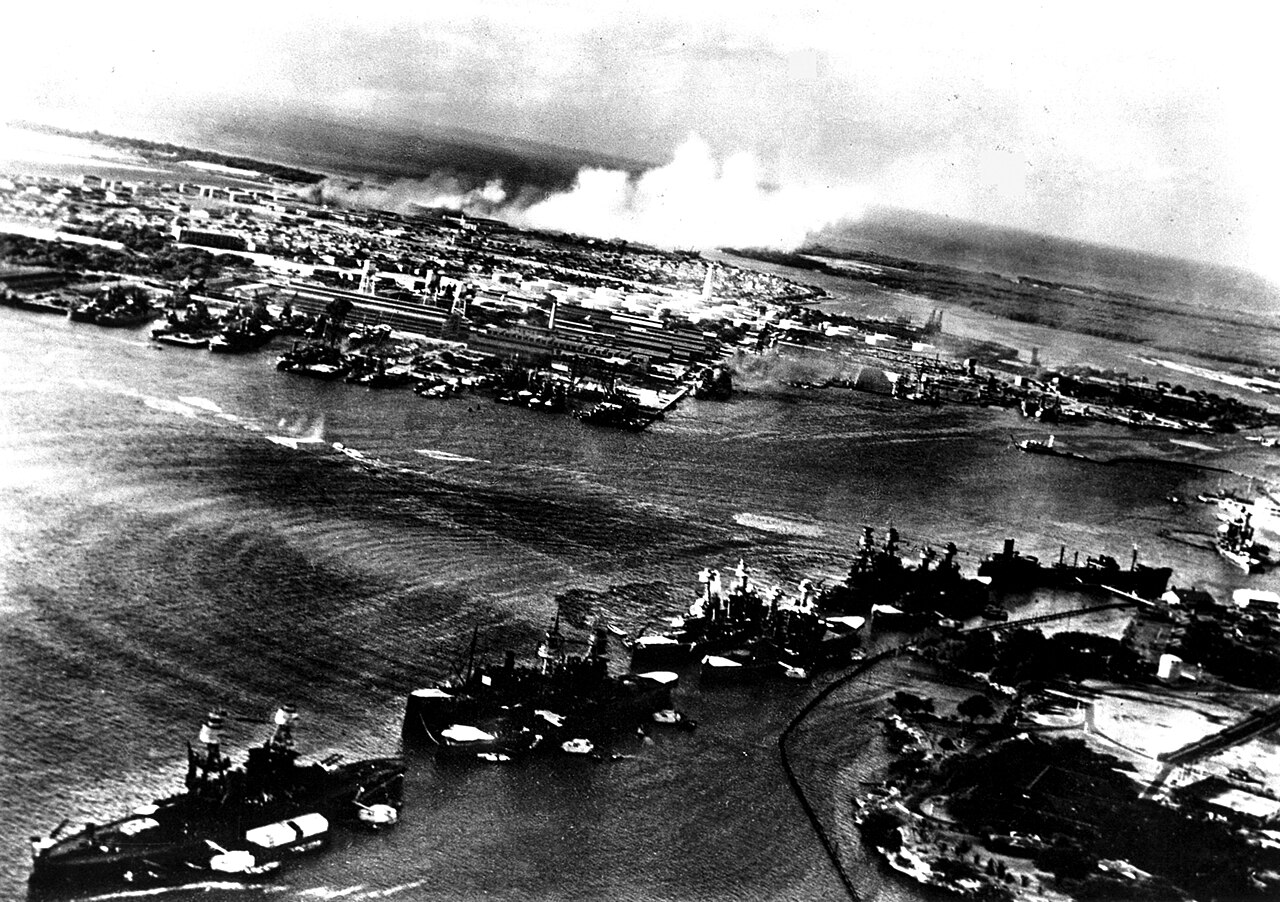
*Via Wikimedia Commons: [Battleship Row at the start of the attack on Pearl Harbor, December 7,](https://commons.wikimedia.org/wiki/File:Battleship_Row_at_the_start_of_the_attack_on_Pearl_Harbor,_December_7,_1941._(c4e77252-1dd8-b71b-0bf0-ea4350912f11).jpg) by NPS photo, public domain.*
The National Park Service says that 2,390 Americans, service members and civilians, lost their lives, and that "almost half" of the total casualties occurred when the battleship USS Arizona exploded.[3][5] The next day President Franklin D. Roosevelt asked Congress for a declaration of war against Japan.[8]
## The road to the attack
The State Department's history of the period mentions the clash between Japanese and Chinese forces at the Marco Polo Bridge on July 7, 1937, and says Japan signed the Tripartite Pact with Germany and Italy on September 27, 1940. It says the United States responded to Japan's expansion by instituting a full embargo on exports to Japan and freezing Japanese assets in American banks, and that negotiations between the two countries, which restarted after the embargo, made little headway.[11]
## The attack
The Park Service's account says the Japanese fleet was about 230 miles north of Oahu at 6:00 a.m. on December 7. Six carriers, which it names as Akagi, Hiryu, Soryu, Kaga, Zuikaku and Shokaku, turned into the wind and launched a first wave of 183 aircraft, and about an hour later launched a second wave of 167.[1] Earlier that morning, at 6:30, the destroyer Ward fired on and sank a submarine, and at 7:02 the radar at Opana picked up the approaching aircraft.[1]
The first wave attacked at 7:55 a.m., with fighters and dive bombers striking the airfields at Kaneohe, Hickam, Ewa, Bellows and Wheeler. The Park Service says its assault ended at about 8:45 and the second wave arrived at 8:50; another of its pages says the second wave arrived about a half-hour after the first, so the timing of the second wave differs between its own pages.[1][2] The National Archives dates the opening of the attack to just before 8 a.m. Hawaii time.[9] The Park Service says the assault weakened the Pacific Fleet in less than two hours, but did not cripple it.[2]
## The damage
One Park Service page says that at dawn more than half of the Pacific Fleet, approximately 150 vessels and service craft, were at Pearl Harbor, with all but one of its battleships in port, and another page says more than 185 naval vessels were in the harbor.[3][2] The Park Service lists the battleships California, Oklahoma, West Virginia, Nevada and Arizona as sunk, along with the target ship Utah, and Maryland, Tennessee and Pennsylvania as damaged, and says 21 ships of the Pacific Fleet were sunk or damaged by 10 a.m.[1][3] It adds that Nevada was struck by at least six bombs and that its captain intentionally beached it.[2]
On the ground the Army airfields at Hickam, Wheeler and Bellows lost 217 men and 77 aircraft, the naval air stations at Ford Island and Kaneohe lost 19 men, the Marine Corps air station at Ewa lost four men and 33 aircraft, and the Pacific Fleet's naval aircraft losses totaled 92.[3] The Park Service says Kaneohe lost 33 of its 36 PBY seaplanes.[2]
## The toll
The Park Service's figure is 2,390 American dead: 2,341 service members and 49 civilians.[5] An older Park Service article says more than 2,400 were killed and 1,104 wounded, and the National Archives says 2,403 Americans died, so the published totals differ slightly.[1][9] The National Archives also says more than 3,500 Americans were killed or wounded.[8] The Park Service says 35 civilians were wounded.[4] By ship, 1,177 service members died on the Arizona, 429 on the Oklahoma, 106 on the West Virginia and 105 on the California, and 191 people were lost at Hickam Field, five of them civilians.[5] The Park Service says that about 2,000 Americans of Japanese ancestry were on active duty in Hawaii when the attack occurred.[6]
Japanese losses, according to the Park Service's article, were 29 aircraft with 55 airmen, and ten crewmen and all five boats of the midget-submarine force.[1] The Park Service says Japanese forces also attacked Baker and Howland Islands on December 8.[4]
## The president's speech
Roosevelt was told of the attack by telephone in the early afternoon of December 7, and the National Archives says he dictated his request to Congress to his secretary, Grace Tully, in the early evening. His first line read "a date which will live in world history"; he changed "world history" to "infamy."[9][10] On December 8, at 12:30 p.m., he addressed a joint session of Congress, and the nation by radio, in a speech of about six minutes.[8][9] It opened: "Yesterday, December 7, 1941—a date which will live in infamy—the United States of America was suddenly and deliberately attacked." He closed by asking that "the Congress declare that since the unprovoked and dastardly attack by Japan on Sunday, December 7, 1941, a state of war has existed between the United States and the Japanese Empire."[8]
The Senate voted unanimously for war, and in the House only Jeanette Rankin of Montana dissented. Roosevelt signed the declaration of war at 4 p.m. that afternoon.[8] On December 11 Germany and Italy declared war on the United States, which quickly declared war on both.[9]
## Remembered
The Park Service says the USS Arizona Memorial was completed in 1961 and dedicated in 1962, and that more than 900 of the ship's 1,177 crewmen who died remain on board.[7]
## Sources
1. National Park Service, "The Pearl Harbor Attack," last updated August 15, 2019. https://www.nps.gov/articles/pearlattackww2.htm
2. National Park Service, "Battlefield O'ahu," Pearl Harbor National Memorial, last updated March 4, 2026. https://www.nps.gov/perl/learn/historyculture/oahu.htm
3. National Park Service, "Military Casualties," Pearl Harbor National Memorial, last updated March 4, 2026. https://www.nps.gov/valr/learn/historyculture/military-casualties.htm
4. National Park Service, "Civilian Casualties," Pearl Harbor National Memorial, last updated March 4, 2026. https://www.nps.gov/valr/learn/historyculture/civilian-casualties.htm
5. National Park Service, "People," Pearl Harbor National Memorial, last updated September 20, 2024. https://www.nps.gov/valr/learn/historyculture/people.htm
6. National Park Service, "Stories," Pearl Harbor National Memorial, last updated December 20, 2025. https://www.nps.gov/valr/learn/historyculture/stories.htm
7. National Park Service, "USS Arizona," Pearl Harbor National Memorial, last updated August 28, 2024. https://www.nps.gov/perl/learn/historyculture/uss-arizona.htm
8. US National Archives, "Joint Address to Congress Leading to a Declaration of War Against Japan (1941)," last reviewed February 8, 2022. https://www.archives.gov/milestone-documents/joint-address-to-congress-declaration-of-war-against-japan
9. US National Archives, "FDR's 'Day of Infamy' Speech," Prologue, Winter 2001, last reviewed May 26, 2022. https://www.archives.gov/publications/prologue/2001/winter/crafting-day-of-infamy-speech.html
10. US National Archives, "'A Date Which Will Live in Infamy'," last reviewed December 12, 2019. https://www.archives.gov/education/lessons/day-of-infamy
11. US Department of State, Office of the Historian, "Japan, China, the United States and the Road to Pearl Harbor, 1937-41" (undated). https://history.state.gov/milestones/1937-1945/pearl-harbor
