Compare versions
Version 1 → Version 2 (current). Removed · Added. This shows the entry's text as it is written, including its formatting marks.
Version 1 · Version 2 (current) · Version history
Side by side · Together
The Holocaust was the systematic, state-sponsored persecution and murder of six million European Jews by the Nazi German regime, a process that unfolded across Europe between 1933 and 1945.[1]
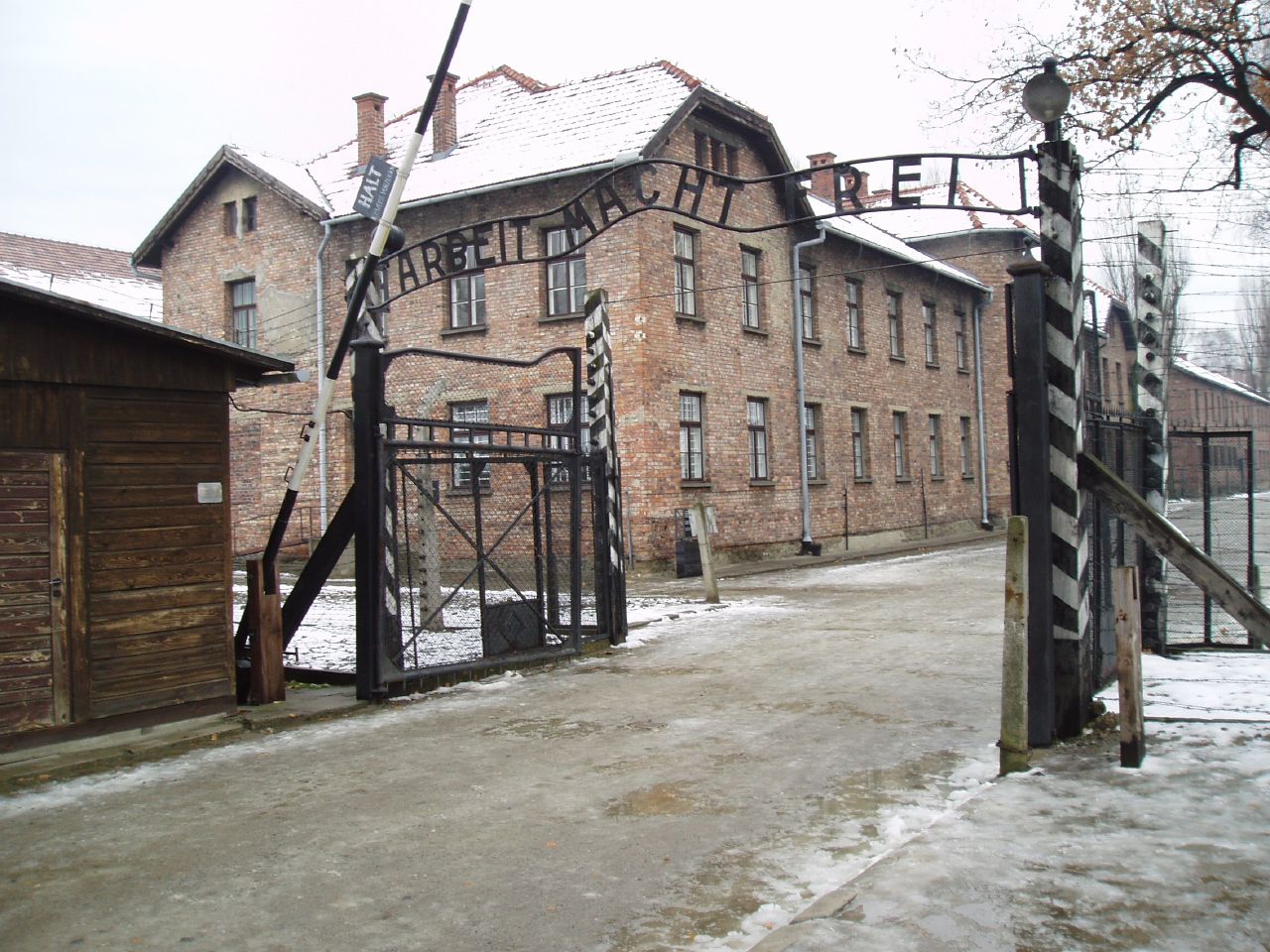
*Via Wikimedia Commons: [Arbeit macht frei sign, main gate of the Auschwitz I concentration cam](https://commons.wikimedia.org/wiki/File:Arbeit_macht_frei_sign,_main_gate_of_the_Auschwitz_I_concentration_camp,_Poland_-_20051127.jpg) by Tulio Bertorini (tbertor1), [CC BY-SA 2.0](https://creativecommons.org/licenses/by-sa/2.0).*
The United States Holocaust Memorial Museum says the Holocaust killed nearly two out of every three European Jews; in 1933 more than 9 million Jews lived in Europe, about 1.7 percent of its population.[1][2] The Museum notes that the Nazis did not invent antisemitism, but that it was a basic tenet of Nazi ideology.[1] The event is also called the Shoah, a Hebrew word meaning "catastrophe," and the Nazi regime used the euphemism "Final Solution" for the mass murder of the Jews.[1][4] This entry sets out the dates and figures the Museum publishes. For the war in which it took place, see [World War II](https://micwyn.com/t/2855/world-war-ii).
## From persecution to war, 1933 to 1939
The Museum dates the Holocaust's beginning to January 30, 1933, when Adolf Hitler was appointed chancellor, and says the Nazi regime then excluded Jews from German economic, political, social and cultural life through discriminatory laws.[1][2] It lists the stages of persecution as legal discrimination, public identification and exclusion, organized violence, physical displacement, internment, widespread theft and plunder, and forced labor, and says that before 1941 the systematic mass murder of all Jews was not Nazi policy.[1] The Dachau camp was established on March 22, 1933, and in the fall of 1935 German Jews lost their citizenship.[1][2]
On the night of November 9 to 10, 1938 Nazi leaders unleashed a nationwide anti-Jewish riot, known as Kristallnacht or the November Pogrom. The Museum says Nazis burned or destroyed more than 1,400 synagogues, vandalized thousands of Jewish-owned businesses, and sent about 26,000 Jewish men to concentration camps; hundreds of Jewish people died during the riot and its aftermath. The riot lasted about 24 hours, and the regime called it off at 4 p.m. on November 10. The Jewish community was then made to pay a 1 billion Reichsmark "atonement payment."[3] Earlier, on October 27 to 29, 1938, more than 17,000 Jewish people were rounded up and deported.[3]
## War and the ghettos
Germany began World War II by attacking Poland on September 1, 1939.[1] The Museum says German officials created the first ghetto at Piotrków Trybunalski in October 1939, and that more than 1,300 ghettos were established in all, about 1,100 of them by German authorities.[7] The Warsaw ghetto was sealed on November 15, 1940, and, established in October 1940, housed approximately 400,000 Jews.[2][8] Hundreds of thousands of Jews died in the ghettos from disease, malnutrition, violence and weather.[7] German authorities liquidated almost every ghetto between 1941 and 1944, most of them in 1942 and 1943, and the last major one, in Łódź, in summer 1944.[7]
## Mass murder, 1941 to 1945
The Museum says that after Germany's attack on the SovietNazi UnionGerman inregime 1941carried killingout operationsthe begangenocide inbetween the1941 occupiedand east,1945, and that as many as 2 million Jews were killed in mass shootings or in gas vans.[1][11] It says it is not known when Nazi leaders definitively decided to carry out the "Final Solution," that the plan was eventually code-named Operation Reinhard, and that the leaders envisioned killing 11 million Jews.[4] On January 20, 1942 Reinhard Heydrich held a secret meeting known as the Wannsee Conference of police and civilian officials to discuss continuing the "Final Solution."[4]
The Nazis built five killing centers, Chełmno, Belzec, Sobibor, Treblinka and Auschwitz-Birkenau, for the purpose of murdering Jewish people on a mass scale using poison gas; approximately 2.7 million Jews were murdered there, which the Museum calls almost half of all Holocaust victims.[5] The first mass gassing of Jews took place at Chełmno on December 8, 1941, and by the end of 1942 the Nazis had murdered more than 1.5 million Jews.[2][5] The Museum's figures for the Jews murdered at each center are approximately 435,000 at Belzec, at least 167,000 at Sobibor, approximately 925,000 at Treblinka II, at least 152,000 Jews of at least 156,300 victims at Chełmno, and approximately 1,000,000 at the Auschwitz complex.[5][11]
Auschwitz was a concentration camp complex in German-occupied Poland that, unlike other camps, also included a killing center. The SS established the camp in spring 1940 and began operating the killing center in March 1942. The Museum says the Nazis deported at least 1.3 million people to the complex, about 1.1 million of whom were murdered, and that 1.1 million of those deported were Jews, about one million of whom were murdered. Among the other victims it lists 70,000 to 75,000 Poles, about 21,000 Roma, and more than 14,000 Soviet prisoners of war.[6]
## Resistance
The Warsaw ghetto uprising began on April 19, 1943 and was crushed by May 16, a period of twenty-seven days. The Museum says about 700 young Jewish fighters took part, that at least 7,000 Jews died fighting or in hiding, and that approximately 7,000 more were captured and deported to Treblinka. It calls the uprising the largest and symbolically most important Jewish uprising of the war.[8]
## Liberation
Soviet forces liberated the Majdanek camp in the summer of 1944.[9] On January 27, 1945 Soviet troops liberated Auschwitz; the Museum's Auschwitz article puts the number of prisoners freed at approximately 7,000, while its liberation article says more than six thousand.[6][9] US forces liberated Buchenwald, with more than 20,000 prisoners, on April 11, 1945, and in mid-April Bergen-Belsen, with some 55,000 prisoners, more than 13,000 of whom died within three months of liberation.[9] German armed forces surrendered unconditionally in the west on May 7 and in the east on May 9, 1945, and the Museum says the Holocaust ended in May 1945.[1]
## The victims
The Museum states that six million Jewish men, women and children were murdered, a figure calculated from Nazi German documents and from prewar and postwar demographic data. Its breakdown by method gives approximately 2.7 million at killing centers, about 2 million in mass shootings in more than 1,500 cities, towns and villages, between 800,000 and 1,000,000 in ghettos, labor camps and concentration camps, and at least 250,000 through other violence. It adds that no single Nazi document accounts for every death, and that the statistics were calculated using a number of different sources.[11]
The Museum notes that the Holocaust specifically refers to the murder of Jews, and that Nazi persecution also killed millions of others. It gives estimates of around 3.3 million Soviet prisoners of war, around 1.8 million ethnic Poles, at least 250,000 and possibly as many as 500,000 Roma, more than 310,000 Serbs, and 250,000 to 300,000 people with disabilities, as well as tens of thousands of political opponents.[1][11]
## Aftermath
At the end of 1946 the number of Jewish displaced persons was estimated at 250,000, of whom 185,000 were in Germany, 45,000 in Austria and 20,000 in Italy. The largest postwar violence, the Kielce pogrom, took place in Poland in 1946 and killed at least 42 Jews. Under the Displaced Persons Act of 1948 approximately 400,000 United States immigration visas were authorized for 1949 to 1952, about 68,000 of them for Jews, and possibly as many as 170,000 Jewish displaced persons and refugees had immigrated to Israel by 1953.[10]
## Sources
All of these are articles of the United States Holocaust Memorial Museum's Holocaust Encyclopedia.
1. "Introduction to the Holocaust," last edited September 20, 2024. https://encyclopedia.ushmm.org/content/en/article/introduction-to-the-holocaust
2. "Timeline of Events" (undated). https://encyclopedia.ushmm.org/content/en/timeline/holocaust
3. "Kristallnacht," last edited September 3, 2025. https://encyclopedia.ushmm.org/content/en/article/kristallnacht
4. "'Final Solution': Overview," last edited December 8, 2020. https://encyclopedia.ushmm.org/content/en/article/final-solution-overview
5. "Nazi Killing Centers: An Overview," last edited September 15, 2026. https://encyclopedia.ushmm.org/content/en/article/killing-centers-an-overview
6. "Auschwitz," last edited September 15, 2026. https://encyclopedia.ushmm.org/content/en/article/auschwitz
7. "What Were Ghettos During the Holocaust?" last edited September 15, 2026. https://encyclopedia.ushmm.org/content/en/article/ghettos
8. "Warsaw Ghetto Uprising," last edited April 17, 2023. https://encyclopedia.ushmm.org/content/en/article/warsaw-ghetto-uprising
9. "Liberation of Nazi Camps," last edited November 3, 2025. https://encyclopedia.ushmm.org/content/en/article/liberation-of-nazi-camps
10. "The Aftermath of the Holocaust: Effects on Survivors" (undated). https://encyclopedia.ushmm.org/content/en/article/the-aftermath-of-the-holocaust
11. "How Many People Did the Nazis Murder?" last edited September 26, 2023. https://encyclopedia.ushmm.org/content/en/article/documenting-numbers-of-victims-of-the-holocaust-and-nazi-persecution
